7) PCF
 Call Kai
 Learn
Learn Practice Test
 Spaced Repetition
 Match
Match Flashcards
 Knowt Play
1/95

There's no tags or description
Looks like no tags are added yet.
Name | Mastery | Learn | Test | Matching | Spaced | Call with Kai | Chat |
|---|
No analytics yet
Send a link to your students to track their progress
96 Terms

Outline for Lipid Transport and Cholesterol Biosynthesis
Lipoprotein Classes and Composition

Apolipoproteins: Located on the lipoprotein
Serve as:
Structural components and mechanism to increase?
What for cell-surface receptors
What or What for lipoprotein metabolism
Divided by _____ and _____ into classes and subclasses with letters and numbers
Solubility
Recognition
Activators; Coenzyme
structure; function

ApoA-1 is an activator of what? A ligand for?
LCAT
HDL Receptor
Apo A-5 is an activator of what?
lipoprotein lipase
Apo b-100 is made in the liver and incorporated into what two lipoproteins?
Apo b-100 is a ligand for?
VLDL
LDL
LDL receptor
Apo C-2 is incorporated into what 3 things?
Apo C-2 is an activator of ?
VLDL
Chylomicrons
HDL
extraheptic lipoprotein lipase

ApoE is synthesized in the liver and found on what 4 things?
ApoE is a ligand for?
VLDL
HDL
Chylomicron
Chylomicron remnant
chylomicron remnant receptor

Apo A-1, A-2, A-4, A-5: found in HDL and chylomicron. Where are each found?
Apo A-I: mainly HDL, but also present on chylomicrons
Apo A-II: mainly HDL
Apo A-IV: found on chylomicrons and HDL
Apo A-V: can be associated with HDL and triglyceride-rich particles, including
Apo B-48 is made where? and are found on?
intestine
chylomicron

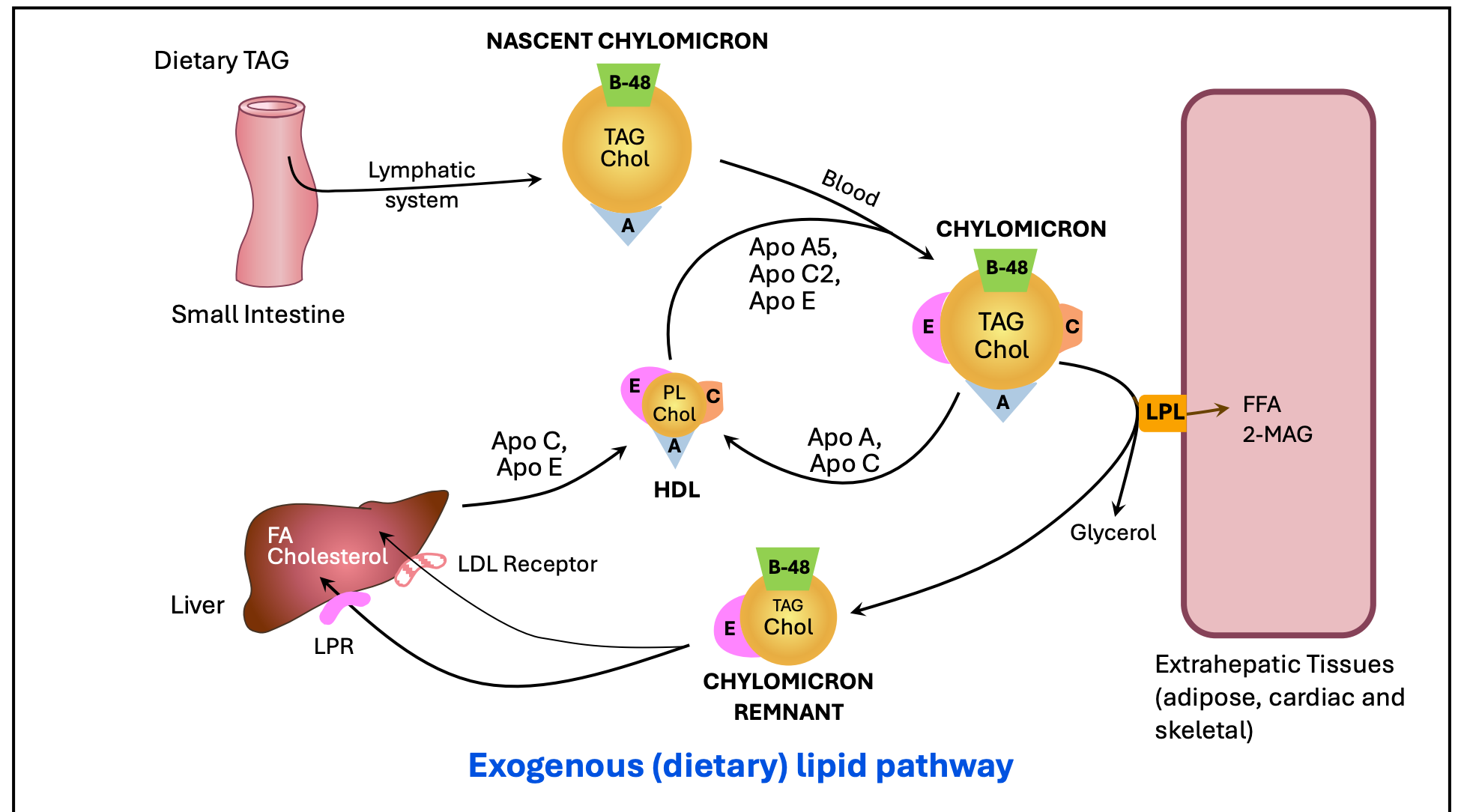
Exogenous Lipid Transport: Chylomicron’s are synthesized in the? and transports what type of lipids in the blood via lymph?
Gut
exogenous
Nascent chylomicron are primarily? it contains some CHOL and CHOL esters. What is the structural protein of nascent chylomicron?
TG (85% of weight)
ApoB48
Nascent chylomicron becomes hylomicron by exchanging components with HDL in lymph and blood. What two things does it pick up to become a chylomicron?
apo C-2 and apo E
TG in CM removed by what and taken up by tissues of the body? What is the cofactor for this?
lipoprotein lipase (LPL)
Apo C-2
As TG are removed, the CM gets smaller by the ↓TG content and becomes a?
cholesterol-rich chylomicron remnant (CR)
As TG are removed, the CM gets smaller by the ↓TG content and becomes a cholesterol-rich chylomicron remnant (CR) • Apo C-2 proteins returned to?
HDL
CR binds to a liver receptor that recognizes ___ and are taken up via?
apo E ; endocytosis

Synthesized by adipocytes and myocytes, secreted, transported, and attached to capillary endothelium
Lipoprotein lipase is synthesized in what two locations?
Its secreted, transported, and attached to?
Adipocytes
Myocytes
Capillary endothelium
LPL is found predominantly in capillaries of what three locations?
Adipose tissue
Cardiac
Skeletal muscle
LPL is activated by what apoprotein
Apo C-2 (also by apo A-5)
LPL is responsible for hydrolysis of the TG into what two products?
3 FFA
Glycerol
FFA taken up by adjacent _____ and ___ for energy production/storage
muscle cells; adipocytes
FFA taken up by adjacent muscle cells and adipocytes for energy production/storage • Uptake facilitated by what proteins and what transporter?
FATPS
CD36
Some of the released FFAs bind to? Where does this go to?
albumin → other tissues

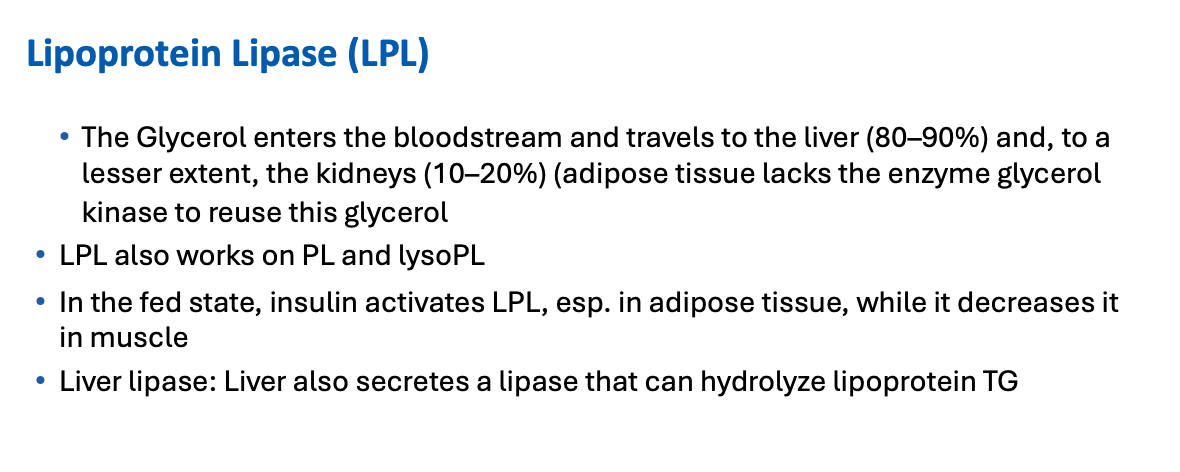
LPL is responsible for hydrolysis of the TG into three FFAs and glycerol. The Glycerol enters the bloodstream and travels to the ____ (80–90%) and, to a lesser extent, the ___ (10–20%) (adipose tissue lacks the enzyme _____ to reuse this glycerol)
liver; kidneys; glycerol kinase
LPL also works on ?
PL and lysoPL.
In the fed state, insulin activates LPL, esp. in? while it decreases it in muscle
adipose tissue; muscle
Liver also secretes a lipase that can hydrolyze? What is it called?
lipoprotein TG → liver lipase
Chylomicron Summary

Exogenous (dietary) lipid pathway
Endogenous Lipid Transport: VLDL, IDL and LDL: Liver has limited capacity to store TG; must continually move them out via ____ to peripheral tissues for either ___ or ___ production
VLDL; storage; energy
Hepatic fatty acids origin in the postabsorptive state. Released from the ___ cells and transported back to the liver (or intestine) via ____ -
adipose; albumin
Hepatic fatty acids origin in the postprandial state, what are the 5 reasons?
CHO overconsumption
Excessive blood glucose
Excess fructose
Some amino acids
High alcohol consumption
Hepatic fatty acids origin in the postprandial state from excess fructose Enters the glycolytic pathway at DHAP + glyceraldehyde 3-P and can make?
pyruvate which → acetyl CoA
FA incorporated into TG are circulation in what lipoprotein?
VLDL
Very low-density lipoproteins (VLDL) are produced in the?
Liver
VLDL are formed when _____ and ____ are transferred in the ER to newly synthesized apo _____
TG; CE; apo B-100
Rate of VLDL synthesis determined by TG availability
If TG supply is limited the newly synthesized apo B-100 is rapidly?
degraded
(Apo B-100 needs lipids, especially triglycerides (TG), to be properly assembled into VLDL)
What is required for the early addition of lipid to apo B-100?
Microsomal triglyceride transfer protein (MTTP)
BUT additional lipid is added via MTTP-independent pathways
Size of the VLDL particles is determined by TG availability:
When TG are abundant the VLDL particles are?
However, VLDL particles are smaller than?
Larger
CM
VLDL consists of what 4 things?
~60% triglycerides (TG) ← largest component
~15% phospholipids (PL)
~20% cholesterol/cholesteryl esters
~5% protein
What produces VLDL as well, esp. in fasting state?
Intestine

VLDL to IDL and LDL: Nascent VLDL released into blood; apo B-100 as core structural apoprotein. It picks up what 2 things from HDL to become VLDL?
apo C-2
apo E

TAGs are hydrolyzed in mature VLDL by what in muscle and adipose tissue? What does this form?
lipoprotein lipases
Chol enriched VLDL remnants or IDL (intermediate density lipoprotein) particles
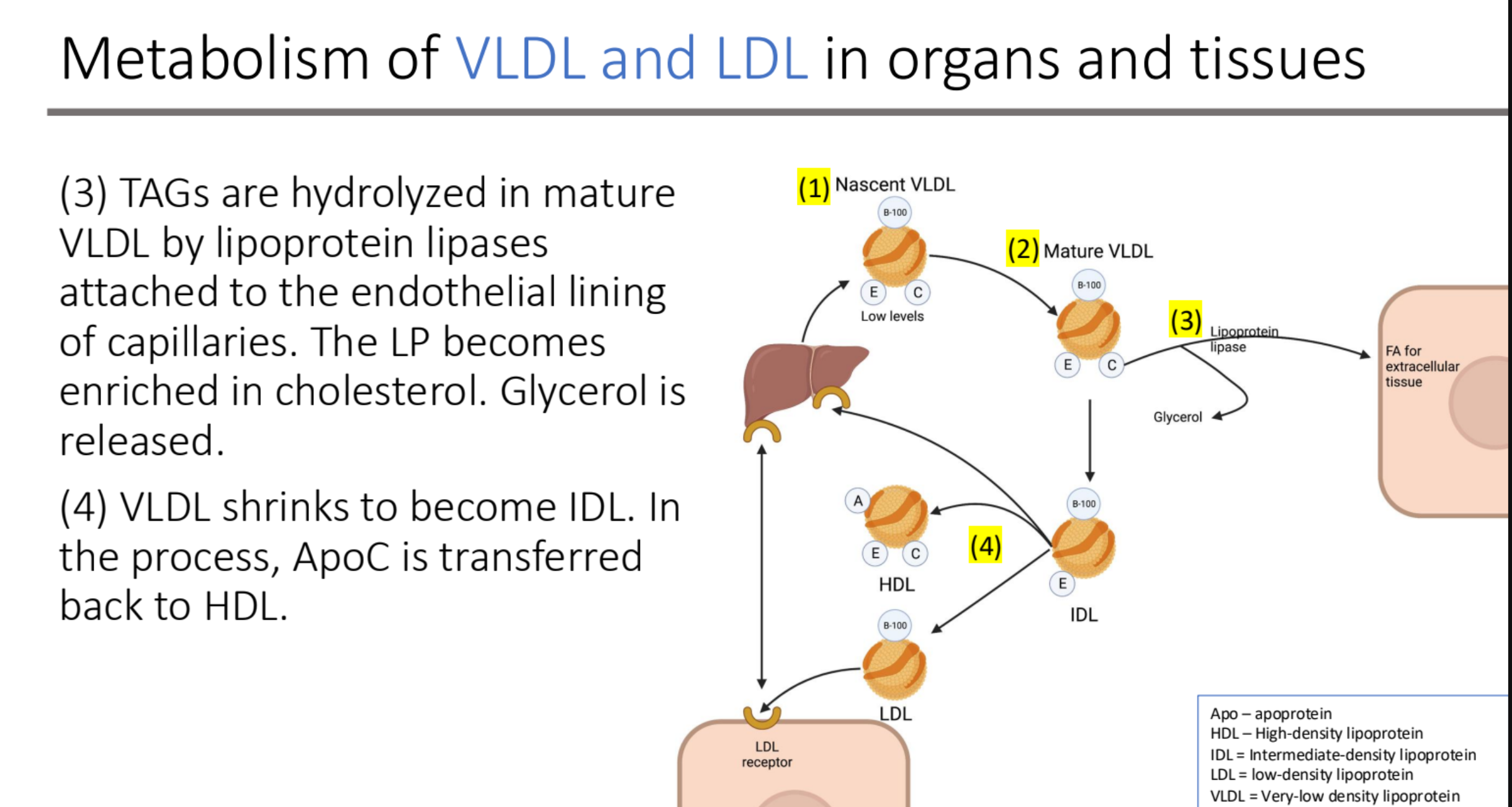
• IDL particles can be removed from circulation by liver via binding of apo B-100 to?
LDL receptor
What containing lipoproteins can also bind the lipoprotein receptor-related proteins (LRP), on the liver?
ApoE-containing lipoproteins

TG in IDL are hydrolyzed bywhat two things which further ↓TG content
LPL and by hepatic lipase
Some CE from HDL is transferred to VLDL in exchange for TG this is catalyzed by what protein?
cholesteryl ester transfer protein (CETP)
What two things are transferred from IDL back to HDL?
Apo C-2 & apo E

LDL originates in blood from the conversion of VLDL → IDL → LDL
What 4 things is it made of?
~50% cholesterol — both cholesteryl esters and free cholesterol
~22% phospholipids (PL)
~20% protein — primarily Apo B-100
~8% triglycerides (TG)
LDL is a major carrier of cholesterol
LDL transports cholesterol through the plasma to what two locations for use in cellular metabolism
Peripheral tissues
Liver
The cholesterol delivered by LDL can be used for what 3 things?
Conversion into other metabolites (e.g., steroid hormones, bile, vitamin D)
Membrane construction
Storage (cholesteryl esters)
LDL Bind to?
LDL internalized by?
LDL receptors (LDLR, recognizes apoprotein B-100)
endocytosis
After LDL is endocytosed, its contents are degraded releasing what 4 things?
Cholesterol
AA
FA
PL
Most LDL is taken up by ___ and the rest by ____
liver; peripheral tissue

VLDL summary

Fate of Fat in Chylomicron or VLDL (Fed State): Fat in CM or VLDL are taken up by extrahepatic tissues and used for what 4 things?
Storage → Energy deposition in adipose tissue and muscle tissue as TG
Structural component → PL incorporated cellular membranes
Synthesis of other substances → Prostaglandins (PG), thromboxanes (TXA), and leukotrienes (LT)
Energy Production
Fat in CM or VLDL are taken up by extra hepatic tissues and used for energy production, especially the? It can also be used in what two muscle fibers?
heart (even under the ↑Glc supply in the fed state)
Red skeletal (glc at rest but FA oxidation in activity)
Smooth muscle fibers

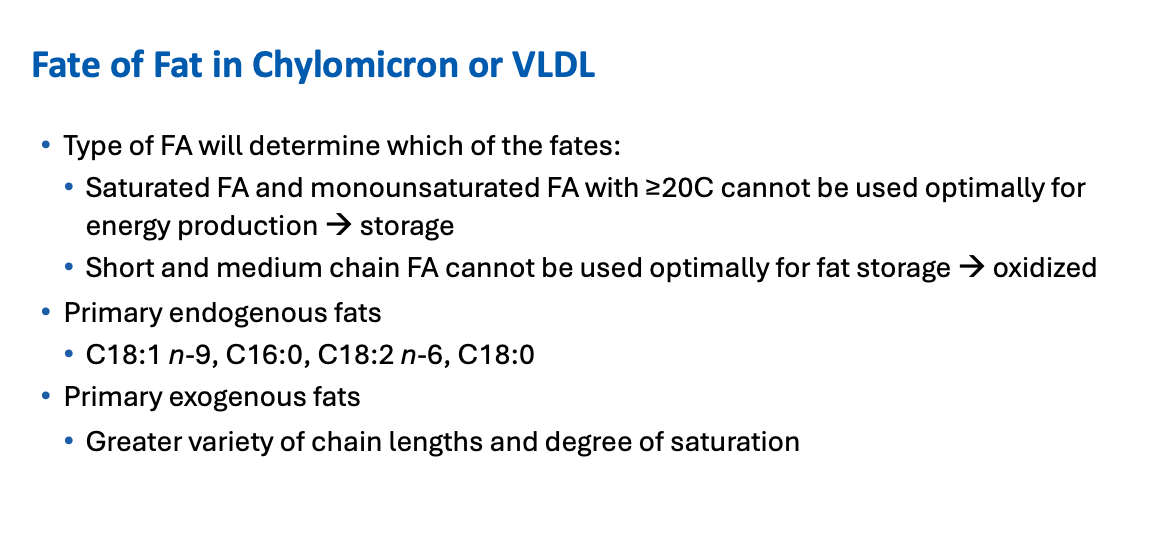
Fate of Fat in Chylomicron or VLDL:
Type of FA will determine which of the fates:
Saturated FA and Monounsaturated FA with >/= 30 C can’t be used for enery production but rather?
Short and medium chain FA can be?
Storage
Oxidized → they cant be used for fat storage
Primary endogenous fats are?
Primary exogenous fats?
Endo → C18:1 n-9, C16:0, C18:2 n-6, C18:0
Exo → Greater variety of chain lengths and degree of saturation
Endogenous lipid pathwaya

LDLR-mediated LDL uptake by hepatocytes: What 3 things decrease the number of LDLRs?
SFA and trans FA
Obesity
Familial hypercholesterolemia (FH, autosomal dominant): loss of function LDLR receptor mutations, or ApoB gene mutations

What regulates number of LDLR in liver cells?
PCSK9 → a protein synthesized by the liver
PCSK9 synthesis increased by what in the postprandial state?
insulin
Downregulating LDLRs via PCSK9, the liver avoids immediate re-uptake of _____ and ______ while dietary lipids are being cleared and processed by peripheral tissues
VLDL particles; chylo remnants
PCSK9-associated FH: PCSK9 gain of function / dysregulation mutation results in?
low LDLR → elevated Chol in blood
What are two medications that lower LDL cholesterol by targeting PCSK9?
Evolocumab (Repatha) and Alirocumab (Praluent): monoclonal Ab injected every 2-4 weeks
Inclisiran (Leqvio): A small interfering RNA (siRNA) that reduces PCSK9 production, given twice a year after an initial dose

Where is HDL synthesized? and how is it released?
Hepatocytes and enterocytes
exocytosis
When is HDL synthesis and maturation enhanced?
In the postprandial (fed) state.
Nascent HDL is newly secreted, disc-shaped HDL that contains which apo protein?
Apo A-I.
What 4 things does nascent HDL collect as it circulates?
Lipids
Apo E
Apo C 2
Free cholesterol
HDL moves through system picking up ________ from extrahepatic tissues
free (unesterified) cholesterol
What enzyme esterifies cholesterol in HDL? Where is it synthesized?
LCAT (lecithin:cholesterol acyltransferase).
liver and released into plasma.
What activates LCAT? What does it do?
Apo A-I on HDL.
LCAT transfers a fatty acid from ____ to free cholesterol, forming a ____.
lecithin; cholesteryl ester
What happens to the cholesteryl esters formed by LCAT?
They become trapped inside the HDL particle.
How does HDL change as it accumulates cholesteryl esters?
HDL becomes more spherical (discoidal HDL → HDL3 → HDL2)

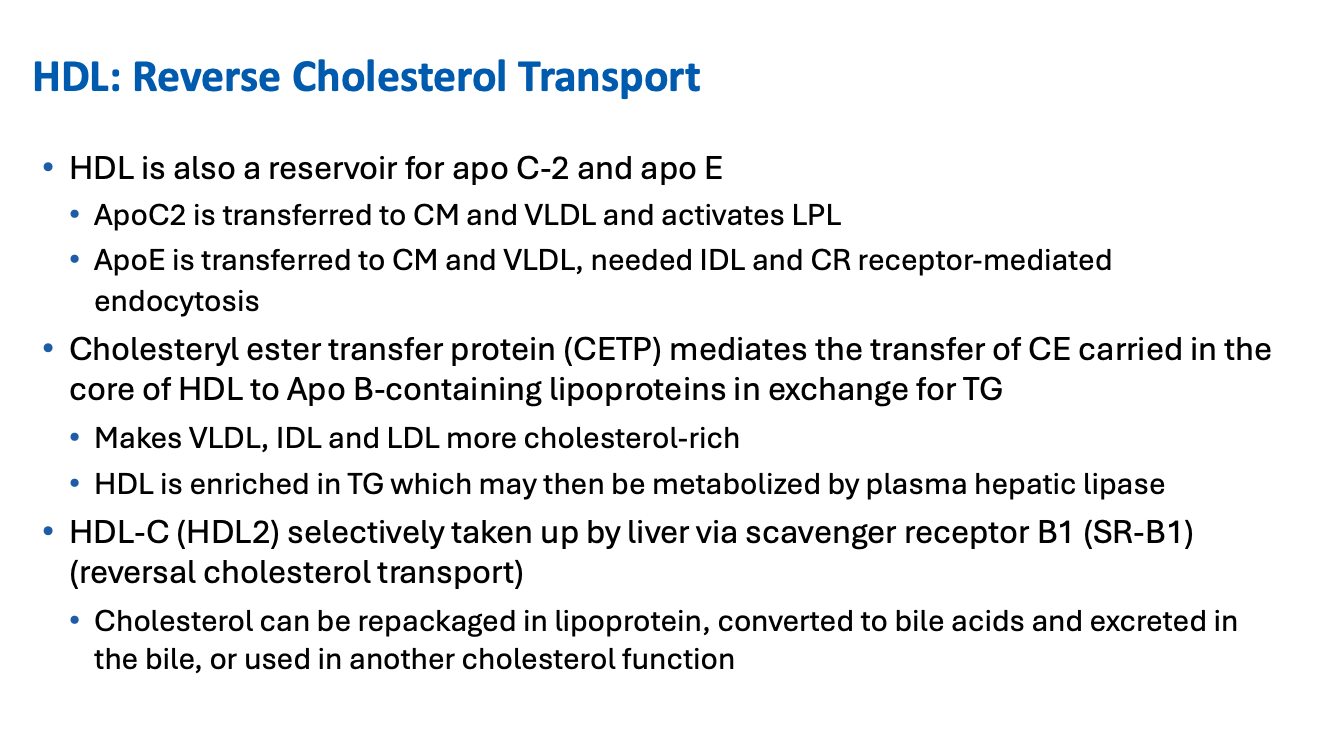
What two apoproteins is HDL a reservoir for
1 .C2
E
HDL transfers Apo C-II to what two areas?
chylomicrons and VLDL.
What does of Apo C-II activate after HDL transfers it to chylomicrons and VLDL?
Lipoprotein lipase
HDL Transfers Apo E to what two things?
chylomicrons and VLDL.
ApoE is needed for receptor-mediated uptake of what two things?
chylomicron remnants
IDL
Cholesteryl ester transfer protein (CETP) mediates the transfer of cholesteryl esters (CE) from HDL to___ -containing lipoproteins in exchange for?
Apo B; TG
Which Apo B-containing lipoproteins receive cholesteryl esters from HDL via CETP?
VLDL, IDL, and LDL.
What happens to VLDL, IDL, and LDL due to CETP activity?
They become more cholesterol-rich.
During CETP HDL gives up ___ and receives __, becoming more TG-rich.
cholesteryl esters; TG
TG that HDL receives through CETP can be metabolized by?
hepatic lipase
HDL cholesterol (especially HDL2) taken up by the liver via what receptor?
scavenger receptor B1 (SR-B1).
Reverse cholesterol transport → HDL collects cholesterol from peripheral tissues and transports it back to the liver.
What can the liver do with cholesterol delivered by HDL?
Repackage it into lipoproteins, convert it to bile acids for biliary excretion, or use it for other cholesterol functions.
Metabolism of HDL

Summary: Lipoproteins

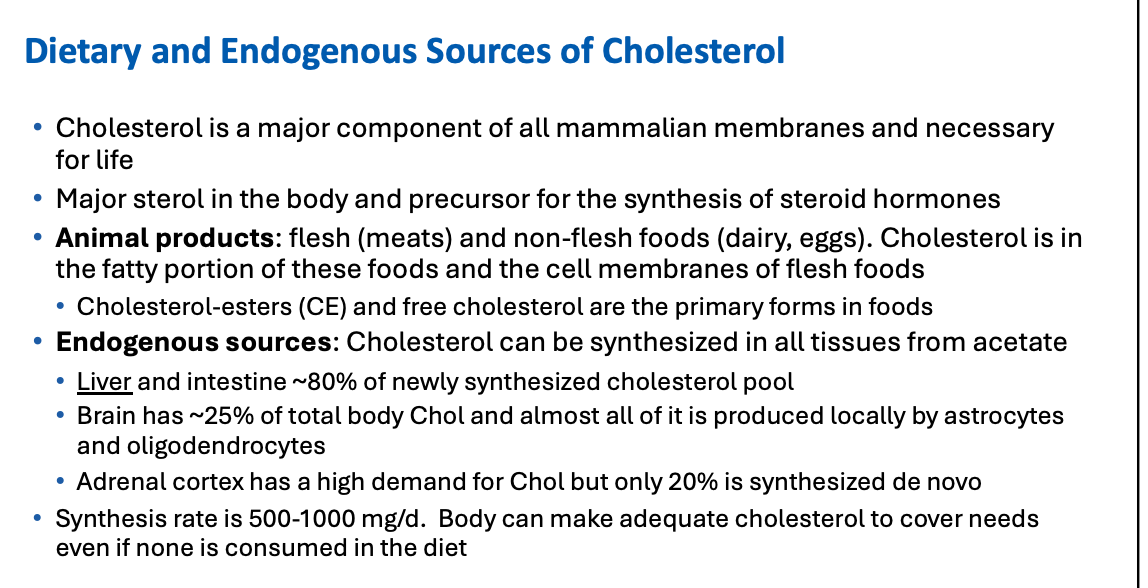
Dietary and Endogenous Sources of Cholesterol: Endogenous sources: Cholesterol can be synthesized in all tissues from?
acetate
Endogenous sources of cholesterol. What makes ~80% of newly synthesized cholesterol pool?
Liver and intestine
Endogenous sources of cholesterol. What makes ~25 % of total body Chol
brain → almost all of it is produced locally by astrocytes and oligodendrocytes
What has a high demand for Chol but only 20% is synthesized de novo
Adrenal cortex