Lecture 12 - Carbohydrates pt. 1
 Call Kai
 Learn
 Practice Test
 Spaced Repetition
 Match
 Flashcards
 Knowt Play
1/39

There's no tags or description
Looks like no tags are added yet.
40 Terms
carbohydrates
saccharides, sugars
class of molecules with the molecular formula (CH2O)n
but are frequently modified in biological systems to contain N, P, and S
ultimately derived from CO2 and H2O by photosynthesis
play a series of important biological roles
important biological role of carbohydrates in energetics
glucose and its derivatives for ATP production (glycolysis + TCA cycle)
starch and glycogen in energy storage
important biological role of carbohydrates as recognition events
recognition events - notify the body of the cell type
proteins with carbohydrate prosthetic groups (glycoproteins)
carbohydrates attached to lipids in membranes (glycolipids)
important biological role of carbohydrates as components of nucleic acids
ribose in RNA
deoxyribose in DNA
important biological role of carbohydrates in cell stricture
cellulose - component of plant cell walls
peptidoglycan - component of bacterial cell walls
chitin - component of arthropod exoskeletons
carbohydrate structure
allows for molecule diversity, predominantly through large numbers of potential configurations (stereoisomers) and conformations (cyclic and linear structures)
can vary in size from small to extremely large
types of carbohydrates
monosaccharides - consists of 1 saccharide unit
disaccharide - consists of 2 saccharide units
oligosaccharide - consists of several (more than 2, but less than 12) saccharide units
polysaccharide - consists of many (dozens to millions) of saccharide units
monosaccharides
typically vary from 3 - 6 carbons
triose - C3H6O3
3 carbons
ex. D-Glyceraldehyde
tetrose - C4H8O4
4 carbons
pentose - C5H10O5
5 carbons
hexose - C6H12O6
6 carbons
exist in linear forms (like trioses and tetroses) and some can assume cyclized forms (like pentoses and hexoses)
linear form of monosaccharides (structure)
consist of a backbone of carbon-carbon bonds where every bond is bonded to an oxygen atom
one of these carbon-oxygen bonds takes the form of a carbonyl
remaining bonds are single C-OH bonds
ex. aldoses and ketoses
aldoses and ketoses
linear forms of monsaccharides
aldose - aldehydes with carbonyl as terminal carbon (C1)
ex. glucose is specifically an aldohexose
ketose - ketones with carbonyl is C2
ex. fructose is specifically a ketohexose
chirality in monosaccharides
monosaccharides have multiple chiral centers, giving several possible stereoisomers for each molecular formula
how are monosaccharides named D-sugars (based on fischer convention)
named D-sugars when chiral centers farthest from carbonyl-containing end has same absolute configuration as D-glyceraldehyde
all naturally occurring sugars are in D-config (because they have same config as D-glyceraldehyde)
where is the OH group oriented in D-glyceraldehyde (in fischer projection)
OH group oriented towards the right side
types of aldoses
aldotriose - 3 carbons
aldotetroses - 4 carbons
aldopentoses - 5 carbons
aldohexoses - 6 carbons
aldotriose example
D-glyceraldehyde
what is C2 (carbon number 2) and C3 (carbon number 3) on aldoses and ketoses?
and what is their importance?
usually the newly added carbon (newly added stereocenter) when extending an aldose or ketose by 1 carbon
important because the way the OH on C2 (for aldoses) or on C3 (for ketoses) is oriented (left or right) determines the configuration for the new aldose/ketose
examples of aldetetroses
D-erythrose - OH group of C2 is on right side
D-therose - OH group of C2 is on left side
both are formed from D-glyceraldehyde
examples of aldetetroses
formed by extension of D-Erythrose
D-Ribose (Rib) - OH group of C2 is on right
D-Arabinose (Ara) - OH group of C2 is on left
formed by extension of D-Therose
D-Xylose (Xyl) - OH group of C2 is on right
D-Lyxose (Lyx) - OH group of C2 is on left
examples of aldohexoses (check the branching tree photo too)
formed from extension of D-Ribose (Rib)
D-Allose - OH group of C2 is on right
D-Altrose - OH group of C2 is on left
formed from extension of D-Arabinose (Ara)
D-Glucose (Glc) - OH group of C2 is on right
D-Mannose (Man) - OH group of C2 is on left
formed from extension of D-Xylose (Xyl)
D-Gulose - OH group of C2 is on right
D-Idose - OH Group of C2 is on left
formed from extension of D-Talose
D-Galactose (Gal) - OH group of C2 is on right
D-Talose - OH group of C2 is on left
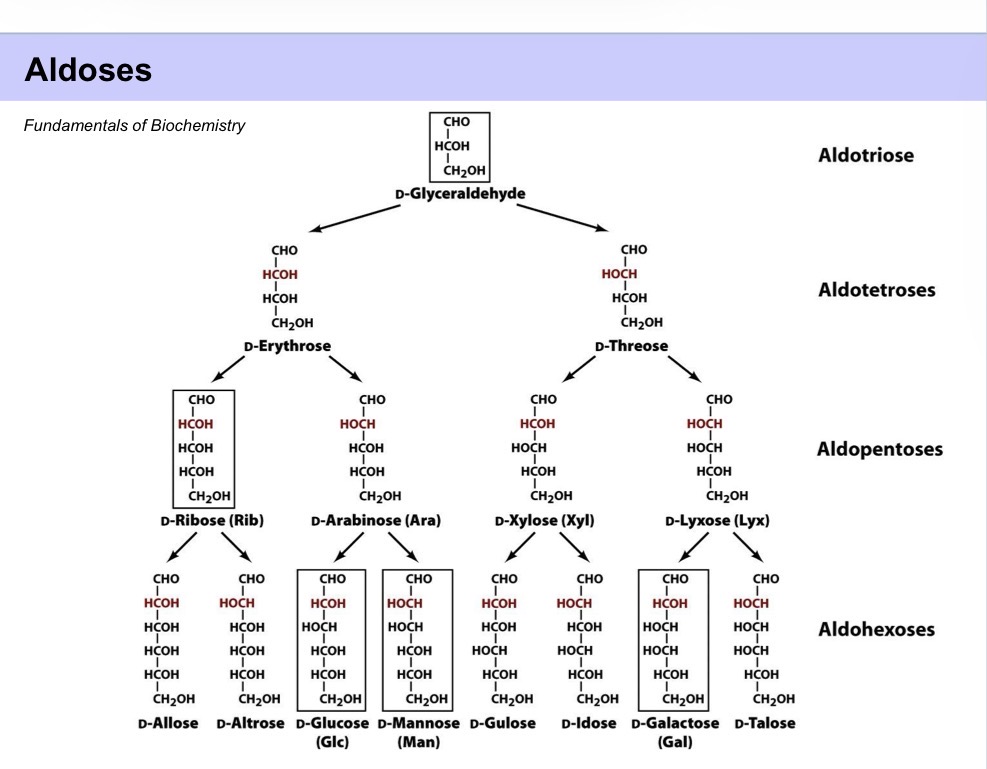
which aldoses are more common/popular in nature?
D-glyceraldehyde
D-Ribose (Rib)
D-Glucose (Glc)
D-Mannose (Man)
D-Galactose (Gal)
types of ketoses
ketotriose - 3 carbons
ketotetrose - 4 carbons
ketopentoses - 5 carbons
ketohexoses - 6 carbons
ketotriose and ketotetrose example
ketotriose - Dihydroxyacetone
ketotetrose - D-Erythrulose - OH of C3 is on right
examples of ketopentoses
formed by extension of D-Erythrulose
D-Ribulose - OH of C3 is on right
D-Xylulose - OH of C3 is on left
examples of ketohexoses
formed by extension of D-Ribulose
D-Psicose - OH of C3 is on right
D-Fructose - OH of C3 is on left
formed by extension of D-Xylulose
D-Sorbose - OH of C3 is on right
D-Tagtose - OH of C3 is on left
which ketoses are more common/popular in nature?
Dihydroxyacetone
D-Ribulose
D-Fructose
epimers
monosaccharides that differ in structure only by configuration of 1 chilra center
ex. D-mannose and D-glucose are epimers (C2)
ex. D-galactose and D-glucose are epimers (C4)
epimerization
process of changing configuration of a chiral center to the opposite configuration
enzyme-catalyze for carbohydrates
monosaccharides and cyclic forms
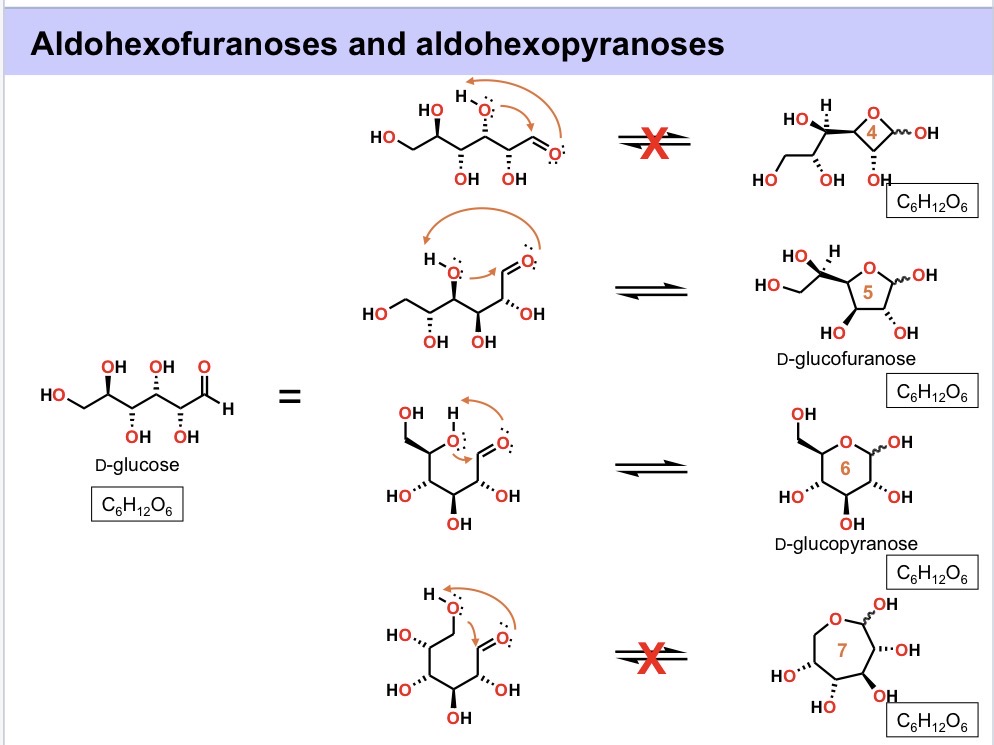
monosaccharides with 5 or more carbons can cyclize by intramolecular formation of hemiacetals (aldoses) and hemiketals (ketoses)

furanoses and pyranoses
furanoses - monosaccharides with 5-membered rings
pyranoses - monosaccharides with 6-membered rings
aldohexofuranoses and aldohexopyranoses (CHECK IMAGE)
keohexopyranoses and ketohexofuranoses (CHECK IMAGE)

shorter cyclic forms (CHECK IMAGE)

Anomeric carbon
chiral center formed by the carbon that used to be carbonyl C (which is now a hemiketal or hemiacetal) going through cyclization
mutarotation
process in which the two configurations of the anomeric carbon (alpha and Beta) are in equilibrium in aqueous media
specific type of epimerization
two configurations of anomeric Carbon
alpha - absolute configuration of anomeric carbon is opposite to the configurational reference atom (which was the atom used to determine D- or L)
OH group is pointing down (in Haworth configuration)
Beta - absolute configuration of anomeric carbon is the same as the configurational reference atom (which was the atom used to determine D- or L-)
OH group is pointing up (in Haworth configuration)
chair conformations and equilibrium
pyranose conformation with the least axial strain (least axial configurations) in hydroxyl groups is favoured
pyranose conformations are analagous to the chair conformations of cyclohexane
basically, you can ring flip the chair conformations of pyranoses, just like how you can ring flip chair conformations of cyclohexanes
Monosaccharide modification
Oxidation
Reduction
Deoxygenation
Amination
Phosphorylation
Sulfation
Oxidation modification of monosaccharides
terminal Ch2OH group of both aldoses and ketoses oxidized to yield carboxylic acids
in aldoses, aldehyde group is oxidized to yield aldonic acids (type of carboxylic acids)
aldonic acids can cyclize to form lactones
Reduction, Deoxygenation, Amination, Phosphorylation, and sulfation modification of monosaccharides
reduction - carbonyl group of aldoses and ketoses reduced to yield alcohols
deoxygenation - hydroxyl groups replaced by hydrogen substituents
amination - hydroxyl groups replaced with amino groups (and derivatives of them)
phosphorylation - phosphorylation groups appended to hydroxyl groups
sulfation - sulfate groups appended to hydroxyl groups
sialic acids
N-acetylneuraminic acid (9 carbon monosaccharide) and its derivatives
important components of glycoproteins and glycolipids