Plant ID
 Call Kai
 Learn
 Practice Test
 Spaced Repetition
 Match
 Flashcards
 Knowt Play
1/121

There's no tags or description
Looks like no tags are added yet.
122 Terms

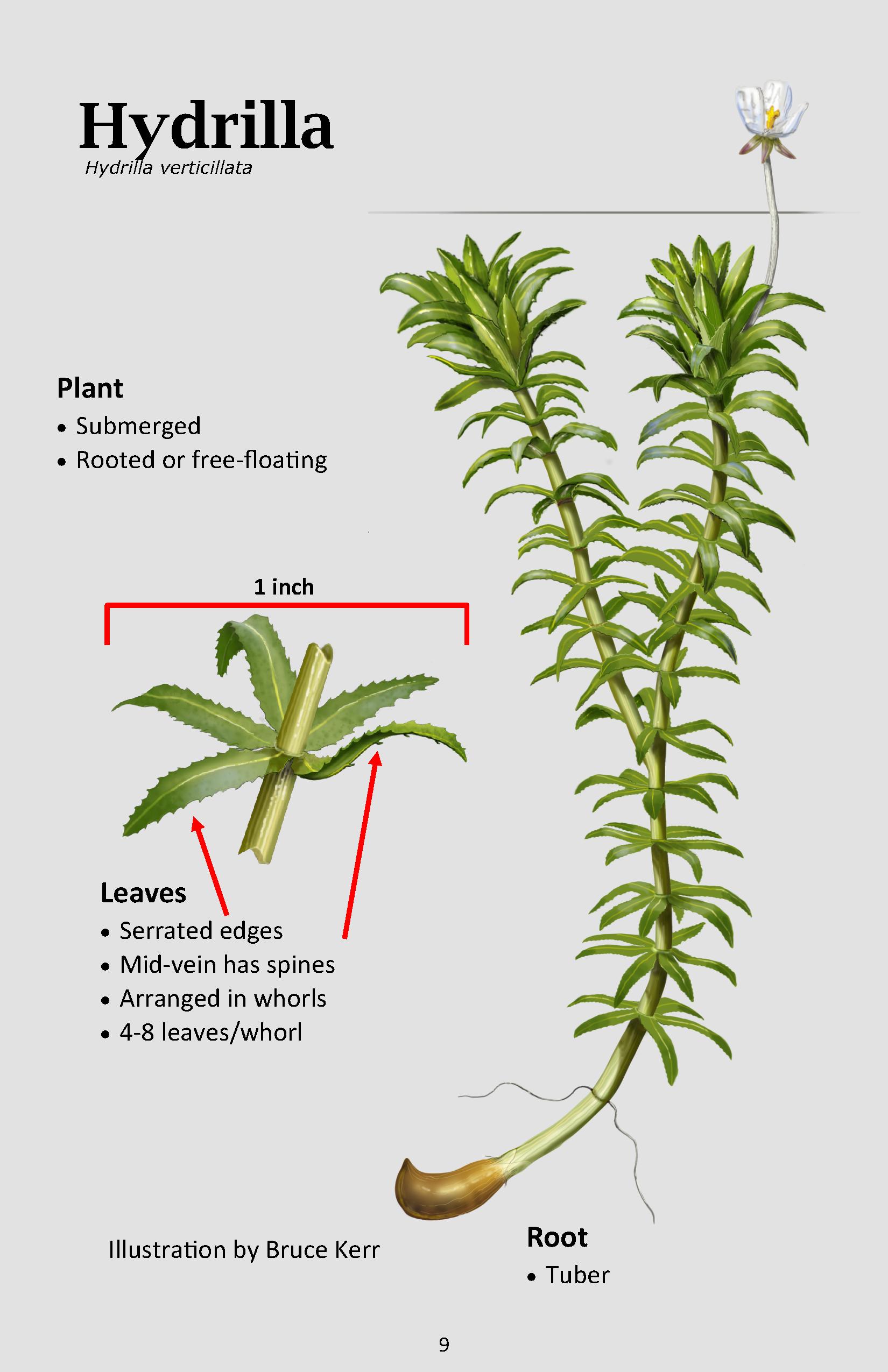
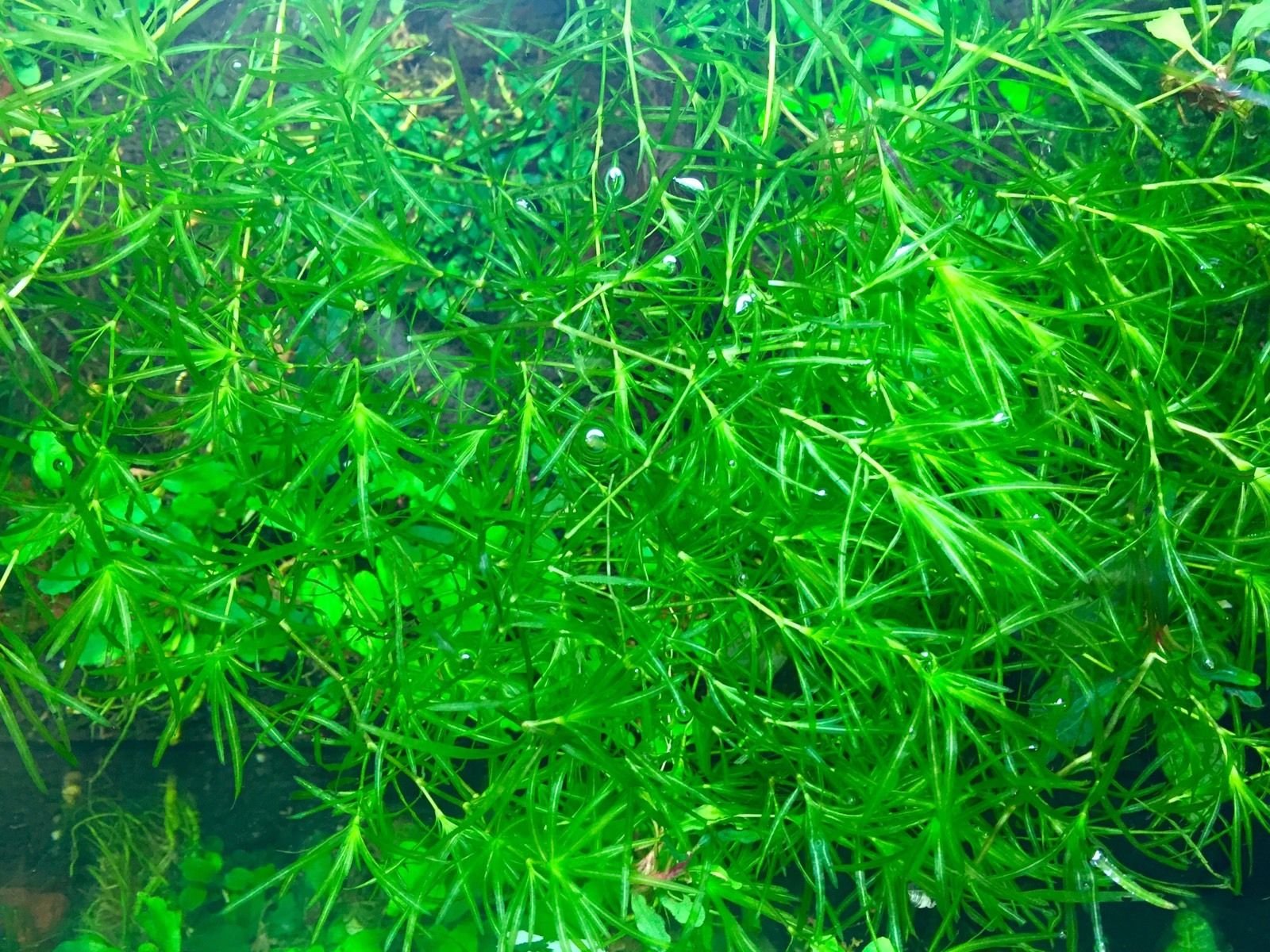
Hydrilla verticillata
Hydrilla: Greek hydra (water serpent) + diminutive, "little water thing" · verticillata: whorled
hydrilla, water thyme · Exotic: native to Asia, Africa and Australia
HABIT: rooted, branching stems up to 9 m long. Forms dense mats that fill the water column and top out at the surface.
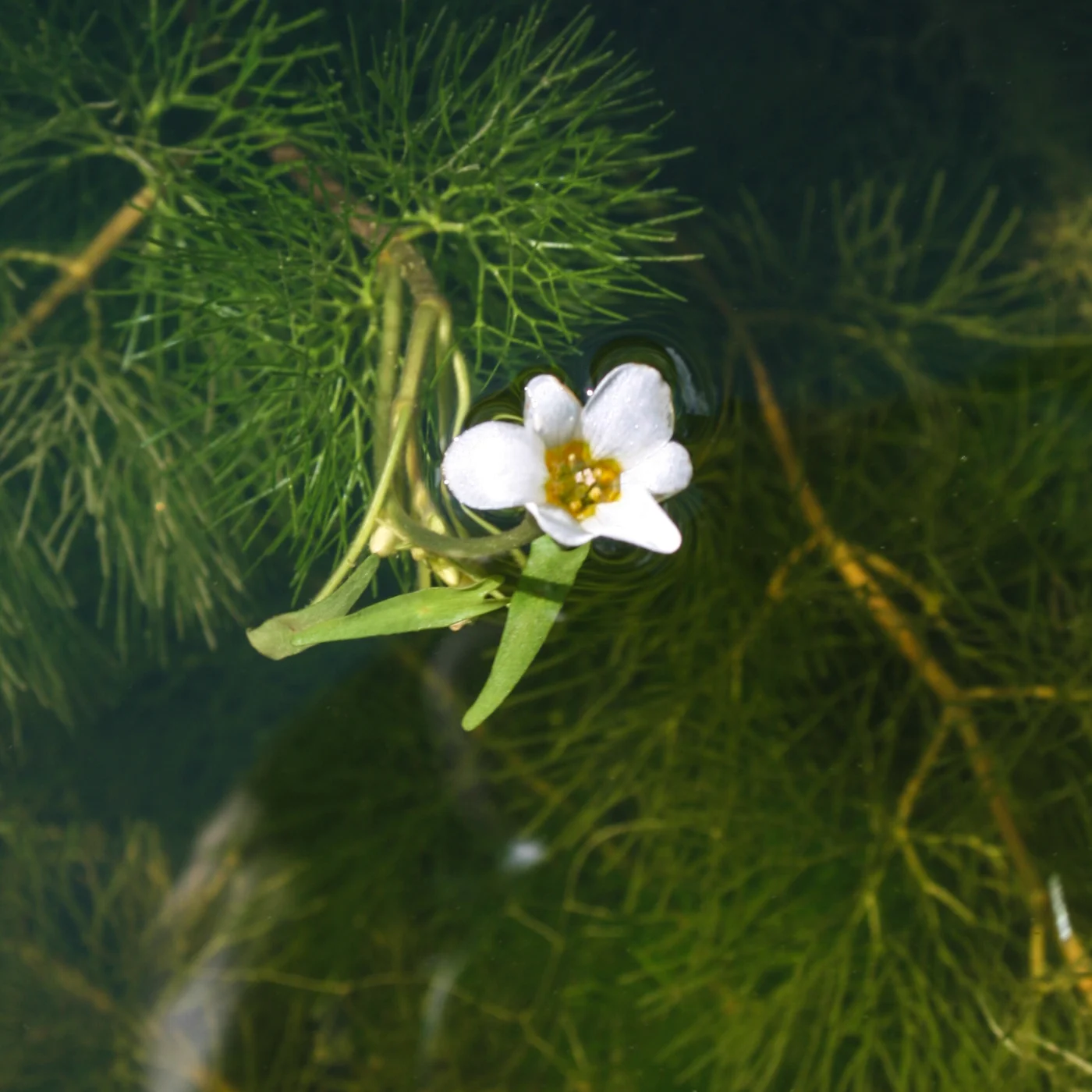
FLOWERS: tiny, white, 3-petaled, floating on threadlike stalks. Florida plants are mostly female.
LEAVES: in whorls of 4–8 (usually 5). Sharply toothed margins, visible to the naked eye. Midrib often reddish with small spines underneath, so it feels rough when pulled through your fingers.
ROOTS: fibrous. Makes potato-like tubers in the mud and turions (compact winter buds) in leaf axils.
FOUND: nearly every water depth and type in Florida, from clear spring-fed lakes to nutrient-rich ones.
LOOK-ALIKES: Egeria (leaves in 4s, fine teeth only under a lens, large white flowers) and Elodea (leaves in 3s, no spines).
Family: frog's-bit family (Hydrocharitaceae)
EDIBILITY: not a food plant. Can host the cyanobacterium behind avian vacuolar myelinopathy (AVM), which kills eagles and coots.
LVI DATA: C of C 0 · FLEPPC: Category 1 · Wetland: OBL · Exotic

Ceratophyllum demersum
Cerato-: Greek keras (horn) + phyllon (leaf), for the stiff forked leaves · demersum: submerged
coontail, hornwort · Native: cosmopolitan
HABIT: free-floating or loosely anchored, with no true roots. Branch tips are crowded, giving the bushy "raccoon tail" look.
FLOWERS: tiny, without petals, in leaf axils. Pollinated underwater. Rarely noticed.
LEAVES: whorls of 5–12. Each leaf forks 1–2 times into stiff segments with small teeth on one side. Feels rough and brittle.
ROOTS: none. Pale modified branches may anchor it in mud.
FOUND: quiet, often nutrient-rich lakes, ponds and canals. Tolerates low light.
LOOK-ALIKES: Cabomba (leaves opposite and fan-shaped, soft, with no teeth) and Myriophyllum (feather-like leaves with a central axis).
Family: hornwort family (Ceratophyllaceae)
EDIBILITY: not edible. Good habitat for fish and invertebrates.
LVI DATA: C of C 4.16 · FLEPPC: Not Listed · Wetland: OBL · Native

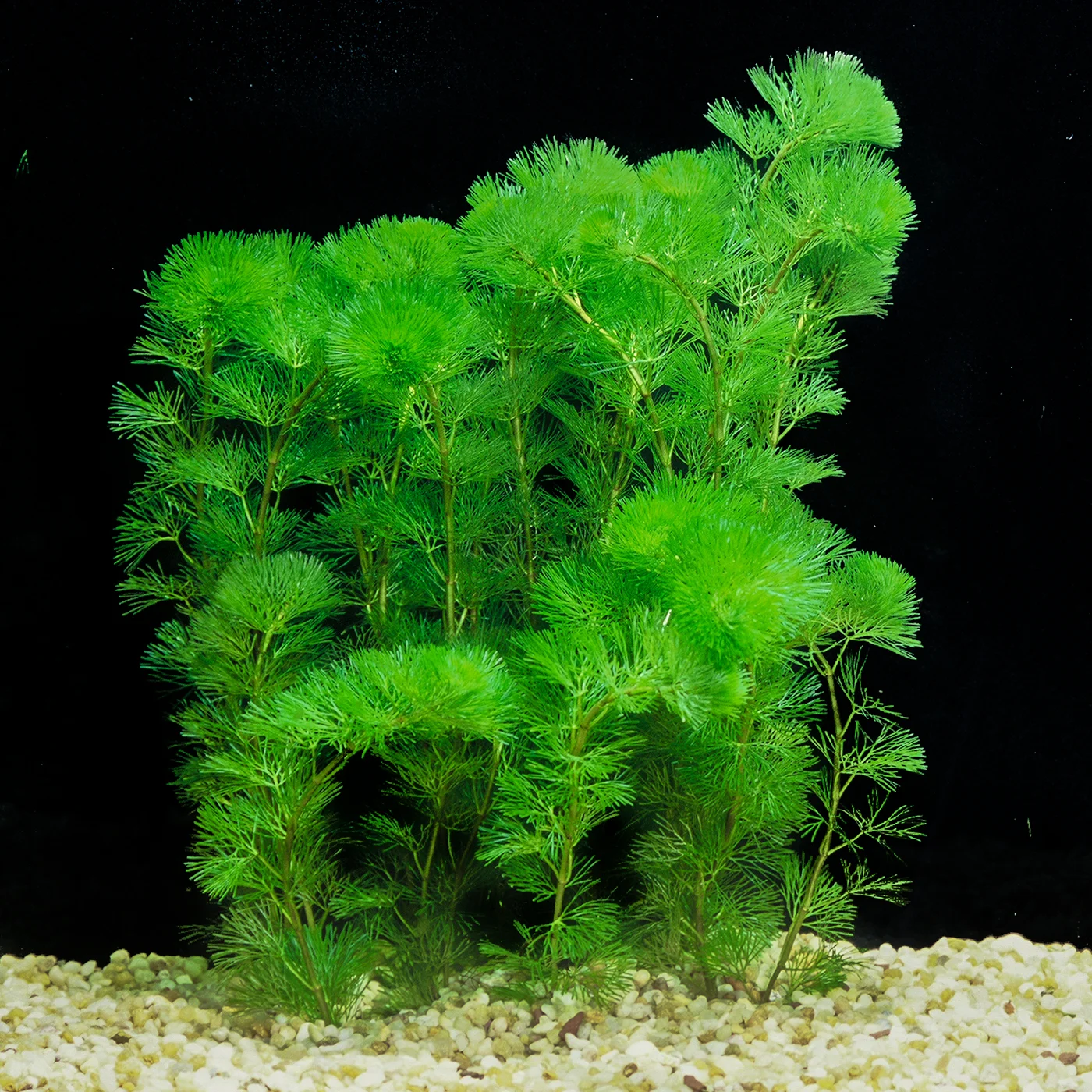
Cabomba caroliniana
Cabomba: from an Indigenous South American name for an aquatic plant · caroliniana: of the Carolinas
fanwort, Carolina fanwort · Native: southeastern U.S. to South America
HABIT: rooted, with soft branching stems. Covered in a gelatinous coat, so it feels slimy.
FLOWERS: small (about 1.5 cm), white to cream with yellow centers, held just above the water.
LEAVES: submersed leaves are opposite, on petioles, and finely divided into fan shapes. Small diamond-shaped floating leaves appear when flowering.
ROOTS: fibrous, from the rhizome and lower nodes.
FOUND: acidic, soft-water lakes and slow streams, often in still, somewhat tea-colored water.
LOOK-ALIKES: Ceratophyllum (whorled, toothed leaves) and Utricularia (alternate leaves with bladders).
Family: water-shield family (Cabombaceae)
EDIBILITY: not considered edible.
LVI DATA: C of C 5.5 · FLEPPC: Not Listed · Wetland: OBL · Native

Najas guadalupensis
Najas: from naiad, a Greek water nymph · guadalupensis: of Guadeloupe (Caribbean), where it was first described
southern naiad, southern waternymph · Native: the Americas
HABIT: rooted annual with slender, much-branched, brittle stems. Forms bushy underwater beds.
FLOWERS: tiny and inconspicuous, in leaf axils. Pollinated underwater.
LEAVES: opposite or in apparent whorls, narrow (under 2 mm), up to 3 cm long, with minute teeth only under a lens. The leaf base widens into a sheath.
ROOTS: fine roots at the lower nodes.
FOUND: lakes, ponds and canals in shallow to moderate depths. Often grows with hydrilla.
LOOK-ALIKES: N. marina (coarse spiny teeth and a prickly stem) and Hydrilla (true whorls with obvious teeth).
Family: frog's-bit family (Hydrocharitaceae), formerly Najadaceae
EDIBILITY: not a human food. An important waterfowl food.
LVI DATA: C of C 5.07 · FLEPPC: Not Listed · Wetland: OBL · Native

Vallisneria americana
Vallisneria: honors Antonio Vallisneri, an Italian naturalist · americana: of America
eelgrass, tapegrass, wild celery · Native: eastern North America
HABIT: rooted, stemless rosettes. Spreads by runners to form meadows of ribbon-like leaves.
FLOWERS: female flowers float at the surface on long spiral stalks. Tiny male flowers break free and drift to them. The spiral stalk coils to pull the fruit underwater.
LEAVES: ribbon-like, up to 2 m long and about 1 cm wide, with blunt tips. Faint lengthwise lines with a lighter central stripe. Margins finely toothed near the tip.
ROOTS: fibrous, from the base of the rosette and the stolon nodes.
FOUND: clear lakes, spring runs and rivers, on sandy bottoms.
LOOK-ALIKES: Sagittaria in its submersed ribbon form (thicker, spongy, no central stripe) and Potamogeton (has stems).
Family: frog's-bit family (Hydrocharitaceae)
EDIBILITY: not a common human food. Waterfowl favor it, notably canvasback ducks.
LVI DATA: C of C 7 (sensitive) · FLEPPC: Not Listed · Wetland: OBL · Native


Chara spp.
Chara: classical name for a plant
muskgrass, stonewort
HABIT: rooted by rhizoids. Stems have whorls of branchlets at regular nodes and look like a horsetail or a vascular plant.
FLOWERS: none. Reproductive organs are tiny orange-red (male) and brown (female) structures at the nodes.
LEAVES: no true leaves; whorled branchlets instead. Gritty from calcium carbonate (lime) crust and smells skunky or garlicky ("musk"). more grayish green
ROOTS: colorless rhizoids.
FOUND: hard, alkaline, clear water.
Family: stonewort family (Characeae)
EDIBILITY: not edible.
LVI DATA: C of C 3.9 · FLEPPC: Not Listed · Wetland: OBL · Native


Nitella spp.
Latin nitens (shining)
nitella (Nitella)
Native: worldwide. These are macroalgae, not vascular plants.
HABIT: rooted by rhizoids. Stems have whorls of branchlets at regular nodes and look like a horsetail or a vascular plant.
FLOWERS: none. Reproductive organs are tiny orange-red (male) and brown (female) structures at the nodes.
LEAVES: no true leaves; whorled branchlets instead. Smooth, translucent, bright green and odorless, with forked branchlets. sometimes slimy. delicate, finer
ROOTS: colorless rhizoids.
FOUND: soft, acidic lakes. grow in deep water in clear lakes.
Family: stonewort family (Characeae), green algae
EDIBILITY: not edible.
LVI DATA: C of C 6 · FLEPPC: Not Listed · Wetland: OBL · Native


Potamogeton spp.
Potamogeton: Greek potamos (river) + geiton (neighbor)
pondweeds · Native
HABIT: rooted, with jointed stems from rhizomes. Leaves alternate, with stipules (a sheath) at the leaf base.
FLOWERS: small, green-brown, in cylindrical spikes raised above the water. Fruit is a small nutlet.
LEAVES: P. illinoensis has large submersed leaves (8–20 cm) with a wavy, sharp-pointed blade and oval floating leaves. P. diversifolius has thread-like submersed leaves and small oval floating leaves.
ROOTS: fibrous, from rhizome nodes.
FOUND: lakes and slow streams. P. illinoensis often grows in harder water.
Family: pondweed family (Potamogetonaceae)
EDIBILITY: rhizomes of some pondweeds were historically eaten. Not recommended. An important waterfowl food.
Potamogeton illinoensis (Illinois pondweed) OBL Native
Potamogeton diversifolius (Waterthreat pondweed) OBL Native


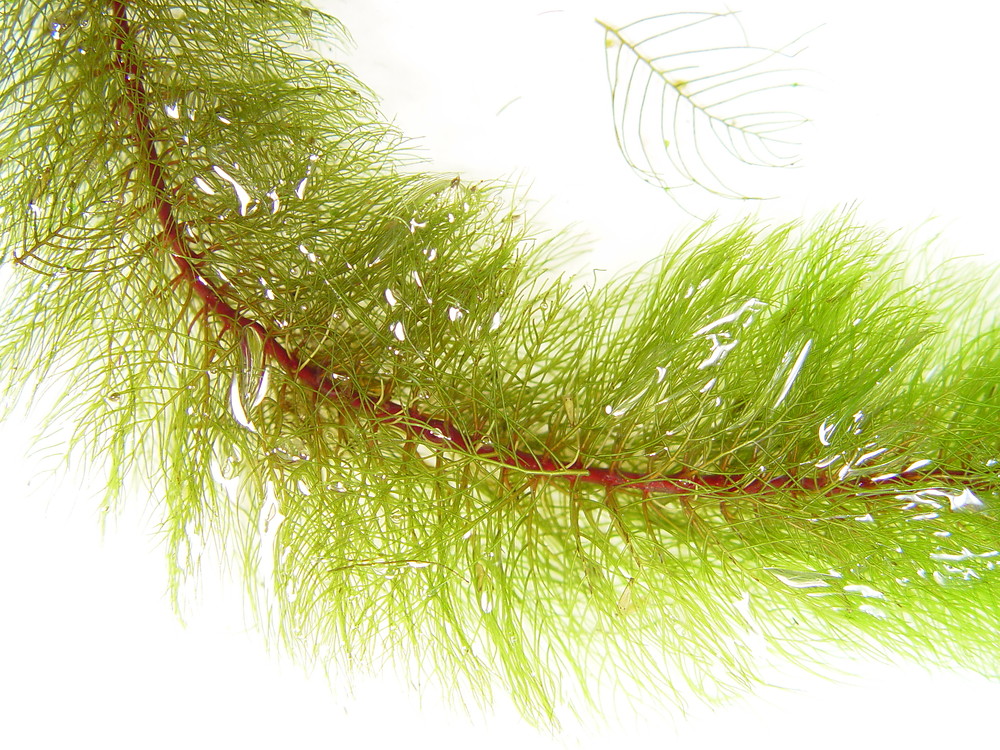
Myriophyllum heterophyllum
Myriophyllum: Greek myrios (countless) + phyllon (leaf) · heterophyllum: different leaves
variable watermilfoil
HABIT: rooted, with long stems. Submersed leaves are feather-like and in whorls. The flower spike often rises above the water.
FLOWERS: tiny, in a spike above the water. Bracts at the top become leaflike in some species.
LEAVES: Stout reddish stem. Whorls of 4–6 crowded leaves. Emersed spike with toothed, leaflike bracts. pinnately divided like a feather or fishbone.
ROOTS: fibrous, from the lower nodes.
FOUND: lakes, ponds and slow streams.
Family: watermilfoil family (Haloragaceae)
EDIBILITY: not edible.
LVI DATA: C of C 4.77 · FLEPPC: Not Listed · Wetland: OBL · Native

Myriophyllum laxum
Myriophyllum: Greek myrios (countless) + phyllon (leaf) · laxum: loose
piedmont watermilfoil
HABIT: rooted, with long stems. Submersed leaves are feather-like and in whorls. The flower spike often rises above the water.
FLOWERS: tiny, in a spike above the water. Bracts at the top become leaflike in some species.
LEAVES: Leaves loosely spaced. Emersed bracts linear and entire. Rare in sandhill lakes in the Panhandle. pinnately divided like a feather or fishbone.
ROOTS: fibrous, from the lower nodes.
FOUND: lakes, ponds and slow streams.
Family: watermilfoil family (Haloragaceae)
EDIBILITY: not edible.
LVI DATA: C of C 7.5 (sensitive) · FLEPPC: Not Listed · Wetland: OBL · Native


Myriophyllum spicatum
Myriophyllum: Greek myrios (countless) + phyllon (leaf) · spicatum: in spikes
Eurasian watermilfoil
HABIT: rooted, with long stems. Submersed leaves are feather-like and in whorls. The flower spike often rises above the water.
FLOWERS: tiny, in a spike above the water. Bracts at the top become leaflike in some species.
LEAVES: 12–21 pairs of leaflets per leaf (natives have fewer than 12). Leaves collapse limply out of water. Tips often reddish.pinnately divided like a feather or fishbone.
ROOTS: fibrous, from the lower nodes.
FOUND: lakes, ponds and slow streams.
Family: watermilfoil family (Haloragaceae)
EDIBILITY: not edible.
LVI DATA: C of C 0 · FLEPPC: 2 · Wetland: OBL · Exotic

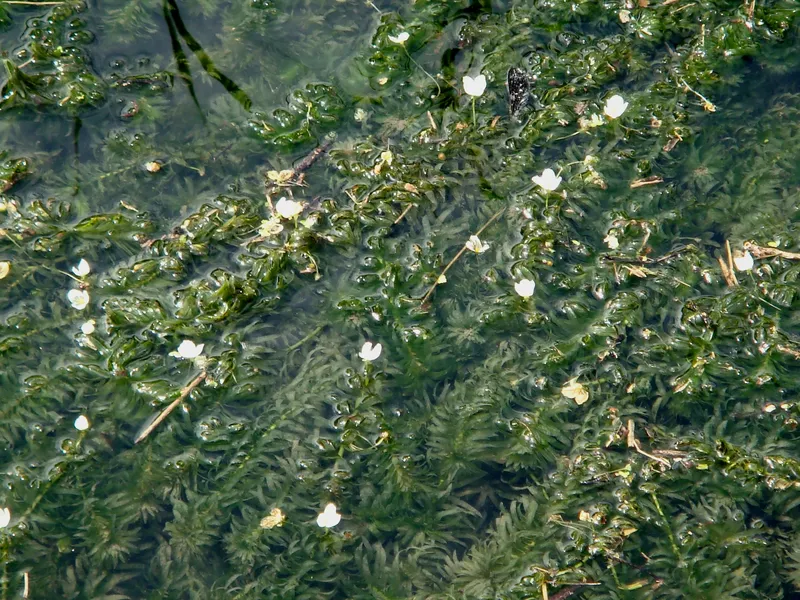
Egeria densa
Egeria: a water nymph of Roman myth · densa: dense
Brazilian waterweed, Brazilian elodea · Exotic: native to South America
HABIT: rooted or drifting, with dense leafy stems. Common in the aquarium trade.
FLOWERS: showy (about 2 cm), white, 3-petaled, held just above the water. U.S. plants are all male.
LEAVES: whorls of 4 (sometimes 3–6), 1–4 cm long, crowded near the tips. Fine teeth visible only under a hand lens. No spines on the midrib.
ROOTS: from double nodes along the stem.
FOUND: lakes and springs. More local than hydrilla.
LOOK-ALIKE: Hydrilla has obvious teeth, often 5 leaves per whorl, and a rough midrib.
Family: frog's-bit family (Hydrocharitaceae)
EDIBILITY: not edible.
LVI DATA: C of C 0.49 · FLEPPC: Not Listed · Wetland: OBL · Exotic


Mayaca fluviatilis
Mayaca: from an Indigenous South American name · fluviatilis: of rivers
bog moss, stream bogmoss · Native: southeastern U.S. to tropical America
HABIT: soft, moss-like stems, submersed or creeping on wet sand. Forms bright green tufts.
FLOWERS: small (about 1 cm), 3-petaled, white to pale pink or lavender, on short stalks.
LEAVES: tiny (under 1 cm), narrow, crowded, spirally arranged, translucent.
ROOTS: fine, from the lower nodes.
FOUND: clear, acidic, sandy-bottomed lakes and seepage streams.
Family: bogmoss family (Mayacaceae)
EDIBILITY: not edible.
LVI DATA: C of C 8.45 (sensitive) · FLEPPC: Not Listed · Wetland: OBL · Native


Websteria confervoides
Websteria: named for a 19th-century botanist named Webster · confervoides: like Conferva, a filamentous green alga
water bulrush, algal bulrush · Native: tropical and subtropical worldwide
HABIT: a submersed sedge with hair-fine branching stems that form tangled masses. Easily mistaken for algae.
FLOWERS: single small spikelets on stems that reach the surface. Rarely seen.
LEAVES: reduced to sheaths. The thread-like stems do the photosynthesis.
ROOTS: fine roots at the nodes.
FOUND: soft-water, acidic, clear lakes, often with Eleocharis and Utricularia.
LOOK-ALIKE: submersed Eleocharis has hollow stems arising in tufts, while Websteria branches at nodes.
Family: sedge family (Cyperaceae)
EDIBILITY: not edible.
LVI DATA: C of C 7 (sensitive) · FLEPPC: Not Listed · Wetland: OBL · Native


(Submersed) Eleocharis baldwinii
Eleocharis: Greek helos (marsh) + charis (grace) · baldwinii: for William Baldwin, an early Florida botanist
Baldwin's spikerush (roadgrass)
HABIT: forms dense, hair-like mats on wet sand or floats as tangled masses in water. It produces plantlets (vivipary) at the tips.
FLOWERS: a small terminal spikelet, the only "flower" in the genus. Often absent in submersed forms.
LEAVES: reduced to basal sheaths. Stems are green and leafless.
ROOTS: fibrous, from the base of the tufts.
FOUND: shallow, sandy lake margins and seasonally flooded flats in soft-water lakes.
Family: sedge family (Cyperaceae)
EDIBILITY: not edible. The edible water chestnut is a different, non-Florida Eleocharis.
LVI DATA: C of C 2.82 · FLEPPC: Not Listed · Wetland: OBL · Native


(Submersed) Eleocharis elongata
Eleocharis: Greek helos (marsh) + charis (grace) · elongata: elongated
slim spikerush
HABIT: long, flexible underwater stems from tufts.
FLOWERS: a small terminal spikelet, the only "flower" in the genus. Often absent in submersed forms.
LEAVES: reduced to basal sheaths. Stems are green and leafless.
ROOTS: fibrous, from the base of the tufts.
FOUND: shallow, sandy lake margins and seasonally flooded flats in soft-water lakes.
Family: sedge family (Cyperaceae)
EDIBILITY: not edible. The edible water chestnut is a different, non-Florida Eleocharis.
LVI DATA: C of C 6.97 · FLEPPC: Not Listed · Wetland: OBL · Native


Utricularia foliosa
Utricularia: Latin utriculus (little bag), for the bladder traps | foliosa: leafy
leafy bladderwort
HABIT: carnivorous and rootless. Flattened stems carry many bladders on separate branches that suck in zooplankton.
FLOWERS: two-lipped and snapdragon-like, with a spur, on stalks above the water. Yellow
LEAVES: finely divided, thread-like branches carrying bladders.
ROOTS: none.
FOUND: soft-water, acidic, nutrient-poor lakes, ponds and marshes.
KEY TRICK: Flower color plus the presence of a floating wheel separates the species from Cabomba or Myriophyllum
Family: bladderwort family (Lentibulariaceae)
EDIBILITY: not edible.
LVI DATA: C of C 5 | OBL | Native


Utricularia gibba
Utricularia: Latin utriculus (little bag), for the bladder traps | gibba: humped
leafy bladderwort
HABIT: carnivorous and rootless. Very small, delicate. Fine threads with few branches that suck in zooplankton.
FLOWERS: two-lipped and snapdragon-like, with a spur, on stalks above the water. Small and yellow
LEAVES: finely divided, thread-like branches carrying bladders.
ROOTS: none.
FOUND: Often on mud. soft-water, acidic, nutrient-poor lakes, ponds and marshes.
KEY TRICK: Flower color plus the presence of a floating wheel separates the species from Cabomba or Myriophyllum
Family: bladderwort family (Lentibulariaceae)
EDIBILITY: not edible.
LVI DATA: C of C 6.37 | OBL | Native
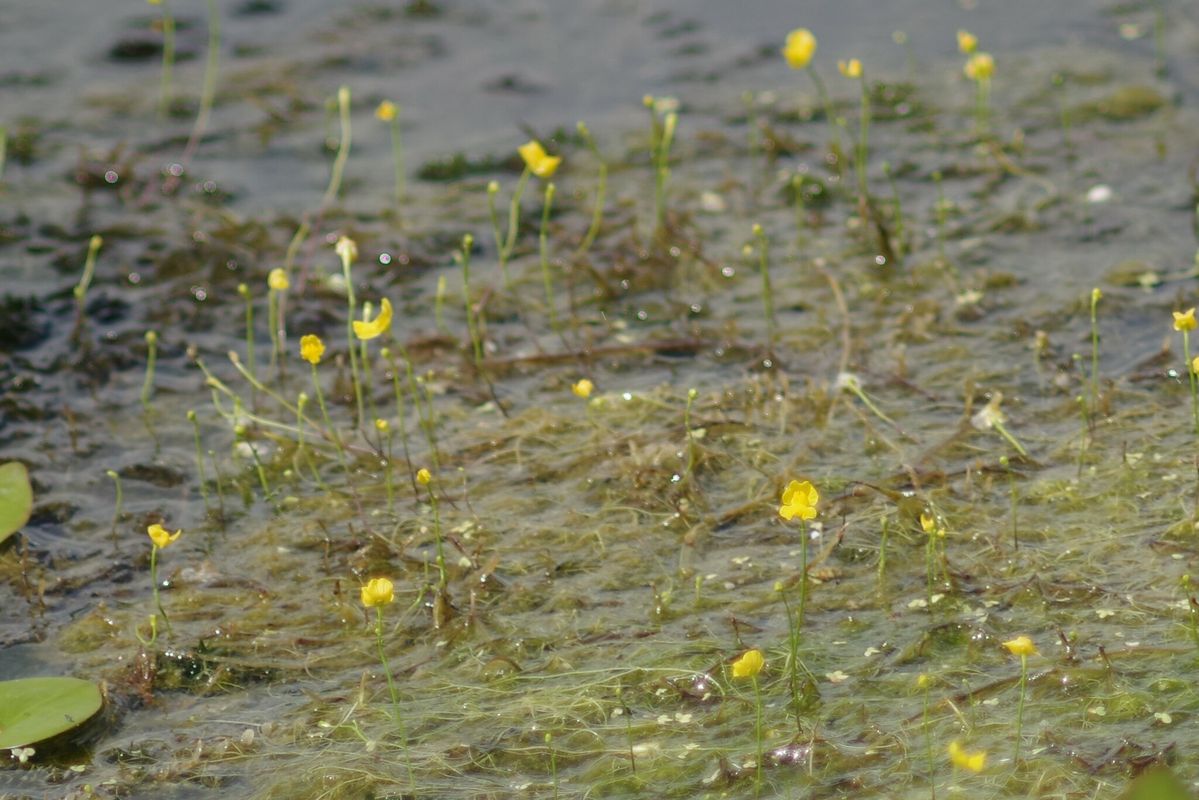

Utricularia purpurea
Utricularia: Latin utriculus (little bag), for the bladder traps | purpurea: purple
eastern purple bladderwort
HABIT: carnivorous and rootless.
FLOWERS: two-lipped and snapdragon-like, with a spur, on stalks above the water. Purple to pink
LEAVES: Leaves in whorls, with bladders at the tips of branchlets.
ROOTS: none.
FOUND: soft-water, acidic, nutrient-poor lakes, ponds and marshes.
KEY TRICK: Flower color plus the presence of a floating wheel separates the species from Cabomba or Myriophyllum
Family: bladderwort family (Lentibulariaceae)
EDIBILITY: not edible.
LVI DATA: C of C 6.5 | OBL | Native


Utricularia floridana
Utricularia: Latin utriculus (little bag), for the bladder traps | floridana: of FL
Florida yellow bladderwort
HABIT: carnivorous and rootless. Tall stalk with many yellow flowers. Long, sparse stems.
FLOWERS: two-lipped and snapdragon-like, with a spur, on stalks above the water. Many yellow flowers
LEAVES: bladders at the tips of branchlets.
ROOTS: none.
FOUND: soft-water, acidic, nutrient-poor lakes, ponds and marshes.
KEY TRICK: Flower color plus the presence of a floating wheel separates the species from Cabomba or Myriophyllum
Family: bladderwort family (Lentibulariaceae)
EDIBILITY: not edible.
LVI DATA: C of C 6.34 | OBL | Native


Utricularia inflata
Utricularia: Latin utriculus (little bag), for the bladder traps | inflata: swollen
swollen bladderwort
HABIT: carnivorous and rootless. Floating wheel of inflated spokes, 5 cm or more across, each spoke tapering.
FLOWERS: two-lipped and snapdragon-like, with a spur, on stalks above the water. Large yellow flowers
LEAVES: bladders at the tips of branchlets.
ROOTS: none.
FOUND: soft-water, acidic, nutrient-poor lakes, ponds and marshes.
KEY TRICK: Flower color plus the presence of a floating wheel separates the species from Cabomba or Myriophyllum
Family: bladderwort family (Lentibulariaceae)
EDIBILITY: not edible.
LVI DATA: C of C 5.85 | OBL | Native


Utricularia radiata
Utricularia: Latin utriculus (little bag), for the bladder traps | radiata: rayed
little floating bladderwort
HABIT: carnivorous and rootless. Smaller floating wheel (under 5 cm), with spokes inflated mainly toward the base. Smaller plant overall.
FLOWERS: two-lipped and snapdragon-like, with a spur, on stalks above the water. many yellow flowers
LEAVES: bladders at the tips of branchlets.
ROOTS: none.
FOUND: soft-water, acidic, nutrient-poor lakes, ponds and marshes.
KEY TRICK: Flower color plus the presence of a floating wheel separates the species from Cabomba or Myriophyllum
Family: bladderwort family (Lentibulariaceae)
EDIBILITY: not edible.
LVI DATA: C of C 6.01 | OBL | Native


Nymphaea odorata
Nymphaea: from Greek nymphe (water nymph) · odorata: fragrant
fragrant water-lily; white water-lily
HABIT: rooted in mud by thick rhizomes. Leaves and flowers float on long, flexible stalks.
FLOWERS: large (7–15 cm), many-petaled, open by day. white (rarely pink) and very fragrant.
LEAVES: round pads (10–30 cm) with a deep notch running to the petiole. often purple underneath.
ROOTS: thick, fleshy rhizomes with fibrous roots.
FOUND: lakes, ponds and slow streams, often in water 0.5–2 m deep.
LOOK-ALIKE: Nymphoides has smaller heart-shaped leaves, small 5-lobed flowers and no rhizome.
Family: water-lily family (Nymphaeaceae)
EDIBILITY: buds, young leaves, seeds and rhizome were historically eaten cooked. They contain alkaloids, so eat little if any.
LVI DATA: C of C 5 | OBL | Native

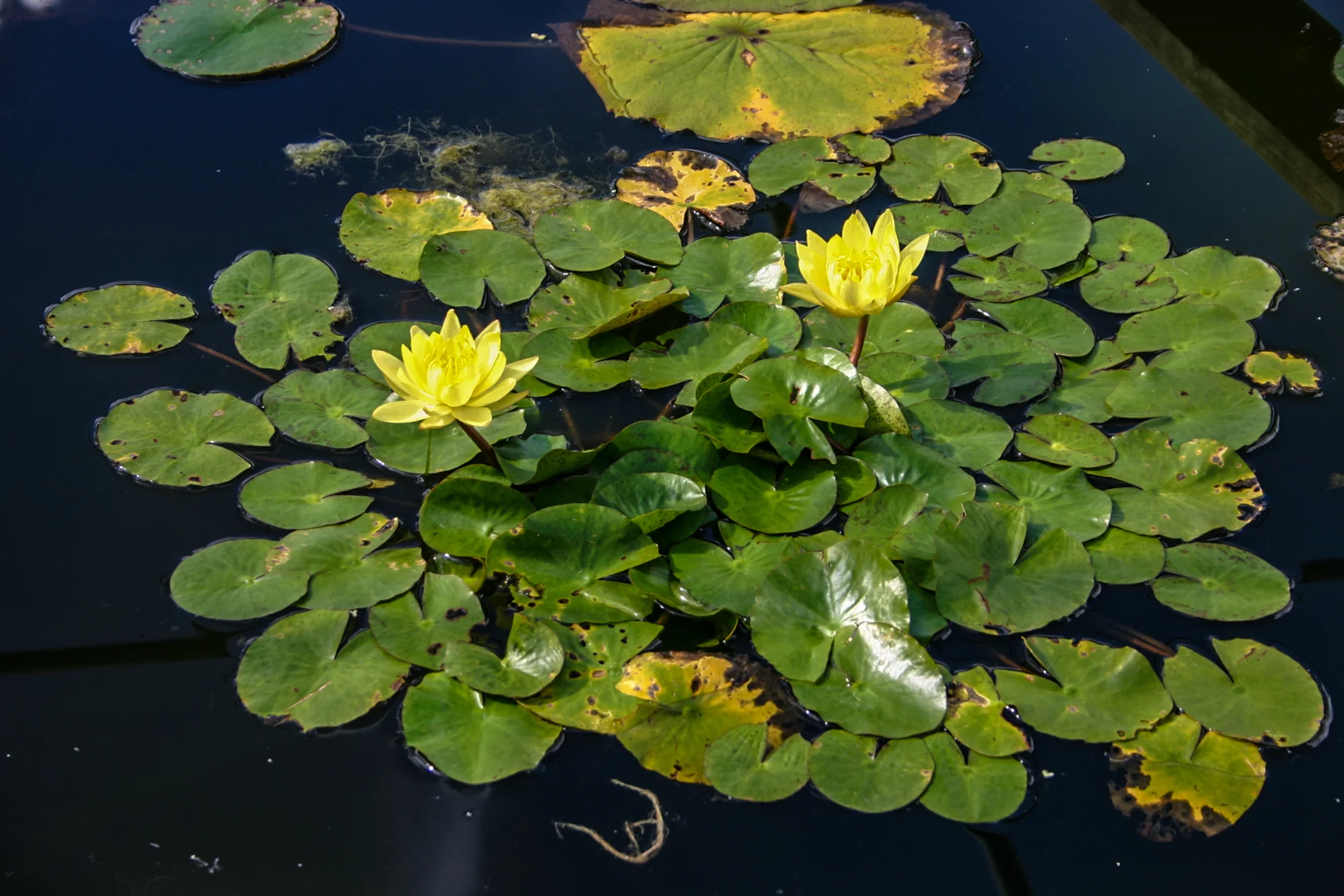
Nymphaea mexicana
Nymphaea: from Greek nymphe (water nymph) · mexicana: of Mexico
yellow water-lily; banana water-lily
HABIT: rooted in mud by thick rhizomes. Leaves and flowers float on long, flexible stalks.
FLOWERS: large (7–15 cm), many-petaled, open by day. yellow
LEAVES: round pads (10–30 cm) with a deep notch running to the petiole. pads are often mottled brown on top, and the plant spreads by stolons and banana-like tuber clusters.
ROOTS: thick, fleshy rhizomes with fibrous roots.
FOUND: lakes, ponds and slow streams, often in water 0.5–2 m deep.
LOOK-ALIKE: Nymphoides has smaller heart-shaped leaves, small 5-lobed flowers and no rhizome.
Family: water-lily family (Nymphaeaceae)
EDIBILITY: buds, young leaves, seeds and rhizome were historically eaten cooked. They contain alkaloids, so eat little if any.
LVI DATA: C of C 6.5 | OBL | Native


Nuphar advena/luteum
Nuphar: from Arabic/Persian naufar (water-lily) · advena: newcomer or stranger
spatterdock, yellow pond-lily, cow-lily · Native: eastern North America
HABIT: rooted by huge, log-like rhizomes. Leaves usually stand erect above the water rather than lying flat.
FLOWERS: yellow, globe-shaped, 3–5 cm, never fully opening. The "petals" are thick, waxy sepals.
LEAVES: large (20–40 cm), heart-shaped to oval with a V-shaped notch. Stiff, often held upright. Petiole round in cross-section.
ROOTS: thick rhizomes (up to 10 cm across) marked with leaf scars.
FOUND: lake margins, rivers and springs. Tolerates current and murky water.
Family: water-lily family (Nymphaeaceae)
EDIBILITY: seeds were popped and rhizomes roasted by Native Americans. Rhizomes are bitter and contain alkaloids.
LVI DATA: C of C 3.5 | OBL | Native


Nelumbo lutea
Nelumbo: from the Sinhalese name for the lotus · lutea: yellow
American lotus, yellow lotus · Native: eastern North America
HABIT: rooted by long rhizomes with tubers. Leaves float or rise well above the water.
FLOWERS: pale yellow, large (15–25 cm). They leave a distinctive seed head shaped like a showerhead.
LEAVES: round, 30–60 cm across, with no notch. The petiole attaches at the center (peltate). Leaves shed water, which beads up.
ROOTS: thick rhizomes with starchy tubers.
FOUND: lakes and slow rivers, often in water rich in nutrients and organic matter.
LOOK-ALIKE: Nymphaea has a notched pad; lotus has none.
Family: lotus family (Nelumbonaceae)
EDIBILITY: edible. Seeds are eaten raw or roasted, and tubers cooked. A traditional Native American food.
LVI DATA: C of C 5.5 | OBL | Native


Brasenia schreberi
Brasenia: honors Christoph Brasen, a Moravian missionary-physician · schreberi: honors J.C.D. von Schreber, a German naturalist
watershield · Native: worldwide except Europe
HABIT: rooted, with branching stems. Floating leaves on long stalks. Underwater parts are coated in thick, clear jelly.
FLOWERS: small (about 2 cm), dull purple-red, with 3 sepals and 3 petals.
LEAVES: oval, 5–10 cm, with no notch. The petiole attaches at the center (peltate). Purplish underneath.
ROOTS: from rhizomes and lower stem nodes.
FOUND: acidic, soft-water lakes and ponds.
LOOK-ALIKE: Nymphaea has a notch. Watershield is smaller and slimy.
Family: water-shield family (Cabombaceae)
EDIBILITY: young leaves and shoots are a delicacy in Japan (junsai), eaten for their jelly coating.
LVI DATA: C of C 8.79 (sensitive) | OBL | Native


Nymphoides aquatica
Nymphoides: like Nymphaea · aquatica: of water
big floating heart; banana lily
HABIT: rooted, with each leaf on a long stalk. The flowers grow from a point on the stalk just below the leaf. Some species form clusters of roots that look like a bunch of bananas.
FLOWERS: small (1–2 cm), white, 5-lobed, often fringed.
LEAVES: Leaves 5–15 cm, thick, spongy and purple-pitted underneath. floating, round to heart-shaped, notched at the base.
ROOTS: fibrous. Tuberous "banana" clusters.
FOUND: lakes, ponds and canals.
Family: buckbean family (Menyanthaceae)
EDIBILITY: not reliably documented. Avoid.
LVI DATA: C of C 6.09 | OBL | Native


Nymphoides cordata
Nymphoides: like Nymphaea · cordata: heart-shaped
little floating heart
HABIT: rooted, with each leaf on a long stalk. The flowers grow from a point on the stalk just below the leaf.
FLOWERS: small (1–2 cm), white, 5-lobed, often fringed.
LEAVES: Leaves under 5 cm, smooth, often mottled. floating, round to heart-shaped, notched at the base.
ROOTS: fibrous. Some species form tuberous "banana" clusters.
FOUND: lakes, ponds and canals.
Family: buckbean family (Menyanthaceae)
LVI DATA: C of C -9 (no score) | OBL | Native

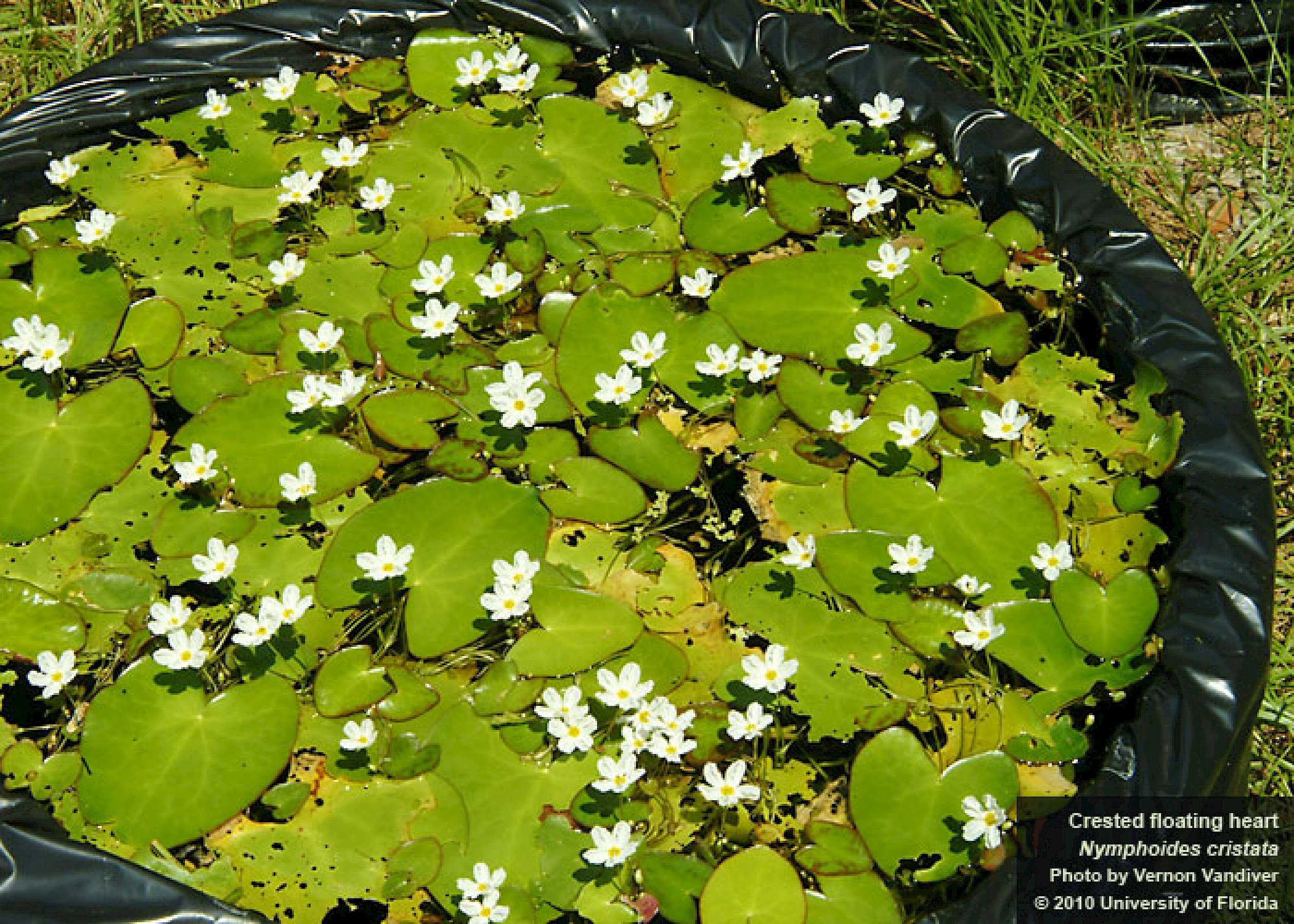
Nymphoides cristata
Nymphoides: like Nymphaea · cristata: crested
crested floating heart
HABIT: Dense surface mats. Leaves often mottled. rooted, with each leaf on a long stalk. The flowers grow from a point on the stalk just below the leaf. Some species form clusters of roots that look like a bunch of bananas.
FLOWERS: White flowers with a raised crest down each petal. small (1–2 cm), 5-lobed, often fringed.
LEAVES: floating, round to heart-shaped, notched at the base.
ROOTS: fibrous. Some species form tuberous "banana" clusters.
FOUND: lakes, ponds and canals.
Family: buckbean family (Menyanthaceae)
LVI DATA: C of C 0 | FLEPPC 1 | OBL | Exotic

Hydrocotyle umbellata (flowers needed to identify)
Hydrocotyle: Greek hydro (water) + kotyle (small cup) · umbellata: with umbels
manyflower marsh pennywort, dollarweed · Native worldwide tropical and temperate
HABIT: low-growing, creeping or floating. Spreads quickly by stolons to form dense mats.
FLOWERS: tiny and inconspicuous, 5-petaled stars, greenish white or purplish green. Grow in single umbels on stalks rising from the leaf.
LEAVES: peltate (centered) coin-shaped and glossy green with scalloped or lobed edges. Depending on species, the petiole attaches either at the dead center of the underside or at a notch in the leaf margin.
ROOTS: fibrous white roots growing straight from stolon nodes. Can anchor in mud or float freely in shallow water.
FOUND: saturated or submerged places: lake margins, slow streams and often-watered lawns.
Family: ginseng or ivy family (Araliaceae)
EDIBILITY: edible raw or cooked, with a parsley-like flavor. Beware runoff, parasites and chemicals from standing water. Large amounts, or certain species, can upset the stomach.
LVI DATA: C of C 1.92 | FACW | Native


Hydrocotyle ranunculoides (flowers needed to identify)
Hydrocotyle: Greek hydro (water) + kotyle (small cup) · ranunculoides: buttercup-like
floating marsh pennywort, dollarweed · Native to tropical and temperate regions worldwide
HABIT: low-growing, creeping or floating. Spreads quickly by stolons to form dense mats.
FLOWERS: tiny and inconspicuous, 5-petaled stars, greenish white or purplish green. Grow in small clusters, separated whorls or umbels on stalks rising from the leaf.
LEAVES: Leaf kidney-shaped and lobed, with stalk attached at the notch. Often floating.
ROOTS: fibrous white roots growing straight from stolon nodes. Can anchor in mud or float freely in shallow water.
FOUND: saturated or submerged places: lake margins, slow streams and often-watered lawns.
Family: ginseng or ivy family (Araliaceae)
EDIBILITY: edible raw or cooked, with a parsley-like flavor. Beware runoff, parasites and chemicals from standing water. Large amounts, or certain species, can upset the stomach.
LVI DATA: C of C 2 | OBL | Native


Pontederia crassipes (Eichhornia crassipes)
Pontederia: Giulio Pontedera, an Italian botanist · crassipes: Latin crassus (thick) + pes (foot), for the swollen leaf stalks
water hyacinth · Exotic: Amazon basin, South America
HABIT: free-floating rosettes, up to 1 m tall in crowded mats. Spreads fast by stolons and forms solid rafts.
FLOWERS: showy spikes of lavender-blue flowers. The upper petal has a yellow spot ringed in purple.
LEAVES: glossy, round to oval and thick. Petioles are spongy and bulb-like (float bladders) on open-water plants, and longer and thinner in dense mats.
ROOTS: long, feathery, dark purple-black roots hanging in the water.
FOUND: lakes, rivers and canals statewide, especially nutrient-rich water.
LOOK-ALIKE: Limnobium (frog's-bit) has small white flowers and a spongy pad on the underside of the leaf, not a swollen petiole.
Family: pickerelweed family (Pontederiaceae)
EDIBILITY: young leaves and petioles are cooked as a vegetable in parts of Asia. The plant absorbs heavy metals and contains calcium oxalate (itchy). Not recommended.
LVI DATA: C of C 0 | FLEPPC 1 | OBL | Exotic (listed as Eichhornia crassipes)

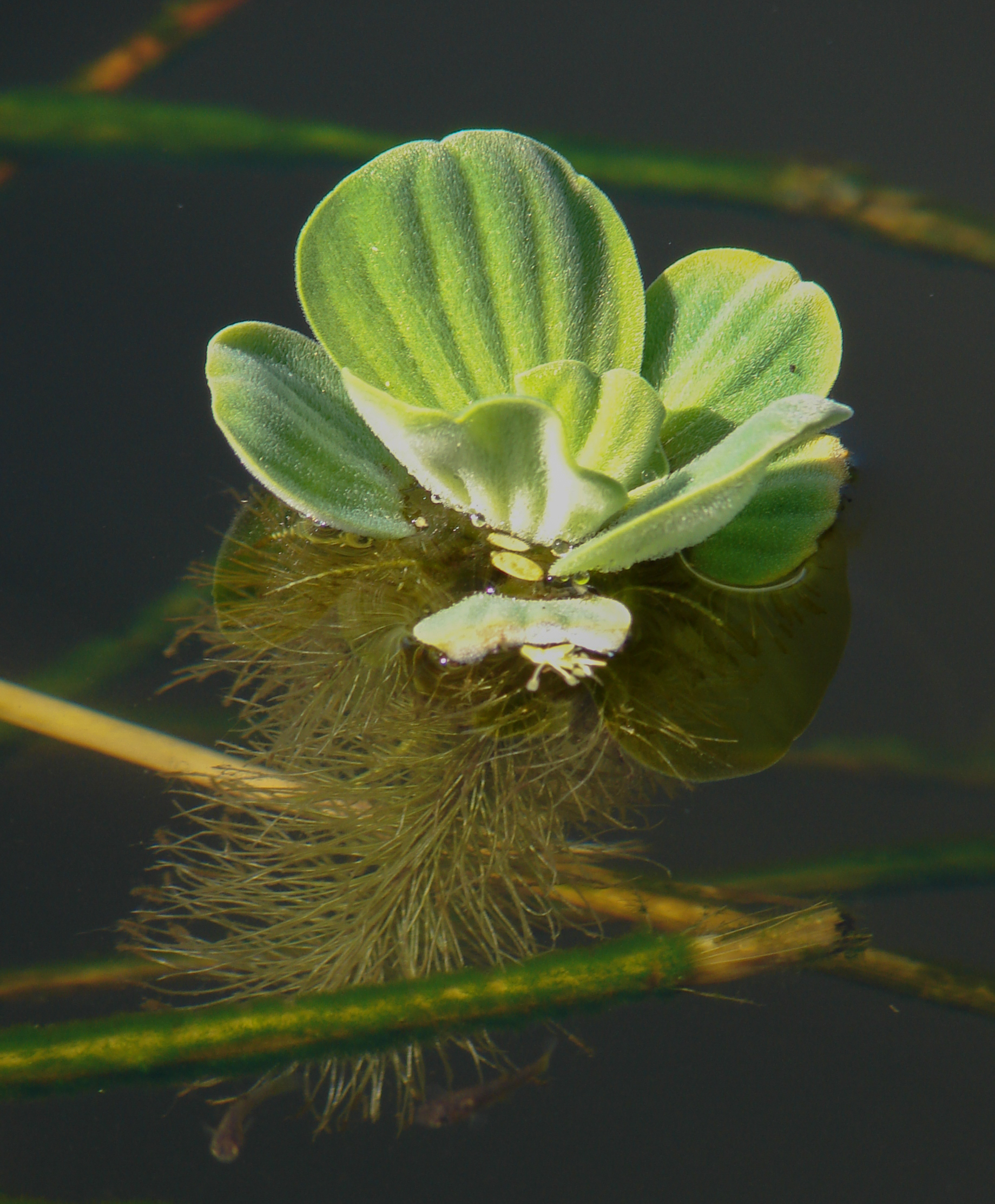
Pistia stratiotes
Pistia: Greek pistos (watery, drinkable) · stratiotes: soldier, for the sword-like leaves
water lettuce · Exotic: pantropical, of disputed origin (likely South America or Africa).
HABIT: free-floating rosettes that look like small heads of lettuce. Spreads by stolons into large mats.
FLOWERS: tiny and hidden, a small spathe tucked among the leaves at the center. It's an aroid.
LEAVES: velvety-hairy and gray-green, wedge-shaped with strong parallel ridges. Spongy at the base. Repel water.
ROOTS: dense, feathery, white to dark roots hanging below.
FOUND: lakes, rivers, canals and ponds, especially nutrient-rich water.
Family: arum family (Araceae)
EDIBILITY: not edible. Contains calcium oxalate crystals that burn the mouth and throat.
LVI DATA: C of C 0 | FLEPPC 1 | OBL | Exotic


Salvinia minima
Salvinia: Antonio Maria Salvini, 17th/18th century Italian scholar · minima: smallest
water spangles, common salvinia · Exotic: Central and South America
HABIT: a small floating fern. Chains of paired leaves form a velvety surface mat.
FLOWERS: none. Spore cases (sporocarps) form in chains on the submerged leaves.
LEAVES: paired floating leaves, oval to round (under 2 cm), covered in stiff hairs. The tips of the hairs split into 4 branches that stay separate, unlike giant salvinia, where they rejoin like an eggbeater. Leaves may fold as mats get crowded. The third, submerged leaf in each set is finely divided and looks like roots.
ROOTS: none. The root-like part is the modified third leaf.
FOUND: still lakes, ponds, canals and marshes, often mixed with duckweed.
LOOK-ALIKES: Azolla has tiny overlapping scale-like leaves and often turns reddish. Duckweeds are smooth with no hairs.
Family: water spangles family (Salviniaceae)
EDIBILITY: not edible.
LVI DATA: C of C 0 | FLEPPC 1 | OBL | Exotic


Duckweeds: Lemna
Lemna: Greek limne (pond)
Lemna duckweeds, Native
HABIT: tiny floating plants, each a single leaf-like body (flat frond) 1–5 mm across. Reproduce by budding to form green carpets.
FLOWERS: microscopic and rarely seen. Some are among the smallest flowering plants in the world.
LEAVES: no true leaves; flat fronds. 1 root per frond
ROOTS: 1 root per frond hanging from the underside
FOUND: still, nutrient-rich water in ponds, ditches, canals and sheltered lake margins.
Family: arum family (Araceae), formerly Lemnaceae
EDIBILITY: Duckweeds are edible in principle, but plants from the wild take up contaminants.
LVI DATA: C of C 1 | OBL | Native


Duckweeds: Spierodela polyrhiza
Spirodela: Greek speira (cord) + delos (visible); poly (many) + rhiza (roots)
Giant duckweeds, Native
HABIT: tiny floating plants, each a single leaf-like body (frond) 1–5 mm across. Reproduce by budding to form green carpets.
FLOWERS: microscopic and rarely seen. Some are among the smallest flowering plants in the world.
LEAVES: no true leaves; Frond 3–10 mm, purple underneath
ROOTS: 7-21 roots per frond hanging from the underside
FOUND: still, nutrient-rich water in ponds, ditches, canals and sheltered lake margins.
Family: arum family (Araceae), formerly Lemnaceae
EDIBILITY: Duckweeds are edible in principle, but plants from the wild take up contaminants.
LVI DATA: C of C 2.95 | OBL | Native


Duckweeds: Landoltia puncata
Landoltia: honors Elias Landolt, a Swiss duckweed specialist; punctatus: dotted/pointed
Dotted duckweeds, Native
HABIT: tiny floating plants, each a single leaf-like body (frond) 1–5 mm across. Reproduce by budding to form green carpets.
FLOWERS: microscopic and rarely seen. Some are among the smallest flowering plants in the world.
LEAVES: no true leaves; Frond 2–5 mm, reddish underneath.
ROOTS: 2-7 roots per frond hanging from the underside
FOUND: still, nutrient-rich water in ponds, ditches, canals and sheltered lake margins.
Family: arum family (Araceae), formerly Lemnaceae
EDIBILITY: Duckweeds are edible in principle, but plants from the wild take up contaminants.
LVI DATA: C of C 0 | FLEPPC 2 | UPL | Exotic


Duckweeds: Wolffia
Wolffia: honors J.F. Wolff, a German physician and botanist
watermeal, Nativity not assigned
HABIT: tiny floating plants, each a single leaf-like body (frond) 1–5 mm across. Reproduce by budding to form green carpets.
FLOWERS: microscopic and rarely seen. Some are among the smallest flowering plants in the world.
LEAVES: no true leaves; Globe-shaped, about 1 mm, no roots. Feels like grit.
ROOTS: None
FOUND: still, nutrient-rich water in ponds, ditches, canals and sheltered lake margins.
Family: arum family (Araceae), formerly Lemnaceae
EDIBILITY: Duckweeds are edible in principle, but plants from the wild take up contaminants.
LVI DATA: No C of C | OBL | NA


Duckweeds: Wolffiela
Wolffiella: little Wolffia
bogmat, Native
HABIT: tiny floating plants, each a single leaf-like body (frond) 1–5 mm across. Reproduce by budding to form green carpets.
FLOWERS: microscopic and rarely seen. Some are among the smallest flowering plants in the world.
LEAVES: no true leaves; Thin, strap- or sickle-shaped frond, floats just below the surface
ROOTS: None
FOUND: still, nutrient-rich water in ponds, ditches, canals and sheltered lake margins.
Family: arum family (Araceae), formerly Lemnaceae
EDIBILITY: Duckweeds are edible in principle, but plants from the wild take up contaminants.
LVI DATA: C of C 1 | OBL | Native


Azolla caroliniana (Azolla filiculoides)
Azolla: Greek azo (to dry) + ollyo (to kill), since drought kills it · caroliniana: of the Carolinas
mosquito fern, water fern · Native
HABIT: a tiny floating fern (1–2 cm) with branched fronds. Forms mats that turn red in sun or cold.
FLOWERS: none. Sporocarps form on the underside.
LEAVES: minute, overlapping, 2-lobed scales. A cyanobacterium (Anabaena) living in the leaf cavities fixes nitrogen.
ROOTS: fine, unbranched roots hanging below.
FOUND: quiet ponds, ditches and lake margins, often with duckweed.
Family: water spangles family (Salviniaceae), sometimes split as Azollaceae
EDIBILITY: not a human food. Used as livestock and rice-paddy green manure in Asia.
LVI DATA: C of C 1.81 | OBL | Native


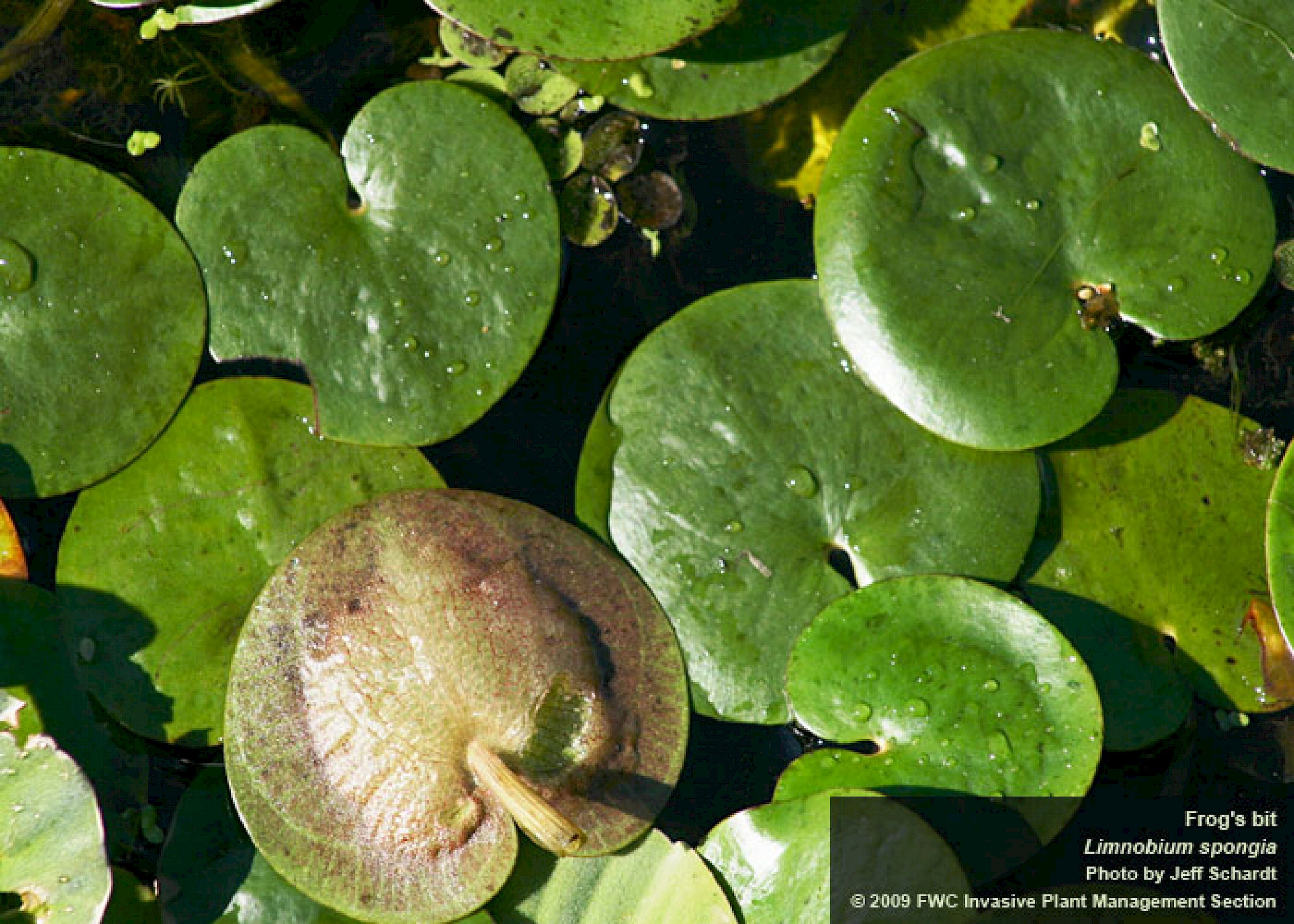
Limnobium spongia
Limnobium: Greek limne (pond) + bios (life) · spongia: sponge, for the spongy tissue under the leaf
American frog's-bit, spongeplant · Native: eastern U.S.
HABIT: floating rosettes linked by stolons. Roots anchor in mud in shallow water.
FLOWERS: small, white, 3-petaled, on short stalks.
LEAVES: round to heart-shaped (2–5 cm), glossy. A spongy purple pad (aerenchyma) lies in the center of the underside.
ROOTS: long, unbranched, root hairs visible.
FOUND: quiet water in lakes, swamps and ditches.
LOOK-ALIKES: young water hyacinth (has swollen petioles, not a pad under the leaf) and Hydrocotyle (scalloped leaves, no spongy pad).
Family: frog's-bit family (Hydrocharitaceae)
EDIBILITY: not documented. Avoid.
LVI DATA: C of C 2.5 · OBL · Native

Ricciocarpos natans
Ricciocarpos: P.F. Ricci, Italian patron, + Greek karpos (fruit) · natans: swimming or floating
purple-fringed riccia · Native: worldwide. liverwort, not a vascular plant.
HABIT: small floating thalli (5–15 mm), heart- or fan-shaped, often in groups.
FLOWERS: none.
LEAVES: no leaves. The thallus has a central groove and a bumpy, spongy top. Long purple scales fringe the underside.
ROOTS: no roots. The purple ventral scales hang in the water.
FOUND: still, shaded ponds and swamps, among duckweed.
Family: crystalwort family (Ricciaceae), liverworts
EDIBILITY: not edible.
LVI DATA: C of C 6 · OBL · Native


Pontederia cordata
Pontederia: honors Giulio Pontedera · cordata: heart-shaped
pickerelweed · Native: the Americas
HABIT: an emergent perennial, 0.5–1.2 m tall, in dense colonies from creeping rhizomes.
FLOWERS: dense spikes of violet-blue flowers. The upper lobe has two yellow spots. Blooms spring to fall.
LEAVES: glossy, heart-shaped to lance-shaped, with many fine parallel veins curving up from the base. Leaf stalk spongy.
ROOTS: thick rhizomes with fibrous roots in mud.
FOUND: shallow lake margins, marshes and slow streams, in water 0–1 m deep.
LOOK-ALIKES: Sagittaria (net veins converging on the tip, white 3-petaled flowers) and Peltandra (net veins plus 3 prominent main veins).
Family: pickerelweed family (Pontederiaceae)
EDIBILITY: seeds eaten raw, dried or roasted. Young leaves and stalks eaten cooked.
LVI DATA: C of C 5.38 · OBL · Native


Sagittaria lancifolia
Sagittaria: Latin sagitta (arrow) · lancifolia: lance-leaved
bulltongue arrowhead, duck potato · Native
HABIT: emergent rosettes from corms or rhizomes. Milky sap.
FLOWERS: white, 3-petaled, in whorls of 3 along an upright stalk. Upper flowers male, lower female.
LEAVES: S. lancifolia has lance-shaped blades, no lobes, thick and erect. S. latifolia has arrowhead-shaped blades with long backward lobes. Veins converge toward the tip.
ROOTS: fibrous, with starchy tubers on runners (S. latifolia).
FOUND: marshes, lake margins and ditches.
LOOK-ALIKE: Pontederia (blue flowers, no milky sap).
Family: water-plantain family (Alismataceae)
EDIBILITY: tubers may be edible cooked, like potatoes.
LVI DATA: C of C 3 | OBL | Native
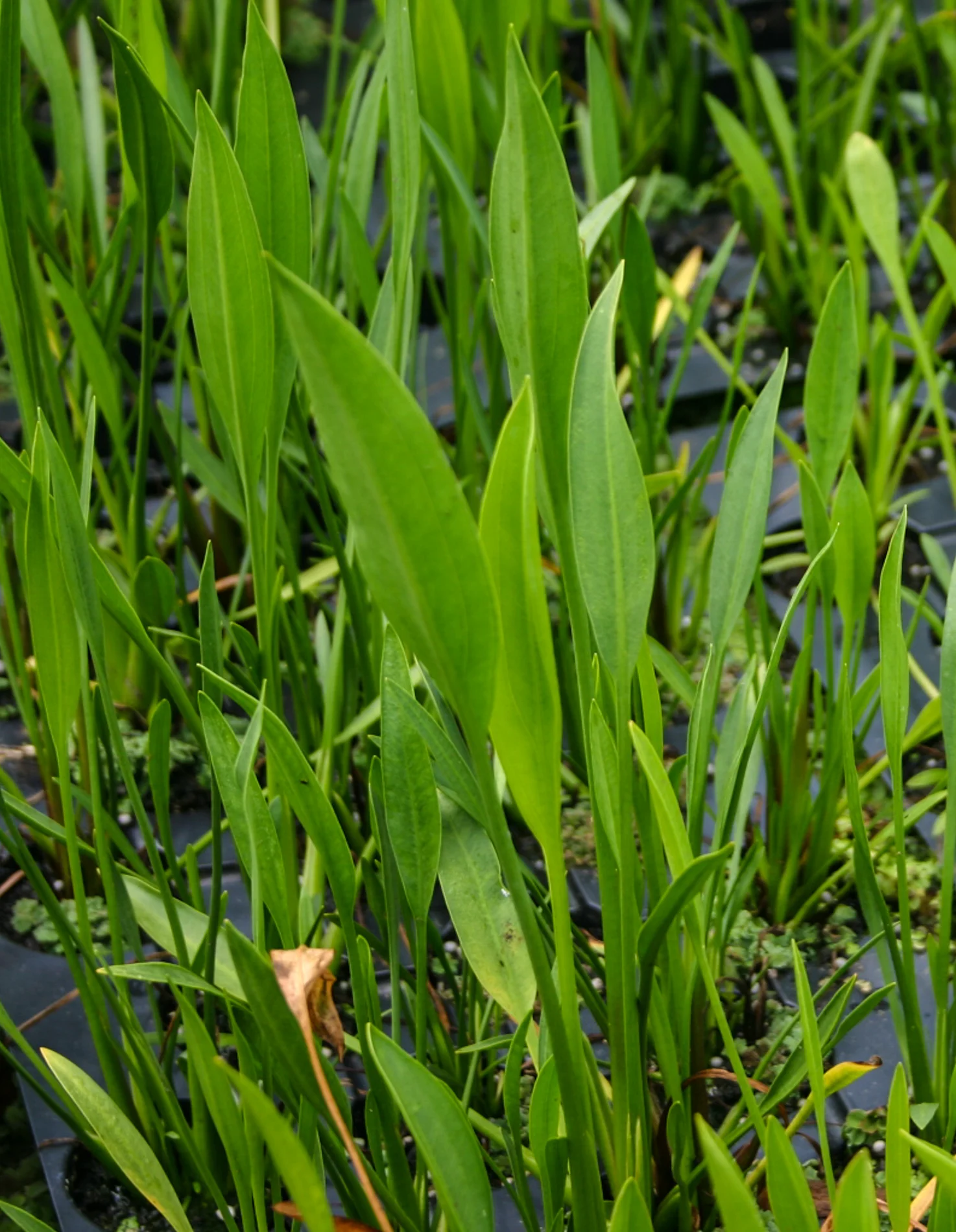

Sagittaria latifolia
Sagittaria: Latin sagitta (arrow) · latifolia: broad-leaved
broadleaf arrowhead, duck potato · Native
HABIT: emergent rosettes from corms or rhizomes. Milky sap.
FLOWERS: white, 3-petaled, in whorls of 3 along an upright stalk. Upper flowers male, lower female.
LEAVES: S. lancifolia has lance-shaped blades, no lobes, thick and erect. S. latifolia has arrowhead-shaped blades with long backward lobes. Veins converge toward the tip.
ROOTS: fibrous, with starchy tubers on runners (S. latifolia).
FOUND: marshes, lake margins and ditches.
LOOK-ALIKE: Pontederia (blue flowers, no milky sap).
Family: water-plantain family (Alismataceae)
EDIBILITY: S. latifolia tubers ("wapato" or duck potato) are edible cooked, like potatoes.
LVI DATA: C of C 3.5 | OBL | Native
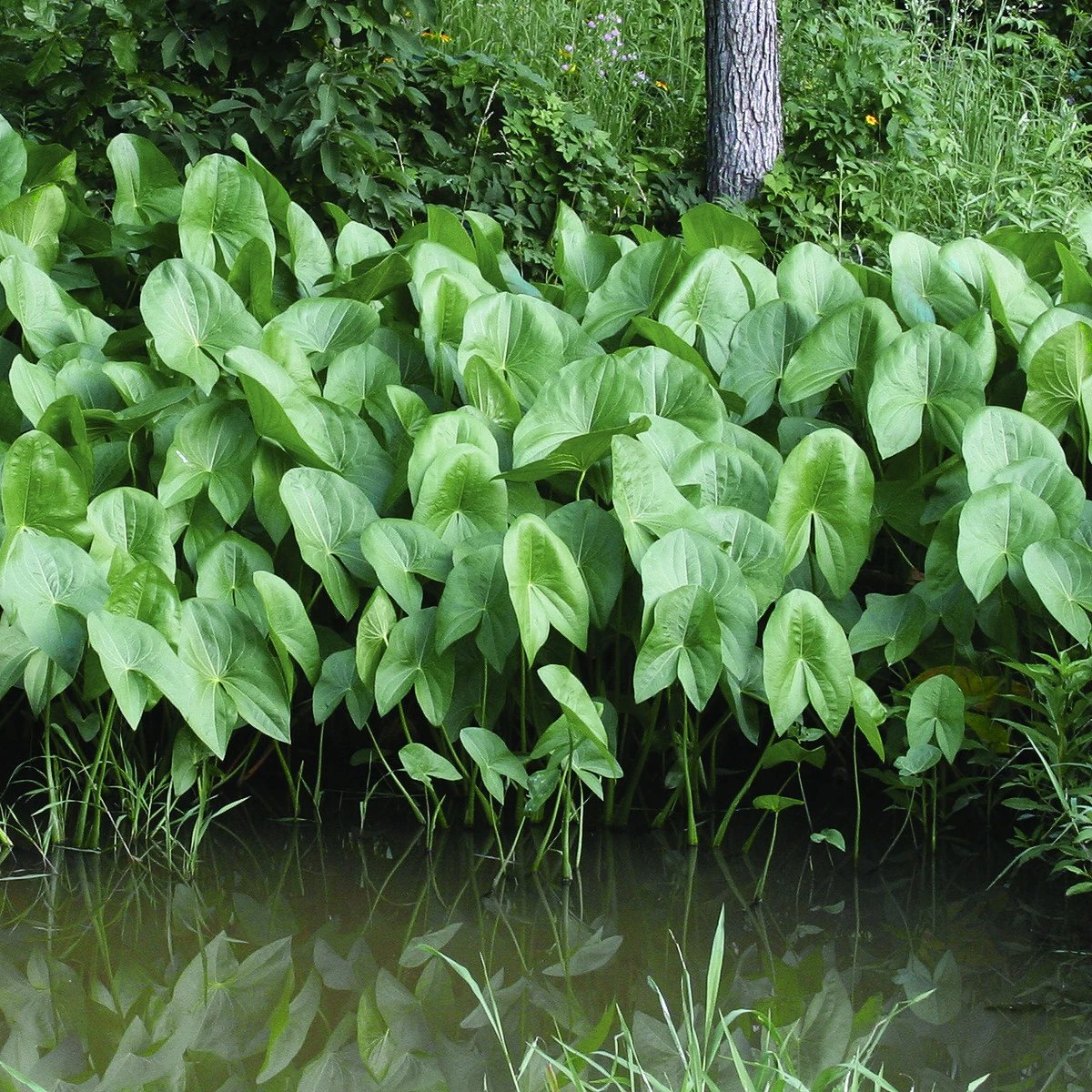

Thalia geniculata
Thalia: Johannes Thal, a 16th-century German physician · geniculata: bent like a knee, for the zigzag flower branches
alligatorflag, fireflag · Native: Florida, tropical Americas, Africa
HABIT: a tall emergent perennial, 1–3 m, in clumps from rhizomes. Banana-like look.
FLOWERS: purple flowers in pairs on zigzag, drooping branches high above the leaves.
LEAVES: large (up to 60 cm) and paddle-shaped on long stalks. A swollen joint (pulvinus) sits where the blade meets the stalk.
ROOTS: thick rhizomes.
FOUND: deep marshes, swamps and lake margins. Alligators often lie in it.
Family: arrowroot family (Marantaceae)
EDIBILITY: not considered edible.
LVI DATA: C of C 6 · OBL · Native


Peltandra virginica
Peltandra: Greek pelte (shield) + aner/andros (male), for the shield-shaped stamens · virginica: of Virginia
green arrow arum · Native: eastern North America
HABIT: emergent clumps, 0.5–1 m, from a thick root mass.
FLOWERS: a green spathe wrapped around a spadix, the typical aroid structure. Fruit is a cluster of green-black berries that bends down into the water.
LEAVES: arrow-shaped with 3 prominent main veins (a midrib plus two veins along the lobes) and a vein running around the margin. Fine net veins between.
ROOTS: a thick, fibrous root mass.
FOUND: swamps, lake margins and tidal freshwater marshes.
LOOK-ALIKE: Sagittaria (veins converge on the tip, no marginal vein, milky sap).
Family: arum family (Araceae)
EDIBILITY: toxic raw from calcium oxalate. The rhizome was eaten by Native Americans only after long drying and cooking. Not recommended.
LVI DATA: C of C 7.5 | OBL | Native

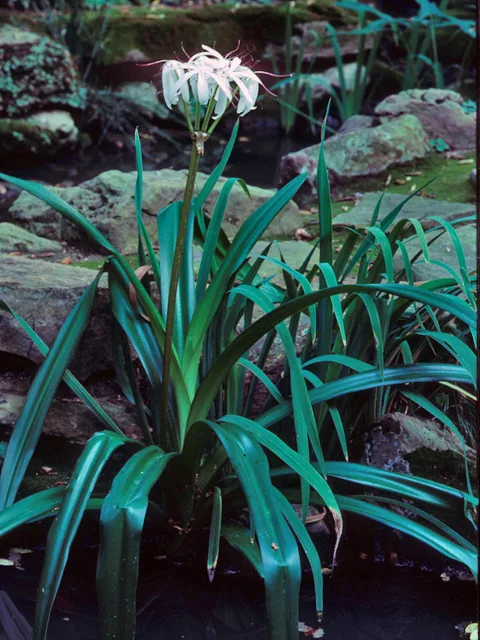
Crinum americanum
Crinum: Greek krinon (lily) · americanum: of America
string lily, swamp lily, seven-sisters · Native: southeastern U.S. and the Caribbean
HABIT: emergent clumps from a large bulb.
FLOWERS: large white flowers with 6 narrow, spidery tepals and long pink-red stamens. Fragrant. In clusters on a stout stalk.
LEAVES: long (up to 1 m), strap-shaped, fleshy and bright green, with finely toothed margins.
ROOTS: a bulb with fleshy roots.
FOUND: swamps, marshes, lake and river edges.
Family: amaryllis family (Amaryllidaceae)
EDIBILITY: toxic. The bulb contains lycorine-type alkaloids.
LVI DATA: C of C 9 (sensitive) · FLEPPC: Not Listed · Wetland: OBL · Native
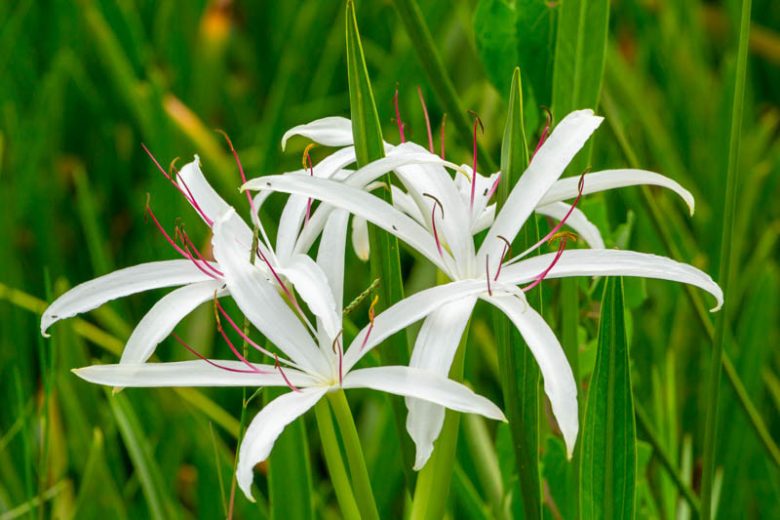

Colocasia esculenta
Colocasia: from Greek kolokasion (an edible root) · esculenta: edible
wild taro, dasheen, elephant ear · Exotic: Southeast Asia
HABIT: large emergent herb, 1–2 m, in dense colonies from corms and runners. Takes over shorelines.
FLOWERS: a yellowish spathe and spadix. Not often seen.
LEAVES: huge (up to 1 m), heart- or arrow-shaped, velvety, and shed water. Peltate: the stalk attaches inside the blade, not at the notch. Often a purple spot where it joins.
ROOTS: starchy corms and fibrous roots.
FOUND: lake and river margins, springs and ditches statewide.
LOOK-ALIKE: Xanthosoma (stalk attached at the notch, not peltate).
Family: arum family (Araceae)
EDIBILITY: corms and leaves are a staple food (taro, poi) only after thorough cooking. Raw, the calcium oxalate burns the mouth and throat.
LVI DATA: C of C 0 · OBL · Exotic


Alternanthera philoxeroides
Alternanthera: Latin for alternating anthers, as fertile stamens alternate with sterile ones · philoxeroides: resembling Philoxerus, a related genus
alligatorweed · Exotic: native to South America
HABIT: sprawling, matted stems that root at nodes and often float out over the water. Stems hollow.
FLOWERS: papery white balls of flowers (about 1 cm, clover-like) on stalks.
LEAVES: opposite, elliptic, smooth, 5–10 cm.
ROOTS: from nodes. The plant breaks apart and regrows from fragments.
FOUND: lake margins, canals, ditches and wet pastures.
LOOK-ALIKE: Ludwigia repens (alternate or opposite leaves, yellow flowers, stems not hollow).
Family: amaranth family (Amaranthaceae)
EDIBILITY: leaves are cooked as a vegetable in parts of Asia. Plants from the wild may be contaminated.
LVI DATA: C of C 0 · FLEPPC 2 · OBL · Exotic

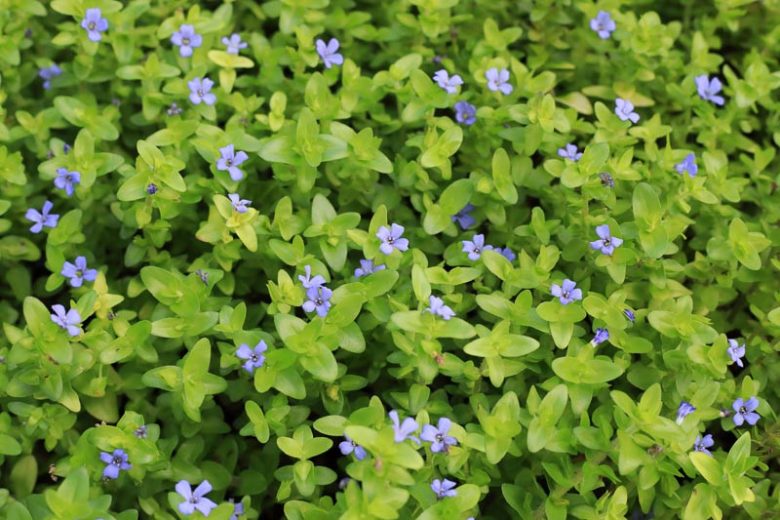
Bacopa caroliniana
Bacopa: from an Indigenous name in French Guiana · caroliniana: of the Carolinas
lemon bacopa, blue waterhyssop · Native
HABIT: creeping, succulent, mat-forming stems that root at nodes.
FLOWERS: Blue. Small (about 1 cm), 5-lobed, bell-shaped.
LEAVES: opposite, rounded, fleshy. clasps the stem, is hairy, and smells of lemon when crushed.
ROOTS: fibrous, from nodes.
FOUND: wet shores and shallow water.
Family: plantain family (Plantaginaceae)
EDIBILITY: B. caroliniana leaves are used as a lemony tea. Use only small amounts.
LVI DATA: C of C 4.5 | OBL | Native


Bacopa monnieri
Bacopa: from an Indigenous name in French Guiana · monnieri: honors L.G. Le Monnier, a French botanist
herb-of-grace, coastal waterhyssop · Native
HABIT: creeping, succulent, mat-forming stems that root at nodes.
FLOWERS: small (about 1 cm), 5-lobed, bell-shaped. white to pale pink.
LEAVES: opposite, rounded, fleshy. wedge-shaped and hairless.
ROOTS: fibrous, from nodes.
FOUND: wet shores and shallow water. also grows in brackish water, unlike B. caroliniana
Family: plantain family (Plantaginaceae)
EDIBILITY: (also called "brahmi") is used in Ayurvedic medicine. Use only small amounts.


Hydrolea corymbosa
Hydrolea: Greek hydro (water) + elaia (olive), "water olive"
false fiddleleaf, skyflower · Native
HABIT: an emergent herb, 30–90 cm, in shallow water and wet soil. Some species are spiny at the leaf axils.
FLOWERS: bright blue, 5-petaled, about 1.5 cm, in clusters.
LEAVES: alternate, lance-shaped and smooth. no spines.
ROOTS: fibrous.
FOUND: marshes, wet ditches and lake margins.
Family: fiddleleaf family (Hydroleaceae)
EDIBILITY: not edible.
LVI DATA: C of C 5.85 | OBL | Native


Hydrolea quadrivalvis
Hydrolea: Greek hydro (water) + elaia (olive), "water olive"
false fiddleleaf, skyflower · Native
HABIT: an emergent herb, 30–90 cm, in shallow water and wet soil. Some species are spiny at the leaf axils.
FLOWERS: bright blue, 5-petaled, about 1.5 cm, in clusters.
LEAVES: alternate, lance-shaped and smooth. Spiny.
ROOTS: fibrous.
FOUND: marshes, wet ditches and lake margins.
Family: fiddleleaf family (Hydroleaceae)
EDIBILITY: not edible.
LVI DATA: C of C 2 · OBL · Native


Hibiscus moscheutos
Hibiscus: from Greek hibiskos, the ancient name for marsh mallow · moscheutos: musky
crimsoneyed rosemallow · Native
HABIT: tall herbaceous perennials (1–2.5 m) that die back in winter.
FLOWERS: very large (10–20 cm), 5-petaled. H. moscheutos is white to pink with a red center. The stamens are fused into a central column.
LEAVES: alternate, ovate to 3-lobed, often softly hairy and gray-green underneath.
ROOTS: a woody crown.
FOUND: marshes, lake and river margins.
Family: mallow family (Malvaceae)
EDIBILITY: young leaves and flowers are edible, raw or cooked. They're mucilaginous, like okra, which is in the same family.
LVI DATA: C of C 4.75 | OBL | Native

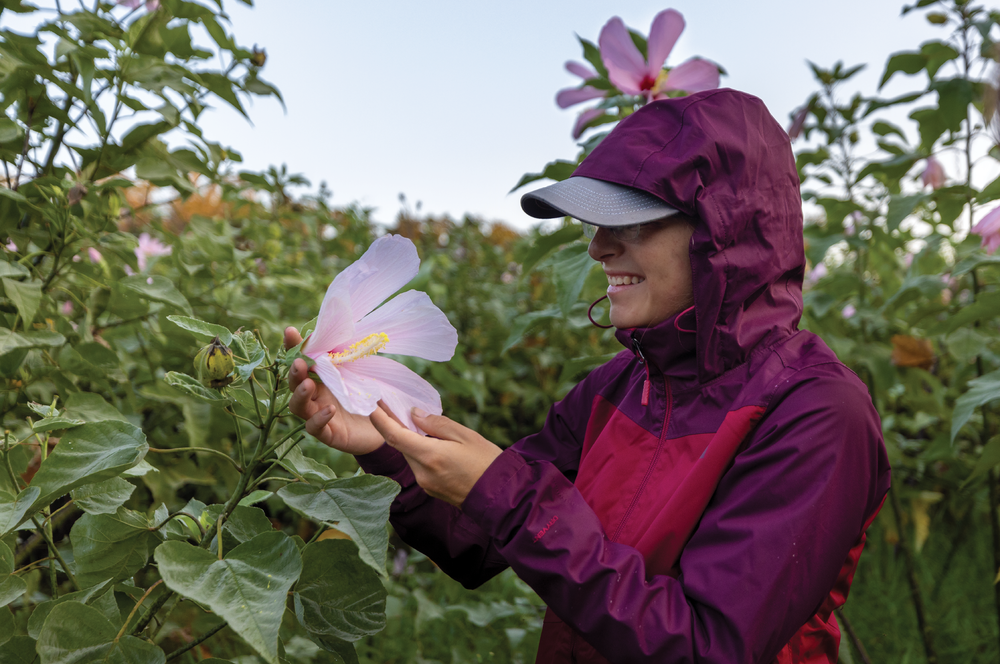
Hibiscus grandiflorus
Hibiscus: from Greek hibiskos, the ancient name for marsh mallow · moscheutos: musky
swamp rosemallow · Native
HABIT: tall herbaceous perennials (1–2.5 m) that die back in winter.
FLOWERS: very large (10–20 cm), 5-petaled. Pink. The stamens are fused into a central column.
LEAVES: alternate, ovate to 3-lobed, often softly hairy and gray-green underneath.
ROOTS: a woody crown.
FOUND: marshes, lake and river margins.
Family: mallow family (Malvaceae)
EDIBILITY: young leaves and flowers are edible, raw or cooked. They're mucilaginous, like okra, which is in the same family.
LVI DATA: C of C 6 | OBL | Native


Habenaria repens
Habenaria: Latin habena (strap or rein), for the strap-like petal lobes · repens: creeping
water spider orchid · Native: southeastern U.S. to South America
HABIT: an orchid, 15–60 cm, often growing on floating mats and logs.
FLOWERS: small, green, spidery flowers with thread-like petal lobes, in a dense spike.
LEAVES: alternate, lance-shaped, sheathing the stem.
ROOTS: fleshy roots with stolons.
FOUND: floating mats (tussocks), lake margins and marshes.
Family: orchid family (Orchidaceae)
EDIBILITY: not edible. Don't collect: wild orchids are protected.
LVI DATA: C of C 3.5 · FACW · Native


Panicum hemitomon
Panicum: Latin for millet · hemitomon: Greek "half-cut," for the short first glume
maidencane · Native: southeastern U.S.
HABIT: emergent grass, 0.5–1.5 m, in dense stands from long rhizomes. Often the dominant plant in Florida lake margins.
FLOWERS: a narrow, spike-like panicle (10–30 cm) with branches pressed close to the axis. Blooms mainly spring to early summer.
LEAVES: flat, 10–30 cm × 5–15 mm, smooth, bright green. Sheaths often hairy at the throat. Ligule a short fringe of hairs.
ROOTS: long, pointed, creeping rhizomes. Sterile shoots are common.
FOUND: lake margins, marshes and wet prairies, from wet sand to 1 m of water.
LOOK-ALIKE: Panicum repens (blue-green, stiffer and more upright leaves, open panicle, sharp rhizome tips). Check for hairs on the upper leaf surface and the sheath.
Family: grass family (Poaceae)
EDIBILITY: not a human food. Excellent wildlife and fish habitat.
LVI DATA: C of C 5.82 · OBL · Native


Panicum repens
Panicum: millet · repens: creeping
torpedograss · Exotic: native to Africa and Eurasia
HABIT: grass, 0.3–1 m, from extensive rhizomes with sharp, torpedo-like tips. Forms floating mats.
FLOWERS: an open, loose panicle (7–20 cm), branches spreading upward.
LEAVES: stiff, narrow, held at an angle. Often blue-green and folded or rolled. Sheath margins and throat hairy.
ROOTS: thick, sharp-pointed rhizomes that can pierce soil and even other roots.
FOUND: lake shores, canals, pastures and disturbed ground statewide.
Family: grass family (Poaceae)
EDIBILITY: not a human food. Used as forage.
LVI DATA: C of C 0 · FLEPPC 1 · FACW · Exotic


Coleataenia rigidula (formerly Panicum rigidulum)
Coleataenia: Greek koleos (sheath) + tainia (band) · rigidula: somewhat stiff
redtop panicum · Native
HABIT: a clumping grass, 0.5–1 m, in tufts with no long rhizomes.
FLOWERS: a crowded panicle with many small spikelets, often purplish.
LEAVES: flat to folded. Basal sheaths flattened and keeled.
ROOTS: fibrous, in clumps.
FOUND: lake margins, wet ditches and marshes.
Family: grass family (Poaceae)
EDIBILITY: not edible.
LVI DATA: C of C 5.47 · FACW · Native (listed as Panicum rigidulum)


Sacciolepis striata
Sacciolepis: Greek sakkos (bag) + lepis (scale), for the inflated glume · striata: striped
American cupscale · Native
HABIT: a grass, 0.5–1.5 m, often sprawling and rooting at nodes. Commonly floats out from the shore.
FLOWERS: a narrow, cylindrical, dense panicle. Spikelets have strongly ribbed glumes swollen at the base.
LEAVES: flat, broad (5–15 mm), with hairy sheaths. Bristly hairs at the leaf base.
ROOTS: from the lower nodes.
FOUND: lake margins, ditches and marshes.
Family: grass family (Poaceae)
EDIBILITY: not edible.
LVI DATA: C of C 5.35 · OBL · Native
