Chem 1012 Midterm
 Call Kai
 Learn
Learn Practice Test
 Spaced Repetition
 Match
Match Flashcards
 Knowt Play
1/95

There's no tags or description
Looks like no tags are added yet.
Name | Mastery | Learn | Test | Matching | Spaced | Call with Kai | Chat |
|---|
No analytics yet
Send a link to your students to track their progress
96 Terms
Compositions of Matter
Pure Substances: Have constant, fixed composition and uniform properties.
Elements: Made up of only one atom type (oxygen, gold). CANNOT be broken down into simpler substances.
Compounds: Made up of two or more elements chemically bonded in a fixed ratio (H2O, CO2)
Molecular Compounds, made of molecules
Ionic Compounds, made of ions (NaCl)
Mixtures: Physical combinations of two or more substances. Can be separated by physical means
Homogeneous: Uniform composition (saltwater, air)
Heterogeneous: Non-uniform composition with visibly distinct parts
Molecule
A group of two or more atoms chemically bonded. The smallest unit of a pure substance that keeps the chemical properties of that substance.
Allotrope
Same element, different form (carbon allotropes: diamond, graphene)
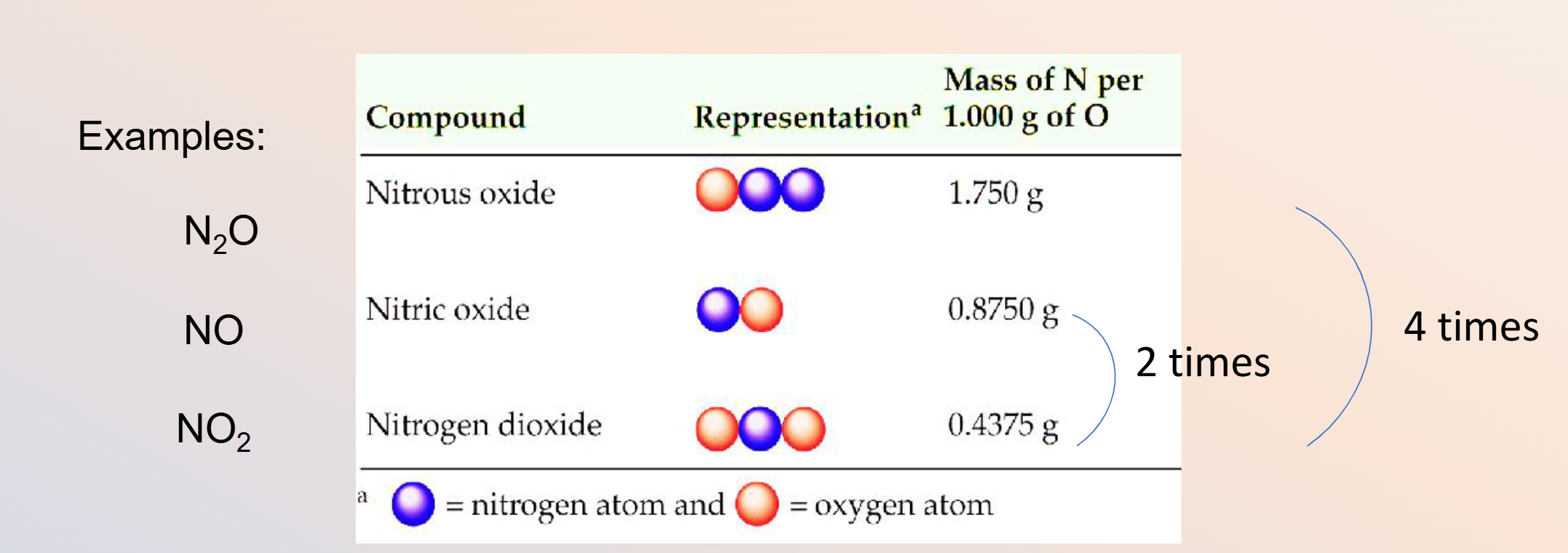
Law of Definite Proportions
A given compound always contains the same proportion of elements by mass.
Law of Multiple Proportions
When two elements combine to form more than one compound, the masses of one element that combine with a fixed mass of the other element are in a ratio of small whole numbers

Nuclear Notation
A = Mass number, Z = atomic number
Atomic Models
Democritus (460-370 B.C.)
Aristotle (384 B.C.)
John Dalton (1808)
J.J. Thompson (1904)
Rutherford (1911)
Democritus Model
(460-370 B.C.)
All matter is composed of indivisible particles called atoms.
Substances are a mixture of atoms with distinct shapes and sizes.
Aristotle Model
(384 B.C.)
All matter is continuous, atoms do not exist.
All matter is composed of the 4 elements: earth, air, fire, and water
John Dalton
(1808)
Atoms are indivisible and indestructible
Elements are made up of same atom type (all atoms in an element are identical)
Compounds are composed of atoms in specific ratios
Chemical reactions are the rearrangement of atoms
J.J. Thompson
(1904)
Plum Pudding: Fully positive sphere with electrons spread within
Postulated existence to interpret findings from cathode-ray tubes
Rutherford
(1911)
Nuclear Model, gold foil experiment
Most passed through, small number were deflected, some bounced straight back
Most of atom’s mass is in nucleus
Radius of atom is ~10^5x larger than nucleus
Light
Electromagnetic radiation, can be viewed as a stream of photons. E = hf
Light Wavelengths

Continuous Spectra
When white light or sunlight is passed through a prism, it produces continuous (all possible wavelengths and frequencies) spectrum of colors
Absorption Spectra
White light passes through a gas which absorbs specific wavelengths, making them become black
Emission Spectra
Opposite of absorption spectra
Proof of quantized electronic states
Absorption/emission spectra are discontinuous
Bohr Model
Electrons in circular orbit (shell)
n is the shell number: principal quantum number
Integer
Orbital radius is quantized: rn=cn2Z
Orbital velocity is quantized
Energy of electron in orbit: En=-Rz2n2
Lower energy is more stable
Energy difference between energy levels converges
Limitations of Bohr Model
Only works for Hydrogen (single-electron atom)
Could not explain binding of atoms into molecules
Why don’t electrons fall into the nucleus (-,+)
Could not account for the intensities of fine structure of spectral lines
Quantum Model
Erwin Schrödinger (1926) formulated an equation based on Standing
Waves that describes the wave nature behavior and energies of atoms.
– Standing waves are stationary waves that do not travel along any length
– Only certain orbits have a circumference into which whole number wavelengths of
standing electron waves will fit
– Other waves produce destructive interference of the standing electron wave
– we can only know where electrons are by chance (possibility), which is square of ψ
de Broglie Hypothesis
All matter can be behave like waves: lambda = h/p
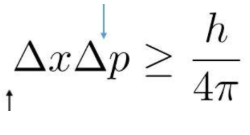
Heisenberg Uncertainty Principle
It is impossible to know the exact position and velocity of an electron at the same time due to the equation:
Wave Function
Plot of wave function gives shape of atomic orbital, a region in space where there is a high probability of finding an electron, when squared gives the probability of finding an electron in space.
The solutions to the Schrodinger equation bring forth AOs (including their shapes) and their quantized energies
Wave Function Squared
Gives probability of finding an electron in a place in space.
AO Possible Energy States
Same as bohr model

Principal Quantum Number (n)
Integer value determining energy and size of orbital, and defining its shell (electrons and orbitals with same n are in the same shell). Number before s, p, d, f, etc…
Angular Momentum Quantum Number (l)
Defines shape of orbital
Defines subshells (sets of orbitals with same l are within the same subshell (e.g. 2px , 2py , 2pz)
Labels for different l values: 0 = s, 1 = p, 2 = d, 3 = f, 4 = g
If n = 3, there are 3 subshells (l = 0, 1, 2 = s, p, d)
For n shells, there are max n-1 values of l
Magnetic Quantum Number (ml)
Describe orbitals orientation in space
Allowed values for a given l: -l, -l+1, -l+2, …0, …,l-2,l-1,+l
Number of possible orientations of orbitals for a given l is 2l + 1
Ex. l = 1 has 3 orientations, px , py , pz
Spin Quantum Number (ms)
Electrons have intrinsic spin
Possible values are ½, -½
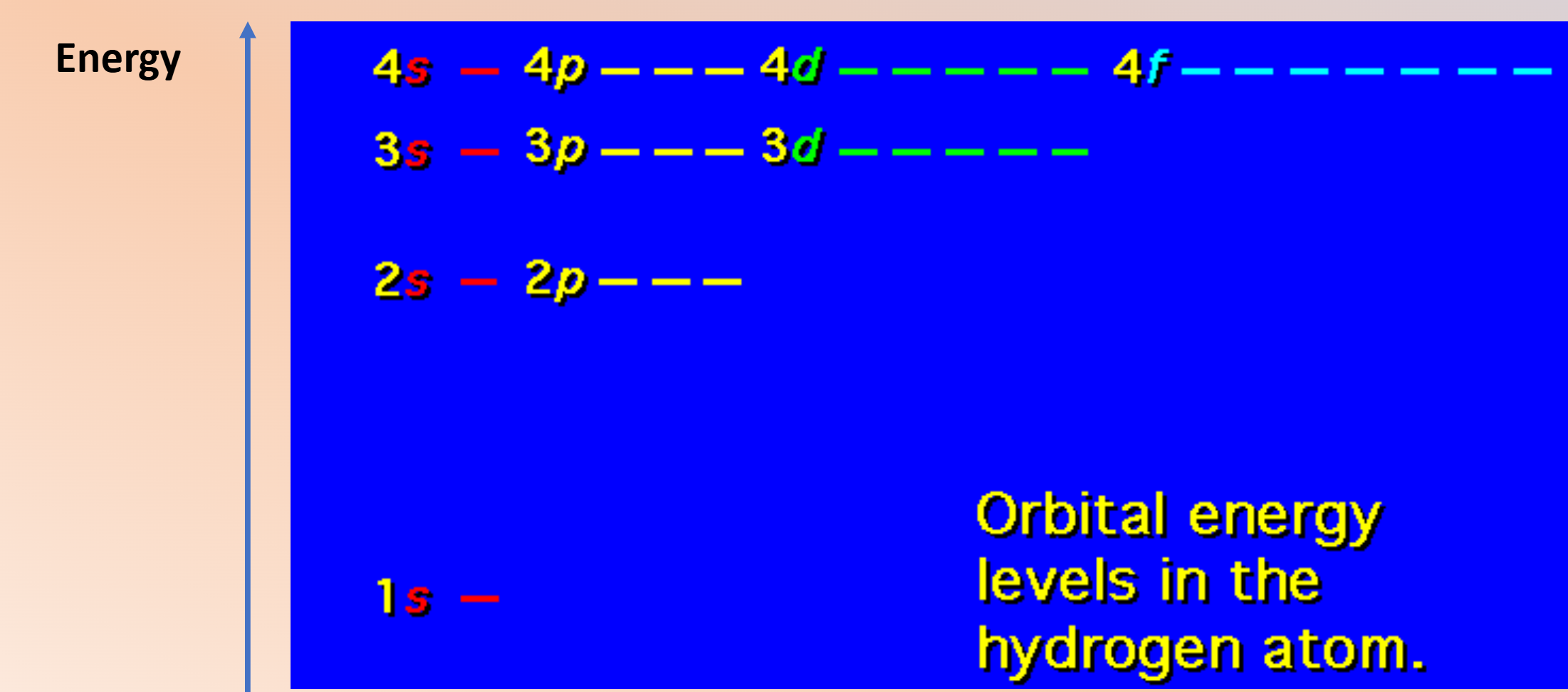
Orbital Energy Levels in H atom
Shell
Group of orbitals with same n
Subshell
Group of orbitals with same n and l
1s orbital
Further from center, lower probability of finding electrons

Radial Probability Distribution Function
Indicates the total electron density of a spherical shell of radius r, or region we most likely find electron (e-). Since probability decreases with increasing r, but total space that electrons could be increases.

Node
Region of zero electron density
Angular Node
Plane node
Radial Node
Node of radius about center
Number of angular nodes
Equals l
d orbitals
ns orbital
Shape depends on n (including nodes)
Nodes across ns orbitals

Signs of s orbitals
Positive = electron is in phase, negative = electron is out of phase.
Alternates, innermost = positive, the negative, then positive

Nodes on 3p orbital
Angular node and radial node

Comparing 2p and 3p
Sizes:
3p is larger than 2p
3p is more diffused the 2p
Nodes:
Both have one angular node
2p has zero, but 3p has one radial node
Signs of 2p and 3p orbitals
2p: Opposite lobes have opposite signs.
3p: Same and alternating lobes have opposite signs.
Total Nodes
n-1
Number of radial nodes
n-l-1
Number of angular nodes
l
Number of orbitals in a shell n
n²
Factors that must be known to solve Schrodinger’s equation
KE of electrons
Potential energy due to attraction between nucleus and electrons
Potential energy due to repulsion between electrons
Electron pathways are unknown, meaning e-e repulsion in unknown
Assumptions with Polyelectronic atoms
Electrons occupy hydrogenic orbitals
Energy and size of orbitals are different from those of hydrogen
Degenerate Orbitals
Orbitals with the same n have the same energy. Only for single-electron atoms.
Shielding Effect
Outer electrons feel repulsion from inner electrons resulting in a lower force of attraction from nucleus.
Electrons in the same shell can have shielding effect on other ones (due to penetration effect)
Effective Nuclear Charge
Real charge felt by electron (after shielding effect)
Energy of AOs in polyelectronic atoms

Penetration effect
Ability of an outer electron to get close to the nucleus (possible due to wave nature).
E.x. Based on its radial probability distribution (2s has a higher probability to be closer to the nucleus than 2p)
Order of shielding effect to others (strength)
s > p > d > f
for any shell
Aufbau Principle
Orbitals with lower energy are filled first
Pauli’s Exclusion Principle
Each orbital can have a maximum of two electrons, with opposite spin
Hund’s Rule
For degenerate orbitals, electrons are filled first with one in each, with parallel spins.
Electron configuration exception (9→10, 4→5)
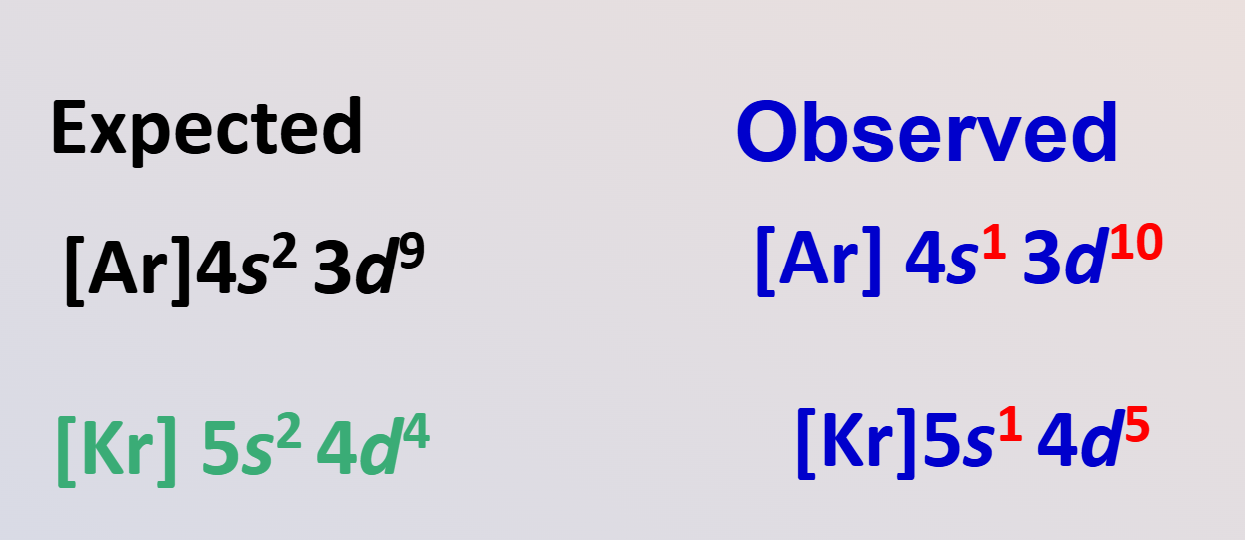
Valence Electrons
Those that define chemical properties of an element.
Commonly used radii
Covalent radius: Half the intermolecular separation of neighboring atoms in the same element in a molecule
Metallic radius: Half the empirically determined distance between the nuclei of two neighboring atoms
Ionic: Related to distance between neighboring cation/anion
Ionization Energy
Energy required to remove an electron from a gaseous atom or ion
For Mg (2 valence electrons):
I2>I1 by ~ a factor of 2
I3>I2 by ~ a factor of 5
Ionization energy increases greatly after valence electrons are all ionized
Electronegativity
Measure of an atom’s ability to attract electrons to itself.
Unable to be directly measured; calculated through other atomic/molecular properties
Most commonly used is Pauling scale
Ionic Bond
Electrostatic attraction between cation and anion.
F=kQq/r
Lattice energy: energy required to break one mole of a solid ionic compound into its gaseous ions
Ion formation from transition metals
May not follow octet rule
Lewis Structure
Draw only valence electrons
Period 2 elements usually follow octet rule (no d-orbital)
Exceptions to octet rule
Atoms with d-orbitals can have more than 8 electrons (or if >= period 3)
Hypervalent molecules: species with more than 8 electrons around at least one atom
B and Be can have less than 8 electrons
Electron deficient molecules
Species with an odd number of electrons
Covalent Bonding Early Theories
Lewis Bonding Theory (Gilbert Lewis – 1916)
Valence Bond Theory (Pauling -1927)
Hybrid Orbital Theory (Pauling -1931)
VSEPR - Valence Shell Electron Pair Repulsion (1940)
Formal Charge
Charge assigned to an atom in a molecule (assumes that electrons in covalent bond are shared equally between atoms). Not a real charge, but a “formal” charge in molecule
FC = # of valence electrons – 2 (# of lone pairs) – # of bonds
Resonance
Some species have multiple lewis structures with same atomic positions but different electron positions (e.g. a double bond might be on the left side instead of right). Actual structure is taken as a blend of all Lewis structures.
Most favorable resonance structure has:
Smallest formal charge (in magnitude)
No formal charges with the same sign on adjacent atoms
Negative F.C. on most electronegative atoms
Bond Length
Distance between nuclei of bonded atoms
Bond Strength
Measured by bond (dissociation) energy, energy required to break one mole of a bond of a molecule in its gaseous state.
Bond Polarity
Covalent bonding between different atoms results in unequal electron sharing
Result is polar covalent bond
Side with greater electron density gets partial charge -
Electron deficient side gets partial charge +
Dipole moment: =Qr (charge * distance)
Arrow points to side with greater electron density
Greater electronegativity difference = greater bond polarity
Polar Covalent Bond
Has a bond dipole (relationship between partial charges across atoms)
Electronegativity difference means unequal sharing
Greater difference = more polar bond
End with greater electron density gets partial negative charge (vice versa for positive side)
Net vector direction of bond dipoles creates a dipole moment: mu=Qr
EN and Bond type

Polar Molecules
Have a net dipole moment across all bonds.
Will align in an electric field.
Molecules with polar bonds can be nonpolar if net bond dipole = 0 (symmetrical)
Will be polar if:
Bond(s) are polar AND Molecule is not symmetric (bond dipoles do not cancel)
VSEPR Theory
The most stable arrangement of groups attached to a central atom has the maximum separation of “effective electron pairs” to minimize electron pair repulsion.
Effective electron pairs: include bonding and non-bonding (lone) pairs
A multiple bond counts as one electron pair
Ideal Geometry (# of e- pairs, ideal shape, angle)


Deviations from ideal geometry (with lone pairs)
Lone pairs have a greater spatial requirement than bonding pairs, meaning they have greater repulsion than bonding pairs. (if a central atom has two lone pairs, draw them as far from each other as possible about the atom)
Increasing lone pairs decreases bond angle between atoms.
Deviations from ideal geometry (with bonds)
Multiple bonds require more space than single bonds. Space requirement:
Triple bond > Double > Single
Influence of electronegativity on geometry

Molecular Geometry

Quick calculation for # of electron pairs

Limitations of VSEPR
Fails to predict shape of isoelectronic species containing heavy elements
Often fails to predict shapes of d-block transition metal compounts
Valence Bond Theory
Theory describing covalent bonding as the overlap of atomic orbitals.
The bond is formed by an overlap of atomic orbitals so that two orbitals can be occupied by a pair of electrons with opposite spins.
Only atomic orbitals that match with each other (in phase) can overlap to form a bond. The better the overlap, the stronger the bond.
Energy of a system can be significantly lowered by bonding involving a pair of electrons with opposite spins
Will bond vs won’t (AOs)
Will: Head-head, shoulder-shoulder
Won’t: Head-shoulder
Sigma Bond
Head-to-head overlap of orbitals, symmetric about internuclear axis, stronger
Pi Bond
Side-to-side overlap of orbitals, has one nodal plane through internuclear axis (due to angular node), usually weaker

Which bonding type in a bond
Single bonds are usually sigma bonds.
In multiple bonds, one is a sigma bond, the rest is/are pi bonds.

How many bonds can an atom form?
Pairing up electrons lowers energy, so atoms with unpaired electrons tend to form chemical bonds to pair up electrons.
# of bonds = # of unpaired e- (or orbitals with unpaired electrons)
How to explain molecular geometry?
Orbitals’ directional characteristics primarily determines molecule’s geometry (not in reality, so another theory is required)

Problem with using only pure atomic orbitals in bonding theory
Shape of molecule is incorrect
Number of valence orbitals containing unpaired e- (C has two unpaired electrons, how can it form 4 bonds)
Hybridization
Atomic orbitals mix to create “hybridized” orbitals. Practically takes “average” of them, and their energy. Hybridized orbitals are equal and have a different geometry to original orbitals.