Ther-Ex Exam II
 Call Kai
 Learn
 Practice Test
 Spaced Repetition
 Match
 Flashcards
 Knowt Play
1/175

There's no tags or description
Looks like no tags are added yet.
176 Terms
Shoulder conditions most popular (in order)
Rotator cuff pathology (tendinopathy, tears, rotator cuff shoulder pain)
Glenohumeral and acromioclavicular osteoarthritis
Frozen shoulder
Long head of bicep
Labral tears (SLAP)
Instability
Four joints of shoulder
Glenohumeral
Acromioclavicular
Sternoclavicular (only connection from shoulder to body)
Scapulothoracic *not a true joint
Mobility is bought with stability! (ball on a golf tee)
Static stabilizers for shoulder
Glenoid labrum: deepens socket by about half
like fish lips→ suctions on to humerus→ negative pressure inside the joint
Capsule and glenohumeral ligaments
Superior ligament and coracohumeral ligament
stretched when arm at side
Middle ligament
stretched with anterior translation in mid range abduction
Inferior ligament
stretched with anterior and inferior translation at 90 degrees abduction and external rotation
Subacromial space of shoulder
Roof: acromion, coracoacromial ligament, coracoid
Floor: humeral head
Contents: supraspinatus tendon, subacromial bursa, long head of biceps
Narrows with elevation
Continued compression associated with pain
Could lead to subacromial decompression
Dynamic stabilizers of shoulder
Rotator cuff: compresses the humeral head into the glenoid
*lose the rotator cuff→ head rides up under acromion
Deltoid: lifts and the cuff holds the head centered
Long head of bicep: helps anterior stability
Scapular muscles: position the socket under the head
Glenohumeral arthrokinematics
convex head on concave glenoid: roll slide go opposite
Abduction: superior roll, inferior slide
Flexion: mostly spin
External rotation: posterior roll anterior slide
Scapulothoracic motion
Scapula moves because clavicle moves at SC and AC joints
SC joint is VERY STRONG
Elevation and depression
Protraction and retraction
Upward and downward rotation
Upward rotator of scapula
serratus anterior, upper and lower trapezius
Downward rotators of scapula
rhomboids, levator scapulae, pectorialis minor
Normal ROM for shoulder
Flexion: 160-180
Extension: 50-60
Abduction: 170-180
Adduction: 50-70
External rotation: 70-90
Internal rotation: 60-90
*compare to other side
Throwers internal and external rotation shoulder
Throwers often have more external, less internal on throwing arm
Scapulohumeral rhythm
180 degrees of elevation (120 GH and 60 scapulothoracic)
2:1 ratio after first 30 degrees (first 30 all GH)
Clavicle rotates posteriorly as arm rises
Age shoulder interview
Age:
Under 30: instability
40-60: frozen shoulder and cuff
60+: osteoarthritis and degenerative tears
Onset shoulder interview
Onset:
Trauma: dislocation, acute tear, fracture
Gradual: tendinopathy, osteoarthritis, frozen shoulder
Location shoulder interview
Location:
Lateral delt: cuff or cervical
Anterior: bicep, AC joint
Deep: labrum, osteoarthritis
Between shoulder blades: cervicothoracic
Night pain, overhead sports shoulder interview
Night pain: common with frozen shoulder and osteoarthritis
Constant change that does not change with position=red flag
Overhead work or sport: cuff, labrum, biceps
Red flags shoulder interview
deformity, unable to lift arm after a fall→ fracture
numbness, tingling or weakness in hand after trauma→ axillary nerve
left shoulder or arm pain with exertion, SOB→ cardiac
Right shoulder or scapular pain after meals→ gallbladder
Constant progressive pain that position does not change→ tumor, cancer
fever, hot swollen joint→ infection
Dosing a high irritability painful shoulder
Pain 7/10
Night pain wakes them
Goal: calm symptoms, keep motion
Mobility: pain free PROM and AAROM
Manual therapy: grade 1 and 2 glides, distraction
Dosing: isometrics, 3-4 RIR
Dosing a moderate irritability painful shoulder
Pain 4-6, some night pain
Goal: restore motion, begin loading
Mobility: AROM, stretching to tolerance
Manual therapy: grade 3 slides
Dosing: light resistance
Dosing a low irritability painful shoulder
Pain 0-3, only with overpressure or after activity, no night pain
Goal: build capacity, return to task
Mobility: full range under load
Manual therapy as needed
Dosing: heavy slow resistance, power, task practice
Rotator cuff related shoulder pain
Umbrella term: tendinopathy, partial tears, bursitis, used to be called impingement
Pain and weakness with ELEVATION and EX ROTATION, usually with no single injury
Not one structure: muscle, tendon, bursa
Pain does NOT equal structural damage
Influenced by sleep, stress, work, beliefs about the shoulder
How common is shoulder pain?
3rd most common MSK complaint
70% of this is rotator cuff related
Most cases start 40-60
Rotator cuff tendinopathy
Load exceeds tissue capacity
Intrinsic: age, reduced blood supply near insertion, tendon degeneration
Extrinsic: repeated compression under coracoacromial arch, overhead work
Risk factors: age over 40, overhead occupation or sport, smoking
Supraspinatus #1, Infraspinatus #2
Shoulder tendiopathy
pain in overhead positions, lying on shoulder
weakness from pain
diffuse pain over anterolateral shoulder and deltoid
better once warmed up
range mostly full, painful arc 60-120 degrees
Rotator cuff tears acute
Younger patient, often a FALL
Sudden, pop, immediate weakness
Cannot lift arm after fall
Early surgical opinion
Rotator cuff degenerative tears
40 and older, no single event
Gradual pain, night pain
Manage with exercise first, surgery if it fails
Shoulder application rotator cuff
Tissue healing: tendinopathy is a load problem
Mobility: keep full range
Motor control: practice the task, external focus, vary load and angle
Dosing: isometrics 20-45s for pain, heavy slow resistance
Deltoid
P: lateral 1/3 of clavicle, acromion, scapular spine
D: deltoid tuberosity of humerus
Action: anterior deltoid abducts and flexes GH joint, middle deltoid abducts GH, posterior deltoid adduction and extension of shoulder, IR, post deltoid ER
Biceps brachii
P: LHB-supraglenoid tubercle, SHB-coracoid process of scapula
D: radial tuberosity
Action: long head flex GH joint
Latissimus Dorsi
P: spinous process of T7-T12, inferior angle of scapula, 9-12 ribs, iliac crest
D :floor of intertubercular sulcus
Action: ST joint depressor, should adduction and extension, IR
Rotator cuff muscles
SITS. Supraspinatus, infraspinatus, teres minor, subscapularis. Help create roll slide in abduction.
Trapezius
P: occipital bone, spinous process C1-C7, aponeurosis T1-T4, spinous process T5-T12
D :lateral 1/3 of clavicle, acromion, scapular spine
Action: upper trapezius elevates ST joint. lower trap depresses ST joint. Middle and lower trapezius retracts ST joint, upper and middle trap upward rotate ST joint
GH joint elevators
muscles for abduction (anterior deltoid, middle deltoid, supraspinatus) and muscles for flexion (anterior deltoid, coracobrachialis, long head of bicep)
Shoulder adductors and extensors
pectoralis major, latissimus dorsi, teres major, posterior deltoid, long head of tricep
Shoulder internal rotators
subscapularis, anterior deltoid, pectoralis major, latissimus dorsi, teres major
Shoulder external rotators
infraspinatus, teres minor, posterior deltoid
Pain that is not from the shoulder
Neck refers pain into the shoulder and between the shoulder blades
C5 and C6→ refer to deltoid and lateral arm, same place cuff pain lives
Lower cervical level→ interscapular region
Neck and shoulder are married
Neck movement, sustained neck position changes the shoulder pain
Symptoms travel below elbow and into hand
Pain with coughing or sneezing
Glenohumeral and AC joint osteoarthritis
Loss of cartilage, changes in bone and capsule
No clear cause
secondary to trauma
instability
massive cuff tear
avascular necrosis
Risk factors shoulder OA
shoulder injury, history or shoulder problems
repetitive occupational stress, especially overhead
age over 50
women more than men
metabolic disorders, obesity
90% of people with OA have at least 1 risk factor
Patient reports shoulder OA
worse in the morning, loosens with movement
night pain (wakes them)
deep pain in joint
worse after exercise
crepitus, catching
loss of IR and ER
TSA vs rTSA
Total shoulder replacement vs reversed total shoulder replacement
TSA: replace the ball (top of humerus)
rTSA: switch the ball and socket
if rotator cuff muscles are very degraded, they can’t assist roll slide correctly
rTSA allows for deltoid to just take over and lift arm (roll slide happen same direction)

OA shoulder patient application
Tissue healing: chronic condition, inflammatory flares
Mobility: PROM and AAROM, respect the hard end feel
Manual therapy: Grade 1 and 2 for pain, grade 3 for motion
Motor control: task specific reaching and lifting in the available range
Dosing: strengthening 2-3 days per week
Frozen shoulder (adhesive capsulitis)
Inflammation of capsule (synovitis), then thickening and tightening (fibrosis)
Coracohumeral ligament and rotator interval contract
Gradual stiffness and pain over 1-3 months
night pain
ER lost first and most, then abduction and elevation
Passive and active motion are EQUALLY limited: this is the giveaway
Who gets frozen shoulder
40-60
women more than men
idiopathic (we don’t why people get it)
about 1 in 5 later get it later in the other shoulder
Stages of frozen shoulder
Freezing (painful): 2-9 months. Pain, at night, motion falling *not much can be done
forcing motion does NOT help
corticosteroid injection best short term evidence
Frozen (stiff): 4-12 months. stiffness, pain settling
Thawing: 5-24 months. Motion slowly returns
Whole course: 9 months- 4 years
Long head of biceps pathology
tendon runs inside the joint, over humeral head, anchors on superior labrum
Could be tendinopathy, subluxation out of the groove, rupture
Rarely alone (often with cuff)
Anterior shoulder pain, pain with overhead reaching
Rupture: a sudden pop, bruising, a bulge in the upper arm
Older adults with a rupture usually do well without surgery
Labral Tears
SLAP: Superior Labrum Anterior to Posterior, at the biceps anchor
Overhead throwing (anchor peels back in late cocking), a fall on an outstretched hand (FOOSH)
deep, vague pain, clicking or catching, dead arm in throwers
Common in overhead athletes
superior labral changes appear on MRI in most pain free adults over 40
non-operative first
Two kinds of instability
TUBS vs AMBRI
TUBS
Traumatic
Unilateral
Bankart lesion (usually with Hill-Sachs)
First Treatment: Reduction, protection, then rehab.
If it fails: bankart repair, bone procedures with bone loss
Bankart lesion
the anteroinferior labrum and ligament tear away from glenoid
present in 9/10 first time dislocations
Hill Sachs lesion
a compression fracture of the posterolateral humeral head where is struck the glenoid rim
Bony Bankart
the glenoid rim breaks, more bone loss means more recurrence
AMBRI
Atraumatic
Multidirectional
Loose capsule, generalized laxity, often Bilateral
First treatment: Rehabilitation
If it fails: Inferior capsule
Traumatic anterior dislocation
About 95% of dislocations are anterior
Arm abducted and externally rotated (fall, tackle, throw)
Severe pain, arm held at side
Recurrence depends on age
about 3 in 4 under 20 dislocate again
younger, male
about half between 20 and 40
Multidirectional instability
Symptomatic instability in two or more directions without a major injury
loose capsule and generalized joint laxity, often both shoulders
easy dislocation
younger, more often female (swimmers, gymnasts, overhead athletes)
aching, apprehension overhead, subluxations
Rehab first: scapular and cuff control programs
3 joints in elbow
Humeroulnar joint: flexion and extension
Humeroradial joint
Proximal radioulnar joint: pronation and supination
ONE capsule surrounds all three
coronoid process blocks posterior translation of the ulna
olecranon locks into its fossa in full extension
Elbow ligaments
Medial (ulnar) collateral ligament
anterior band: restraint to valgus stress
posterior band: taut in flesion
Lateral collateral ligament complex: restraint to varus stress
Annular ligament: holds the radial head against the ulna, allows the radius to spin
Nerves through elbow
Median
through cubital fossa
between two heads of pronator teres
Ulnar
behind the medical epicondyle in cubital tunnel
Radial
splits at elbow into superficial sensory branch and deep motor branch
deep branch passes through the radial tunnel and supinator
Muscles that flex the wrist
Flexor tendon: medial epicondyle
flexor capri radiallis, flexor carpi ulnaris, flexor digitorum superficialis, palmaris longus, pronator teres
Extensor tendon: lateral epicondyle
extensor carpi radialis brevis, extensor digitorum, extensor digit minimi, extensor carpi ulnaris
Arthrokinematics of elbow
Flexion and extension: concave on convex, roll and slide in same direction
Forearm rotation: radius rotates around a fixed ulna
radial head spins inside the annular ligament
ROMs of elbow
Flexion: 145-150
Extension: 0 to 5 of hyperextension
Pronation: 80
Supination: 90
Carrying angle: relaxed arm resting angle
10-15 degrees in men
15-20 in women
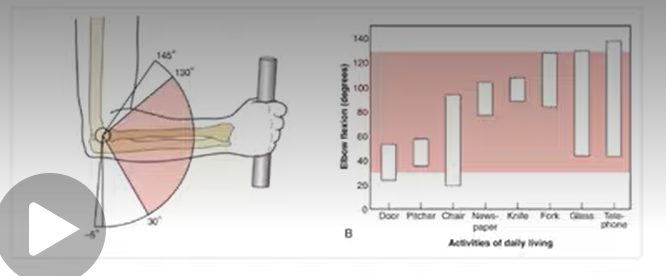
Most daily tasks ROM requirements
30-130 degrees of flexion
about 50 degrees of pronation and supination
Red flags for the elbow
FOOSH→ could be fracture or dislocation
Deformity, bony tenderness, swelling after fall
Numbness, weakness, cold hand→ nerve
pop with bruising at front of elbow→ distal biceps rupture
hot, red, swollen elbow→ infection
constant pain that position does not change, night pain→ tumor
neck pain, arm symptoms that change with neck movement→ neck
Lateral elbow tendinopathy
tennis elbow, lateral epicondylitis
common extensor tendon, most often extensor carpi radialis brevis
load exceeds tissue capacity
degenerative more than inflammatory
repetitive gripping and wrist extension
work, tools, racquet sports
Who gets Lateral elbow tendinopathy?
1-4% of adults
peak age 40-60
Over half still report symptoms at one year
Risk factors: smoker, more than 2 hrs per day of repetitive wrist and elbow motion, manual labor, tennis
Interventions lateral elbow tendinopathy
thoracic rotation- may help indirectly
external rotation (extensor isometric)
mobilize w/ movement
counterforce brace (pins muscle down, new proximal attachment)
corticosteroid injection: no better unless extreme symptoms
Load lateral elbow tendinopathy
Main muscle: extensor carpi radialis brevis
isometric wrist extension, as gets less irritable slow, heavy wrist extension and supination
eccentric emphasis
plan for 12 weeks
change grip diameter on tools and racquets
Medial elbow tendinopathy
golfers elbow, medial epicondylitis
common flexor and pronator tendon
repetitive gripping, wrist flexion, pronation
golfers, throwers, manual laborers
interventions and load for medial elbow tendinopathy
same as lateral!
Ulnar nerve entrapment (elbow)
Entrapment sites: medial intermuscular septum, cubital tunnel, guyon’s canal at the wrist
Typical Cause: sustained elbow flexion, leaning on the elbow
Median nerve entrapment (elbow)
Entrapment sites: pronator teres, flexor digitorum superficialis arch, carpal tunnel at wrist
Cause: repetitive forceful pronation and gripping
Radial nerve entrapment (elbow)
Entrapment sites: spiral groove, arcade of froshe, supinator
Cause: saturday night palsy, arm draped over back of chair
Nerve entrapment interventions
Ulnar:
educate about elbow position at rest
Exercise: ulnar nerve glide progressions, supine shoulder abduction on foam roller, scalene stretch
Median:
educate about reducing repetitive pronation and gripping
exercise: stretch into supination and extension
Radial:
educate that a one time compression will improve on its own
exercise: radial nerve glides, pronation and supination
Olecranon Bursitis
swelling of bursa at the tip of the elbow
Cause: repetitive pressure, trauma, gout, infection
jobs with prolonged pressure
infection (1/3 of cases, refer)
should resolve in 3-8 wks
Osteoarthritis (elbow)
Uncommon.
almost all men, mean age 50
after trauma, years of heavy manual work, lifting
Osteoarthritis (elbow) interventions
joint mobilization
load management
strengthen surrounding muscle to absorb force
NSAIDs
OA vs RA
OA=degenerative
usually one elbow
activity usually eases symptoms
RA= inflammatory and systemic
usually both elbows
flares can be random or triggered by activity
be gentle during flares, increase strength between flares
*the elbow is common place for RA
Valgus load in throwing
late cocking and acceleration→ high valgus stress
leads to tension in UCL, flexor and pronator muscles, medical epicondyle
lateral side→ compression of radial head
Skeletally immature: the growth plate and bone fail
Skeletally mature: ligament fails
Little league elbow
young overhead throwers
medial side: medial epicondyle apophysitis or avulsion fracture (ligament rips bone out of socket)
lateral side: compression injury to capitulum
panner disease
osteochondritis dissecans
also with upper extremity weight bearing (gymnastics)
Amount of pitching is strongest risk factor (not pitch type)
Little league elbow interventions
significant reduction in overhead throwing for 4-6 wks
improve throwing mechanics
thoracic mobility
shoulder mobility
task specific proximal stability
Return to throwing in graded steps
load management- pitch counts and rest days
lateral involvement- refer to orthopedics
UCL tear
skeletally overhead throwers, high school and up
Acute on chronic: repeated valgus overload
25% of major league pitchers
Partial tear: trial of rehabilitation first
UCL sprain interventions
Grade 2 sprain
Acute: 0-3 wks. protect, no stretching. maintain available range, isometrics
Subacute: 2-6 wks. full acute range without valgus load. progressive strengthening
RTP: 6-12 wks. full range with increasing load. sport specific practice
Elbow dislocation
highest in adolescent males, nearly half in sport
fall on outstretched hand in older adults
POSTERIER is most common
MCL usually injured, image for fracture, especially of coronoid process
elbow dislocation interventions
brief immobilization near 90 degrees
early motion: more range at 6 weeks, return to work
wrist and forearm strengthening
Heterotopic ossification: bone forms in soft tissue around the capsule. WATCH FOR THIS
RTS: 6-12 wks
Nursemaids elbow
children age 1-4, most often 2
radial head subluxation: the annular ligament slips over radial head
Caused by a pull on the arm, fall, twist
outside rehab scope of practice (reduction)
Distal biceps rupture
sudden eccentric load on the flexed elbow
risk factors: smoking, high BMI
far less common than rupture of the proximal long head
Distal bicep interventions
surgical repair needs to happen within first 6 weeks (tendon will go too far up in arm over time, won’t be able to stretch back out)
After repair: healing takes 3-4 months
Wrist joints
Radiocarpal joint, midcarpal joint, distal carpometacarpal joints
Proximal carpal row
Scaphoid, lunate, triquetrum, pisiform
relatively loose
Distal carpal row
trapezium, trapezoid, capitate, hamate
relatively tight and rigid
Degrees of freedom in wrist
Two degrees of freedom
Because of ulnar tilt: you get more ulnar than radial deviation (run in to bone on radial side)
Because of palmar tilt: you get more flexion than extension
Circumduction combines all of them (hand in circle)
ROM of each direction in wrist
Flexion: 80
Extension: 70
Radial deviation: 20
Ulnar deviation: 40
Roll slide in wrist
Convex carpals on concave radius
roll slide happen opposite directions
Grip and the wrist
Finger flexors also flex wrist
wrist extensors must counterbalance them
Max grip: about 30 degrees of wrist extension, 5 degrees ulnar deviation
optimal length tension
flexed wrist=weakens grip
Hand muscles, bones, joints
29 muscles, 19 bones, 19 joints
built for precision
Three arches hold and shape the hand around objects
Carpometacarpal joints: 1st, 4th, 5th more mobile. 2nd and 3rd more stable
Thumb joint
Saddle joint
abduction and adduction: roll slide happen opposite
Flex and extend: roll slide happen same direction
Types of grip
power grip, precision grip, key pinch, tip to tip, pulp to pulp, hook grip
Red flags for wrist
FOOSH w/ deformity, swelling, bony tenderness→ refer for imaging
radial wrist pain after a fall: a scaphoid fracture can be missed on first radiograph
Numbness, weakness, cold hand after trauma
Hot, red, swollen joint→ infection
prolonged morning stiffness, swelling in both hands→ refer to rheumatology
progressive weakness or muscle wasting in hand
neck pain, hand symptoms that change with neck movement→ screen neck