Bio of Fishes Quiz 2
 Call Kai
 Learn
Learn Practice Test
 Spaced Repetition
 Match
Match Flashcards
 Knowt Play
1/76

There's no tags or description
Looks like no tags are added yet.
Name | Mastery | Learn | Test | Matching | Spaced | Call with Kai | Chat |
|---|
No analytics yet
Send a link to your students to track their progress
77 Terms

Osteichthyes
Known as the bony vertebrates and they have internal bony skeletons and fin rays that are ossified (formed from bone tissue rather than cartilage), and has two sister lineages: Sarcopterygii and Actinopterygii.
Sarcopterygii
- lobe finned clade, members have fleshy lobed fins or limbs: includes tetrapoda, osteolepiformes, ceratodontiformes, and coelacanthiformes
- enamel on teeth
- choanae (internal nostrils) present (in some)
- cosmoid scales
- intracranial joint
- modified ceratotrichia (fin rays)
Coelacanthiformes
- coelacanths, ancient deep sea living fossils, ex. Latimeria chalumnae
• three-lobed diphycercal caudal fin
• choanae absent
• fin rays not branched
• unossified notochord
• intracranial joint
• most fins lobed
Dipnoi
the lungfish
- caudal fin diphycercal (but not trilobed as in coelacanths)
• plate-like teeth
• palatoquadrate fused with cranium
• gas bladder
Ceratodontiformes
- modern lungfish, ex. Australian lungfish (Neoceratodus forsteri)
• flipper-like paired fins
• large scales
• single gas bladder
• facultative air breather
• do not estivate
Lepidosireniformes
lungfish
• paired fins filamentous
• small scales
• two gas bladders
• obligate air breather
• estivate in mud during dry season
Polypteriformes
- Polypteridae: (bichirs, ropefish)
- Polypterus palmas: a species of bichir,
- note the ganoid scales
- abbreviate heterocercal caudal fin
- lobe-based pectoral fins
Subclass Actinopterygii
- ray-finned fishes
- internal nostrils (choanae) absent
- scales ganoid (primitively), cycloid, or ctenoid
-lepidotrichia (segmented bony fin rays)
Orders in Subclass Actinopterygii
- Polypteriformes: bichirs, ropefish
- Acipenseriformes: sturgeon, paddlefish
- Lepisosteiformes: gars
- Amiiformes: bowfin
Amiiformes
the bowfins
- ex. Amia calva (Bowfin)
- only living species of the order Amiiformes
Teleostei (Division)
It includes two main types of vertebrae in bony fishes (teleosts): abdominal and caudal

What are the two key synapomorphies regarding jaw mobility/protrusion and the caudal skeleton as supports the homocercal caudal fin?
• premaxillae mobile (relative to cranium) enhanced suction feeding
• urostyle and uroneurals present; caudal fin usually homocercal
What are urostyles and uroneurals?
specialized bone structures found at the posterior (tail) end of the vertebral column in modern bony fishes (teleosts), functioning together to support the caudal (tail) fin.

Osteoglossomorpha - Order Osteoglossiformes
- The synapomorphy for this group is the "tongue-bite" mechanism (teeth on tongue bite against teeth on the ventral surface of the cranium)
- Family Osteoglossidae - bonytongues
(teeth on tongue (basihyal bone) bite against teeth of parasphenoid and pterygoid bones)
Osteoglossiformes Family examples
- Family Hiodontidae: goldeye and mooneye species inland freshwater of North America
- Family Mormyridae: elephantfishes or elephantnose fishes
- Family Notopteridae: featherfin knifefishes
Subdivision Elopomorpha
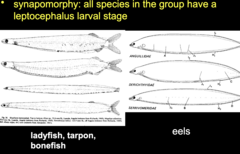
This subdivision includes Eels, tarpon, ladyfish, and bonefsh
• synapomorphy: all species in the group have a leptocephalus larval stage

Order Elopiformes
Includes:
- Family Elopidae (ladyfishes, tenpounders)
- Family Megalopidae (tarpons)
Order Anguilliformes
Includes:
- Family Anguillidae: freshwater eels,
- Family Muraenidae: moray eels,
- Family Ophichthidae: snake eels, shrimp eels and worm eels

Cohort Otocephala
Includes:
- Clupeomorpha (herrings and anchovies)
= Family Engraulidae: anchovies, ex. (Anchoa mitchilli) Bay Anchovy
= Family Clupeidae: herrings, shads, menhadens, & sardines
- Ostariophysi (minnows, tetras, catfishes): fishes with an otophysic connection

Ostariophysi (super order)
includes:
- Characiformes, Cypriniformes, Siluriformes)
- catfishes, tetras, minnows, knifefishes
- synapomorphy: presence of the Weberian apparatus
What is a Weberian apparatus?
It is an anatomical structure that connects the swim bladder to the auditory system in fishes belonging to the superorder Ostariophysi. When it is fully developed in adult fish, the elements of the apparatus are sometimes collectively referred to as the Weberian ossicles.


Order Characiformes
Family Characidae -tetras/characins
Serrasalmidae
These are a family of characiform fishes native to freshwater habitats of South America.
The name means "serrated salmon family", which refers to the serrated keel running along the belly of these fish. They are are also known by these common names: pacu, piranha, and silver dollar.
- Red Bellied Piranha (Pygocentrus nattereri)
- spotted silver dollar ( Metynnis maculatus)

Order Cypriniformes
Family Leuciscidae (Cyprinidae)‑ carps & minnows

Order Siluriformes
- Family Ictaluridae: bullhead catfishes (Ameiurus sp.)
- Family Ariidae: sea catfishes
Class: Protacanthopterygii
includes orders:
Percopsiformes, Ophidiiformes, Gadiformes, Batrachoidiformes and Lophiiformes.
Order Esociformes
Family Esocidae ‑pikes

Order Salmoniformes
- Family Salmonidae: salmon, trouts, whitefishes,‑ ciscoes, graylings
Neoteleostei
Synapomorphy:
• retractor dorsalis muscle present
• origin on anterior vertebrae, with insertion on posterior pharyngobranchial bones
• enhances physical preparation of food items

Order Stomiiformes
- viperfishes, deep-sea hatchetfishes)
- Family Stomiidae: dragonfishes, viperfishes (Chauliodus sloani)
- Family Sternoptychidae: deep-sea hatchetfishes
Order Percopsiformes
- Family Aphredoderidae - pirate perch; A spiny-rayed fish with an adipose fin; an unusual combination

Order Ophidiiformes
Includes:
- Family Ophidiidae: cusk-eels, note the anterior pelvic fins (jugular position)
Order Gadiformes
Includes:
- Family Phycidae: phycid hakes
- Family Gadidae - cods

Order Batrachoidiformes
There is only one family in the ray-finned fish order. Both the English common name and scientific name refer to their toad-like appearance.
Includes:
- Family Batrachoididae: toadfishes, midshipman

Order Lophiiformes
The synapomorphy of these are the modified first dorsal fin spine (illicium) bearing a lure (esca)
Includes:
- Family Antennariidae - frogfishes; (Deep-sea ceratioid anglerfish); unique illicium (fishing line) and esca (bait); gill openings pore-like and posterior
What is a fish assemblage?
It is a fish species that occur together in a single place, such that they have at least a reasonable opportunity for daily contact with each other.
What is a fish community?
It is an assemblage of fish species found in a common set of environmental conditions.
What is a foraging guild?
It is a group of species coexisting and sharing a food resource base. The concept is often used to help understand the ecological roles of species within an assemblage
What is the filter/screen concept?
Matthews (1998) visualized a filter or screen concept as a means of explaining which species occur in a given assemblage.
• historical filter
• abiotic filter
• biotic filter
• human activity filter

What does the historical filter concept include?
This filter includes past events (e.g., glaciations, disturbances) that shaped the present available species pool.

What does the abiotic filter concept include?
This filter includes physical or chemical environmental conditions (e.g., temperature, salinity, substrate type, light availability) that exclude species outside certain tolerances.

What does the biotic filter concept include?
This filter includes biological interactions such as predation, competition, or herbivory that further reduce the species pool.

What does the human activity filter concept include?
This filter includes anthropogenic changes altering environmental conditions or species availability.

What is the first component of the biotic filter?
Predation: typically intense predation pressure in the marine environment
- ex. barracudas (Sphyraena) worldwide in warm coastal seas, piranhas (Amazon and Orinoco drainages)
- defensive structures against predation: fin and head spines as defensive structures, spiny skin as a defensive structure - Burrfish (Diodontidae)
What is the second component of the biotic filter?
Competition: Direct competition for resources, such as food, mates, or space. Avoiding competition is much more common than direct competition
What is the third component of the biotic filter?
Symbiosis: This is is any close and long-term biological interaction between two organisms of different species.
What is resource partitioning?
It is differential use of resources by co-occurring species, which minimizes competition among them.
- ex. Morphological and behavioral attributes resulting in differential resource utilization;
- ex. Feeding behavior = four species of butterfly fish on coral reefs (Chaetodon)
What are the three main types of symbiotic interations?
Mutualistic, Commensal, and Parasitic interactions.
What is an example of a Mutualistic interaction?
1. Coral Goby (Gobiodon histrio) living in association with branching corals (Acropora spp.)
2. Clownfish/Anemonefish (Amphiprion ocellaris) mutualist that lives in association with specific kinds of giant sea anemones
What is an example of a Commensal interaction?
1. Shark Sucker (Echeneis naucrates) a commensal that attaches to various hosts by suction disk on head formed from modified dorsal fin spines
What is an example of a Parasitic interaction?
1. The Pearlfish (family Carapidae), a parasite that lives inside of sea cucumbers (Echinodermata; Holothuroidea)
What is Systematics?
The study of organismic diversity as it pertains to relationships among populations, species or higher groups or taxa.
What is Taxonomy?
The practice of arranging organismic diversity and its patterns of relationships into a system of terms (a classification) that reflects those relationships.
What is Evolutionary Taxonomy?
- It is a type of biological classification that integrates phylogenetic relationships (shared ancestry) and degree of evolutionary change to classify organisms
- Evolutionary taxonomy and patterns of teleostean fish evolution show that some major taxonomic groups of fishes shown to have had multiple origins.
What is Numerical Phenetics (Distance-based phylogenetic methods)?
It builds phylogenetic trees by converting raw traits into pairwise dissimilarity or distance scores arranged in a square distance matrix
- Genetic, morphological, or other character data encoded into the matrix

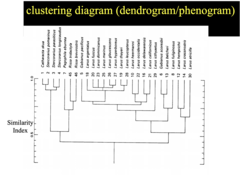
What is a cluster diagram (dendrogram and orphenogram)?
- A dendrogram is a tree‑like diagram that visually represents the hierarchical clustering of objects, showing how individual items or groups merge at different levels of similarity,
- An orphenogram is a similar diagram used in genetics to depict the evolutionary relationships (clades) among organisms.
What is a phylogram?
A tree-like diagram that represents evolutionary relationships, with branch lengths proportional to the amount of genetic change or evolutionary divergence.

What is a neighbor-joining tree?
A neighbor-joining tree is a phylogenetic tree (a diagram showing evolutionary relationships among organisms, genes, or sequences)

Distance versus discrete character types of analysis
Distance-based methods calculate pairwise similarity or dissimilarity (often as a numeric genetic distance - a measure of how different two sequences or taxa are), while discrete character-based methods model the evolution of traits that exist in a finite set of distinct states.
What is Phylogenetic systematics?
One approach to systematics that
(i) attempts to recover the phylogenetic or genealogical relationships among organisms, (ii) Trees show only relative branching order, not distance or amount of divergence
(iii) and produces classifications that exactly reflect those genealogical relationships.
What is the Cladogram (maximum parsimony tree)?
This analysis seeks the most parsimonious tree for the input character state matrix, usually produces multiple, equally parsimonious trees/cladograms
What is the Consensus tree?
A tree that summarizes branching information shared by a set of equally parsimonious trees
What is an Ingroup?
The primary group of organisms being studied, sharing a recent common ancestor and specific traits of interest.
What is an Outgroup?
This is a group closely related to the ingroups, but used to determine apomorphic (derived character states) traits and plesiomorphic (primitive character states, not used to make the trees, but helpful comparative information) traits
What is the Consistency Index?
It provides an objective way of choosing the best tree among a series of possible trees. C.I. varies between 0 and 1, where a value of 1.0 would be the best possible. When C.I. = 1.0 the character states are completely consistent with the tree - no multiple derivations or reversals of any character states (no homoplasy).
How can you calculate the consistency index?
Equation shows that C.I. = M/L
- M is the minimum possible number of steps of character state transformation (from the matrix)
- L is the observed "length" of the tree in number of steps of character state transformation (from the tree)

Applications for phylogenetics
- classification: placing species and higher groups into monophyletic groups (e.g.,genera, families, etc.)
- character evolution
- evolution of behavior and ecological features
- co-evolution
- biogeography
What is the urohyal?
A small, unpaired median bone located ventral to the basibranchial region, within the hyoid and branchial arches of teleost fishes. It is formed by the ossification of an unpaired tendon of the sternohyoideus muscle and plays a key role in the mouth opening-closing mechanism
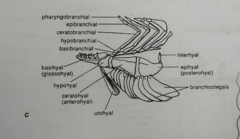
What is the branchiohyoid apparatus?
Often referred to as the hyoid apparatus—is part of the hyoid arch (second pharyngeal arch) and supports the floor of the mouth, the tongue, and, in many species, the branchiostegal rays. It is a key element in feeding, respiration, and sometimes prey handling
What makes up the hyoid apparatus?
- basihyal
- hypohyal
- epihyal
- interhyal
- ceratohyal
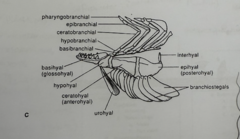
What are the 4 parts of the opercular apparatus?
- Opercle
- subopercle
- preopercle
- interpercle

What is the neurocranium?
The bony (or cartilaginous in some groups) portion of the skull that encloses and protects the brain, sensory organs, and inner ear, forming the central base of the skull
What are the 4 parts of the suspensorium?
The hyomandibular, the quadrate, the symplectic, and the palatine.
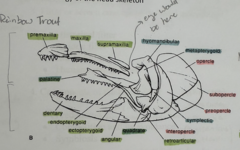
What are the parts of the jaws?
- premaxilla
- maxilla
- supermaxilla
- dentary
- endopterygoid
- ectopterygoid
- angular
- retroarticular

What is a node?
A point on a phylogenetic tree that represents the most recent common ancestor of the lineages branching from that point
What are the bones of the vertebral column?
- centrum
- neural arch
- haemal arch
- pleural ribs
What are the parts of the caudal skeleton?
- hypurals
- epurals
- urostyle
- uroneurals