11.7 Valence Bond Theory: Hybridization of Atomic Orbitals
 Call Kai
 Learn
 Practice Test
 Spaced Repetition
 Match
 Flashcards
 Knowt Play
1/31

There's no tags or description
Looks like no tags are added yet.
32 Terms
hybridization
mathematical procedure in which standard atomic orbitals are combined to form new, hybrid orbitals
hybrid orbitals
orbitals formed from the combination of standard atomic orbitals that correspond more closely to the actual distribution of electrons in a chemically bonded atom
localized on individual atoms
Hybrid orbitals are __________________________ (localized on individual atoms/delocalized over the entire molecule), but their shapes and energies differ from those of standard atomic orbitals.
minimize, maximizing
We hypothesize that electrons in some molecules occupy hybrid orbitals because hybrid orbitals ___________ (minimize/maximize) the energy of the molecule by ___________ (minimizing/maximizing) the orbital overlap in a bond (electron probability density in hybrid orbitals is more concentrated on a single directional lobe, allowing greater overlap with the orbitals of other atoms).
bond
Hybridization costs energy in most cases and only occurs to the degree that the energy payback through _____ formation is substantial.
greater
Generally, the more bonds an atom forms, the _________ (lesser/greater) the tendency of its orbitals to hybridize.
most, greatest
Central/interior atoms form the _____ (least/most) bonds and therefore have the _________ (least/greatest) tendency to hybridize.
least, least
Terminal atoms form the ______ (least/most) bonds and therefore have the __________ (least/greatest) tendency to hybridize.
is not
Hybridization ___ (is/is not) an all-or-nothing process and can occur to varying degrees that are not always easy to predict.
equal to
General statements regarding hybridization
The number of standard atomic orbitals added together is always __________ (greater than/less than/equal to) the number of hybrid orbitals formed. The total number of orbitals is conserved.
shapes, energies
General statements regarding hybridization
The particular combination of standard atomic orbitals added together determines the ______ and _______ of the hybrid orbitals formed.
lowest
General statements regarding hybridization
The particular type of hybridization that occurs is the one that yields the _______ (highest/lowest) overall energy for the molecule.
degenerate
Hybrid orbitals are ___________ (all have the same energy).
true
(true/false) Hybrid orbitals can accommodate lone pairs.
sp³, 0
Hybridization of 1 s and 3 p orbitals (4 electron groups) results in 4 ___ hybrid orbitals and _ leftover unhybridized p orbitals.

sp², 1
Hybridization of 1 s and 2 p orbitals (3 electron groups) results in 3 ___ hybrid orbitals and _ leftover unhybridized p orbital.

sp, 2
Hybridization of 1 s and 1 p orbital (3 electron groups) results in 2 ___ hybrid orbitals and _ leftover unhybridized p orbital.

pi bond (π)
the bond that forms between 2 unhybridized p orbitals that overlap side to side; electron density is above and below the internuclear axis with electrons spread out over both upper and lower lobes

sigma bond (σ)
resulting bond that forms between a combination of any two s, p, or hybridized orbitals that overlap end to end

bond type: atom(orbital/orbital hybridization)—atom(orbital/orbital hybridization)
labeling bonds using notation to specify bond type, bonded atoms, and orbital/orbital hybridization

1, 0
A single bond is composed of __ sigma bonds and _ pi bonds.
1, 1
A double bond is composed of __ sigma bonds and _ pi bonds.
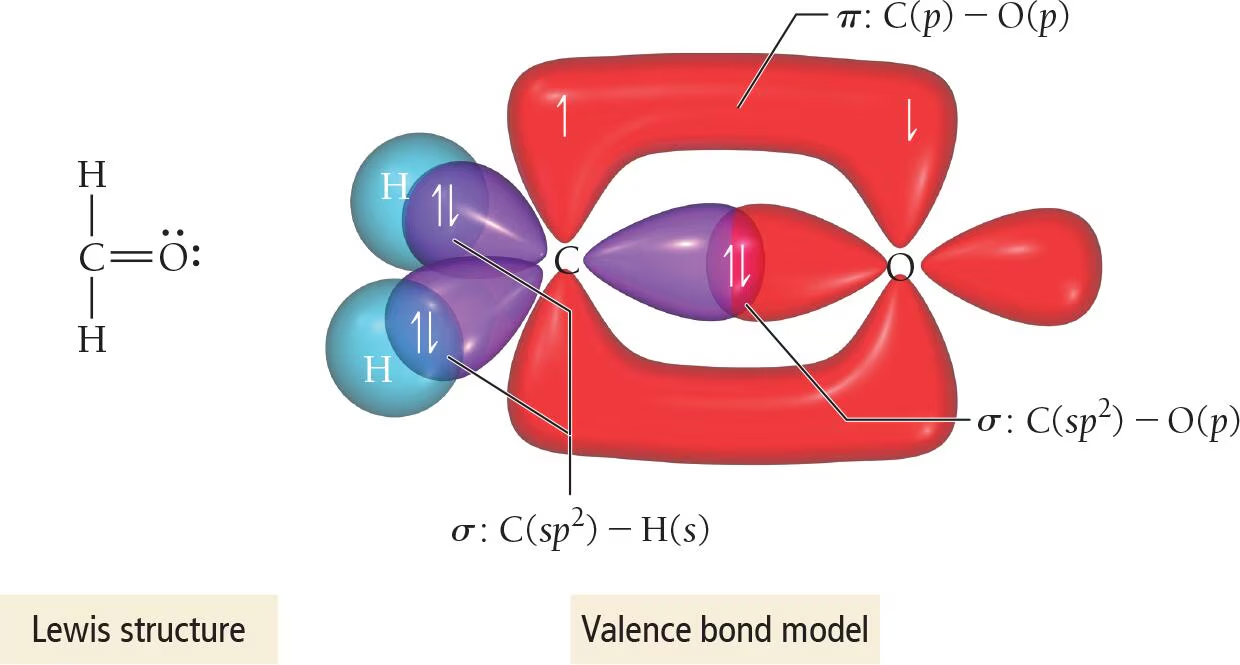
1, 2
A triple bond is composed of __ sigma bonds and _ pi bonds.

weaker, less
Pi bonds are generally ________ (stronger/weaker) than sigma bonds because side-to-side orbital overlap tends to be _______ (more/less) efficient than end-to-end orbital overlap.

double, triple, single
The rotation about a _______ (single, double, triple) bond and ________ (single, double, triple) bond is severely restricted - due to side-by-side overlap of p orbitals, the pi bond(s) must essentially break for rotation to occur. However, rotation about a ______ (single, double, triple) bond is relatively unrestricted.
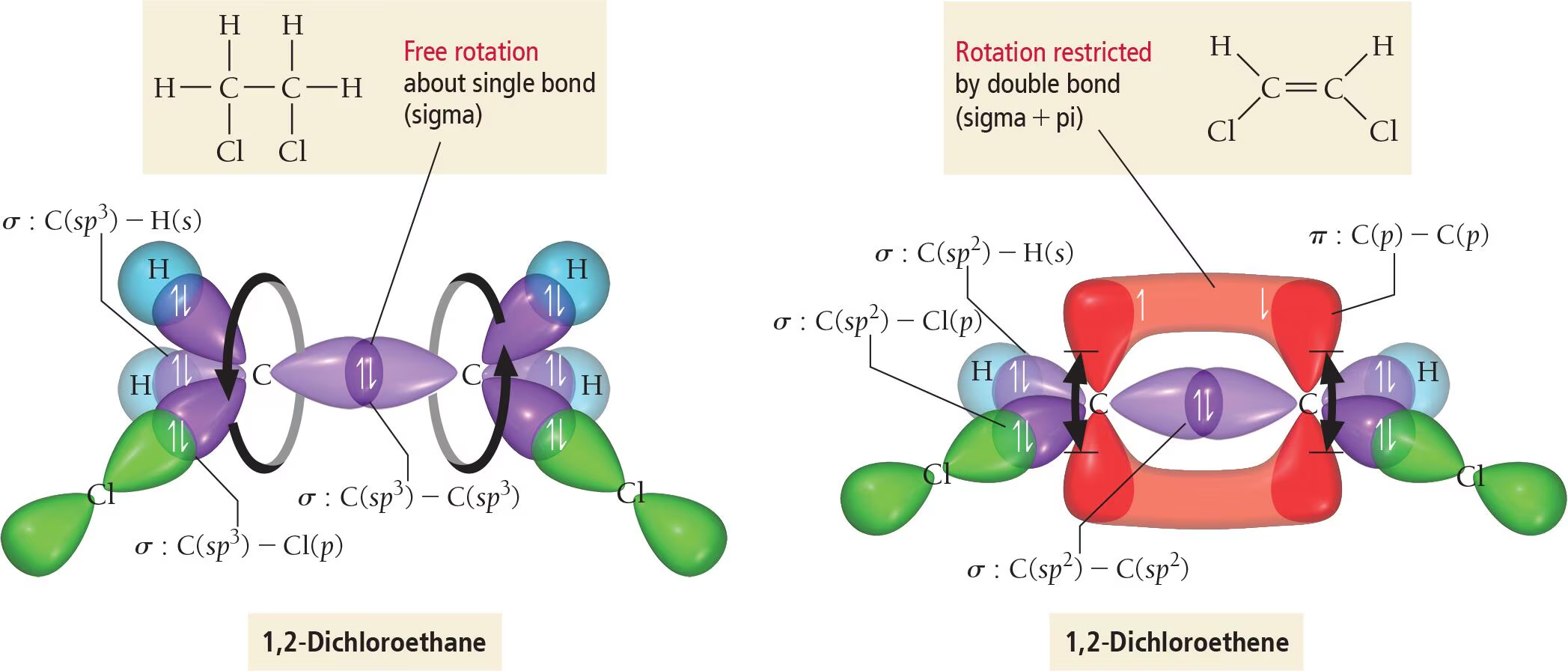
isomers
compounds with the same molecular formula but different structures or different spatial arrangement of atoms (cis-same side, trans-opposite sides)

d
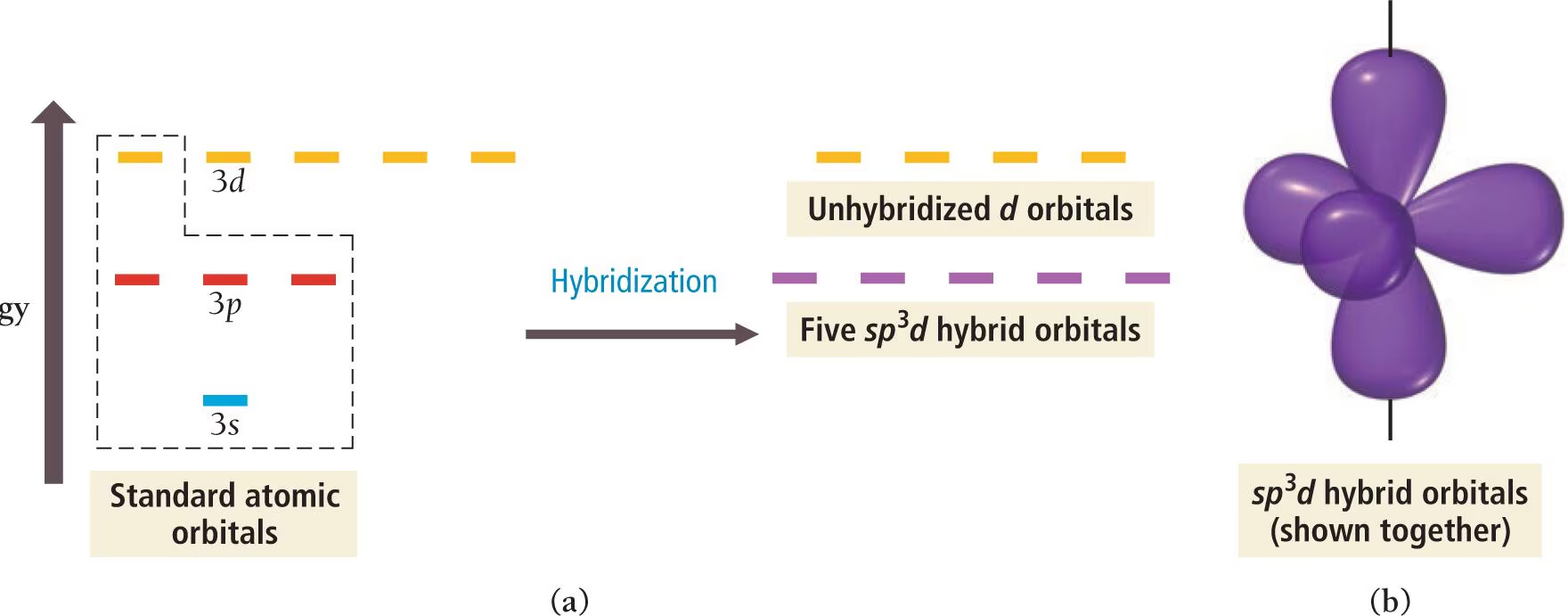
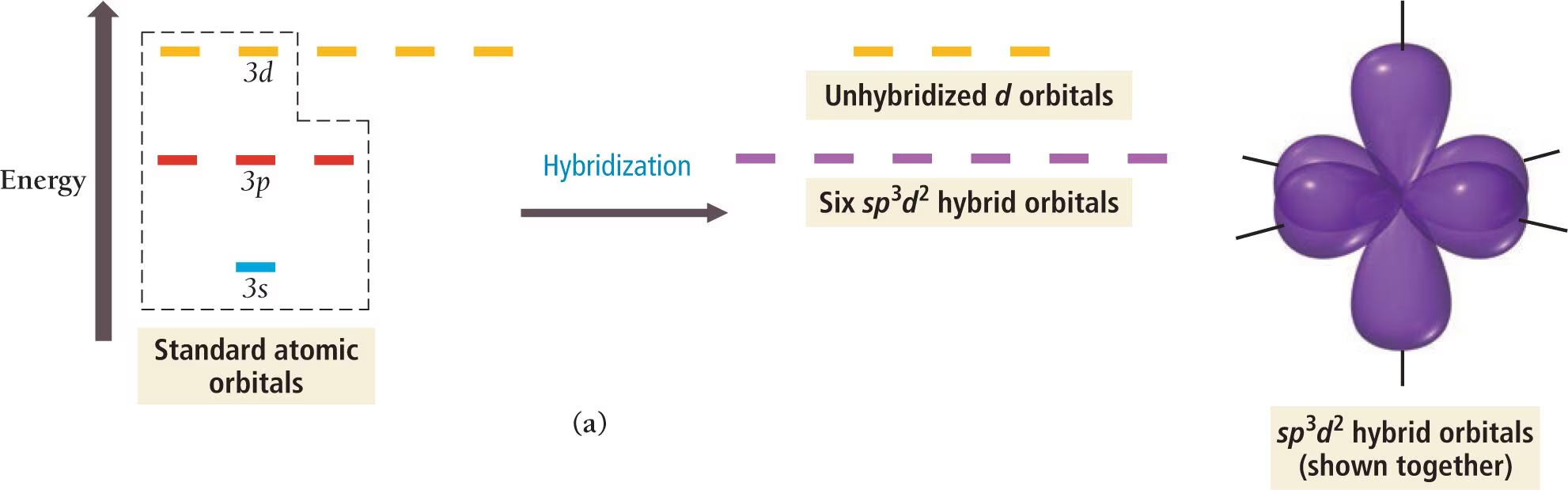
The Lewis model’s concept of expanded octets sometimes exhibited in the 3rd row of the periodic table or below has an equivalent concept in valence bond theory — the hybridization involving _ orbitals.
close
For 3rd period elements, 3d orbitals are involved in hybridization because their energies are _______ to the energies of 3s and 3p orbitals.
sp³d
Hybridization of 1 s, 3 p, and 1 d orbital (5 electron groups) results in 5 ___ hybrid orbitals.
sp³d²
Hybridization of 1 s, 3 p, and 2 d orbital (6 electron groups) results in 6 ___ hybrid orbitals.
false
(true/false) Valence bond theory accounts for the delocalization of electrons.
false
(true/false) Valence bond theory perfectly predicts magnetic behavior and other properties of molecules.