Super molecular Lect 1-5 haddleton
 Call Kai
 Learn
 Practice Test
 Spaced Repetition
 Match
 Flashcards
 Knowt Play
1/26

There's no tags or description
Looks like no tags are added yet.
27 Terms
defintion of the words:
Linear, hyperbranched, dendrimer,dendron
Linear: Unbranched backbone
Hyperbranched: randomly branched in one pot, imperfect, broad, dispersity.
Dendrimer: Perfectly branched, monodisperse, built gen by gen
dendron: wedge of a dendrimer, one focal point. TERMINAL functional group at the outer ends.
Anatomy of a dendrimer:
Core, generation, branch point, surface group, focal point
Core: central multifunctional starting point
generation: each successive branching layer
branch points: repeat units that build the tree
surface groups: terminal end group, number grows geometrically,
Focal group: single reactive group at a dendron root

Why can’t a certain molecule or a reason for something to not be able to be gp lc analysed
It has cross links so its not soluble
How are hyperbranched polymers produced
usually in one pot of ABx molecules where x is more than 2.

what if you want a cyclic molecule or hybrid branch
For cyclic, change the reaction conditions to favour it
hybrid, you avoid ABx
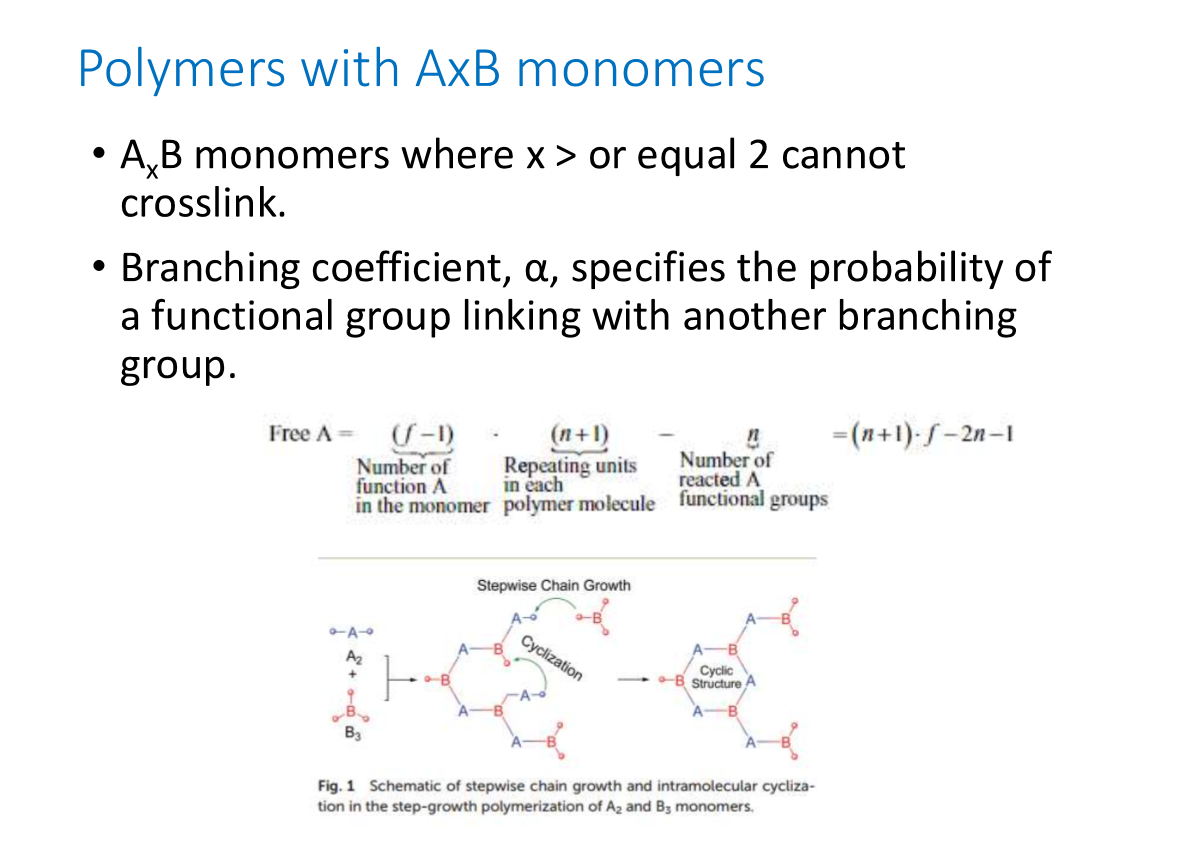
Monomers of AxB where x is > 2 cannot crosslinks, so what happens instead
Formed branch structures isntead. This leads to the creation of networks or hyperbranched polymers that do not exhibit cross-linking features. This results in branched structures that allow for solubility and flexibility, forming complex network architectures.
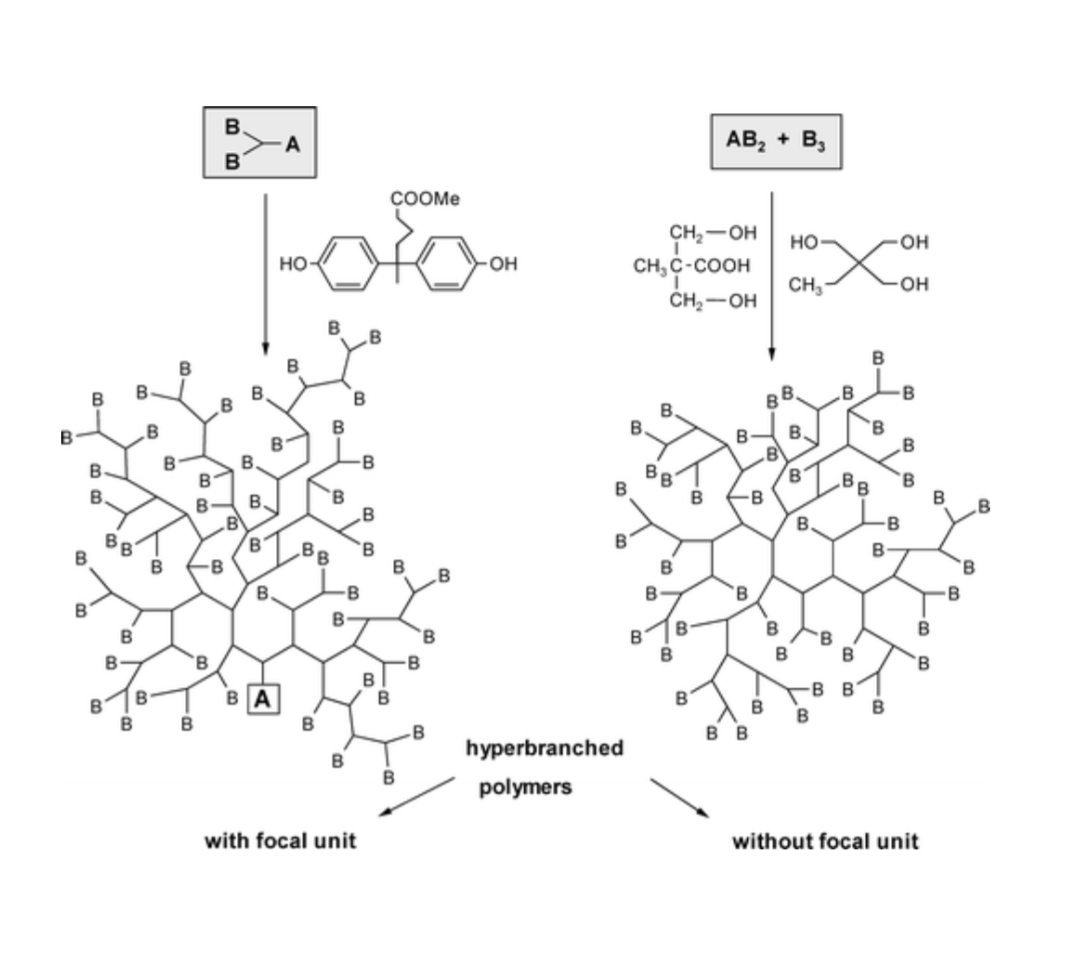
whats the difference between these two
On the left, there is a focal point, labelled A. Right has no focal point, so polymers are branched but has no distinct focal.
With the focal point, specific units associated with branching structure, But if i had just AB, i would have linear growth.
How would you make a dendrimer?
theres divergent and convergent growth.
what does divergent growth consist of
Starts from a central initiator core.
Monomers are added outwards from the core.
Each successive reaction creates additional branching points.
Repeated addition produces higher generations (G1, G2, G3, etc.).
The process continues until the desired dendrimer generation is achieved.

How does convergent growth work
Start with small monomers.
Join them together to make small branches called dendrons.
Repeat this process to make larger dendrons (G1, G2, G3).
Protect certain functional groups so they don't react too early.
Attach the completed dendrons to a central core using their focal points.

advantages of convergent and divergent (EQ)
divergent:
-reaches high generations/ large dendrimers
-many identical surface reactions per step
Convergent:
Few reactions per step - high purity, easy to purify
precise focal- point functionalisation
disadvantage of divergent and convergent
Divergent
Limitation: defects accumulate; purification is hard
large excess of reagent needed
Convergent:
Limited to lower generation (steric crowding at core)
lower yeild at final core- coupling
What are some instruments that we can use to characterise these molecules?

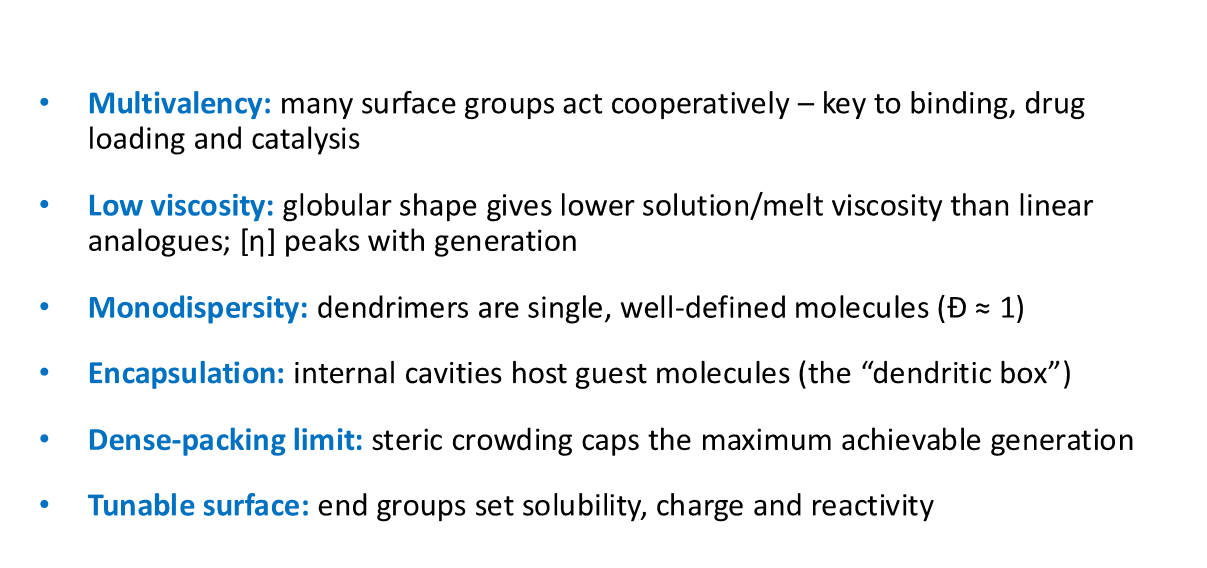
Why do the properties of dendrimers matter?
multivalency, low viscosity, encapsulation
Defintions of
Crosslink, Gel, Gel point, Crosslink density, functionality

what are hydrogels and organogels
hydrogels theyre crosslinked networks that swell in water. They need to be hydrophilic.
Organogels: crosslinked networks that swell in organic solvents. They need to be compatible with organic solvent
Why do we vulcanise rubber
Natural rubber (cis-1,4-polyisoprene) is initially soft and sticky.
Heating it with sulphur introduces sulphur crosslinks between polymer chains.
These crosslinks turn the soft rubber into a more durable elastomer.
This is important because soft and tacky can be used as adhesives, cross linked is used for a tyre.
How does a perm work
A reducing agent breaks the disulphide bonds in the hair.
The hair can then be reshaped into curls.
An oxidising agent reforms the disulphide bonds.
The new crosslinks help maintain the curled shape.
explain what happens before and after the gel point
Before the gel point:
The polymer molecules are finite.
The material can still flow.
There isn't a continuous network.
At the gel point:
A continuous network first forms.
The molecular weight theoretically becomes infinite.
After the gel point:
The material behaves as a gel.
It no longer flows like an ordinary liquid.
whats the gel point equation
P=1/N-1 = 1/N

Why do monomers with more than 2 functional groups produce crosslinked networks?
They can form branches and connect polymer chains in multiple directions, eventually creating a 3D network.
Give examples of monomers used to produce crosslinked polymers.
Polyester: trifunctional alcohol (e.g. glycerol) + difunctional acid.
Polyurethane: triisocyanate + diol OR diisocyanate + triol.
What is the Carothers approach to predicting gelation?
A stoichiometric approach that uses reactant functionality and extent of reaction to predict gelation.
For a stoichiometric system: pc = 2/fav, where fav is the average functionality.
What is Flory–Stockmayer branching theory?
A statistical approach to predicting gelation using the branching coefficient (α).
Gelation occurs when αc = 1/(f − 1), where f is functionality.

What is the gel point for random crosslinking of pre-formed polymer chains?
pc = 1/(N − 1) ≈ 1/N, where N is the degree of polymerisation. Approximately one crosslink per chain on average is needed to form a network.

How do intramolecular loops affect gelation?
Mean-field theory ignores intramolecular loops, so it underestimates the conversion needed for gelation. In reality, slightly higher conversion is required.
Give an example of a 3:2 stoichiometric crosslinking reaction.
Glycerol (3 hydroxyl groups) + phthalic anhydride (2 acid functionalities) → crosslinked polyester network.
