FAA Ground School
 Call Kai
 Learn
 Practice Test
 Spaced Repetition
 Match
 Flashcards
 Knowt Play
1/91

There's no tags or description
Looks like no tags are added yet.
92 Terms
To carry passengers at night, how must a pilot qualify?
Log 3 takeoffs and landings to a full stop from the time between one hour after sunset to one hour before sunrise.
Each person who holds a pilot certificate or a medical certificate shall present it for inspection upon the request of the FAA Administrator, the National Transportation Safety Board, or any
federal, state, or local law enforcement officer.
For private pilot operations, a Second-Class Medical Certificate issued to a 41-year-old pilot on July 15, this year, will expire at midnight on
July 31, two years later.
What is the definition of a high-performance airplane?
An airplane with an engine of more than 200 horsepower.
A pilot operating under BasicMed may not operate an aircraft that weighs more than
12,500 pounds
A Third-Class Medical Certificate is issued to a 36-year-old pilot on August 10, this year. To exercise the privileges of a Private Pilot Certificate, the medical certificate will be valid until midnight on
August 31, 5 years later.
What is the maximum speed limit for a pilot flying under BasicMed?
250 knots.
The three takeoffs and landings that are required to act as a pilot in command at night must be done during the time period from
1 hour after sunset to 1 hour before sunrise.
Can a private pilot under BasicMed legally operate in furtherance of their personal business?
Yes, but only if the flight is incidental to the business and the aircraft does not carry passengers or property for compensation or hire.
In order to qualify under BasicMed, a pilot must
have a medical examination with a physician every 48 months.
You are a private pilot operating under BasicMed. Your driver's license has recently expired. May you operate as PIC (pilot in command) of your Cessna 172?
No.
The takeoffs and landings required to meet the recency of experience requirements for a tailwheel airplane
must be to a full stop.
Under BasicMed, what is the maximum number of occupants allowed on board?
7 occupants
In order to qualify under BasicMed, a pilot must take an online course
every 24 calendar months.
If recency of experience requirements for night flights are not met and official sunset is 1830, the latest time passengers may be carried is
1929
If a private pilot had a flight review on August 10, this year, when is the next flight review required?
August 31, two years later.
To act as pilot in command of an aircraft carrying passengers, a pilot must show by logbook endorsement the satisfactory completion of a flight review or completion of a pilot proficiency check within the preceding
24 calendar months.
May a pilot flying under BasicMed share expenses with passengers?
Yes.
Under BasicMed, what is the maximum number of passengers allowed on board?
6 passengers
Before a person holding a private pilot certificate may act as a pilot in command of a high-performance airplane, that person must have
received ground and flight instruction from an authorized flight instructor who then endorses that person's logbook.

Based on the wind indicator, from which direction is the wind coming?
From the southwest.
When landing with a crosswind
the aileron should be up on the upwind side.

When taxiing a tricycle-gear airplane with a left quartering tailwind, how should the flight controls be positioned?
Left aileron down, elevator down.
A military air station can be identified by a rotating beacon that emits
two quick, white flashes between green flashes.
A below glide slope indication from a pulsating approach slope indicator is a
pulsating red light.

While on final approach to a runway equipped with a standard 2-bar VASI, the lights appear as shown by illustration D. This mean that the aircraft is
below the glide slope.
When flying in a VFR corridor designated through Class B airspace, the maximum speed authorized is
200 knots.
If instructed by ground control to taxi to Runway 9, the pilot may proceed
to the next intersecting runway where further clearance is required.
Who should not participate in the Land and Hold Short Operations (LAHSO) program?
Student Pilots.

When taxiing a tricycle-gear airplane into a left quartering headwind, how should the flight controls be positioned?
Left aileron up, elevator neutral.
Airspace at an airport with a part-time control tower is classified as Class D airspace only
when the associated control tower is in operation.
At an airport with pilot-controlled lighting, how many times should a pilot key the mic on a specified frequency to activate medium-intensity lighting?
5 times within 5 seconds
During a landing rollout, there is a significant quartering headwind. How should the controls be positioned?
Apply aileron pressure into the wind.
A slightly high glide slope indication from a precision approach path indicator (PAPI) is
three white lights and one red light.

Illustration A indicates that the aircraft is
on the glide slope.
Which wind condition would be more critical when taxiing a nose-wheel equipped high-wing airplane?
Quartering tailwind.
When taxiing with strong quartering tailwinds, which aileron position should be used?
Aileron should be down on the side from which the wind is blowing.
Where is the "Available Landing Distance" (ALD) data published for an airport that utilizes Land and Hold Short Operations (LAHSO)?
Chart Supplement publication.

If the wind is as shown by the landing direction indicator, the pilot should land on
Runway 18 and expect a crosswind from the right.
While on final approach for landing, an alternating green and red light followed by a flashing red light is received from the control tower. Under these circumstances, the pilot should
exercise extreme caution and abandon the approach, realizing the airport is unsafe for landing.
An airport's rotating beacon operated during daylight hours indicates
that weather at the airport located in Class D airspace is below basic VFR weather minimums.
After landing at a tower-controlled airport, when should the pilot contact ground control?
When advised by the tower to do so.
A flashing white light signal from the control tower to a taxiing aircraft is an indication to
return to the starting point on the airport.
As standard operating practice, all inbound traffic to an airport without a control tower should continuously monitor the appropriate facility from a distance of
10 miles.
If the aircraft's radio fails, what is the recommended procedure when landing at a controlled airport?
Observe the traffic flow, enter the pattern, and look for a light signal from the tower.

Area C on the airport shown is classified as
a closed runway.
When approaching to land on a runway served by a visual approach slope indicator (VASI), the pilot shall
maintain an altitude at or above the glide slope.
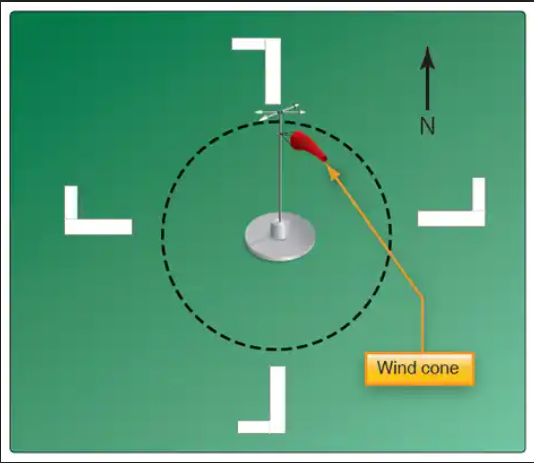
The traffic patterns indicated in the segmented circle have been arranged to avoid flights over an area to the
southeast of the airport.
ATC issues the following advisory to a pilot flying on a heading of 090°: "TRAFFIC 3 O'CLOCK, 2 MILES, WESTBOUND..." Where should the pilot look for this traffic?
South
The number 9 and 27 on a runway indicate that the runway is oriented approximately
090° and 270° magnetic
What is the purpose of the runway/runway hold position sign?
Denotes intersecting runways.

Based on the airport diagram shown, which statement about location A is true?
Takeoff is allowed here.

This sign is a visual clue that
confirms the aircraft's location to be on Taxiway B.

From the cockpit, this marking confirms the aircraft to be
on a runway, about to clear.
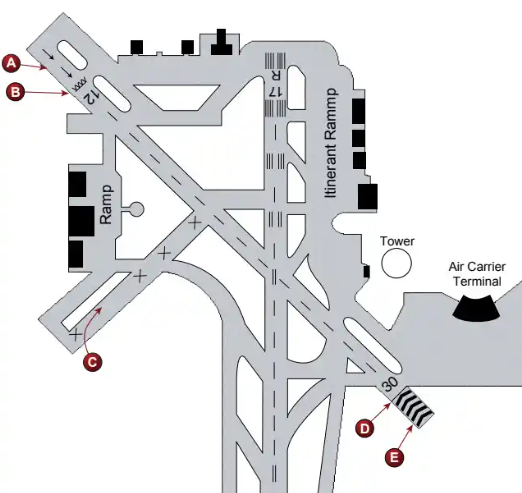
Area C on the airport shown is classified as
a closed runway.
The yellow "demarcation bar" marking indicates
a runway with a displaced threshold that precedes the runway.

The arrows that appear on the end of the north/south runway indicate that the area
cannot be used for landing, but may be used for taxiing and takeoff.
What does the outbound destination sign identify?
Identifies direction to take-off runways.

Which sign identifies your position on a runway?
L
When turning onto a taxiway from another taxiway, what is the purpose of the taxiway directional sign?
Indicates designation and direction of a taxiway leading out of an intersection.

Which sign identifies an area where aircraft are prohibited from entering?
D
What purpose does a taxiway location sign serve?
It identifies the taxiway upon which an aircraft is located.

Which sign is a designation and direction of an exit taxiway from a runway?
K

Which marking indicates a vehicle lane?
C
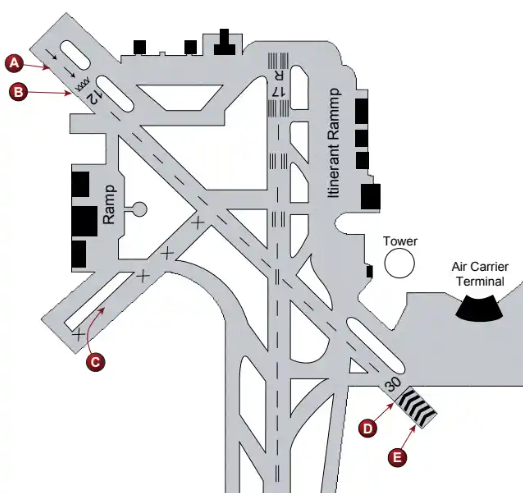
The line shown at position D is a
demarcation bar.
What does a runway exit sign indicate?
Direction to a taxiway.

What is the difference between area A and area E on the airport shown in the diagram?
'A' may be used for taxi and takeoff; 'E' may be used only as an overrun.

This sign confirms your position on
runway 22.

Area E on the airport shown is classified as
blast pad or emergency overrun

You are holding short of the runway at a towered airport on a midfield taxiway. To your left you see the red sign shown in the figure and labeled A.
The tower controller clears you for an intersection takeoff on Runway 22. Which direction must you turn for the takeoff?
left
An airplane said to be inherently stable will
require less effort to control.
To minimize the side loads placed on the landing gear during touchdown, the pilot should keep the...
longitudinal axis of the aircraft parallel to the direction of its motion.
As an airplane's CG moves aft, the airplane becomes
less stable at all airspeeds.
After takeoff, which airspeed should the pilot use to gain the most altitude in a given period of time?
Vy
Loading an airplane to the most aft CG will cause the airplane to be
less stable at all speeds.
Trim systems are designed to do what?
They relieve the pilot of the need to maintain constant back pressure on the flight controls.
Which would provide the greatest gain in altitude in the shortest distance during a climb after takeoff?
Vx
What causes an airplane (except a T-tail) to pitch nosedown when power is reduced and controls are not adjusted?
The downwash on the elevators from the propeller slipstream is reduced and elevator effectiveness is reduced.
Changes in the center of pressure of a wing affect the aircraft's
aerodynamic balance and controllability.
What is one purpose of wing flaps?
To allow the pilot to make steeper approaches to a landing without increasing airspeed.
An airplane has been loaded in such a manner that the CG is located aft of the CG limit. One undesirable flight characteristic a pilot might experience would be
difficulty in recovering from a stall.
FAA advisory circulars containing subject matter specifically related to Airspace are issued under which subject number?
70
In comparison to an airplane with a conventional tail, a T-tail airplane (such as a Diamond DA-40) is
more susceptible to stall recovery difficulties because the elevator is above the propeller slipstream.
FAA Advisory Circulars may be obtained from
the Government Printing Office.
FAA Advisory Circulars are available to all pilots and are obtained by
downloading them from the FAA website.
What determines the longitudinal stability of an airplane?
The location of the CG with respect to the center of lift.
What is the purpose of the rudder on an airplane?
To control yaw.
An airplane has been loaded in such a manner that the CG is located aft of the aft CG limit. One undesirable flight characteristic a pilot might experience with this airplane would be
difficulty in recovering from a stalled condition.
Longitudinal stability refers to an aircraft's stability about which axis?
Lateral
FAA advisory circulars containing subject matter specifically related to Airmen are issued under which subject number?
60
One of the main functions of flaps during approach and landing is to
increase the angle of descent without increasing the airspeed.
FAA advisory circulars containing subject matter specifically related to Air Traffic Control and General Operations are issued under which subject number?
90