Physical Chemistry Exam 3
 Call Kai
 Learn
 Practice Test
 Spaced Repetition
 Match
 Flashcards
 Knowt Play
1/69

There's no tags or description
Looks like no tags are added yet.
70 Terms
Which of the following is true for the Gibbs Free Energy?
It is always negative
It is a path function
It is useful at constant T,P
It is defined at constant T,P only
It is useful at constant T,P
An endothermic reaction that increases the entropy is spontaneous at which conditions?
Always
High T
Never
Low T
High T
An endothermic reaction that decreases the entropy is spontaneous at which conditions?
High T
Always
Low T
Never
Never
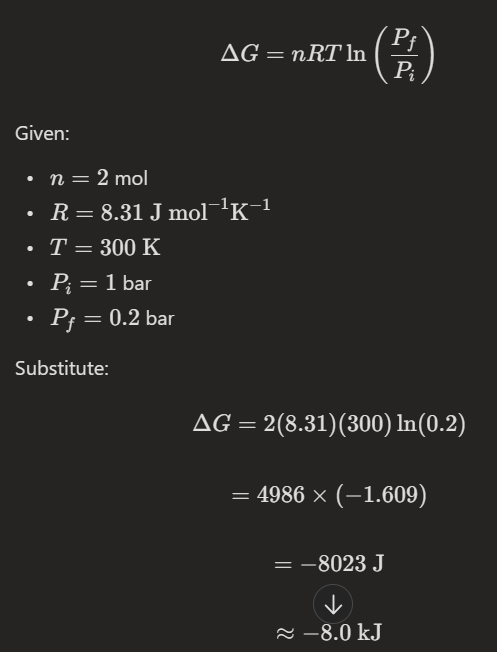
What is the change in Gibbs free energy when 2 mol of an ideal gas are expanded from Pi = 1 bar to Pf = 0.2 bar, at T = 300 K? (R = 8.31 J/(mol K)).
+8 kJ
+4 kJ
-4 kJ
–8 kJ
-8 kJ
What is the change in Gibbs free energy when 2 m3 of a liquid are brought from Pi = 1 bar to Pf = 0.2 bar, at T = 300 K? (assume that no phase change happens)
–160 kJ
–4.0 kJ
–0.8 J
–0.008 kJ
–160 kJ

What are the variables that the Gibbs free energy depend on?
T, P, n
S, V, chemical potentials
T, V, n
n only
T, P, n
The chemical potential of a substance is:
The Gibbs free energy
The molar enthalpy
The molar Gibbs free energy
The enthalpy
The molar Gibbs free energy
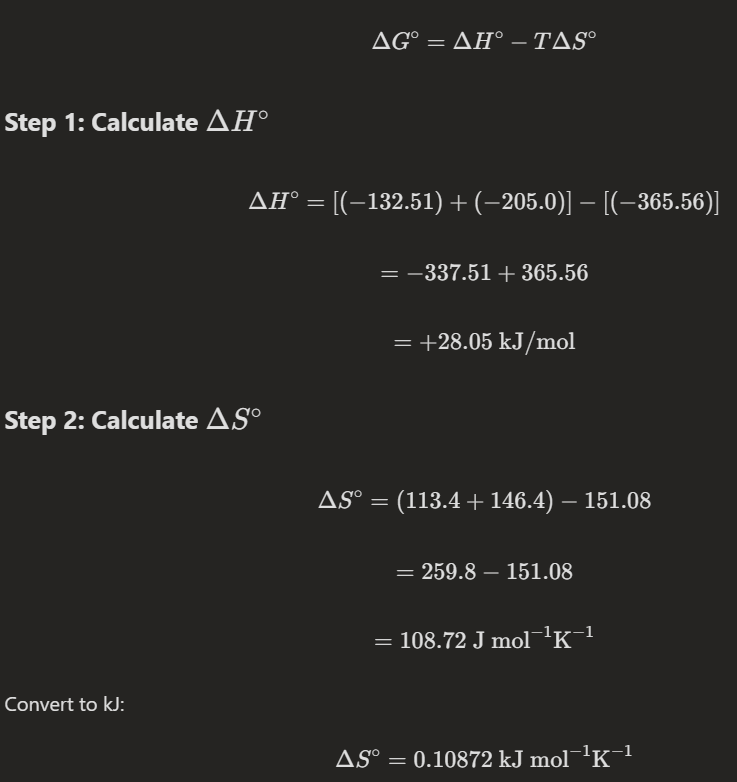
Calculate the Gibbs free energy at standard conditions and T = 25ºC of the following reaction:
NH4NO3 + H2O → NH4+ + NO3–
Given:
Compound: triangle fHo(kJ/mol): So(J/mol-K):
NH4NO3 -365.56 151.08
NH4+ -132.51 113.4
NO3– -205.0 146.4
60 kJ/mol
109 J/mol
–4.4 kJ/mol
+28 kJ/mol
–4.4 kJ/mol
then:
Step 3: Calculate ΔG∘
At T = 25 C = 298 K
ΔG∘=28.05−(298)(0.10872) = −4.35 kJ/mol
Is the reaction in question 9 spontaneous or non-spontaneous at 25ºC?
Non-spontaneous
Spontaneous
Spontaneous
At which temperature the reaction in question 8 changes its spontaneity?
At around –232ºC
At around –15ºC
At around –266ºC
At around –104ºC
At around –15ºC
Which of the following is the correct definition of the Gibbs energy?
G=U−TS.
G=H+TS.
G=H−TS.
G=H−PV+TS.
G=H+PV−TS.
G=H−TS.
For a spontaneous process at constant T and P, which of the following is true?
ΔG>0.
ΔG<0.
ΔG=0.
ΔG≥0.
ΔG is undefined.
ΔG<0.
Which of the following is NOT a natural variable of the Gibbs energy?
Temperature.
Pressure.
Chemical composition.
Volume.
Number of moles.
Volume
What is the temperature dependence coefficient of G?
(∂G/∂T)P,{ni}=S.
(∂G/∂T)P,{ni}=−S.
(∂G/∂T)P,{ni}=H.
(∂G/∂T)P,{ni}=−H.
(∂G/∂T)P,{ni}=V.
(∂G/∂T)P,{ni}=−S.
What is the pressure dependence coefficient of G?
(∂G/∂P)T,{ni}=−V.
(∂G/∂P)T,{ni}=V.
(∂G/∂P)T,{ni}=S.
(∂G/∂P)T,{ni}=−S.
(∂G/∂P)T,{ni}=H.
(∂G/∂P)T,{ni}=V.
For an ideal gas, how does G change with pressure at constant T?
G=G⊖−nRTlnP/P⊖
G=G⊖+nRTlnP/P⊖
G=G⊖+nRTP/P⊖
G=G⊖−nRTP/P⊖
G=G⊖+RTlnP/P⊖
G=G⊖+nRTlnP/P⊖
What is the composition dependence coefficient of G?
(∂G/∂ni)T,P,{nj≠i}=−μi.
(∂G/∂ni)T,P,{nj≠i}=μi.
(∂G/∂ni)T,P,{nj≠i}=RTlnμi.
(∂G/∂ni)T,P,{nj≠i}=RTμi.
(∂G/∂ni)T,P,{nj≠i}=μi/RT.
(∂G/∂ni)T,P,{nj≠i}=μi.
For a pure substance, what is the relationship between chemical potential and molar Gibbs energy?
μ∗=G/n^2
μ∗=G/RT
μ∗=G
μ∗=G/n
μ∗=nG
μ∗=G/n
How does the chemical potential of a substance in an ideal gas mixture compare to its chemical potential as a pure substance?
μ mixture i > μ∗i
μ mixture i < μ∗i
μ mixture i = μ∗i
μ mixture i = RTlnμ∗i
μ mixture i = μ∗i/RT
μ mixture i < μ∗i
What is the equation for the change in Gibbs energy due to mixing of ideal gases?
ΔmixingG=∑ni(μmixturei+μ∗i).
ΔmixingG=∑ni(μmixturei−μ∗i)>0.
ΔmixingG=∑ni(μmixturei−μ∗i)=0.
ΔmixingG=∑ni(μmixturei−μ∗i)<0.
ΔmixingG=RT∑nilnμmixturei.
ΔmixingG=∑ni(μmixturei−μ∗i)<0.

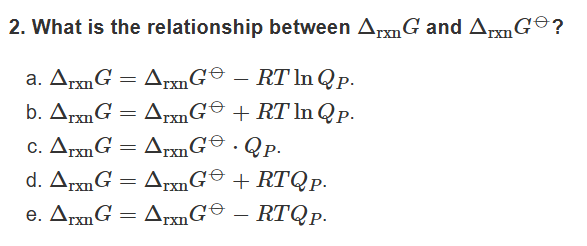
a
b

c
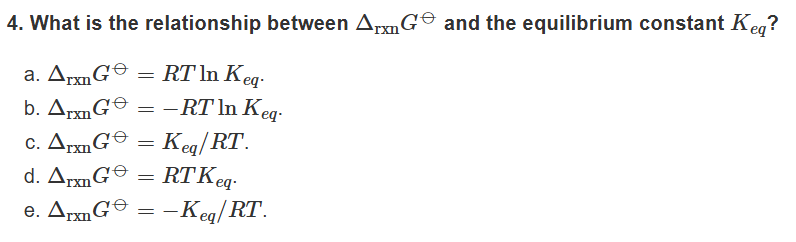
b

c

b
b
c
b

c
The critical Temperature of a non-ideal gas is:
The Temperature below which the gas never liquefy
TC = 0 K
The Temperature above which the gas never liquefy
The Temperature at which the gas liquefy at P=1atm
The Temperature above which the gas never liquefy
Calculate the final pressure of an ideal gas that is expanded from 3 L to 13 L and heated from a temperature of 25ºC to 100ºC from an initial pressure of 2 atm.
0.92 atm
0.58 atm
0.29 atm
0.37 atm
0.58 atm

A sample of CO2 (g), occupies 0.300 L at 10 °C and 1.3 atm. What volume will the gas have at 30 °C and 1.3 atm?
0.321 L
0.364 L
0.418 L
0.280 L

The hydrogen in a particular hydrogen gas thermometer has a volume of 150.0 cm3 when measured at 10.0 °C. When immersed in a boiling liquid substance, the volume of the hydrogen, at the same pressure, is 131.7 cm3. What is the temperature of the boiling substance?
248.5 K
322.3 K
8.78 K
283.0 K

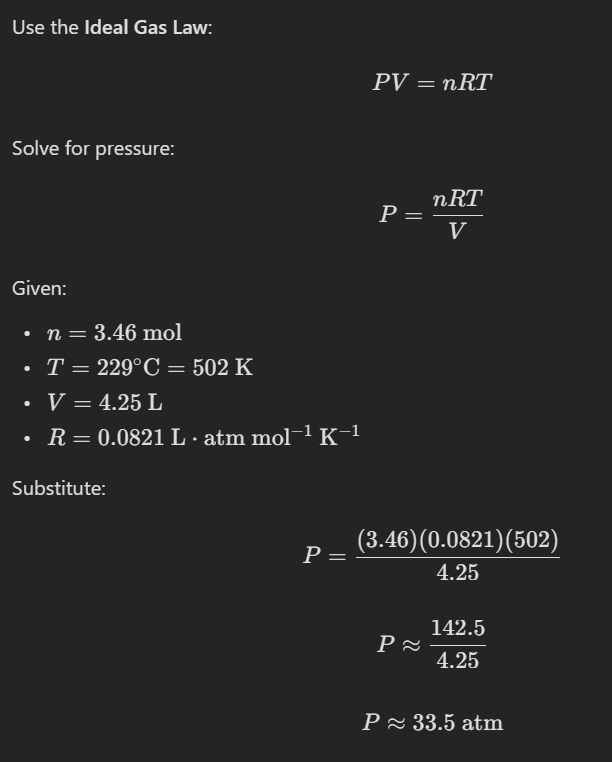
A 4.25-L flask contains 3.46 mol of CO2 at 229 °C. Calculate the pressure of this sample of CO2 assuming ideal gas behavior.
33.51 atm
23.06 atm
50.56 atm
15.28 atm
Calculate the pressure of the same quantity of CO2 at the same conditions of question 5 using the van der Waals equation with parameters: a = 3.59 L2 atm mol2 and b = 0.0427 L mol-1.
vdW eq: P = RT/V-b - a/V²
38.2 atm
32.4 atm
26.5 atm
30.0 atm

The a and b parameter of the vdW equation represent:
The ideal gas behavior and the non-ideal gas behavior
The density of the molecule in the real gas
The molar volume and the attractive intermolecular forces
The density of the molecules in the ideal gas
The molar volume and the attractive intermolecular forces
Consider the following phase diagram:
What phase/phases are present at point A?
It depends on the gas
Liquid and Gas
Gas
Liquid
Liquid and Gas
What is point B? (same pic as before)
The Boyle point
The average volume
The critical point
The boiling point
The critical point
The fugacity is used for a real gas as an effective:
Temperature
Equilibrium Constant
Pressure
Volume
Pressure
1. Which of the following is NOT an assumption of the ideal gas model?
The particles occupy no volume.
The particles do not interact with each other.
The particles have no kinetic energy.
The particles are in constant motion.
The particles undergo perfectly elastic collisions.
The particles have no kinetic energy.
2. What does the Joule-Thomson coefficient measure?
The rate of change of volume with respect to temperature.
The rate of change of pressure with respect to volume.
The rate of change of temperature with respect to pressure at constant enthalpy.
The rate of change of entropy with respect to temperature.
The rate of change of enthalpy with respect to pressure.
The rate of change of temperature with respect to pressure at constant enthalpy.
3. What is the value of the critical compressibility factor predicted by the van der Waals equation?
1/3.
3/8.
1/2.
2/3.
1/4.
3/8.
4. Which of the following statements about fugacity is correct?
Fugacity has units of pressure squared.
The fugacity coefficient is always greater than 1.
As pressure approaches zero, the ratio of fugacity to pressure approaches infinity.
Fugacity is independent of temperature for all gases.
Fugacity is used to replace pressure in equilibrium constant calculations for non-ideal gases.
Fugacity is used to replace pressure in equilibrium constant calculations for non-ideal gases.
5. How is the critical temperature of a gas defined?
The temperature at which the gas becomes a supercritical fluid.
The temperature above which the gas cannot be liquefied by pressure alone.
The temperature at which the gas occupies its largest volume.
The temperature at which the gas behaves most ideally.
The temperature at which the gas has zero compressibility.
The temperature above which the gas cannot be liquefied by pressure alone.
6. The compressibility factor z for an ideal gas is always:
Greater than 1.
Less than 1.
Equal to 0.
Equal to 1.
Dependent on pressure.
Equal to 1.
7. How is the Boyle temperature defined?
The temperature at which a gas liquefies.
The temperature at which a gas behaves most ideally over a large pressure range.
The critical temperature of a gas.
The temperature at which a gas solidifies.
The temperature at which a gas has maximum entropy.
The temperature at which a gas behaves most ideally over a large pressure range.
8. In the van der Waals equation, what does the parameter ‘a’ accounts for?
The volume of gas molecules.
The pressure of the gas.
The temperature of the gas.
The number of moles of the gas.
The intermolecular forces between gas molecules.
The intermolecular forces between gas molecules.
9. Which of the following is true regarding the fugacity of a gas?
It is always greater than its pressure.
It is always less than its pressure.
It is the effective pressure that corresponds to the chemical potential of the real gas.
It is independent of temperature.
It is only applicable to ideal gases.
It is the effective pressure that corresponds to the chemical potential of the real gas.
10. Which of the following gases is likely to have a Joule-Thomson inversion temperature below room temperature?
Nitrogen.
Oxygen.
Carbon dioxide.
Helium.
Water vapor.
Helium.
1. What is the definition of a phase in thermodynamics?
A region of the system with heterogeneous chemical composition.
A region of the system with homogeneous chemical composition and physical state.
A region of the system with constant temperature and pressure.
A region of the system with varying density and volume.
A region of the system with uniform crystal structure.
A region of the system with homogeneous chemical composition and physical state.
2. According to the Gibbs phase rule, how many degrees of freedom (f) does a system with 2 components (c) and 3 phases (p) have?
f=1.
f=2.
f=3.
f=4.
f=5.
f = 1
f = c - p + 2
3. Which of the following statements about the triple point is correct?
It has one degree of freedom for a one-component system.
It represents the coexistence of four phases.
Its coordinates are uniquely determined for each chemical substance.
It always occurs at standard temperature and pressure.
It is the point where all phases become identical.
Its coordinates are uniquely determined for each chemical substance.
4. What does the Clausius-Clapeyron equation describe?
The dependence of critical temperature on pressure.
The relationship between enthalpy and entropy of vaporization.
The dependence of vapor pressure on temperature.
The relationship between molar volume and critical pressure.
The dependence of boiling point on atmospheric pressure.
The dependence of vapor pressure on temperature.
5. Which of the following is true about the entropy change during vaporization?
It is always negative.
It is approximately equal to 88J/(mol⋅K) for many substances (Trouton’s rule).
It decreases with increasing temperature.
It is always zero at the critical point.
It is the same for all substances at their normal boiling points.
It is approximately equal to 88J/(mol⋅K) for many substances (Trouton’s rule).
6. What is the typical shape of the solid-liquid equilibrium line in a P-T phase diagram for most substances?
Nearly horizontal.
Nearly vertical with a positive slope.
Nearly vertical with a negative slope.
Parabolic.
Exponential.
Nearly vertical with a positive slope.
7. Which of the following is true about the critical point?
It represents the end of the solid-liquid equilibrium curve.
It is the point where all three phases (solid, liquid, gas) coexist.
Its pressure is always 1atm.
It represents the end of the liquid-gas equilibrium curve.
It is the point where the substance changes directly from solid to gas.
It represents the end of the liquid-gas equilibrium curve.
8. What is the mathematical expression for the Clapeyron equation?
dP/dT=ΔS/ΔV.
dP/dT=ΔH/TΔV.
dP/dT=ΔG/ΔV.
dP/dT=ΔH/ΔS.
dP/dT=TΔS/ΔV.
dP/dT=ΔS/ΔV.
9. Which of the following is an anomalous behavior exhibited by water?
Its solid phase is less dense than its liquid phase.
Its boiling point increases with increasing pressure.
Its triple point is at 0°C and 1atm.
Its critical point is at 100°C.
Its solid-liquid equilibrium line has a positive slope in the P-T diagram.
Its solid phase is less dense than its liquid phase.
10. What is the definition of a supercritical fluid?
A fluid at a temperature below its critical point and pressure above its critical point.
A fluid at a temperature and pressure both above its critical point.
A fluid at a temperature above its critical point and pressure below its critical point.
A fluid at its triple point.
A fluid at standard temperature and pressure.
A fluid at a temperature and pressure both above its critical point.
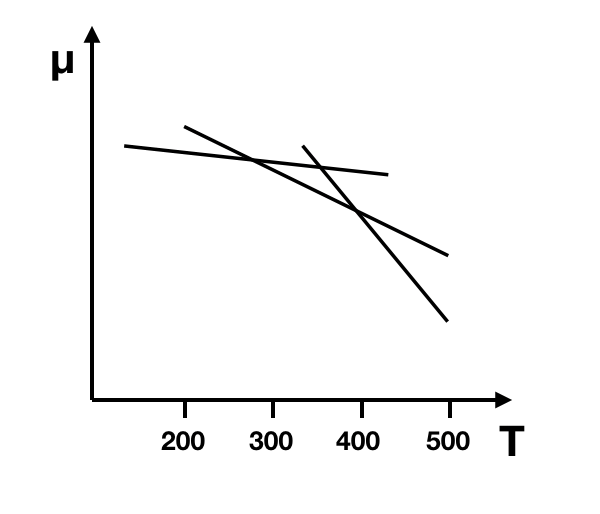
The following phase diagram for substance X shows its chemical potential as a function of temperature (in K). The usual three phases are present (gas, liquid, solid), but are not labelled.
Which phase is the most stable at T = 200 K?
solid
gas
it's impossible to say based on this diagram
liquid1
solid
If we increase the pressure on top of a pure substance, the boiling temperature of the substance will:
usually increase, but it depends on the substance
always decrease
always increase
usually decrease, but it depends on the substance
always increase
The boiling point of methane at P = 1 atm is T = 111.65 K.
The chemical potential of which phase of CH4 will be smaller at that point (P =1 atm and T = 111.65 K)?
liquid
gas
solid
Both liquid and gas will have the same chemical potential
Both liquid and gas will have the same chemical potential

The following is the P/T phase diagram for substance Y.
What is the name of point A?
critical point
Boyle temperature
Gibbs phase
triple point
triple point
The following is the P/T phase diagram for substance Y (same diagram as in question 4).
(same pic as before)
What is the name of point B?
critical point
Gibbs phase
triple point
Boyle temperature
critical point

The following is the P/T phase diagram for substance Y (same diagram as in question 4 and 5).
Using the Gibbs phase rule: f = c - p + 2, calculate the number of degrees of freedom of point A?
2
3
0
1
f = 2 - 2 + 2 = 2

The following is the P/T phase diagram for substance Y (same diagram as in question 4,5,6).
Which of the following substances does the diagram describe?
water
carbon dioxide
ammonia
ethane
water
The critical point of nitrogen is at P = 33.5 bar and T = 126.2 K.
If a chemical plant is operating at room temperature, what is the minimum pressure at which it can produce supercritical N2 fluid?
it can't, it needs to reduce the temperature
at P = 14.2 bar
at P = 33.5 bar
at P = 79.2 bar
at P = 33.5 bar


The following is the Pressure/molar Volume phase diagram for substance Z (new diagram).
Which phase is present at point A?
solid
gas
gas + liquid
liquid
gas (outside solid + liquid dome)


The following is the Pressure/molar Volume phase diagram for substance Z (same diagram in question 9).
Calculate the degrees of freedom of point B (Gibbs phase rule is given in question 6):
0
2
1
3
f = c - p + 2
= 1 (singular Z component) - 2 (solid and liquid) + 2 = 1