atomic structure

0.0(0)
Studied by 2 people
call kaiCall Kai
learnLearn
examPractice Test
spaced repetitionSpaced Repetition
heart puzzleMatch
flashcardsFlashcards
GameKnowt Play
Card Sorting

1/34

encourage image

There's no tags or description

Looks like no tags are added yet.

35 Terms

1
New cards

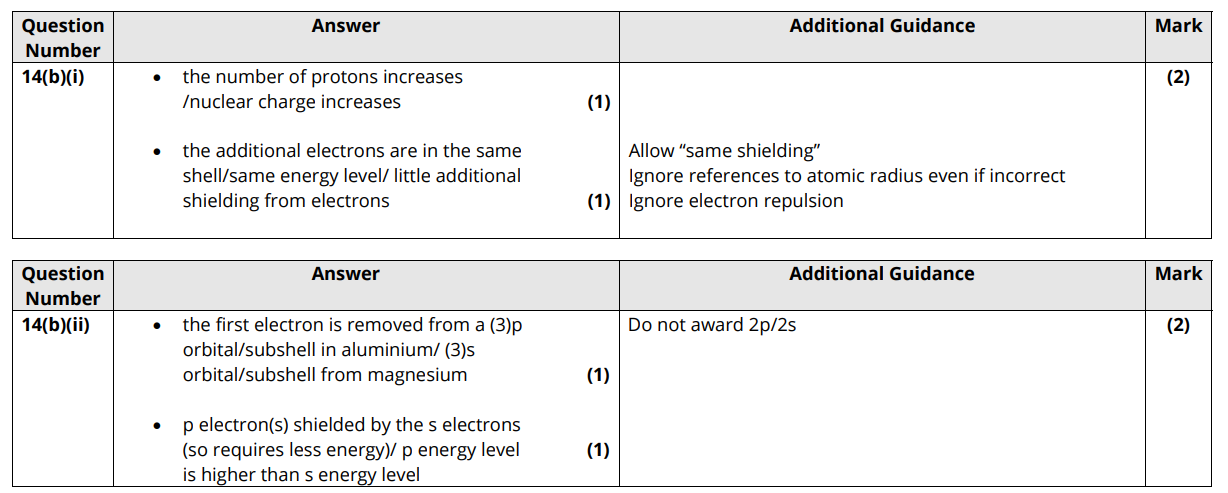
factors that affect ionisation energy of an electron

  • the orbital in which the electron exists

  • the nuclear charge of the atom

  • the repulsion/shielding experienced by the electron
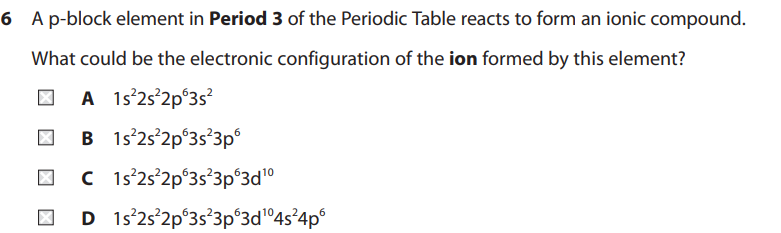

2
New cards
term image
knowt flashcard image
3
New cards
term image
knowt flashcard image
4
New cards
term image
knowt flashcard image
5
New cards
term image
knowt flashcard image
6
New cards
term image
knowt flashcard image
7
New cards
term image
knowt flashcard image
8
New cards
term image
knowt flashcard image
9
New cards
term image
knowt flashcard image
10
New cards
term image
knowt flashcard image
11
New cards
term image
knowt flashcard image
12
New cards
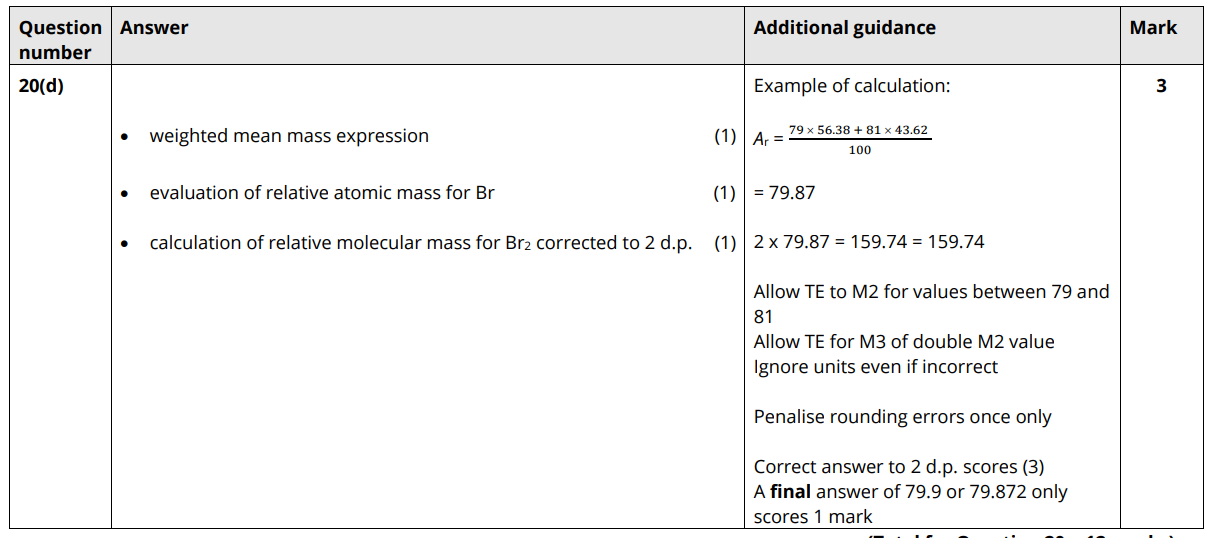
<p>Naturally occurring bromine has two isotopes: bromine‑79 and bromine‑81</p>

Naturally occurring bromine has two isotopes: bromine‑79 and bromine‑81

knowt flashcard image
13
New cards
term image
knowt flashcard image
14
New cards
term image
knowt flashcard image
15
New cards
term image
knowt flashcard image
16
New cards
term image

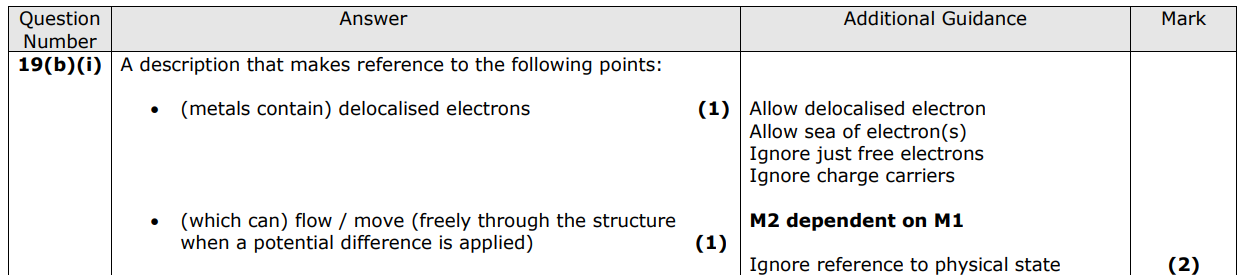
An answer that makes reference to the following points: • the (weighted) average/mean mass of atom(s) • relative to 1/12th (the mass) of one atom of carbon-12

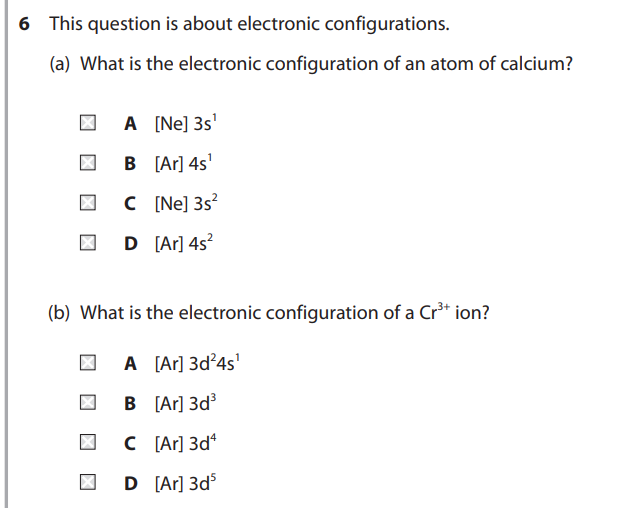
<p>An answer that makes reference to the following points: • the (weighted) average/mean mass of atom(s) • relative to 1/12th (the mass) of one atom of carbon-12</p>
17
New cards
term image
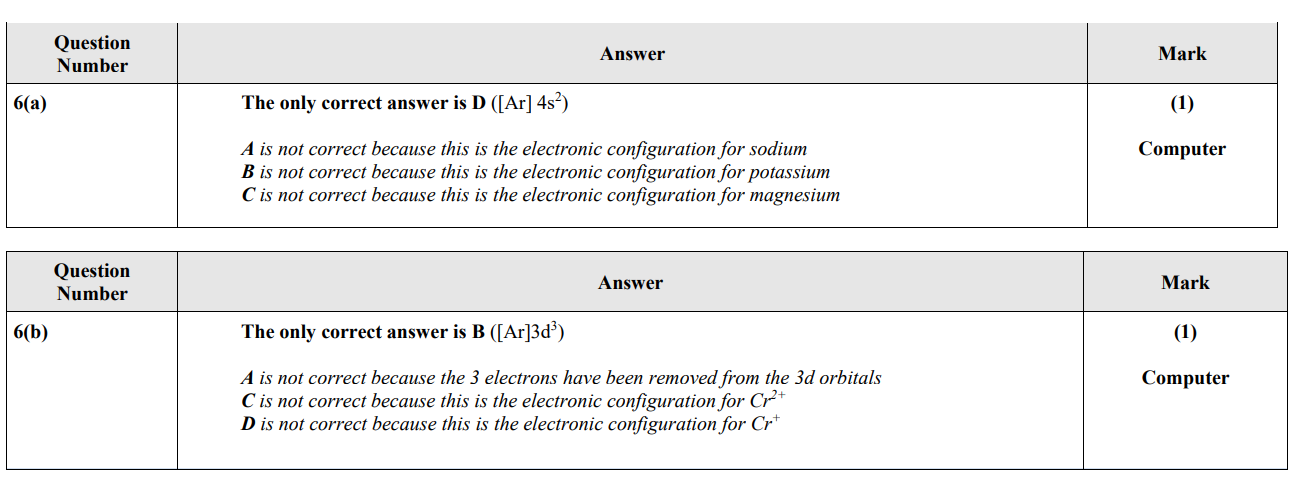
  • Forming the \(\text{Cr}^{3+}\) Ion: A \(3+\) charge indicates the loss of three electrons. When transition metals form cations, electrons are always removed from the outermost shell (highest principal quantum number, \(n\)) first.

  • Electron Removal Order: First, the single electron in the \(4\text{s}\) orbital is removed, leaving \([\text{Ar}]\,3\text{d}^5\). Next, two more electrons are removed from the \(3\text{d}\) subshell, resulting in \([\text{Ar}]\,3\text{d}^3\).
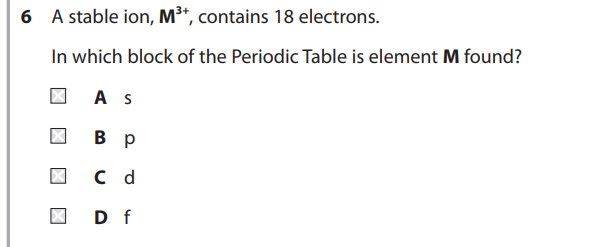
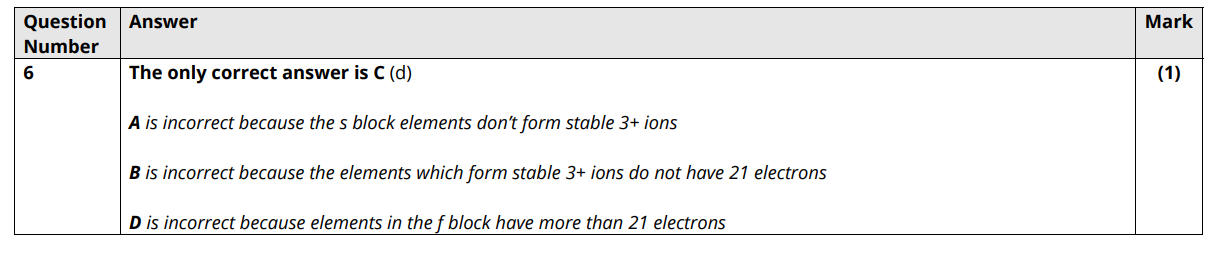
<ul><li><p><span><strong>Forming the \(\text{Cr}^{3+}\) Ion:</strong> A \(3+\) charge indicates the loss of three electrons. When transition metals form cations, electrons are always removed from the outermost shell (highest principal quantum number, \(n\)) first.</span></p></li><li><p><span><strong>Electron Removal Order:</strong> First, the single electron in the \(4\text{s}\) orbital is removed, leaving \([\text{Ar}]\,3\text{d}^5\). Next, two more electrons are removed from the \(3\text{d}\) subshell, resulting in <strong>\([\text{Ar}]\,3\text{d}^3\)</strong>.</span></p></li></ul><p></p>
18
New cards
term image
knowt flashcard image
19
New cards
term image
knowt flashcard image
20
New cards
term image
knowt flashcard image
21
New cards
term image
knowt flashcard image
22
New cards
term image
knowt flashcard image
23
New cards
term image
knowt flashcard image
24
New cards
term image
knowt flashcard image
25
New cards
term image
knowt flashcard image
26
New cards
term image
knowt flashcard image
27
New cards
term image
knowt flashcard image
28
New cards
term image
knowt flashcard image
29
New cards
term image
knowt flashcard image
30
New cards
term image
knowt flashcard image
31
New cards
term image
knowt flashcard image
32
New cards
term image
knowt flashcard image
33
New cards
term image
knowt flashcard image
34
New cards
term image
knowt flashcard image
35
New cards
term image
knowt flashcard image