Cell Mediated Immunity 1
 Call Kai
 Learn
 Practice Test
 Spaced Repetition
 Match
 Flashcards
 Knowt Play
1/38

There's no tags or description
Looks like no tags are added yet.
39 Terms
Why are both T and B cells important for effective immunity?
T cells regulate B cell development and IgG antibodies cannot be produced by B cells without T cells to activate them
therefore without T cell function, B cell function cannot occur
Which antibodies are B cells able to produce without T cells?
IgM antibodies
What happens to animals without T cells?
they lead short lives of continuous infection until their bodies become overwhelmed due to an inadequate immune response
What is the structure of a T cell receptor?
an alpha chain and beta chain held together by a disulphide bond combine to form a completely unique antigen binding site
What are the 2 types of T cell receptor?
alpha/ beta heterodimers
gamma/ delta heterodimers
What are the features of alpha/beta T cell receptors?
membrane bound
can only bind to class I or II antigens presented on MHC molecules
What are the features of gamma/delta T cell receptors?
non-membrane bound
can bind to free, specialised antigens (not just restricted to MHC molecules)
How is the diversity of T cell receptors in an individual generated?
somatic DNA recombination which occurs after conception (not hereditary)
Where does T cell selection occur?
thymus gland
How are T cells selected in the thymus?
T cell is presented an MHC molecule (positive selection)
if T cell recognises and binds strongly, it is selected for and if it does not recognise the MHC molecule/ binds very weakly it undergoes apoptosis
T cell is presented a self antigen (negative selection)
if the T cell recognises and binds to the antigen, it undergoes apoptosis and if it does not recognise it, it is selected for
selected T cells travel from the thymus into the blood
Which 2 things must a T cell be able to do to be selected in the thymus?
recognise and bind strongly to an MHC molecule
not recognise and not bind to a self antigen
What is an MHC molecule?
a Major Histocompatibility Complex molecule; a protein found on the surface of all cells which acts as an antigen/ identity tag
Which MHC molecules are T cells able to recognise?
either a class I or a class II molecule
How must an antigen be presented to T cells in order for them to be recognised?
antigenic protein is processed and presented as a peptide in the groove of an MHC class I or II molecule
What is the difference between MHC class I and II molecules?
MHC class I is expressed on all nucleated cells in the body except RBCs, platelets and nerve cells
MHC class II is expressed only on the surface of progessional antigen presenting cells
What are the 3 main types of antigen presenting cell?
dendritic cells
macrophages
B-cells
What is the function of MHC molecules?
to transport samples of intracellular proteins to the cell surface, allowing detection by T cells
How are self cells recognised?
proteins produced by all nucleated cells are continuously degraded by the cell into peptides which are expressed on the cell surface within a groove of the MHC molecule
circulating T cells do not respond when the peptides are normal products of the self cells
How is a foreign peptide recognised on the surface of a cell?
the peptide expressed in the groove of an MHC molecule is altered from the normal self peptides, meaning that circulating T cells are able to bind to it and trigger an immune response
What is MHC/genetic restriction of the immune response?
T cells are only able to recognise foreign peptides if they are presented in the groove of MHC molecules
How is MHC restriction of the immune response enforced?
CD4 and CD8 molecules bind MHC molecules at sites distal to the peptide cleft which stabilises the APC/lymphocyte interaction
What are the 2 key routes for an antigen to enter an APC?
direct entry to the cytosol (MHC class I restricted)
phagocytosis/ endocytosis. binding to sIg (MHC class II restricted)
What controls which type of antigen processing and presentation process occurs?
the route of entry of the antigen
What type of antigen processing occurs when an antigen enters a cell via direct entry to the cytosol?
endogenous
What type of antigen processing occurs when an antigen enters a cell via phagocytosis/ endocytosis/ binding to sIg?
exogenous
How are naive T cells activated in a new infection?
only professional APCs are able to do this (dendritic cells, macrophages and B cells)
once a T cell is primed, this activating step doesn’t need to happen again
What happens during endogenous antigen processing?
proteins from intracellular pathogens are processed via the cytosole and proteasome to produce peptides which are presented by MHC class I molecules on the surface of the cell to be recognised by the T cell receptors on CD8+ T cytotoxic lymphocytes which enhance cell mediated immunity
What happens during exogenous antigen processing?
proteins from extracellular pathogens are processed via the endocytic pathway which produces peptides to be presented by MHC class II molecules on the cell surface which are recognised by T cell receptors on CD4+ T helper lymphocytes which enhance humoral and cellular immune responses
Which T cells can be activated by dendritic cells?
both MHC I and II binding cells
Which T cells can be activated by macrophages?
only MHC II binding cells

A
antigen binding site

C
carbohydrate
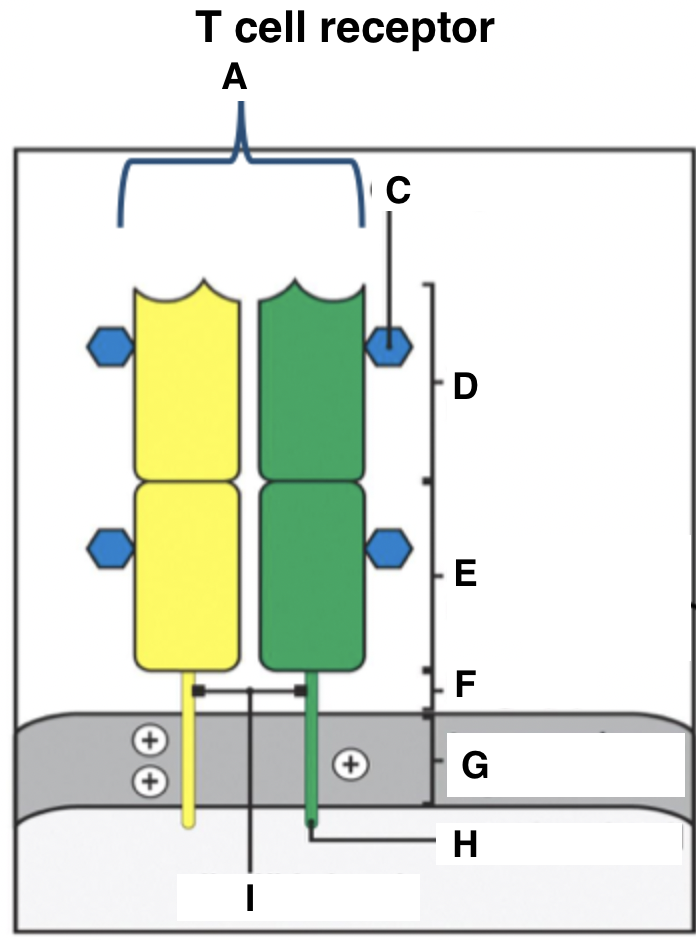
D
variable region

E
constant region
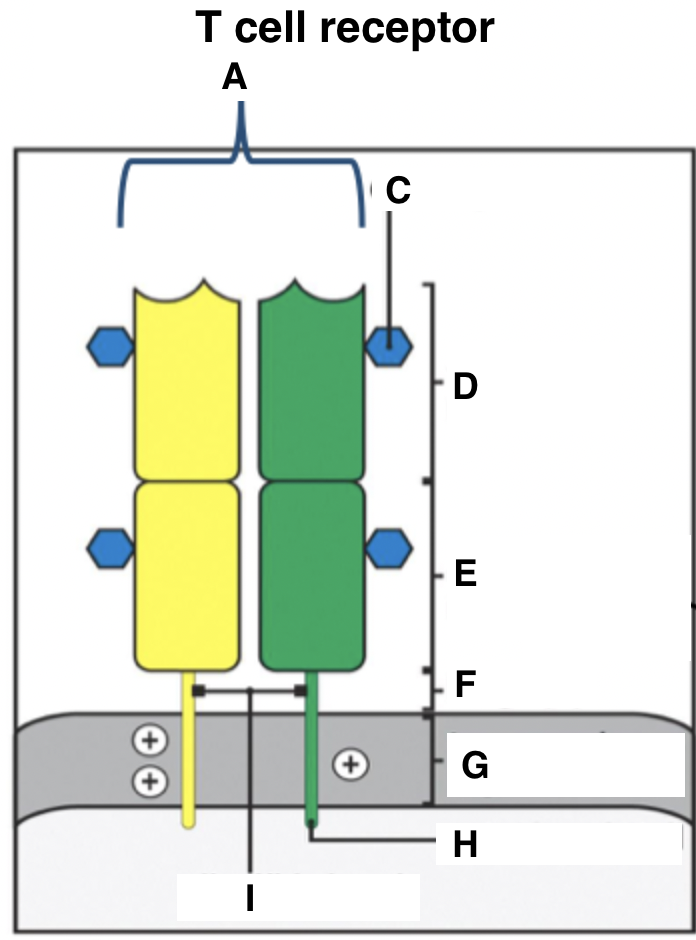
F
hinge

G
transmembrane region

H
cytoplasmic tail

I
disulfide bond
What are the 3 key differences between a naive and a primed immune response?
naive response starts at lymph nodes draining the site of the antigen exposure, while primed starts at the local site of antigen exposure
naive response involves lymph nodes and spleen but primed involves mucosa-associated lymphoid tissue
naive response is much slower than primed