Girl threw her wam in a circle
 Call Kai
 Learn
 Practice Test
 Spaced Repetition
 Match
 Flashcards
 Knowt Play
1/47

There's no tags or description
Looks like no tags are added yet.
48 Terms
What can a company not be successful without?
Safety, quality, & production
Accident costs that must be controlled:
Direct costs = costs paid (or partially paid) by insurance (ex: medical costs)
Indirect (hidden) costs = uninsured costs and often are not tracked or accounted for (ex: schedule delays)
Indirect-to-Direct Cost Ratio
Can range from 1:1 to 20:1, but conservative ratio is 4:1
Experience Modification Rate (EMR)
Dependent on the number and value of claims the establishment had over the last 3 years
- Average= 1.00
- Above 1.00 = Surcharge
- Below 1.00 = Discount
Typical Construction Insurance Plans
Deductible must be met before insurance picks up coverage; the higher the deductible amount, the lower the premium
Jobsite Inspection Duties for: Employees, foremen, supervisors and managers, and safety
- employees = inspect their own tools, equipment, and PPE on a daily basis
- foremen = inspects their work areas throughout the workday
- supervisors and managers = conduct management oversight inspections/audits
- safety = conduct regular safety system audits
Jobsite Inspection Priority Levels
A = Major: requires immediate action
B = Serious: requires short-term action
C = Minor: requires long-term action
What must be done before stepping off excavating equipment?
Instruct operators to lower the boom to the ground and turn off machine before stepping off.
When is a powered industrial truck considered unattended?
When operator is 25 ft. or more away from the vehicle
What is required to guard reinforcing steel?
Reinforced caps designed for impalement protection may be used; not mushroom caps
When can cast-in-place concrete forms be removed?
Forms shall not be removed until concrete strength is sufficient to support its weight & any other imposed loads
Precast Concrete safety factors for: tilt up, precast, and lifting hardware
Tilt up inserts: 2/1 safety factor
Precast inserts: 4/1 safety factor
Lifting hardware: 5/1 safety factor
When would a masonry limited access zone be provided?
Establish prior to start of work for walls over 8 ft. and remain until the wall is adequately supported
What is required of a masonry limited access zone?
- equal to the height of wall plus 4' & run full length of wall
- establish on non-scaffolded side of wall
Council for Masonry Wall Bracing:
Initial period = only one workday allowed to lay masonry above its base or top bracing level. Bracing must be installed by the end of the day. Stop work and evacuate if wind speeds go over 20 mph
Intermediate period = time following initial period until wall is connected to structural elements. Evacuate when wind speeds exceed 35 mph
What is the leading cause of death in construction?
Falls
When ia fall protection required?
Required at 6' or greater above the work/walk surface
Guardrail Systems Requirements:
- Toprail @ 42" +/- 3" must meet 200 lb force
- Midrail @ 21" +/- 3" must meet 150 lb force
- Toeboard 4" must meet 50 lb force
Guardrail Systems rope requirements:
- Wire rope guardrail flagged for visibility every 6'
- Wire rope may not deflect more than 3" (not below 39" from walking surface)
Toeboards must be:
- 3 1/2" nominal height (2x4)
- 50 lb strength
- must extend to height of materials
Hole Covers requirements:
- holes 2" diameter or larger must be covered
- marked cover or hole or color coded
- must be secured
- support twice the maximum intended load
Personal Fall Arrest Systems (PFAS) consist of:
full body harness, connector, and anchorage
Arresting forces of PFAS
- Full body harness must limit arresting force to 1800 lbs
- Most shock absorbing lanyards reduce arresting force to 900 lbs or less
Gate Strength Equipment Design
Gate strength increased from 220 lbs to 3600 lbs to prevent forced roll out (gate failure)
Use of body belts
not designed for fall arrest; only used as a positioning device or restraint device only
Fall Protection Systems - Anchorage Points
Must support 5000 lbs. per employee; can only be designed by a qualified person to meet a safety factor of 2
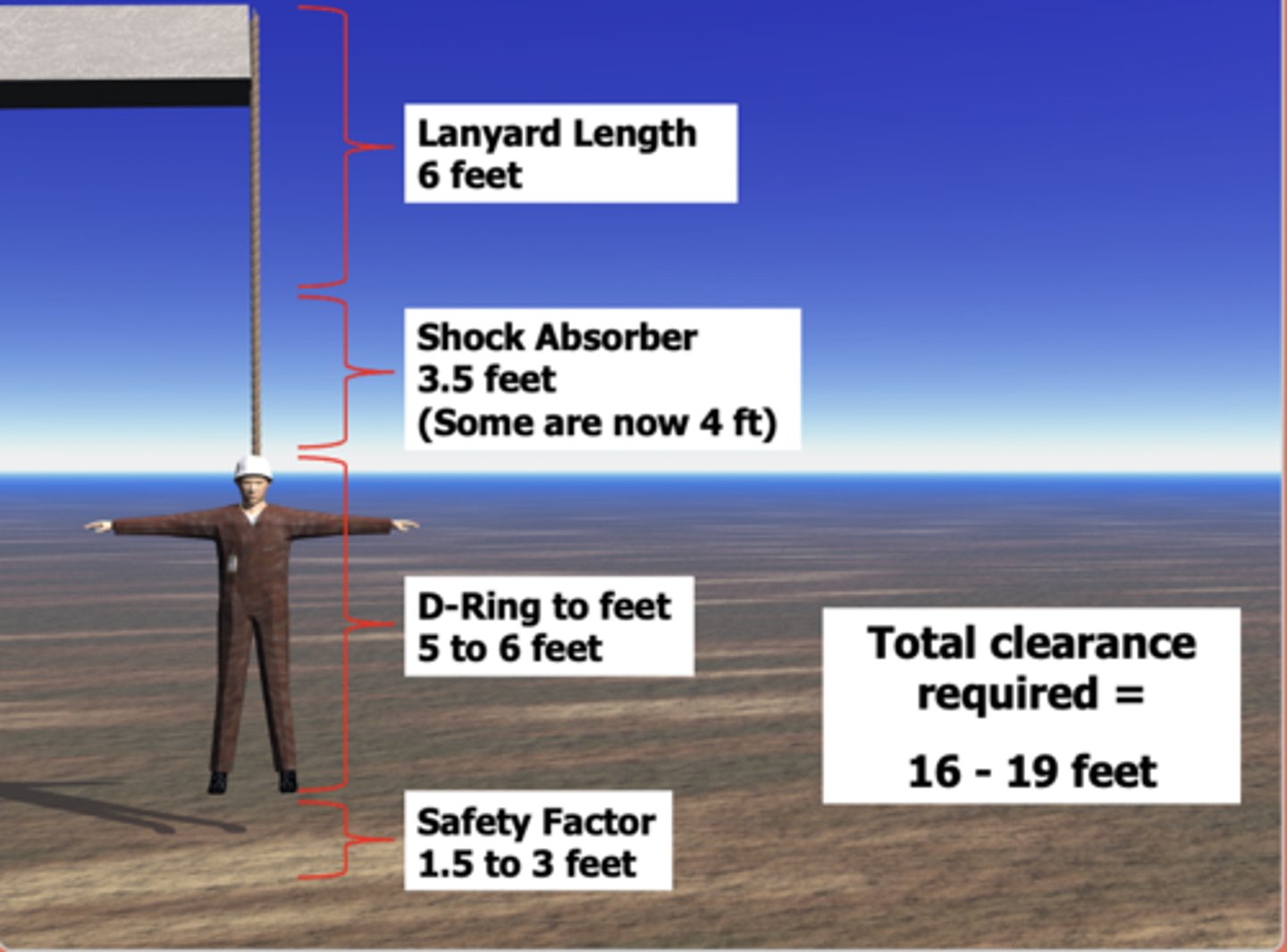
Fall Clearance Distance
- must limit employee free fall distance to 6' or less
- 19 ft of clearance distance is typically needed
Low Slope vs. Steep Slope Roofs
- Low slope = having a slope less than or equal to 4 in 12 (vertical to horizontal)
- Steep slope = having a slope greater than 4 in 12 (vertical to horizontal)
How can employees be protected on low slope roofs?
May use conventional fall protection or a combination of warning line and safety monitor system; on roofs 50 ft or less, may use safety monitoring system alone
Warning Line Systems
- used on low slope roofs only
- line to be not less than 6' from edge of roof
- when mechanical equipment is being used, the warning line shall be not less than 6' from edge which is parallel to the direction of mechanical equipment and not less than 10' from edge which is perpendicular to equipment operation direction
To consist of ropes, wires, or chains ad stanchions as follows:
- flagged at least every 6'
- lowest point no less than 34"
- highest point no more than 39"
- capable of resisting a force of at least 16 lbs applied against stanchion
- the line to have a minimum tensile strength of 500 lbs
Where should safety nets be installed?
No more than 30' below the working area
How are safety nets tested?
Nets must be drop tested with a 400 lb bag of sand prior to use or certified
Signs, Signals, & Barricades
construction in highway/road work zones is one of the most hazardous occupations in the U.S.
When signs, signals, and barricades do not provide the necessary protection on or adjacent to streets, _ must be provided.
flaggers (use flags only in emergency situations)
Hand signaling by flaggers must be done with a standard _ at least _ square.
- STOP/SLOW sign paddle
- 18"
Flaggers for night work must be visible at minimum distance of _, daytime _.
- 1000'
- 500'
Five basic requirements for traffic control devices:
- fulfill a need
- command attention
- convey a clear, simple meaning
- command respect of road users
- give adequate time for proper response
Traffic Control Zones:
1.Advance Warning Area: Tells traffic what to expect ahead.
2.Transition Area: Moves traffic out of its normal path.
3.Buffer Space: Provides protection for workers and motorists.
4.Work Area: Workers, equipment and materials (work being performed).
5.Termination Area: Allows traffic to resume a normal path of travel.
Focus four
1. Falls
2. Electrical
3. Caught in-between
4. Struck by
How can struck by falling objects be prevented?
Toeboards with guardrailing systems, nets/screening for debris control, and overhead canopies at entrances
Severity of electrical shock depends on:
path of current, amount of current, and length of time exposed to current
Ground Fault Circuit Interrupters trip when _ at _.
- when they detect a fault in the electrical circuit
- at 4-6 milliamps
Live parts 50 volts or greater must be guarded by ___________________________.
- location in a room accessible only by electricians
- partitions/screens only to electricians
- location on balcony/platform that excludes unqualified persons
- elevation of 8 ft or more above working surface
Minimum working clearances:
- 3 feet from opening
- no less than 30 in wide
GFCI protection required on all _ that are not part of permanent wiring system.
120v 15-20 amp outlets
GFCI protection to be required on all portable generators _ or greater.
5kW (5000 watts)
Repairs can only be made to _____ gauge or larger extension cords
12 guage