Ancient Science Midterm1
 Call Kai
 Learn
Learn Practice Test
 Spaced Repetition
 Match
Match Flashcards
 Knowt Play
1/41

There's no tags or description
Looks like no tags are added yet.
Name | Mastery | Learn | Test | Matching | Spaced | Call with Kai | Chat |
|---|
No analytics yet
Send a link to your students to track their progress
42 Terms
arche (ar-KAY)
Context: Pre socratic philosophers
Important Idea/Aspect: The first principals - each pre socratic philosopher had a different opinion on what the first principal was
Material monists
Context: Pre Socratic Philosophers – Natural Philosophy
Important Idea/Aspect: The pre socratic philosophers who beleived the first principal was ONE thing (Thales-WATER, Anaximander-BOUNDLESS, Anaximenes-AIR, Heraclitus-FIRE)
Atomoi
Context: Democritus - Natural Philosophy
Important Idea/Aspect: means “Uncuttable” - base of atom, and anatomy. Democritus says the first principals are infinite, indivisible, and atomic
Unity of opposites
Context: Heraclitus - Natural Philosophy
Important Idea/Aspect: Heraclitus believed that the reason things exist is because there is an opposite to it. You can not be cold if there is not warmth, you can not feel “happy” if there is no sad
Monochord
Context: Pythagoreans - Music
Important Idea/Aspect: A single stringed musical instrument made by the pythagoreans and they would put a bridge under the string to see how it changed the tone. They used this to demonstrate the numerical rations behind music
Harmony of The Spheres
Context: Pythagoreans - Music and Astronomy
Important Idea/Aspect: From idea that objects make sound when they hit the surrounding medium (vibrating makes an object hit air) so when the planets/heavenly bodys moved through the air they would produce sound. Because the ratios between their distances are ratios of musical intervals, it creates a harmony. We do not hear it because we were born into it.
Incommensurability
Context: Pythagoreans - Geometry
Important Idea/Aspect: Found that its possible to have incommensurable magnitudes (such as square root 2) which was an issue because they believed everything as numbers. SO everything should be able to be expressed numerically.
Recollection
Context: Plato - Philosophy
Important Idea/Aspect: Platos theory that learning is a process of remembering “the forms” which exist beyond the heavens. Learning is just remembering what we already know. Shown in Menos
Platonic Forms
Context: Plato - Philosophy
Important Idea/Aspect: Plato believed that beyond the heavens were these “platonic forms”. They were perfect an unchanging essence of all things that exist. We saw the “forms” before we are born and as we learn its actually just us recovering our memory of the forms.
Mathemata
Context: Plato- Mathmatics
Important Idea/Aspect: The things that plato believed all people should learn/know before they are placed in a leadership position. study Geometry, Solid geometry, Arithmetic, Astronomy, and Harmonic theory before they can study “the forms”
Platonic solids
Context: Plato - Geometry and Astronomy
Important Idea/Aspect: 5 regular 3D shapes that plato associated with the fundamental elements of the cosmos “Body” —- Air, Water, Earth, Fire, cosmos. There are the principals of nature in timaeus
Body and Soul of the cosmos
Context: Plato, Timeaus, Astronomy
Important Idea/Aspect: Plato believed the Cosmos had a body and a soul. The body was made up of the platonic solids and the soul was made of the Same and The Different
Homocentric Spheres
Context: Eudoxus - Astronomy
Important Idea/Aspect: Each planets motion results from the combined motion of different spheres
Hippopede
Context: Eudoxus
Important Idea/Aspect: Figure 8 curve produced by the rotation of Eudoxus’s homocentric spheres. Designed to explain retrograde motion.
Incubation
Context: Asclepius - Medicine
Important Idea/Aspect: When someone sick would stay in a sanctuary of asclepius and asclepius or one of his helpers would visit them in a dream and either heal them or tell them what to do.
Hippocratic Corpus
Context: Hippocrates - Medicine
Important Idea/Aspect: Collection of around 60 texts attributed to Hippocrates of Cos ( a physician)
Techne
Context: Hippocrates - Medicine
Important Idea/Aspect: Described ancient medicine as a Techne - an Art/Craft
Humoral Theory
Context: Hippocrates - Medicine
Important Idea/Aspect: The central hippocratic theory (in The Nature of Man) is that the human body is made up of 4 humors - Yellow bile, black bile, Phlem, and Blood. Heath is when each of these are balanced throughout the body. Sickness occurs when there is an excess, or an unevenness of the humors.
Principal of Opposition
Context: Hippocrates- Medicine
Important Idea/Aspect: People should treat their illness with opposites - EX: if you have excess phlem which occurs due to wet and cold, you would treat with hot and dry food/diet
Regimen
Context: Hippocrates - Medicine
Important Idea/Aspect: When you manage illness with diet or lifestyle change
Miasma
Context: Hippocrates - Medicine
Important Idea/Aspect: when everyone in a population gets sick, instead of it being in imbalance in the 4 humors, they say there is something called miasmas that enter the body. These miasmas stain/fill the air.
Wandering Uterus
Context: Hippocrates - Medicine
Important Idea/Aspect: The uterus moves when it is too dry & light which causes pain and symptoms. Its recommended that a women be pregnant or have intercourse for it to stay in place

Papyrus Smith
Context: Egyptian Medicine
Important Idea/Aspect: Famous for taking the rational and scientific approach to illness/ truamas. Includes mostly head injurys and then gives the type/location of injury, explains the examination, then eitehr says I will treat, i will try to treat, or I can not treat. The treatments include practical remedys

Papyrus Ebers
Context: Egyptian Medicine
Important Idea/Aspect: Has an encyclopedia with prescription for almost every illness - blends science and magic
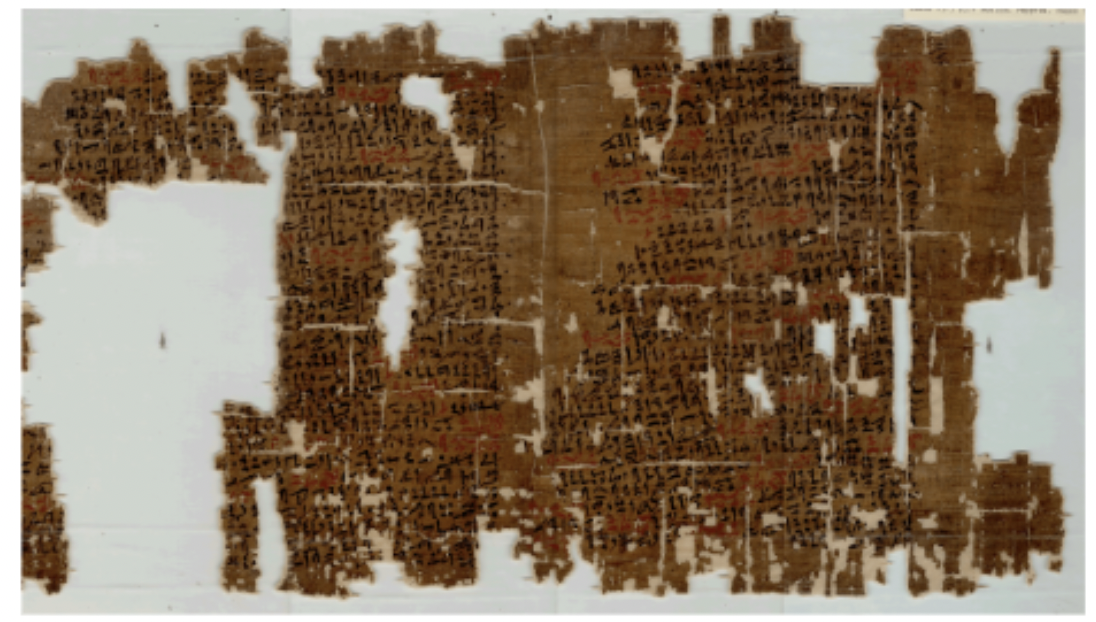
Papyrus Kahun
Context: Egyptian medicine
Important Idea/Aspect: Gynecological cases - explains how the egyptians believed the uterus was connected to the mouth

Plimpton 322
Context: Babylonian Math
Important Idea/Aspect: Explains the Babylonian math system: base 60 and how they wrote their #s
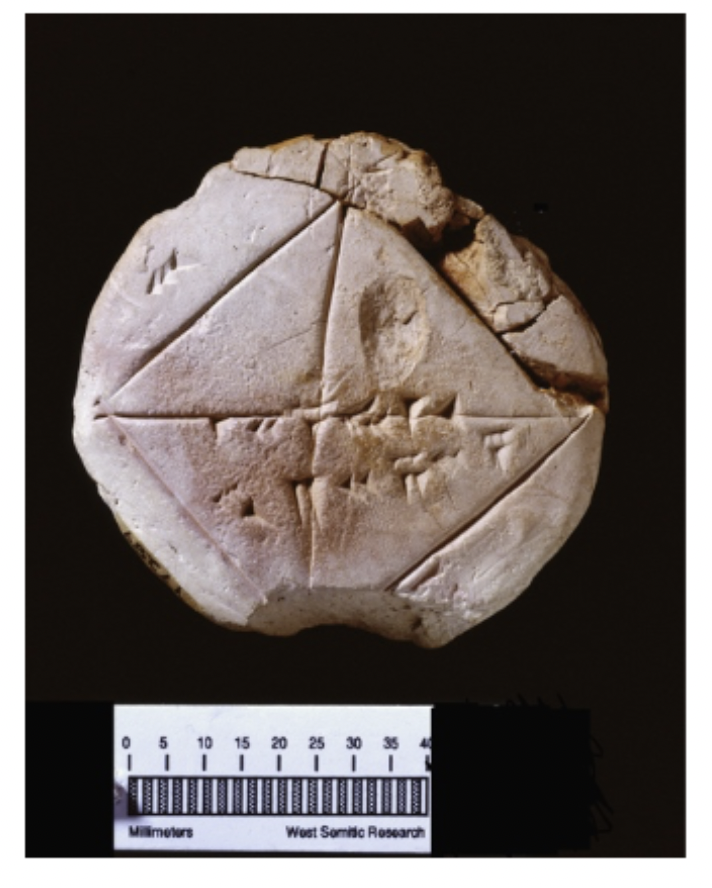
YBC 7289
Context: Babylonian Math
Important Idea/Aspect: Used in school to find the diagonal of a square using coefficient that approximates the square root of 2. The babylonians showed they know how to do the math but never mentioned how the diagonal is incommensurable.

The Monochord
Context: Pythagoreans - Music
Important Idea/Aspect: single stringed instrument where the pythagoreans used a bridge to divide the string into mathematical whole # ratios, these ratios formed harmonies.

The Meno’s Problem
Context: Plato - Philosophy
Important Idea/Aspect: In platos Menos he shows Socrates teaching Menos that knowledge is through recollection by using a square like in this image and asking the boy to double the size of the square. By not telling and only asking questions Socrates walks the boy through the problem.

The Platonic Solids
Context: Plato - Geometry & Astronomy
Important Idea/Aspect: Plato believed each solid represented one of the 5 elements that make up the earth - air, water, earth, fire, cosmos. These make up the BODY of the cosmos

Circle of the Same and the Different
Context: Plato - Astronomy
Important Idea/Aspect: This makes up the SOUL of the cosmos.

Eudoxus’ Homocentric Spheres
Context: Eudoxus - Astronomy
Important Idea/Aspect: The spheres each hold a heavenly body, then one holds the “fixed stars”. There is a system of spheres all connected at the same axis—- the system also explains retrograde motion

Sanctuary of Asclepius in Epidaurus
Context: Asclepius- Medicine
Important Idea/Aspect: Sick people would go to this sanctuary and stay there for a night and Asclepius would visit them and either heal them or give them a regimine. The workers at the sanctuary would then interpret the dream if necessary.

Humoral Theory
Context: Hippocrates - Medicine
Important Idea/Aspect: From On the Nature of Man it explains how the body is made of 4 humors- phlem, blood, black bile, yellow bile, and also explains how each corresponds to wet or dry and hot or cold and a season.

Votive Terracotta Womb
Context: Etruscan - Roman Medicine
Important Idea/Aspect: It was used to either thank god or make a request. looked like a baby/ uterus. Was mainly in Italy.
Anaximander
Believed the first principal was THE BOUNDLESS bc the 4 elements change into one another. says the only explanation for continued creation & destruction was smth infinite.
Says the earth remains in place because it is located in the center of the universe and so its not closer to any extreme point than another
Anaximenes
Believed the first principal was AIR. Says its thanks to rarefaction and condensation that it manifests in different forms/ why it can make up all things. When dilated it becomes fire and when condensed it becomes wind then water then earth then stone.
Thales
Believed the first principal was WATER. Says the earth stays where it is being it is floating on water - earthquakes r bc of the movement of the water.
Heraclitus
Believed the first principal was FIRE. Says as its condensed it becomes moist, then water, then solidifies into earth.
Wrote about the river always flowing so it is impossible to step twice into the same river —- a analogy to how people and things r always changing
Came up with The Principal of The Unity Of Opposites
what is true ab reality (Logos) is that reality is made up of opposites- one opposite can not exist w out the other
Empedocles
Believed the first principals are AIR, WATER, FIRE, EARTH, and LOVE&STRIFE. Says they are eternal but change in respect of quantity by combustion and separation. Under the rule of love- the elements are mixed harmoniously. Under the the rule of strife- the elements r divided into spheres, our world exists between the two.

Democritus (& Leucippus)
Believed the elements are THE FULL AND THE VOID. Things differ by shape, arrangement, and position. They say that the first principals are numerically infinite, indivisible, and atomic (unbreakable)
COSMOS: Since there are infinite atoms, there are infinite worlds
PERCEPTION: says the air between the origin of sign and the seen object is compressed by the seen object and the seeing eye so it gains an imprint of the of the object
there are 2 kinds of knowledge - one comes from senses(bastard) and one from thinking (genuine)
Xenophanes
Argued that humans project their own features and flaws onto the gods - says that if dogs or cats could speak, they would make the gods look like themselves.
Early form of skepticism that human knowledge is limited and subject