AP Biology Unit 1: the Chemistry of Life
 Call Kai
 Learn
Learn Practice Test
 Spaced Repetition
 Match
Match Flashcards
 Knowt Play
1/151

There's no tags or description
Looks like no tags are added yet.
Name | Mastery | Learn | Test | Matching | Spaced | Call with Kai | Chat |
|---|
No analytics yet
Send a link to your students to track their progress
152 Terms
Matter
What organisms are composed of
Anything that takes up space and has mass
What is matter made up of?
Elements
Elements
Substances that cannot be broken down to other substances by chemical reactions
Compound
A substance consisting of two or more elements combined in a fixed ratio
Has characteristic different from those of its elements
Essential elements
Carbon, hydrogen, oxygen, nitrogen
A few other elements make up the remaining 4% of living matter
Trace elements
Elements required by an organism in only minute quantities
Atom
The smallest unit of matter that still retains the properties of an element
Each element consists of a certain kind that is different from those of other elements
Subatomic particles
Smaller parts of an atom
Neutrons
Have no electrical charge
Protons
Positively charged
Electrons
Negatively charged
Surrounding the nucleus in a “cloud”
Atomic nucleus
Composed of protons and neutrons
Atomic number
The number of protons
Is unique to each element
Mass number
Sum of protons plus neutrons in the nucleus of an atom
An approximation of the atomic mass of an atom
Isotopes
Atoms of a given element may occur in different forms
They differ in the number of neutrons in the atomic nucleus, but have the same number of protons
Radioactive isotopes
Spontaneously give off particles and energy
Can be used in biology (ex: tracers)
Energy
Defined as the capacity to cause change
Potential energy
The energy that matter possesses because of its location or structure
The electrons of an atom differ in amounts of potential energy they possess
Energy levels
Represented by electron shells
Energy can move from one level to another only if the energy it gains or loses is exactly equal to the difference in energy between the two levels
Electron behavior and configuration determines..
The chemical behavior of an atom
Valence electrons
Electrons in the outermost, or valence shell
Determine the chemical behavior of an atom
Orbital
The three dimensional space where an electron is found 90% of the time
Each orbital holds up to two electrons
Types of orbitals
First shell: one 1s orbital with a maximum of 2 electrons
Second shell: one 2s orbital, and three 2p orbitals
Covalent bond
The sharing of a pair of valence electrons
Ex: when two hydrogen atoms approach each other, the electron of each atom is also attracted to the proton in the other nucleus and the two electrons become shared in a covalent bond, forming an H2 molecule
Molecule
Consists of two or more atoms held together by covalent bonds
Single bond
The sharing of one pair of valence electrons
Ex: two hydrogen atoms and one oxygen atom are joined by covalent bonds to produce a molecule of water
Double bond
The sharing of two pairs of valence electrons
Electronegativity
Attraction of a particular kind of atom for the electrons in a covalent bond
The more electronegative an atom, the more strongly it pulls shared electrons toward itself
Nonpolar covalent bond
Atoms have similar electronegativities
Share the electron equally
Polar covalent bond
Atoms have differing electronegativities
Share the electrons unequally
Ionic bonds
When atoms strip electrons away from their bonding partners
An attraction between anions and cations
Ions
Caused by electron transfer between two atoms
Atoms with more or fewer electrons than usual
Are charged atoms
Anion
Negatively charged ions
Cation
Positively charged ions
Ionic compounds
Called salts, and may form crystals
Weak chemical bonds
Include hydrogen and van der waals forces
Important in living systems
Hydrogen bond
Forms when a hydrogen atom covalently bonded to one electronegative atom is also attracted to another electronegative atom
Van der Waals interactions
Occurs when transiently positive and negative regions of molecules attract each other
What do weak chemical bonds do?
Reinforce the shapes of larger molecules
Help molecules adhere to each other
Molecular shape
Very important to its function in the living cell
Determined by the positions of the atom’s valence orbitals
Covalent bond molecular shape
The s and p orbitals may hybridize, creating specific molecular shapes
They combine to form four teardrop shaped hybrid orbitals (tetrahedron)
What does molecular shapes determine?
How biological molecules recognize and respond to one another with specificity
Chemical reaction
The making or breaking of chemical bonds
Leads to changes in the composition of matter
Convert reactants to products (ex: photosynthesis)
Chemical equilibrium
Is reached when the forward and reverse reaction rates are equal
Water
Something that all living organisms require more than any other substance
The biological medium on Earth
Is the water molecule polar or nonpolar?
A polar molecule
Allows water molecules to form hydrogen bonds with each other
Cohesion
What water molecules exhibit
It is the bonding of a high percentage of the molecules to neighboring molecules due to hydrogen bonding
Helps pull water up through the vessels of plants
Surface tension
A measure of how hard it is to break the surface of a liquid
How does water moderate air temperature?
It absorbs heat from air that is warmer and releases the stored heat to air that is cooler
Kinetic energy
The energy of motion
Heat
A measure of the total amount of kinetic energy due to molecular motion
Temperature
Measures the insanity of heat
Specific heat
The amount of heat that must be absorbed or lost for 1 gram of that substance to change its temperature by 1 degree Celsius
Does water have a high or low specific heat?
A high specific heat, which allows it to minimize temperature fluctuation to within limits that permit life
In water, how is heat absorbed or released?
Absorbed when hydrogen bonds break
Released when hydrogen bonds form
Evaporation
The transformation of a substance from a liquid to a gas
Heat of vaporization
The quantity of heat a liquid must absorb for 1 gram of it to be converted from a liquid to a gas
Evaporative cooling
Due to water’s high heat of vaporization
Allows water to cool a surface
Ice
Less dense than liquid water
Floats in liquid water
Life can still exist under the frozen surface of lakes and polar seas
Hydrogen bonds in ice
More ordered than in liquid water, making ice less dense
The bond are more stable and less likely to constantly break and reform
Is water a solvent?
Yes, because of its polarity
It can form aqueous solutions
How does water interact with solutes?
The different regions of the polar water molecules can interact with ionic compounds called solutes and dissolve them
Ex: the negative oxygen regions of polar water molecules are attracted to sodium cations, whereas the positive hydrogen regions of water molecules cling to chloride anions
Does water interact with polar molecules?
Yes, especially proteins
Ex: the oxygen is attracted to a slight positive charge on lysozyme (protein)
Hydrophilic substance
Has an affinity for water
Hydrophobic substance
Does not have an affinity for water
Mole
Represents an exact number of molecules of a substance in a given mass
Molarity
The number of moles of solute per liter of solution
Can water dissociate?
Yes, it dissociates into hydronic ions and hydroxide ions
Changes in the concentration of these ions can have an effect on living organisms
Acid
Any substance that increases the hydrogen ion concentration of a solution
Base
Any substance that reduces the hydrogen ion concentration of a solution
pH of a solution
Determined by the relative concentration of hydrogen ions
Is low in an acid
Is high in a base
What must the internal pH of most living cells remain close to?
A pH of 7
Buffers
Substances that minimize changes in the concentration of hydrogen and hydroxide ions in a solution
Consist of an acid-base pair that reversibly combines with hydrogen ions
Acid precipitation
Refers to rain, snow, or fog with a pH lower than pH 5.6
Caused by mixing of different pollutants with water in the air
Can damage life in Earth’s ecosystems
Is carbon found in living organisms?
Yes, all living organisms are made up of chemicals based mostly on the element carbon
Vitalism
Organic compounds arise only within living organisms
Was disproved when chemists synthesize compound in laboratory
How many atoms does carbon typically bond with?
Four
How many valence electrons does carbon have?
Four valence electrons
This allows it to form four covalent bonds with a variety of atoms
Has high bonding versatility and covalent capability with many different elements
Carbon chains
Form the skeletons of most organic molecules
Vary in length or shape, from rings to branches
Hydrocarbons
Molecules consisting of only carbon and hydrogen
Found in many of a cell’s organic molecules
Isomers
Molecules with the same molecular formula but different structures and properties
Include three types: structural, geometric, and enantiomers (important in pharmaceutical industry)
Functional groups
Chemically reactive groups of atoms within an organic molecule and give molecules distinctive chemical properties
What are the six functional groups that are important in the chemistry of life?
Hydroxyl, carbonyl, carbohydrate, amino, sulfhydryl, phosphate

What functional group is this?
Hydroxyl
One in which a hydrogen atom is bonded to an oxygen atom, which in turn is bonded to the carbon skeleton of the organic molecule
Written as -OH, sometimes as HO-

What functional group is this?
Carbonyl group
Consists of a carbon atom joined to an oxygen atom by a double bond
>CO

What functional group is this?
Carboxyl group
Consists of an oxygen atom that is double bonded to a carbon atom that is also bonded to a hydroxyl group
-COOH
What organic compounds contain hydroxyl groups?
Alcohols, with their specific names ending in -ol
Ex: ethanol
What organic compounds contain carbonyl groups?
Ketones if the carbonyl group is within a carbon skeleton
Ex: acetone
Aldehydes if the carbonyl group is at the end of the carbon skeleton
Ex: propanal
What organic compounds contain carboxyl?
Carboxylic acids, or organic acids
Ex: acetic acid
What is true about hydroxyl groups?
Are polar as a result of the electronegative oxygen atom
Attracts water molecules, helping dissolve organic compounds
What is true about carboxyl groups?
Have acidic properties because it is a source of hydrogen ions
The covalent bond between oxygen and hydrogen is so polar that hydrogen ions tends to dissociate reversibly

What functional group is this?
Amino group
Consists of a nitrogen atom bonded to two hydrogen atoms and to the carbon skeleton
-NH2
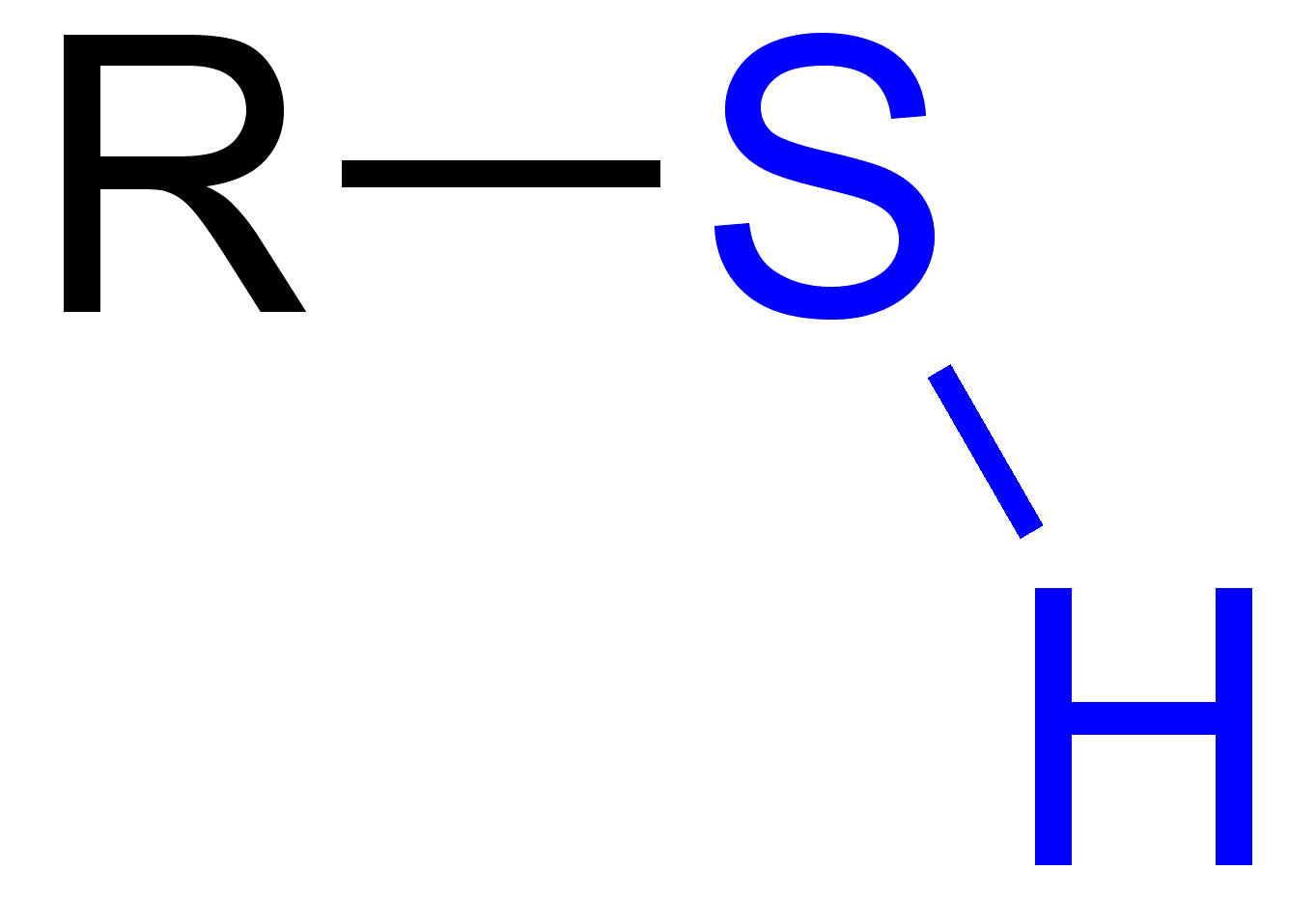
What functional group is this?
Sulfyhdryl group
Consists of a sulfur atom bonded to an atom of hydrogen
-SH, or HS-

What functional group is this?
Phosphate group
A phosphorus atom is bonded to four oxygen atoms; one oxygen is bonded to carbon skeleton, two carry negative charges
-OPO3H2
What organic compounds contain amino groups?
Amine
Ex: glycine, but it also has a carboxyl group so is both an amine and carboxylic acid
What are compounds called who have both amine and carboxylic acids?
Amino acids
What is true about amino functional groups?
Acts as base and can pick up a proton from the surrounding solution to become ionized
Name of compound: amines
What is true about sulfhydryl functional groups?
Two sulfhydryl groups can interact to help stabilize protein sutrcutre
Name of compound: thiol
What is true about phosphate functional groups?
Makes the molecule of which it is a part of an anion
Can transfer energy between organic molecules
Name of compound: organic phosphates
Four main classes large molecules
Carbohydrates, lipids, proteins, nucleic acids