MMA133: Intro to Graphic Design
0.0(0)
Studied by 3 people Call Kai
 Learn
 Practice Test
 Spaced Repetition
 Match
 Flashcards
 Knowt Play
Card Sorting
1/82

Earn XP
Description and Tags
83 Terms
1
New cards
the art and profession of selecting and arranging visual elements—such as typography, images, symbols, and colours—to convey a message to an audience. Sometimes graphic design is called "visual communications," a term that emphasizes its function of giving form—e.g., the design of a book, advertisement, logo, or Web site—to information.
Graphic design
2
New cards
The art or profession of using design elements ( typography and images) to convey or create an effect
Design
3
New cards
Something that is created with imagination and skill that is beautiful or that expresses important ideas or feelings
Art
4
New cards
What are some key distinctions between design and art?
* Design solves problems; art raises questions.
* Design is conclusive; art is open to debate.
* Design follows a script; art creates and interprets its own story.
* Design is driven by the mind seeking solutions; art is the voice of the soul.
* Design relies on collective acceptance; art only requires inner approval.
* Design is an act of empathy; art is an act of freedom.
5
New cards
Why should someone care about graphic design history?
Understanding graphic design history is valuable because it provides insights into the evolution of design trends, techniques, and aesthetics. It offers a foundation for creating meaningful and culturally relevant design work, and it allows designers to appreciate and learn from the innovations of the past.
6
New cards
Why is having a wide visual vocabulary important for becoming a great designer?
Having a wide visual vocabulary is crucial for becoming a great designer because it provides a rich library of historical elements to draw inspiration from. This broad visual knowledge enables designers to create more informed and innovative designs by building upon the ideas and styles of the past.
7
New cards
What advantages does having a visual library of images stored in your memory offer to a designer?
Having a visual library in your memory provides designers with a smarter and more diverse toolset. It enables them to tap into a wide range of visual references and inspirations, enhancing their creativity and problem-solving abilities.
8
New cards
How does design relate to the culture and period in which it was created?
Design is not Darwinian; it doesn't inherently get better over time. Instead, design simply reflects the culture and the period of time in which it was created. Design evolves in response to societal norms, technological advancements, and cultural shifts, shaping its characteristics accordingly.
9
New cards
The evolution of graphic design as a practice and profession has been closely bound to:
* technological innovations
* societal needs
* the visual imagination of practitioners
* societal needs
* the visual imagination of practitioners
10
New cards
Provide examples of ancient civilizations where strong examples of graphic design can be found.
Strong examples of graphic design can be traced back to manuscripts in ancient **China**, **Egypt**, and **Greece**.
11
New cards
When did Graphic Design started?
30,000 BCE
12
New cards
Where is it believed that Homo sapiens, the species of conscious, thinking creatures, evolved from?
It is believed that Homo sapiens evolved from a species that lived in the **southern part of Africa**.
13
New cards
What were the earliest origins of the development of writing and visible language, and how are they connected?
The earliest origins of writing and visible language can be traced back to simple pictures. There is a close connection between drawing pictures and marking writing, as both are natural ways of communicating ideas. Early people used pictures as a basic method to record and transmit information.
14
New cards
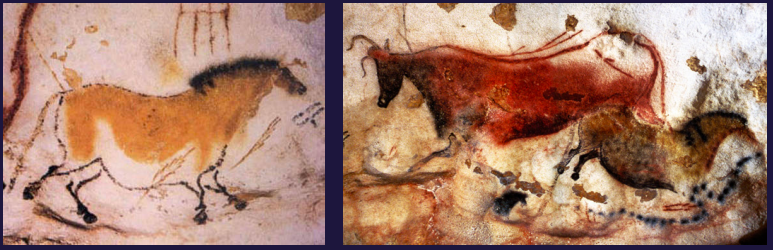
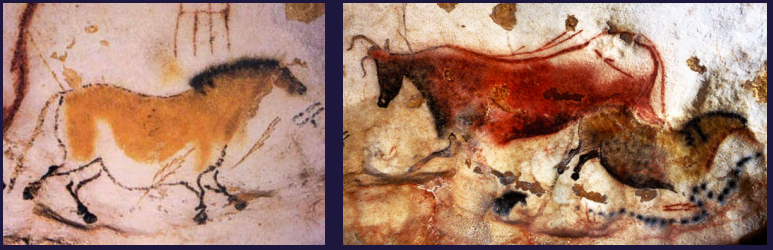
Identify the artwork
**Cave Art at Lascaux**, France
15
New cards
Where can some of the world's first-known works of written communication be found, and what are they?
Some of the world's first-known works of written communication can be found in prehistoric cave paintings located throughout the Pyrenees regions of southern France and northern Spain.
16
New cards
Dating back to around 30,000 BCE, the painted caves raise questions about their nature. What are some of the questions regarding these ancient artworks?
The painted caves, which date back to at least 30,000 BCE, raise questions about whether they should be considered writings, works of art, or possibly even an early form of design from the 1st century.
17
New cards
What does the presence of these paintings in prehistoric caves signify, and what knowledge do they depict?
The presence of these paintings in prehistoric caves signifies that they represent a form of written documentation. These paintings depict:
* knowledge of social hierarchy
* hunting techniques
* seasonality
* knowledge of social hierarchy
* hunting techniques
* seasonality
18
New cards
What is significant about the discovery of visual communication depicted by primitive cultures?
The discovery of visual communication depicted by primitive cultures is significant because it represents the earliest evidence of visual communication in human history. These primitive cultures used visual means to convey information and knowledge, marking a fundamental milestone in the development of human communication.
19
New cards
What materials and pigments were commonly used in prehistoric visual communications, and how were they prepared?
In prehistoric visual communications, **black was made from charcoal**, while a range of warm tones, including light yellows through red-browns, were produced from red and yellow iron oxides. These pigments were typically mixed with **fat** to create a medium for painting.
20
New cards
How were images of animals typically created in prehistoric visual communications, and where were they often found?
In prehistoric visual communications, images of animals were drawn and painted on the walls of former subterranean water channels used as refuges by prehistoric men and women. These images may have been created by smearing pigment onto the walls with a finger or using brushes made from bristles or reeds.
21
New cards
Was the creation of early pictures in prehistoric visual communications the beginning of art as we know it, and what were the primary purposes behind these early pictures?
The creation of early pictures in prehistoric visual communications was not the beginning of art as we know it. Instead, these early pictures were made for survival, **utilitarian, and ritualistic purposes**, signifying the dawning of visual communications.
22
New cards
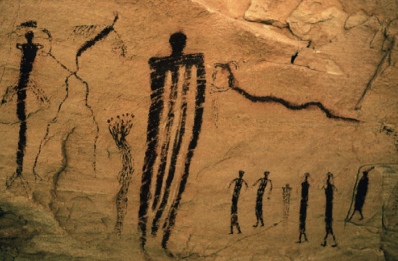
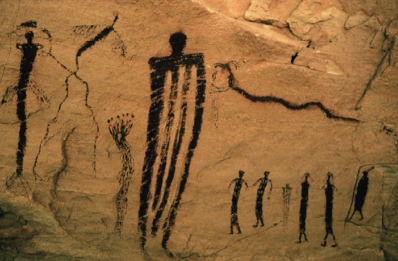
Identify the artwork
**Fremont rock painting from San Raphael Swell**, c. 2000–1000 BCE.
The Fremont people lived in southern Utah.
The Fremont people lived in southern Utah.
23
New cards
What does the presence of spear marks in some prehistoric animal images suggest about their purpose?
The presence of spear marks in some prehistoric animal images indicates that these images were used in magical rites designed to gain power over animals and achieve success in hunting.
24
New cards
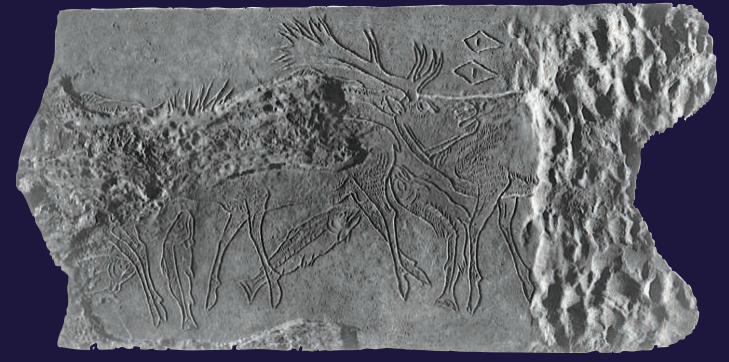
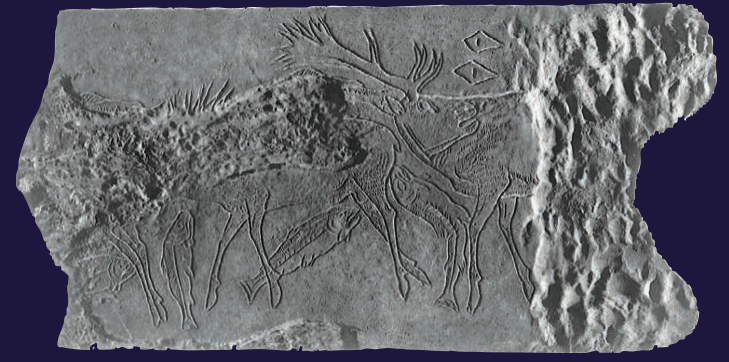
Identify the artwork
**Engraved drawing on a deer antler**, c. 15,000 BCE.
\
This prehistoric image is shown in a cast made by rolling the antler onto clay.
\
This prehistoric image is shown in a cast made by rolling the antler onto clay.
25
New cards
What are some of the abstract geometric signs that are found alongside animals in many cave paintings from prehistoric times, and what is uncertain about their meaning?
In prehistoric visual communications, abstract geometric signs such as dots, squares, and other configurations often accompany animals in cave paintings. It is uncertain whether these signs represent man-made objects or early forms of proto-writing. Due to their creation before the beginning of recorded history, their exact meaning may never be known, as they predate the period during which people began recording knowledge in writing.
26
New cards
What is the connection between the earliest origins of writing and visible language, and how did early people use pictures in communication?
The earliest origins of writing and visible language can be traced back to simple pictures, and there is a close connection between drawing pictures and marking writing. Both are natural ways of communicating ideas. Early people used pictures as an elementary way to record and transmit information.
27
New cards
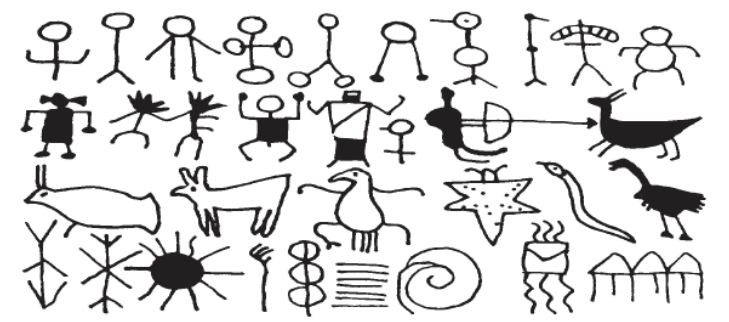
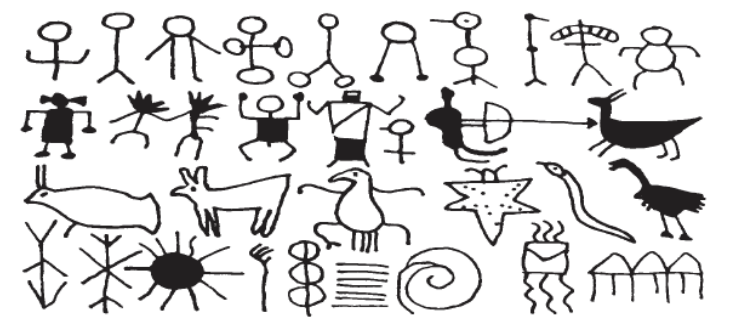
Where are figures, animals, and signs found, and how do they compare to similar findings worldwide?
Figures, animals, and signs have been found carved and sometimes painted on rocks in the western United States. These findings are similar to those discovered in various locations around the world.
28
New cards
Until recent discoveries indicated that early peoples in Thailand may have practiced agriculture and manufactured pottery at an even earlier date, archaeologists had long believed that the ancient land of _____, “the land between rivers,” was the cradle of civilization.
Mesopotamia
29
New cards
Between which two rivers, and in which geographical region, did early human culture find an attractive environment for settlement?
Early human culture found an attractive environment for settlement between the Tigris and Euphrates rivers in the flat, once-fertile plain that spans across the land that is now Iraq, flowing from the mountains of eastern Turkey to the Persian Gulf.
30
New cards
What significant developments occurred around 8000 BCE, marking the beginning of agriculture?
Around 8000 BCE,
* wild grain was planted
* animals were domesticated
* agriculture began as crucial milestones in human history.
* wild grain was planted
* animals were domesticated
* agriculture began as crucial milestones in human history.
31
New cards
What significant developments occurred around 6000 BCE and 3000 BCE, and what invention followed the Bronze Age?
Around 6000 BCE, objects were being hammered from copper, marking early metallurgy.
The Bronze Age was ushered in about 3000 BCE when copper was alloyed with tin to create durable tools and weapons. Following the Bronze Age, **the invention of the wheel took place.**
The Bronze Age was ushered in about 3000 BCE when copper was alloyed with tin to create durable tools and weapons. Following the Bronze Age, **the invention of the wheel took place.**
32
New cards
True or False. The Bronze Age was ushered in about 3000 BCE, when copper was alloyed with tin to make durable tools and weapons. The invention of the wheel followed.
True
33
New cards
who settled in the lower part of the Fertile Crescent before 3000 BCE
Sumerians
34
New cards
The Sumerians invented a system of gods, and their supreme deity was named?
Anu
35
New cards
Among the numerous inventions in Sumer, which one brought about an intellectual revolution with significant impacts on social order, economic progress, technology, and future cultural developments?
The invention of writing in Sumer brought about an intellectual revolution with vast impacts on social order, economic progress, technology, and future cultural developments.
36
New cards
What is the historical pattern of waves of invaders and conquering peoples in Mesopotamia, and which ruling peoples dominated the region during its long history?
The history of Mesopotamia records waves of invaders who conquered the peoples living there. The sequence of ruling peoples who dominated Mesopotamia during its long history includes Akkadians, Assyrians, Babylonians, and Chaldeans. Additionally, Persians from the west and Hittites from the north conquered the area and contributed to the spread of Mesopotamian civilization beyond the Fertile Crescent.
37
New cards
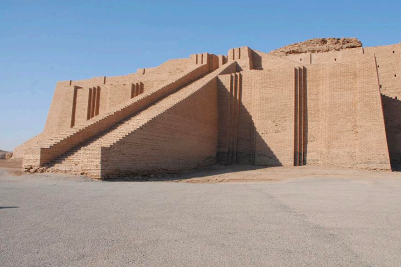
_____ dominated life in the Mesopotamian city-state, just as the massive ziggurat, a stepped temple compound, dominated the city.
Religion
38
New cards
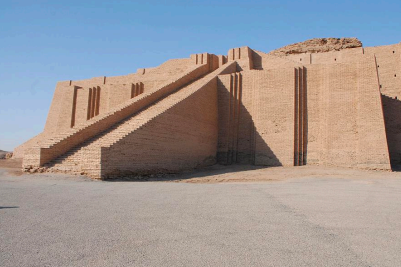
Identify the picture
**Ziggurat of Ur**
39
New cards
What role did priests and scribes play in the temple economy of Mesopotamia, and why did writing possibly evolve during this period?
Inside the temple economy of Mesopotamia, priests and scribes held significant power as they controlled the inventories of the gods and the king and fulfilled the magical and religious needs of the people. Writing may have evolved because there was an increasing need for record-keeping in this temple-based society. Temple chiefs consciously sought a system for recording information to manage the complex affairs of the temple and its resources.
40
New cards
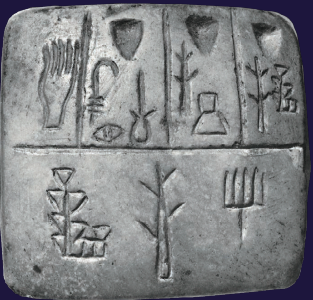
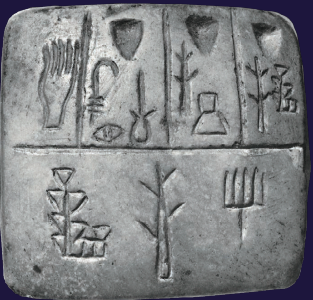
Identify the artwork
**Early Sumerian pictographic tablet**, c. 3100 BCE. This archaic pictographic script contained the seeds for the development of writing. Information is structured into grid zones by horizontal and vertical division.
41
New cards
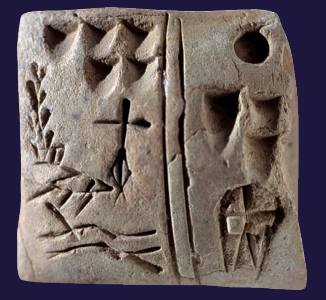
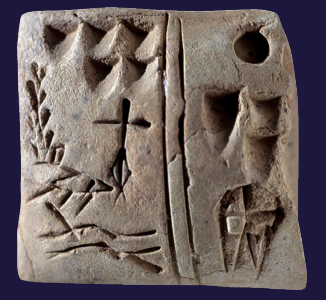
Identify the artwork
**Archaic tablet fragment from the late fourth millennium**.
The drilled hole denotes a number, and the pictographs represent animals in this transaction of sheep and goats.
The drilled hole denotes a number, and the pictographs represent animals in this transaction of sheep and goats.
42
New cards
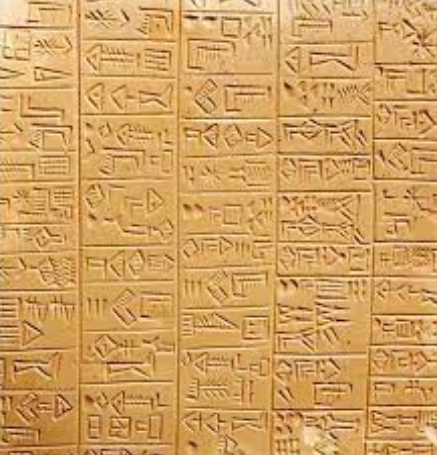
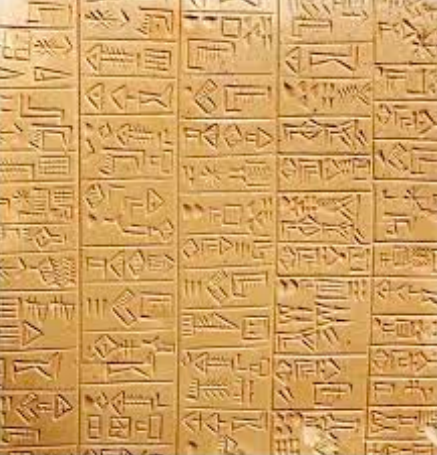
Identify the artwork
**Sumerian written language** – 3300 – 3000 BCE
43
New cards
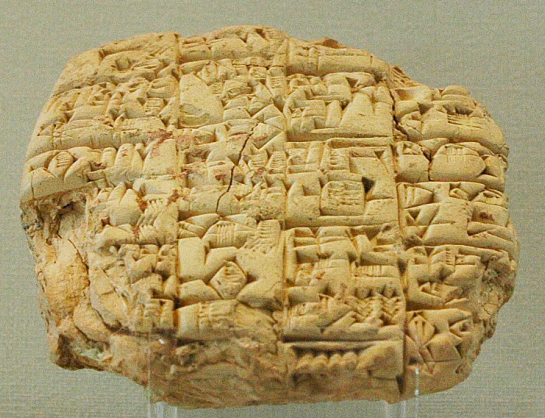
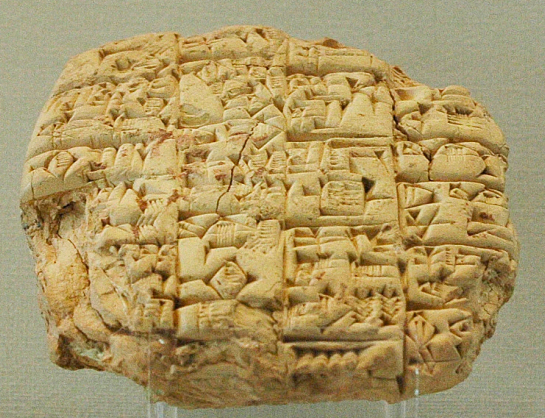
Identify the artwork
**An ancient Sumerian tablet bearing sad news**: a letter written to the king of Lagash informing him of his son’s death in battle.
44
New cards
\
They created one of the first written languages, most likely as a means of recording trader inventories to ensure couriers didn’t steal anything on deliveries.
They created one of the first written languages, most likely as a means of recording trader inventories to ensure couriers didn’t steal anything on deliveries.
Sumerians
45
New cards
Earliest languages of Sumerians
logographic
46
New cards
icons represented entire words instead of phonetic sounds
logographic
\
This suggests a natural ability of humans to use visual representation to communicate complex ideas, **a cornerstone of modern graphic design**.
\
This suggests a natural ability of humans to use visual representation to communicate complex ideas, **a cornerstone of modern graphic design**.
47
New cards
How did the writing system in ancient Mesopotamia evolve over several centuries, and what were some challenges faced by scribes during this evolution?
The writing system in ancient Mesopotamia evolved over several centuries. Initially, taxes in the form of crops were delivered, and the challenge was to determine how much food was stored and whether it would meet community needs until the next harvest. Writing was structured on a grid of horizontal and vertical spatial divisions, and sometimes, the writing got smeared as the scribe's hand moved across the tablet. Around 2800 BCE, scribes turned the pictographs on their sides and began writing in horizontal rows, from left to right and top to bottom, marking a significant evolution in writing techniques.
\
This made writing easier, and it made the pictographs less literal. About three hundred years later, writing speed was increased by replacing the sharp-pointed stylus with a triangular-tipped one. This stylus was pushed into the clay instead of being dragged through it.
\
This made writing easier, and it made the pictographs less literal. About three hundred years later, writing speed was increased by replacing the sharp-pointed stylus with a triangular-tipped one. This stylus was pushed into the clay instead of being dragged through it.
48
New cards
The characters were now composed of a series of wedgeshaped strokes rather than a continuous line drawing. This innovation radically altered the nature of the writing; pictographs evolved into an abstract sign writing called _____.
cuneiform
49
New cards
from the Latin for “wedgeshaped”
cuneiform
50
New cards
Unlike the Sumerians, whose pictographic writing evolved into abstract cuneiform, the Egyptians retained their picture-writing system, called
hieroglyphics
51
New cards
(Greek for “sacred carving,” after the Egyptian for “the god’s words”), for almost three and a half millennia.
hieroglyphics
52
New cards
What was a significant advancement in Egyptian visual communications, and what did it involve?
A major step forward in Egyptian visual communications was the development of papyrus, a paper-like substrate used for manuscripts.
53
New cards
How did the ancient Egyptians utilize the Cyperus **papyrus plant**, and what were some of its various applications?
In ancient Egypt, the Cyperus papyrus plant, which grew along the Nile in shallow marshes and pools, had various uses. Egyptians used papyrus flowers for
* garlands at temples
* roots for fuel and utensils
* stems as raw material for sails, mats, cloth, rope, sandals, and most notably, for making papyrus.
* garlands at temples
* roots for fuel and utensils
* stems as raw material for sails, mats, cloth, rope, sandals, and most notably, for making papyrus.
54
New cards
How were ancient Egyptian hieroglyphics originally inspired, and when did they become a formal "language"?
Ancient Egyptian hieroglyphics were originally inspired by the **Sumerian script**. They later evolved into a formal "language" around 3200 BC.
55
New cards
When was the Egyptian language fully understood, and how did the discovery of the Rosetta Stone contribute to this understanding?
The Egyptian language was not fully understood until the discovery of the Rosetta Stone in 1798 by Napoleon. The Rosetta Stone played a crucial role in deciphering ancient Egyptian hieroglyphics, as it contained inscriptions in three scripts, including Greek, which provided a key to understanding the Egyptian script.
56
New cards
What is significant about hieroglyphs, particularly in terms of their appearance on parchment?
**Hieroglyphs** are considered to be the **first phonetic language** to be written on parchment, marking a notable development in the use of this writing system.
57
New cards
It is one of the earliest papyrus manuscripts compiled within the more commonly known Book of the Dead.
The Papyrus of Ani
58
New cards
It contained illustrations alongside cursive hieroglyphs, which included spells designed to aid the deceased in their afterlife.
The Papyrus of Ani
59
New cards
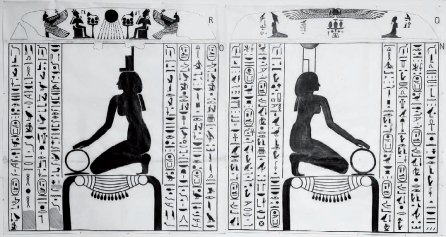
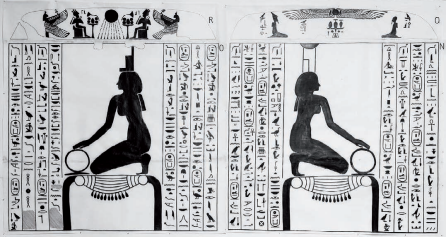
Identify the artwork
**Drawing of the Sarcophagus of Aspalta. King of Nubia (Sudan)**, c. 593–568 BCE. The inscriptions carved into this granite sarcophagus demonstrate the flexibility of hieroglyphics.
60
New cards
Identify the artwork
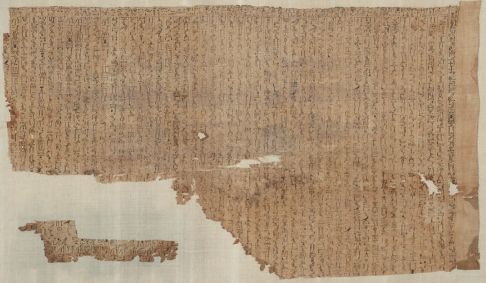
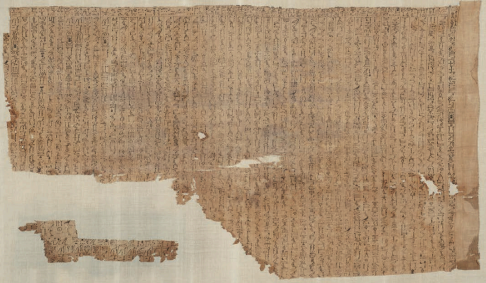
**Mummy shroud fragment of Tuthmosis III**, c. 1450 BCE.
Written hieroglyphics were simplified, but they maintained their pictographic origin.
Written hieroglyphics were simplified, but they maintained their pictographic origin.
61
New cards
What privileges were associated with the profession of scribe in ancient Egypt, and what was one notable privilege?
The profession of scribe in ancient Egypt was highly respected and came with many privileges, including exemption from taxation, which was one of the notable privileges enjoyed by scribes.
62
New cards

Identify the picture
The wooden palette used by the scribe was a trademark identifying the carrier as being able to read and write

63
New cards
What was significant about the Egyptians in the history of illustrated manuscripts, and what motivated them to create such manuscripts?
The Egyptians were the first people to produce illustrated manuscripts in which words and pictures were combined to communicate information. Their preoccupation with death and strong belief in the afterlife compelled them to evolve a complex mythology about the journey into the afterlife, which they depicted in these illustrated manuscripts.
64
New cards
What was the prayer and aspiration of every Egyptian, particularly in the context of their beliefs?
The prayer of every Egyptian was to be cleansed of sin and found worthy at the final judgment, reflecting their deep belief in the afterlife and the importance of being judged favorably in the hereafter.
65
New cards
Scribes and artists were commissioned to prepare funerary papyri, called the?
Chapters of Coming Forth by Day
66
New cards
Who gave the ancient Egyptian texts the name "Book of the Dead," and is this name still commonly used today?
A nineteenth-century scholar named them the "Book of the Dead," and this name is generally used today to refer to these ancient Egyptian texts.
67
New cards
was a third phase in the evolution of funerary texts.
The Book of the Dead
68
New cards
Starting with which pyramid (pyramid of Unas), and during which time period, were the walls and passages of pyramids covered with pyramid texts containing hieroglyphic writings? What themes did these texts typically include?
Beginning with the pyramid of Unas around c. 2345 BCE, the walls and passages of pyramids were covered with pyramid texts containing hieroglyphic writings. These texts included myths, hymns, and prayers relating to the godlike pharaoh's life in the afterworld.
69
New cards
After the pyramid texts, what practice was followed, and how did it differ in terms of where the writings and illustrations were placed? What was the significance of this practice for high officials and noblemen?
Following the pyramid texts, the practice of coffin texts emerged. In this practice, all surfaces of the wooden coffin and/or stone sarcophagus were covered with writings and often illustrated with pictures of possessions for use in the afterlife. This allowed high officials and noblemen to enjoy the benefits of funerary texts, even though the cost of building a pyramid was beyond their means.
70
New cards
Identify the picture
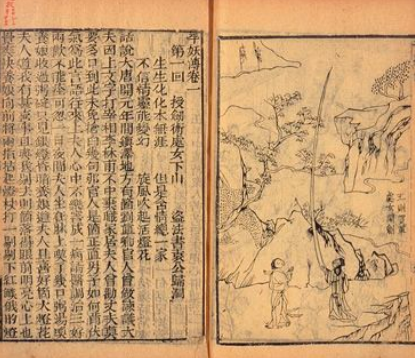
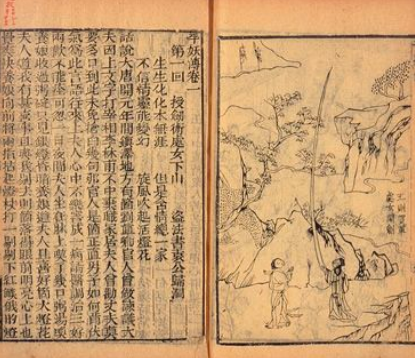
**Advancements in Chinese printing** 200 CE – 1040 CE
71
New cards
What country holds most of the records for printing discoveries, including non-papyrus paper making, woodblock printing, and movable type—all of which occurred earlier than you might have guessed
China
72
New cards
What do surviving artifacts reveal about the Chinese achievements in printing and graphic design, and when did they demonstrate a high level of artistry in these fields?
Surviving artifacts show that the Chinese developed a wide range of uses for printing and achieved a high level of artistry in graphic design and printing from an early date in their history.
73
New cards
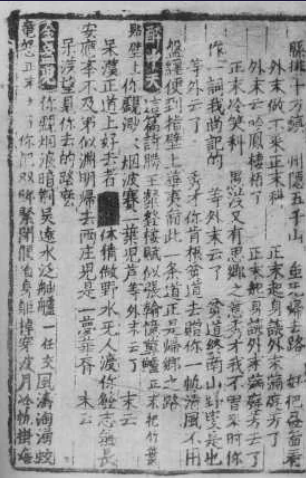
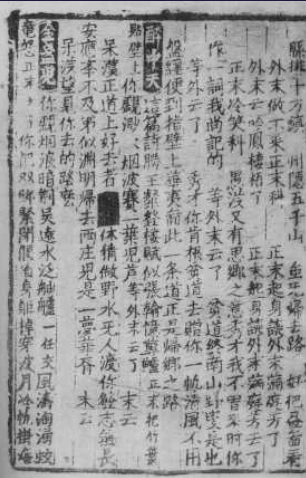
Identify the artwork
A woodblock print of a Chinese play from the Yuan dynasty.
74
New cards
Who invented the world’s first movable type printing press out of porcelain
Bi Sheng
75
New cards
was a Chinese artisan and inventor of the world's first movable type technology, one of the Four Great Inventions of Ancient China.
Bi Sheng
76
New cards
Whose system was made of Chinese porcelain and was invented between 1041 and 1048 during the medieval Song dynasty.
Bi Sheng
77
New cards
In 1454, the printing press was invented by German _____ who was commissioned by the Holy Roman Empire.
Johannes Gutenberg
78
New cards
When was the invention of the Gutenberg press?
1439
79
New cards
Who brought moveable type to Europe in 1439, and what impact did this invention have on Western culture and civilization? How did it change the availability of literature and literacy?
Johannes Gutenberg brought moveable type to Europe in 1439, introducing mass communication to Western culture and forever changing civilization. With the Gutenberg press, people no longer had to rely on lengthy scholarly reproductions of books, which made literature (and literacy) accessible to the masses and affordable.
80
New cards
It was the first book printed in Western Europe using movable metal type, introducing text reproduction to the masses.
The Gutenberg Bible
81
New cards
Graphic design can be traced all the way back to _____ BC, when the first known visual communications arose.
15,000
82
New cards
These pictographs and symbols are present in the _____.
These pictographs and symbols are present in the _____.
83
New cards
It's the first known artifact to use both words and pictures on it.
It's the first known artifact to use both words and pictures on it.