L08: The biosphere and the biomes of the Earth
 Call Kai
 Learn
 Practice Test
 Spaced Repetition
 Match
 Flashcards
 Knowt Play
1/65

Earn XP
Description and Tags
Given by: Prof. Patrick Meir
66 Terms
What did Vladimir Vernadsky (1926) argue?
The make-up of the atmosphere was strongly influenced by life and that living organisms could reshape the planet just as strongly as any physical force
Biosphere
A part of the Earth system that includes all living beings, including animals, plants, and other organisms, and their relationships (ecosystems)
What is the basic driver of climate?
Sunlight intensity
What three components of global atmospheric circulation does sunlight intensity affect?
Global winds
Ocean circulation
Precipitation patterns
What region on Earth acts as the engines of global atmospheric circulation?
The tropics
In what two ways does latitude influence climate?
Global atmospheric circulation and Earth’s biomes
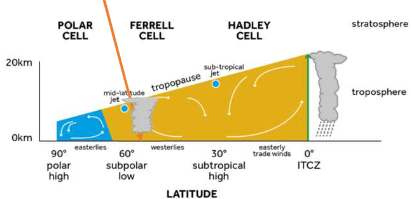
What does this diagram show?
Global atmospheric circulation according to latitude
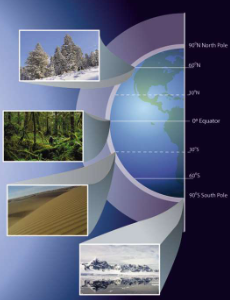
What does this diagram show?
Earth’s biomes according to latitude
A biome
“An intercontinental formation of similar climate and vegetation”
What are three components that a biome must contain?
Characteristic animal and plant adaptations (according to their environment)
Contains functionally distinct biota
Land and water
Seasonality
The relationship between precipitation and temperature in a biome
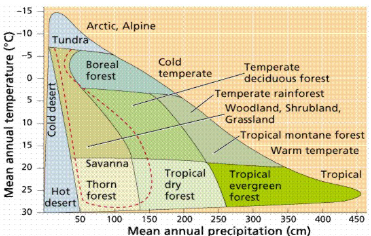
What does this diagram show?
Different biomes determined by precipitation and temperature (seasonality)

What does this diagram show?
Different biomes determined by where they are in the world
What other three components besides climate determine why what is where (WWW)?
History and change (eg. fires, humans, and volcanoes, etc.)
Soils (eg. nutrients and texture, etc.)
Species (eg. ecology and physiology, etc.)
Why are the questions ‘what is a biome?’ and ‘how do we think of natural systems?’ important to link?
So that we can classify the biosphere correctly to identify key properties
What two reasons are there as to why it is important we classify the biosphere correctly to identify key properties?
So that we can identify and analyse causes of change, and so that we can predict change
How do we think of natural systems?
As biomes
Why do distinct biological communities form in biomes?
In response to a shared physical climate
What does the biome concept organise?
Large-scale ecological variation
How are terrestrial biomes distinguished?
By their predominant vegetation
How are terrestrial biomes mainly determined?
By precipitation and temperature (seasonality)

What does this diagram show?
The global distribution of Earth’s major biomes
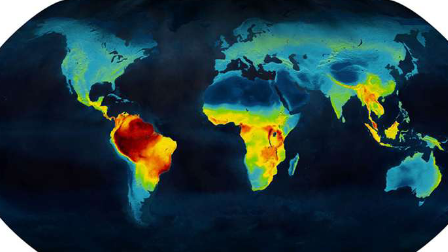
What does this diagram show?
The global distribution of mammals, amphibians, and birds

What does this diagram show?
The global distribution of biodiversity: species numbers of vascular plants
Seasonality of an evergreen (rain-) forest biome
High precipitation and high temperature

What does this diagram show?
A climatograph of an evergreen (rain-) forest biome
Where are evergreen (rain-) forests common?
In places where every month has high precipitation (>100 mm) combined with only short dry periods (1-2 months)
What vegetative characteristic defines evergreen (rain-) forests?
Tall growing trees with a closed canopy (up to 50 m)
What is the net primary production of an evergreen (rain-) forest biome?
1,000 to 3,000 g/m2 per year
Which biome has the highest net primary production rate?
Evergreen (rain-) forests
Net primary production
The rate at which plants produce organic matter (biomass) in an ecosystem
Biomass
Organic material that comes from animals, plants, and microorganisms
Seasonality of a savanna biome
Moderate precipitation and high temperature

What does this diagram show?
A climatograph of a savanna biome in the Northern Hemisphere

What does this diagram show?
A climatograph of a savanna biome in the Southern Hemisphere
What changes occur when a biome transitions from a humid to a semi-humid climate?
Dry periods become longer the further away a biome is to the equator
What percentage of the Earth is covered by savanna biomes?
20%
What threat is there to marginal regions in savanna biomes?
Desertification
Desertification
The degradation of land in arid and semi-arid regions caused by climate change and human activities
What is the net primary production of a savanna?
500 to 1,600 g/m2 per year
Seasonality of a desert biome
Low precipitation and high temperature

What does this diagram show?
A climatograph of a desert biome
What percentage of the Earth is covered by desert biomes?
20%
Where are deserts common?
Around the world in a band between 15o to 30o N and S latitudes
What does low water availability and the absence of vegetation in a desert result in?
Very slow soil development which results in lithosols or syrosols
Example: vegetation that has developed a survival strategy to make use of alternative water sources in deserts
Namibia: lichen fields cover thousands of km2 along the coastal fog line
What is the net primary production of a desert biome?
Extreme deserts: as low as 2 g/m2 per year, and in shrubby deserts: up to 70 g/m2
Seasonality of a grassland biome
Moderate precipitation and moderate temperature

What does this diagram show?
A climatograph of a grassland biome
What percentage of vegetation species is made up of grasses in grasslands?
20%
What percentage of vegetation biomass is made up of grasses in grasslands?
90%
On average how many grass species contribute to the plant cover of grasslands?
2-3 species
What is the net primary production of a grassland biome?
~40 to 300 g/m2 or 200 to 1,500 g/m2 for temperate grassland biomes
Seasonality of a temperate deciduous forest biome
High precipitation and low temperature
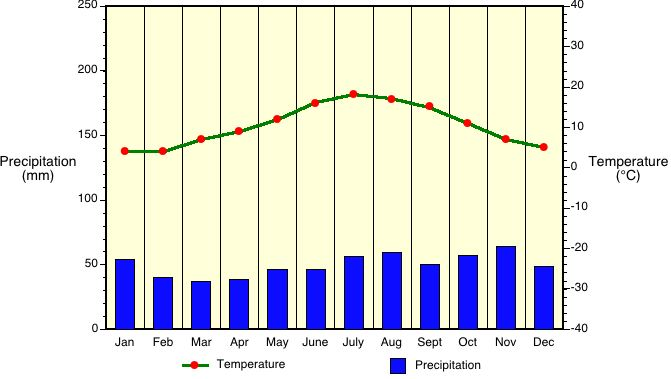
What does this diagram show?
A climatograph of a temperature deciduous forest biome
What is the net primary production of a temperate deciduous forest biome?
600 to 1,500 g/m2 per year
Seasonality of a boreal coniferous forest biome
Moderate precipitation and low temperature

What does this diagram show?
A climatograph of a boreal coniferous forest biome
What is the net primary production of a boreal coniferous forest biome?
200 to 600 g/m2 per year

What does this diagram show?
Permafrost soil
Permafrost soil
A permanently frozen soil with only the near surface layer that unfreezes
Which biome is permafrost soil most common?
Boreal coniferous forests
Seasonality of a tundra and polar desert biome
Low precipitation and low temperature

What does this diagram show?
A climatograph of a tundra and polar desert biome
What is the net primary production of a tundra and polar desert biome?
100 to 200 g/m2 per year

What does this diagram show?
The formation of patterned/polygon soils in tundra and polar deserts