Immunology Chapter 4
 Call Kai
 Learn
Learn Practice Test
 Spaced Repetition
 Match
Match Flashcards
 Knowt Play
1/62

There's no tags or description
Looks like no tags are added yet.
Name | Mastery | Learn | Test | Matching | Spaced | Call with Kai | Chat |
|---|
No analytics yet
Send a link to your students to track their progress
63 Terms
Variable & Constant regions
Regions of antibodies
Polypeptides
Antibodies are composed of [?]
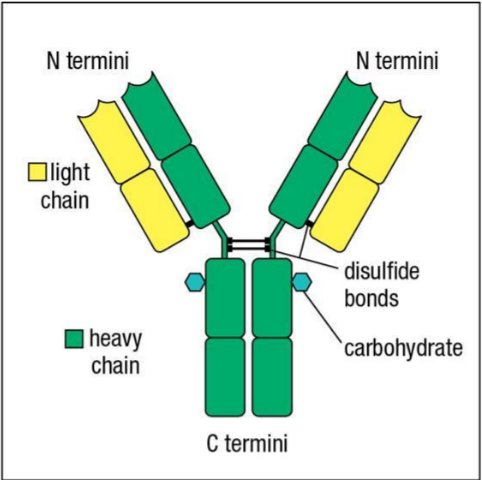
N termini
Top segment of the Y legs
Composed of a light and heavy chain

C termini
Bottom of the straight leg of the Y
Composed of heavy chains
Disufide bonds
Bonds that keep the variable and constant regions together
Carbohydrates
The number of [?] on the antibody determines what type of antibody it is

Fab Region
Part of antibody made of variable region of the legs of the Y
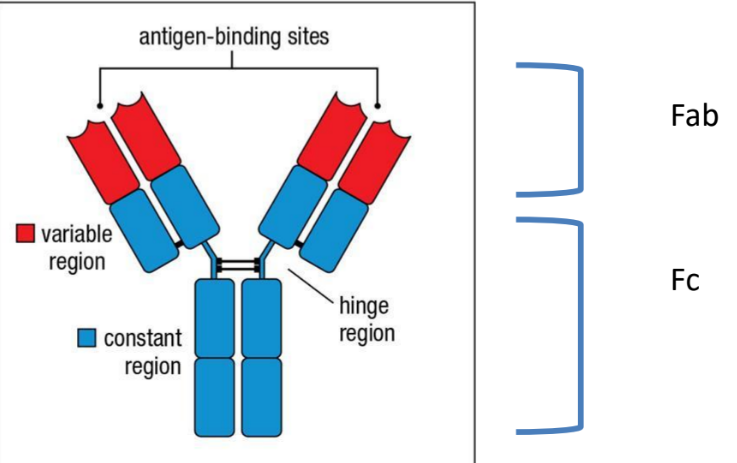
Fc Region
The constant region, made of half of the legs of the Y and the straight part

Hinge Region
Region denoting the bonds between each segment of the antigen
K
λ
2 types of light chains
IgG
IgM
IgD
IgA
IgE
5 types of antibodies

Protein domains of about 110 amino acids
Ig chains are folded into compact & stable [?]

Folds in amino acid chain that bring sulfide groups together
Disulfide bonds formed by …
effector B cells (plasma cells)
Antibodies are produced by [?]
Hypervariable region of H chain V domain and L chain V domain
An Ag binding site is formed from the …
Multivalent
Multiple epitopes on pathogen surface
Univalent
1 epitope on pathogen surface
Polyvalent
Different kinds of epitopes
Increases chances for Abs to bind
Monovalent
1 type of epitope
Antigenic Determinant (epitope)
Part of the antigen that binds to Abs

Linear Epitope
Protein antigen that has all parts that bind to Ag right next to each other

Discontinuous Epitope
Protein antigen that has parts that bind to Ag separate from each other
Complementary structure
Weak noncovalent interactions (ionic bonds, hydrophobic interactions, van der Waals)
What holds the Ab and Ag together
Affinity
Sum of the non-covalent interactions between Ag and Ab

Clone of Ab producing cells
Monoclonal Abs are produced by ….
Fusion of B cells from mouse immunized with antigen + myeloma cells
Myeloma stops antigen B cells from dying
Grow cells in drug-containing medium
Select for antigen-specific hybridoma
Clone selected cells
Creation of monoclonal Abs
Therapeutic Antibodies
B cell cancers
Breast cancer
Utility of Monoclonal antibodies
Germ Line Theory
Theory that the reason for the diversity of Abs is because we already have the genetic info that makes every type of antibody
Somatic Theory
Theory that the reason for the diversity of Abs is due to genetic variations throughout life creating antibody variability
Two Gene Theory
Theory that the reason for the diversity of Abs is due to multiple genes that can encode antibodies come together to create variability
V & J
Variable Light regions are created by [?] gene segments
V, D, & J
Variable Heavy regions are created by [?] gene segments
Random recombination
Produces diversity in Ag binding site of Ig

Germline DNA --somatic recombination→ VJ-joined rearranged DNA
Creation of Light chain

Germline DNA - somatic recombination→ DJ joined DNA -Somatic recombination→ VDJ-joined rearranged DNA
Creation of Heavy Chain
Enzymes
RAG1 & 2
Signal sequence (RSS) - What the enzyme recognizes
1 turn & 2 turn
Gene recombination requires …
12
1 turn RSS have [#] base pairs
23
2 turn RSS have [#] base pairs
1.6 × 10⁶
Number of different Ab specificities
Heptamer
Nonamer
Flank RSS
Have to combine one 1 turn RSS & one 2 turn RSS
1 turn 2 turn rule (12/23 rule)

Diagram of chain regions

Removing gene segments between V, J, and D regions
RAGs cause gene recombination by,,,
P-Nucleotide
N-Nucleotide
Exonuclease Activity
3 mechanism of recombination enzyme driven Ab diversity
Hairpin at end of DNA segment
P Nucleotide Addition Site

Cleavage of hairpin
Vertical
Bases swings up/down
Horizontal
Bases stay where they are
Fill in complementary strands by DNA repair enzymes
Mechanism: P Nucleotide Addition
N Nucleotide Addition
Adds 1-15 base pairs randomly by TdT
Exonuclease Activity
Randomly removes nucleotides
Gaps filled by DNA synthesis and ligation to form coding join
Present in a region of the DNA that is being joined (V, D, or J)
Created by joining of regions
Complementarity-Determining Regions (CDRs) are either:
Differential RNA processing
Naive B cells get IgM and IgD on their cell surface with the same specificity through …

Where AAA (poly-A site) is
Where RNA is processed is determined by… which determines with type of Ab is expressed & if it is membrane-bound
P Nucleotide Addition
N Nucleotide Addition
Exonuclease Activity
Types of recombintion mechanisms
Somatic (hyper)Mutation
Process of further diversification of the whole of the V-domain after clonal selection
AID (Activated-Induced Cytidine Deaminase)
Enzyme that causes Somatic mutation
Made only by proliferating B cells
Converts cytosine into uracil
AID
Somatic mutation is mediated by [?]
Changes in affinity to epitopes
Mutating the hypervariable region causes…
Isotype Switching
Further DNA recombination events enable the rearranged V region coding sequence to be used with other heavy chain C genes
Switch Sites
Highly repetitive sequences that mediate recombination
AID and Switch Sites
Isotype Switching requires [?]
IgM
Pentameric
Best at complement Activation
IgA
Dimer
In mucosal tissue, Breast milk
Works to neutralize antigens
IgG
Highest in the blood
Involved in transplacental transfer from mother to baby
Involved in complement activation & antigen neutralization
IgE
Bound to most mast cells & basophils
Allergies