11 - Management of Medical Emergencies in the Dental Office
 Call Kai
 Learn
 Practice Test
 Spaced Repetition
 Match
 Flashcards
 Knowt Play
1/153

There's no tags or description
Looks like no tags are added yet.
154 Terms
Medical Emergencies Commonly Provoked by Anxiety
• Angina pectoris
• Myocardial infarction
• Asthmatic bronchospasm
• Adrenal insufficiency (acute)
• Hyperventilation
• Epilepsy/seizures
Supplies for establishment and maintenance of IV access:
• Plastic indwelling (Jelco)
• Metal indwelling (Butterfly)
• IV tubing with flow valve
• Tourniquet
• 1-inch-wide plastic tape
• Crystalloid solution (normal
saline, lactated ringers, D5W)
Supplies for high-volume suction:
• Large-diameter suction tip
• Tonsillar suction tip
• Extension tubing
• Connectors to adapt tubing to office suction
Supplies for drug administration:
• Plastic syringes ( 5- and 10-mL sizes)
• Needles (18 and 21 gauge)
Supplies for oxygen administration
• Clear face mask
• Resuscitation bag (AMBU)
• Extension oxygen tubing (with and without nasal cannula)
• Oxygen cylinder with flow valve
• Oral and nasal airways
• Lubricating jelly
Parenteral Preparations
Anticonvulsant
Diazepam, midazolam
Parenteral Preparations
Antihistamine
Diphenhydramine (Benadryl)
Parenteral Preparations
Antihypoglycemic
50% dextrose in water(D50), glucagon
Parenteral Preparations
Corticosteroid
Methylprednisolone (Solu-Cortef), Hydrocortisone
Parenteral Preparations
Narcotic antagonist
Naloxone (Narcan)
Parenteral Preparations
Symphathomimetic
Epinephrine
Parenteral Preparations
Vagolytic
Atropine
Oral Preparations
Antihistamine
Diphenhydramine (Benadryl)
Oral Preparations
Antihypoglycemic
Candy, fruit juice, sugar tablet, glucose gel
Oral Preparations
Vasodilator
Nitroglycerin (Nitrostat, Nitrolingual)
Inhaled Preparations
Bronchodilator
Albuterol (Proventil, Ventolin)
short-acting B2 agonist
Inhaled Preparations
Respiratory stimulant
aromatic ammonia
Inhaled Preparations
Analgesic/Sedative
Nitrous Oxide
Basic Life Support (BLS) ABCs
A- Airway
B- Breathing
C- Circulation
Basic Life Support (BLS) Certification
1. Extending head at the neck by tilting _____ back with one hand and ____ neck up with other hand
forehead
lifting
Basic Life Support (BLS) Certification
2. Pushing mandible forward by pressure on the ____ ____
mandibular angles
Basic Life Support (BLS) Certification
3. Pulling mandible forward by pulling on _____ mandible
anterior
Basic Life Support (BLS) Certification
4. Pulling tongue forward using ____ material or instrument to grasp anterior tongue
suture
Basic Life Support (BLS) Certification
Breathing provided by one of the following:
1. Mouth-to-mouth or mouth-to-mask ventilation
2. Resuscitation bag ventilation
Basic Life Support (BLS) Certification
Circulation provided by external _____ ____
cardiac compressions
Emergencies of Altered Consciousness
• Syncope
• Hypoglycemia
• Seizure
• Stroke
A sudden, transient loss of consciousness that is usually secondary to a period of cerebral ischemia
syncope
Synonyms of Syncope
• Atrial bradycardia
• Faint
• Neurogenic syncope
• Psychogenic syncope
• Swoon
• Vasodepressor syncope
• Vasovagal syncope
_____ is probably most common systemic complication seen in the dental office
Syncope
Syncope Predisposing Psychogenic Factors:
• Fright (sight of blood/local anesthetic syringe and needle)
• Anxiety
• Emotional Stress
• Pain – acute and unexpecte
Syncope Predisposing Non-Psychogenic Factors:
• Moving from a supine position to sitting in an upright
position or standing
• Hunger from dieting or a missed meal (hypoglycemia)
• Exhaustion
• Poor physical condition
• Hot, humid environment
• Age between 16 and 40
Best Method of Management for Syncope is Prevention
Try to eliminate all predisposing ______ and ______ factors
psychogenic
non-psychogenic
Best Method of Management for Syncope is Prevention
Remember- the injection of ____ ____ is the dentalprocedure that most often precipitates a syncopal episode.
local anesthesia
what position should we place the patient in before giving anesthetic
semi-supine
Pre-syncopal Clinical Manifestations - Early
• Feeling of warmth
• “Don’t feel well”
• Nausea
• Loss of color- ashen-gray
• Perspiration
• Blood pressure- about baseline
• Tachycardia
Pre-syncopal Clinical Manifestations - Late
- Pupillary dilation
• Coldness in hands/feet
• Hypotension
• Bradycardia
• Visual disturbance
• Dizziness
• Loss of consciousness
Clinical Manifestations During Syncope:
• Respiration is irregular/shallow
• Pupillary dilation
• Muscular twitching of extremities/face
• Bradycardia- pulse < 60
• Hypotension < 90/60
• Loss of consciousness
• Muscular relaxation- incontinence
Unconsciousness due to syncope may last from ____ to several ____
seconds
minutes
Complete clinical recovery from syncope should occur in ____ minutes.
15-20
Syncope Roadmap - Image

Manifestations of Acute Hypoglycemia
Mild hypoglycemia range
60-70mg/dl
Manifestations of Acute Hypoglycemia - Mild
60-70
Hunger
Nausea
Mood change
Weakness
Lethargic
Manifestations of Acute Hypoglycemia
Moderate hypoglycemia range
50-60 mg/dl
Manifestations of Acute Hypoglycemia - Moderate
Moderate (50-60)
Tachycardia
Perspiration
Pallor
Anxiety
Behavioral change:
• Belligerence
• Confusion
• Uncooperativeness
Manifestations of Acute Hypoglycemia
Severe hypoglycemia range
<50 mg/dl
Manifestations of Acute Hypoglycemia - Severe
Severe <50
Hypotension
Unconsciousness
Seizures
Iatrogenic Hypoglycemia (Insulin Shock) - Risk Factors
• Skipped or insufficient meals
• Excessive physical exertion
• Inappropriate insulin or oral hypoglycemic therapy
• Alcohol ingestion (while liver enzymes metabolize alcohol the liver may
not release stored glucose)
Alcohol can cause Iatrogenic hypoglycemia because while liver enzymes metabolize alcohol the liver may not release stored ____
glucose
Management of Acute Hypoglycemia
_____ all dental treatment. Check blood _____ with glucomete
Terminate
glucose
Signs and symptoms of mild hypoglycemia
1. Administer ____ ___ for mild symptoms ____ grams of carbohydrates
oral glucose
10-15
(ex. ½ cup of orange juice or regular soda; 3 glucose tablets, etc.)
Signs and symptoms of mild hypoglycemia
2. Monitor vital signs
3. Consult ____ if unsure of why hypoglycemia occurred before further dental care
physician
Signs and symptoms of moderate hypoglycemia
1. Administer _____ source such as sugar or fruit juice orally
2. Monitor vital signs
glucose
with hypoglycemia we want to achieve blood glucose of ____ mg/dl or greater
100
With hypoglycemia, if symptoms do not improve within ___ minutes, treat with an additional ___ grams of carbohydrate
15
10-15
Signs and symptoms of severe hypoglycemia
1. Administer ___ ml of 50% dextrose IV or _ mg glucagon IM, IV or intranasal
2. Have someone summon ____ ____
50
1
medical assistance
Signs and symptoms of severe hypoglycemia
3. Monitor vital signs
4. Administer _____
5. Transport to _____ ____ facility
oxygen
emergency care
Manifestations/Kinds of Acute Seizures
Isolated, brief seizure
Tonic-clonic movements of trunk extremities, loss of consciousness, vomiting, airway obstruction, loss of urinary and anal sphincter control
Acute Management of Seizures
1. ____ all dental treatment
2. Place in ____ position
3. Protect from nearby objects and gently _____ patient
Terminate
supine
restrain
After Seizure - Patient Unconscious
1. Have someone summon medical assistance
2. Place on side and suction airway
3. Monitor vital signs
4. Initiate BLS (if necessary)
5. Administer oxygen
6. Transport to emergency care facility
After Seizure - Patient Conscious
1. Suction airway if necessary
2. Monitor vital signs
3. Administer oxygen
4. Consult physician
5. Observe in office for 1 hour
6. Have patient escorted home
Repeated or sustained seizure >5 mins (status epilepticus)
1. Diazepam ___ mg/min IV up to ___ mg or midazolam ___ mg/min IV or IM up to ___
mg titrated until seizure stops. Or use of nasal _____ (Nayzilam)
2. Have someone summon medical assistance
3. Protect from nearby objects
5
10
3
6
versed
_____ is the third leading cause of death in the United States
Stroke
what are the 2 types of strokes
Hemorrhagic vs. occlusive (ischemic)
____ diagnosis is important with strokes
rapid
Early treatment with ____ agents significantly improves outcomes with strokes
thrombolytic
Especially within the first 90 mins of symptom onset
Stroke Manifestations:
Airway, breathing, and circulation are usually ____
normal
Stroke manifestations
• Headache- can range from mild to the worst the patient ever experienced
• Slurring of speech or inability to speak (aphasic)
• Difficulty swallowing
• Confusion
• Weakness or paralysis of extremities and/or facial muscles unilaterally, drooping of face
• Asymmetry in grip strength
• Visual disturbance, blurred vision
• Loss of smell
• Dizziness, loss of balance
• Seizures
• Partial or total loss of consciousness
Management of Stroke in Progress
1. Terminate all dental treatment
2. Have someone summon medical assistance
3. Position patient in _____ position with head slightly raised. Want to avoid increasing _____ ____
supine
intracranial pressure (ICP)
Management of Stroke in Progress
4. Place patient on ____ and institute BLS if necessary
5. Transport to ____ ___ facility ASAP
oxygen
emergency care
It is estimated that 85% of all strokes are of the _____ nature.
occlusive
_____ drugs must be given within 3-4 hours of symptoms in order to be
effective for stroked
Thrombolytic
i.e., TPA, Streptokinase
Emergencies of Respiratory Distress
• Hyperventilation
• Asthmatic bronchospasm
• Airway obstruction
hyperventilation
systolic BP ____, diastolic BP ____, and HR _____
increases x3
hyperventilation
respiratory rate ____ and depth of respiration ______
increases
increases or decreases
normal respiratory rate vs hyperventilation
normal 12-16
can increase up to 30
With hyperventilation, excessive “blowing off” of CO2 leads to a respiratory _____
alkalosis
high pH
in hyperventilation, blood ph can increase up to ____
7.55 (normal is 7.35-7.45)
Respiratory alkalosis may decrease level of ionized _____ in the blood which causes neuromuscular irritability leading to ____.
calcium
tetany
Carpopedal Tetany- _____ muscle contractions, spasm of fingers and toes
sustained
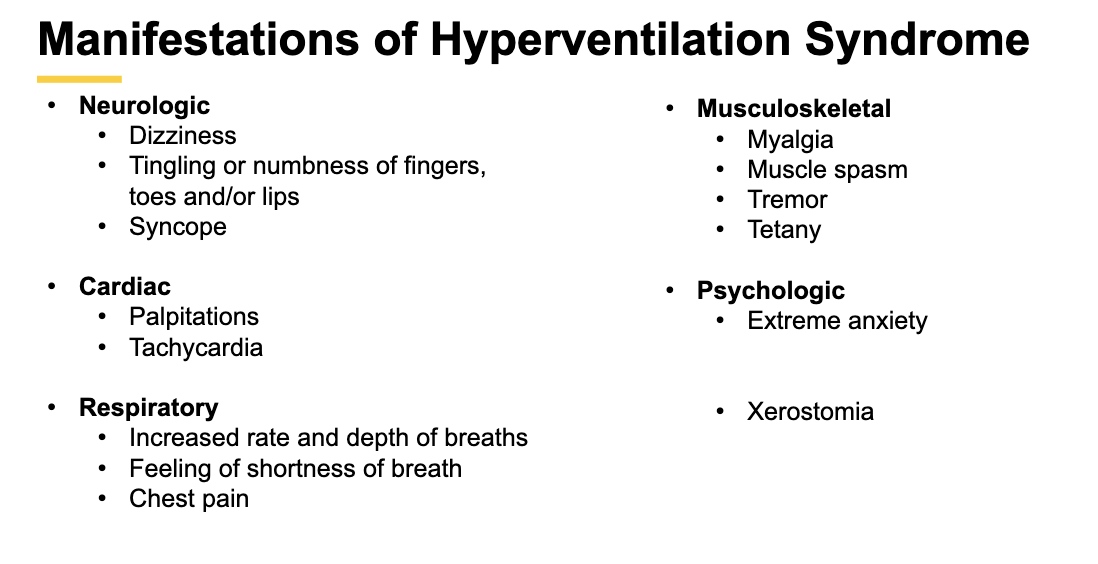
Manifestations of Hyperventilation Syndrome - Image
Management of Hyperventilation Syndrome
1. Terminate all dental treatment and remove foreign bodies from mouth
2. Position patient in chair in almost full ____ position
3. Attempt to ____ calm patient
upright
verbally
Management of Hyperventilation Syndrome
4. Have patient breathe ___-enriched air
5. If symptoms persist or worsen, administer:
______ - 5-10 mg IV, titrate slowly, until anxiety relieved
OR
______- 4-5 mg IM or intravenously titrate slowly, until anxiety relieved
CO2 (breathe into cupped hands)
Diazepam
Midazolam
Management of Hyperventilation Syndrome
6. Monitor vital signs
7. Perform all further dental surgery using _____-_____ measures
anxiety-reducing
Mild to Moderate Asthmatic Symptoms
• Coughing
• Anxiety
• Tachycardia
• Wheezing (audible with or without stethoscope)
• Dyspnea (labored breathing)
Severe Asthmatic Symptoms
• Extreme anxiety
• Flushing of face
• Perspiration
• Intense dyspnea with flaring of nostrils and use of accessory muscles for respiration
• Cyanosis of mucous membranes and nailbeds
• Minimal breath sounds on auscultation
• Mental confusion
Management of Acute Asthma Episode Occurring During Dental Surgery
1. Terminate all dental treatment
2. Position patient in fully ____ posture
3. Administer short-acting ____ by spray (albuterol)
4. Administer _____
5. Monitor vital signs
sitting
bronchodilator
oxygen
Management of Acute Asthma Episode Occurring During Dental Surgery
Signs and symptoms relieved
Monitor during recovery in office
Management of Acute Asthma Episode Occurring During Dental Surgery
Signs and symptoms continue
1. Give epinephrine 0.3 ml of 1:1,000 IM or SQ
2. Monitor vital signs during recovery
Management of Acute Asthma Episode Occurring During Dental Surgery
Signs and symptoms not relieved
1. Call for medical assistance
2. Prepare for transport to emergency care facility
Airway Obstruction
Patients with an effective cough should be left alone with the hope that they can forcibly ____ and _____ the offending foreign body.
cough
remove
Management of Airway Obstruction
Heimlich Maneuver (abdominal thrusts)
Airway Obstruction Management
If patient becomes unconcious
call 911
Airway Obstruction Management:
1. Place patient in _____ position.
2. Tongue- jaw lift maneuver.
3. _____ ____ of mouth if obstruction seen.
4. If not seen, ___ chest compressions at _____beats/min.
supine
Finger sweep
30, 100-120
Airway Obstruction Management
5. After 30 chest compressions, open mouth and look for foreign object. If seen, try to retrieve it.
6. If not seen, head tilt- chin lift, give __ rescue breaths.
7. If chest does not rise, reposition head and try 2 breaths again.
8. If chest does not rise, repeat cycle of __ chest compressions.
2
30
Allergy - skin signs and symptoms
• Pruritis- itching (often the first sign)
• Rash- red patches of skin
• Urticaria- smooth elevated patches of skin (wheals, hives)
• Angioedema- localized swelling
*Frequently involves face, hands, feet, genitalia. Also may involve lips, tongue, pharynx, larynx
Allergic Rxn - image

Allergic Reaction - Angioedema image

Signs and Symptoms - Bronchospasm
• Respiratory distress (constriction of bronchial airways)
• Increased anxiety
• Tachycardia
• Flushing of the face and neck
• Perspiration
• Wheezing
• Cyanosis- oral mucosa, nail beds
• Use of accessory muscles of respiration
Allergy Generalized Anaphylaxis- multiple organ systems
• Skin reactions
• Smooth muscle spasm of GI (nausea, cramping)
• Smooth muscle spasm of GU (loss of bladder control/incontinence,
genital angioedema)
• Smooth muscle spasm of respiratory tract (bronchospasm)
• Respiratory distress
• Cardiovascular collapse- vasodilation, hypotension
Generalized Anaphylaxis
____ ____ and ______ release histamine and leukotrienes into the blood stream.
Mast cells
basophils