ARRT Radiography Exam (Mosby Review)
 Call Kai
 Learn
 Practice Test
 Spaced Repetition
 Match
 Flashcards
 Knowt Play
1/202

There's no tags or description
Looks like no tags are added yet.
203 Terms
Ionizing Radiation
radiation that is able to remove electrons from an atom through ionization
Somatic effects
refers to the effects of radiation to the body being irradiated
Genetic Effects
refers to effects of radiation to a germ cell's genetic code; effects the next generation
natural background radiation
radiation contained in the unpolluted environment
Artificially produced radiation
also called man-made radiation (e.g., medical x-rays)
Primary radiation
radiation exiting the x-ray tube
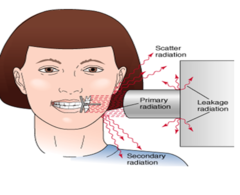
Exit radiation (remnant radiation; image-producing radiation)
x-rays that emerge from the patient and strike the image receptor
attenuation
absorption and scatter of the x-ray beam as it passes through the patient
heterogenous beam
x-ray beam that has photons of many different energies
photoelectric effect
absorption of x-ray photons in the atoms of the body
compton effect
scatter of x-ray photons from the atoms of the body
air kerma
unit of exposure
gray
unit of absorbed dose, measured in joules per kilogram (J/kg); 1 Gy = 1 J/kg
gray(a)
unit of radiation absorbed in air
gray(t)
unit of radiation absorbed in tissue
sievert
unit of effective dose or unit of equivalent dose
becquerel
unit of activity
international commission on Radiologic Protection (ICRP)
organizaiton that
uncontrolled area
general public area, like waiting room or stairways
controlled area
occupied by people trained in radiation safety and wear radiation badges/monitors
x-ray tube leakage may not exceed what?
1mGy(a) per hour at a distance of 1 meter from the housing
minimum lead equivalent for fluoro curtain
0.25mm
minimum lead equivalent for bucky slot shield
0.25mm
NAS or NRC-BEIR
National Academy of Sciences/National Research Counsel on the Biological Effects of Ionizing Radiation
studies biologic effects of ionizing radiation and publishes the data
NCRP
National Counsel on Radiation Protection
publishes radiation protection guidelines for the US
NRC
Nuclear Regulatory Commission
enforces radiation protection standards at the federal level
NCRP Report #102
makes recommendations on equipment design and protection regarding lead shielding and fluoro and mobile exposure rates
NCRP Report #116
makes recommendations pertaining to risk-benefit analysis of radiation exposure; states genetic and somatic effects need to be kept to a minimum; makes annual dose limits
NCRP #160
addresses radiation exposure from all sources to people in the US
effective dose limit
upper boundary dose that can be absorbed (either in a single exposure or annually) with negligible risk of genetic or somatic effects to the individual
cumulative effective dose
lifetime occupational exposure must not exceed radiographer's age x 10 mSv
equivalent dose
equal to the absorbed dose multiplied by the radiation weighting factor
equivalent dose limit
upper boundary dose that can be absorbed (either in a single exposure or annually) with negligible risk of deterministic effect
Dose Area Product (DAP)
total air kerma striking the patient
probabilistic effects (stochastic)
randomly occurring effects of radiation; probability is proportional to the dose (increased dose = increased probability)
Deterministic Effects
radiation effects that become more severe at higher levels of radiation exposure; do not occur below a certain threshold
GSD (Genetically Significant Dose)
average annual gonadal dose of radiation to individuals of childbearing age; addresses the relationship of gonadal doses to individuals versus an entire population and the overall effects
Linear Energy Transfer (LET)
amount of energy deposited by radiation per unit length of tissue
Relative biologic effectiveness (RBE)
ability to produce biologic damage; varies with the LET
Direct effect
occurs when radiation directly strikes DNA in the cellular nucleus
Indirect effect
occurs when radiation strikes the water molecules in the cytoplasm of the cell
Radiolysis of water
occurs as radiation energy is deposited in the water of the cell; the result of radiolysis is an ion pair in the cell: a positively charged water molecule (HOH+) and a free electron
Mutation
erroneous information passed to subsequent generations via cell division
Law of Bergonie and Tribondeau
ells are most sensitive to radiation when they are immature, undifferentiated, and rapidly dividing
Early somatic effects of radiation
hematopoietic syndrome; gastrointestinal (GI) syndrome; central nervous system syndrome
Late somatic effects of radiation
carcinogenesis; cataractogenesis; embryologic effects; thyroid dysfunction; life span shortening
Cardinal principles of radiation protection
time, distance, shielding
what is the best protection against radiation exposure?
distance
Mean marrow dose
average dose to bone marrow
mass
the amount of matter in an object; generally considered the same as weight
energy
the ability to do work
Potential energy
energy of position
Kinetic energy
energy of motion
chemical energy
energy from a chemical reaction
Electrical energy
result of the movement of electrons
Thermal energy
heat energy resulting from the movement of atoms or molecules
Nuclear energy
energy from the nucleus of an atom
Electromagnetic energy
energy that is emitted and transferred through matter
Velocity (speed)
how fast an object is moving
Acceleration
the rate of change of speed per unit of time
work
force applied on an object over a distance
power
the rate of doing work (measured in watts)
Atomic nucleus
contains protons (positive charges) and neutrons (no charge); contains most of the mass of an atom
Atomic mass
number of protons plus number of neutrons; represented by the letter A
Electron shells
contain orbital electrons (negative charges); electron shells represented by the letters K, L, M, N, O, P, and Q; in a stable atom the number of electrons and protons is equal
Atomic number of an atom
equals the number of protons in the nucleus; represented by the letter Z; the atomic number determines the chemical element; all chemical elements are represented in the periodic table of the elements
Isotopes
atoms with the same number of protons but with a different number of neutrons
Electron-binding energy
force that holds electrons in orbit around the nucleus
Octet rule
the outer shell of an atom may not contain more than eight electrons
Particulate radiation
alpha particles (helium nucleus: two protons and two neutrons); beta particles (electron-like particles emitted from the nucleus of a radioactive atom)
Photon
the smallest amount of any type of electromagnetic radiation; also considered a bundle of energy called a quantum; travels at the speed of light; travels in waves in a straight path
Sine waves
waves of electromagnetic radiation; wave height is called amplitude; distance between the peaks of the waves is called wavelength; as photon wavelength decreases, photon energy increases
Frequency
number of wavelengths passing a given point per unit time; measured in hertz (Hz)
Speed of travel
electromagnetic radiation travels at the speed of light (186,000 miles per second); travel at the speed of light is constant regardless of wavelength or frequency; wavelength and frequency of electromagnetic radiation are inversely proportional
gamma rays
electromagnetic rays produced by the nucleus of radioactive atoms
wave particle duality
the concept that although xray photons exist as waves, they exist with properties of particles
attenuation
partial absorption of the energy of an xray beam as it traverses an object
inverse square law
intensity of an xray beam is inversely proportional to the square of the distance between the source of xrays and the object
law of conservation of matter
matter cannot be created or destroyed; only changed in form
law of conservation of energy
energy cannot be created or destroyed; only changed in form
electrostatics
stationary electric charges (static electricity)
electrification
movement of electrons between objects
law of electrostatics
unlike charges attract and like charges repel; electrostatic charges reside on the outer surface of a conductor and are concentrated at the area of the greatest curvature; only negative charges move
methods of electrification
friction, contact, induction
conductor
material that allows the free flow of electrons
insulator
objects that prohibit the flow of electrons
electric current
the movement of electrons along a conductor or pathway; measured in amperes
electromotive force (EMF)
measured in volts; the force with which electrons move in an electric circuit
electrodynamics
electric charges in motion
semiconductor
material that may act as an insulator or conductor depending on conditions
electric resistance
inhibits the flow of electrons; measured in ohms
electric circuits
path along which electrons flow; may be wired as series circuits or parallel circuits
alternating current
current of electrons oscillate back and forth
direct current
electrons flow in one direction
sine waves
representation of electron flow as alternating current
magnetic field
energy field surrounding an electric charge in motion; can magnetize a material if placed in the magnetic field
magnetic poles
every magnetic has a north and south pole
laws of magnetic
like poles repel; unlike poles retract; governed by inverse square law
electromagnetism
movement of electrons in a conductor produces a magnetic field around the conductor
self induction
opposing voltage created in an inductor by passing alternating current through it