GMGT 3300 midterm
 Call Kai
 Learn
 Practice Test
 Spaced Repetition
 Match
 Flashcards
 Knowt Play
1/76

There's no tags or description
Looks like no tags are added yet.
77 Terms
What is Law?
A set of rules come together with a set of sanctions for those who don't follow
A code of behaviour
Has two components (Substantive & Procedural)
Substantive Law
The rights, duties & liabilities that each person has in society
The right to own property/enter into a contract
The duty of avoiding injuring people carelessly
2 Type of substantive law (Public & Private)
Procedural Law
Law that deals with protection and enforcement of substantive law rights and duties.
(e.g., Someone breaches a contract - what is the process?)
Public law
Law that regulates the conduct of government and the relationships between government and people
Law that always include the government some way
Private law
Rules that goven relations between private persons or groups
Gov does NOT need to be included
Sometimes refer as civil law
Systems of Law
Civil Law system of Law
Common Law system of Law
What is Civil Law? (2 meanings)
Civil law/Private law & Civil Law System of Law
Judge doesn’t make law in this system
Law is in Civil code and judges apply the law set out
What is Common law? (3 meanings)
Common Law System of Law: Law based on the desicion of judge
Common Law as opposed to Equity
Common Law: Case law (Law made by judge)
State Law: Law made by legislatures. Statute/Act is the legislation made in the gov
Common law as opposed to statute law
Common: Started in England with case law, very ridged
Equity Laws: Law of fairness, becoming very ridged. Specific rules must be followed. In the court discretion
Common Law system
Principles of stare decisis (Theory of Precedent)
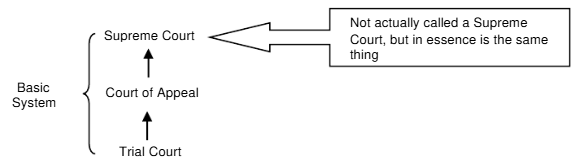
Hierachy of Courts
Trial court → Court of Appeal → Final court of Appeal
Hierachy of Courts
Trial courts
Court of Appeal
Final court of Appeal
Trial Court
1 Judge
Start of lawsuit
Judge listen to both side’s and their witnesses
Make finding of fact and finding of law, and apply the law
Based more on facts sometimes
Court of Appeal
3 to 5 Judges (odd numbers)
No witness
Uses transcript, both side pays for it
No change of facts
Final court of appeal
last chance to appeal
More odd # of judge
No witnesses & change of fact
Principles of Stare Decisis
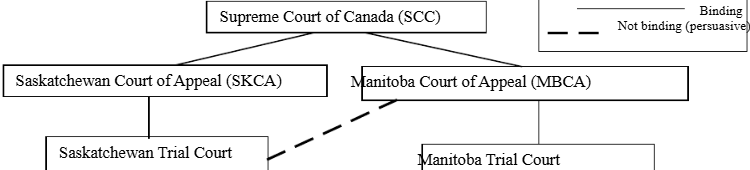
Judge is bound to decision of higher level of court
Precedents bind only the same circumstances
The past judicial decision is only a binding precedent on lower courts in the same jurisdiction/judicial system
Non-binding decisions can be persuasive
Not everything a judge says in deciding a case is binding on judges in later cases
Only ratio decidendi is binding
Obiter dicta is not binding
Ratio decidendi
Part of a judional decision explaining why they did it
Obiter dictum
Everything judge said
Three C’s for stare decisis
Certainty - law needs to be fairly predictable
Consistency - like cases treated similarly
Continuity - rule should stay the same over time
The constitution
Fundamental law of a nation or state
Provides creation of institutions of public authority
Defines powers of institutions and defines relationships
Provides the process for how laws are created and the limitations of power
Method of amending the constitution
Where do you find the constitution?
Authoritative: Create law
Persuasive: Creates rules of the constitution not a part of it but influence it
Entrenchment: Parts of the Constitution so important only be changed extraordinarily
Authoritative Sources of the Constitution
Legislatures: UK parliament, Canadian Parliament, Provincial legislature.
Courts: Create amending formula laws interpreted by jurisdiction and charter.
Royal Prerogative: Can appoint and dismiss PM, dissolve elected assembly, declare war
Federalism
A method of dividing powers in which general and regional governments operate in a sphere of both coordination and independence.
Two authorities not legally subordinate, not subordinate to one another
Two corollaries
Final arbitrator that neither can control
Constitution Amendment in areas which neither level can control
Who creates Law?
Courts - Make case law (aka common law/judge-made law)
11 Legislatures - Make statute law (statutes, Acts or primary legislation)
Federal and provincial governments
Make statutes and Acts
Create entities called administrative entities
Administration Legislation & Entities - Make subordinate legislation
The city of Winnipeg council makes bi-laws (subordinate legislation)
Suborbinate legislation
Law created by board/commission that is below a sovereign legislative body
What law wins out when there is a conflict?
A valid statute overrides all case law made
What are the branches of Law?
Legislative - Make the laws
Executive - Manages the laws
Judicial - Interprets the laws
Roles of the courts
Arbiter of the Constitution (like a referee)
Legislation interpreter
Protects Civil Liberties
5 points about the Charter
Private disputes
Public disputes
Arbiter of the Constitution
NOT the same as arbitrator
Where a judge acts as an umpire or referee dealing with issues involving Canada’s constitution
Determines whether a statute or Act is valid
Legislation Interpreter
The judge must determine what the legislature intended the wording to mean (NOT what the judge thinks it should mean)
Uses literal interpretation for statutes
Protects Civil Liberties (aka Rights)
Freedom of expression, freedom of religion, freedom of association, freedom from arbitrary arrest and detention, freedom from discrimination
5 Main points about the Charter of Rights
5 Main points about the Charter of Rights
The Charter of Rights is Entrenched
Subject to next two points, Statues are not permitted to violate rights set out in charter
Section 33 of the charter permits Parliament and provincial legislature to expressly overside the application of section 2 and 7 to 15 of the Charter of Rights
None of the right is absolute
The charter applies to statue law, any other law made by legislatures, government and government bodies
Inferior Court of Record
Judge only have juridiction under law
Ex. Family law court, small claims
Superior Court
Judge can hear any case they want to unless the statute says no
Ex. Court of appeal and Supreme Court
Adversarial System
System to engage and initiate litigation
Based on fact finding and moral force
Issues: Different means, self-interest
Mediation
Thrid party that is acceptable to both sides act like mediator and help them reach a settlement
Provincial Court System (Manitoba)
Inferior trial court.
Judge hear matters that are given to them
Mainly deals with criminal cases
1 judge no jury
2 divisions
Criminal & Family
Small Claims Court
Inferior speciality trial court
Lawyer not needed
Multiple location
Deals with: Contact disputes, debt owing, damages
Hear matters where you can sue for up to 10k max
Almost impossible to get appeals unless judge doesn’t have jurisdiction in decision they made
Manitoba Court of Appeal
Superior court
1 location
Judge appointed by the Federal cabinet
min 3 judge, can be 3 5 or 7
Standard of Proof
How convincing the evidence has to be for the judge to rule in your favour
Criminal - beyond a reasonable doubt
Civil - On a balance of probabilities
Res judicata
A case that has already been decided by a court and cannot be brought before a court again
Processes of the Court
Who may sue?
Standing to sue
Class actions
Recovery in court
Settlement out of court
Statute of limitations
Party and party cost
Soliciter costs
Procedure in KB
3 Rules of appeal
If criminal matter and your finding of law, you have right to appeal
If criminal case and your finding of fact, and finding of law, you have to seek permission from the Court of Appeal to appeal
If criminal appeal is against conviction based on an unreasonable verdict, it is treated as a question of law
What results are given judge hear appeal?
Allow appeal: Continue in court
Dismiss appeal: You lost
Modify: Judge may vary final juridiction
Send back for new court
Who may sue?
All legal persons may sue, even corporations. If you are incompetent or under 18 then your litigation guardian can sue
Unincorporated collectivity (i.e: a club) can’t sue. Each person in the club has to sue on their own
Judge/court may not let you sue if it’s against public law
Standing to Sue
Only people affected by the issue more than the general public can sue
If the impact on you is no greater than the general public, not given the right to sue
Class action
A person or small group of persons is commit to legal action on behave of, an as yet unidenitfy group of persons
Recovery in Court
Obtaining a legal judgment or award for money, property, or rights owed to you through court
Statute of Limitations
Timeline where an individual can bring an claim
2 years in Manitoba
Party and party costs
Refered as ‘Costs’
Losing party have to pay a contribution to winner legal fee and disbursement that’s reasonable
Have to be requested
Solicitor costs
Loser has to pay the entire legal fees and disbursements of the winner
Likely to be granted if loser commited fraud
Granted if it’s part of the contract
Procedure
Procedure such as evidences and form must be adhered to in Court of King’s Bench Rules
Definitions of Lawyers
Barrister and Solicitor
Litigation Counsel
Counsel: Used in court
In-house Counsel: Work for a business full-time
Outside Counsel: Hire by person
Solicitor
The person who handles the paperwork for legal matters, transactional work, legal advice, or drafting documents
Draft contracts, handling wills, and conducting transactional business
Barrister
The person that takes the matter to court, presenting case to the judge
Settlement out of Court
Settlement where one of the parties agrees to pay money or do something for the other party wavies the right to pursue legal action
Can happen anytime
Contingent fee Agreement
A contact between the lawyer and the client where it’s agreed that the client pay a legal fee if they can collect money
If nothing is collected, the lawyer gets nothing. The client is still expected to pay out-of-pocket expenses
20-40%
Usually for personal injury cases
Legal Aid (2 systems in MB)
Providing a lawyer for free or cheaper than usual
Legal Aid Clinic & Judicare
Legal Aid Clinic
Government pays for legal services
Staff lawyer model
Usually family or criminal cases
Judicare
Any lawyer can agree to represent you on a legal aid certificate basis if you qualify
Legal Aid pays the fee
Trial Process
Pleadings
Pre-trial
Trial
Post-Trial
Pleadings Stage
Doc filed by each party that they will try to prove in court
Statement of Claim: The doc that starts the case, filed in KB & serve personally on defendant
Statement of Defence: File in KB & serve on defendants’s lawyer
Reply (Optional): File in KB & serve on plaintiff’s lawyer
Pre-trial stage
Meeting that the plaintiff's lawyer schedules with a judge and the lawyers, held in the judges chamber (office)
Find dates of availability for both lawyers to meet up with the judge in the Judge’s Chamber, no clients present, the judge tries to find a way for settlement with agreement without needing to go to trial
Trial Stage
Opening Statement → Plaintiff’s Case → Defendant’s Case → Legal argument - regarding fact & law → Judgement - may or may not be reserved
The judge that hear the trial is NEVER the one from pre-trial
Plaintiff’s lawyers direct examine their witnesses, the defendant’s lawyer cross-examines the witness, and they will ask open-ended questions. Lawyer can’t suggest answers
Once the lawyers directly examine their witness, the defendant's lawyer cross-examines the witness; they will ask close-ended questions that they already know the answer to to make the witness look bad
Post-Trial
Appeals and sentencing
Judges give their decision on the case
Can be verbal or published
Reason for Appeal
Legal issues: Judge didn’t follow precedent or cases
Procedural issues: Court failed to follow procedures
Evidence: Evidence which wasn’t readily available
Judgement - may be reserved
Judge can reserve their judgement = give their decision another time
Give you a timeframe: Days, weeks, months (within 3 months usually)
Judge can give judgement right away or after a short recess
Statutes
pieces of legislation passed by government
Legal liability
responsibility for the consequence of breaking the law
3 forms of liability
Criminal, quasi-criminal, civil
Criminal liability
responsibly arising from commission of an offence against the government or society as a whole
Regulatory or quasi-criminal liability
responsibility arising from breaches of less serious rules of public law, often enforced through specialized regulatory tribunals set up by the government for specific purposes
Regulations
administrative rules implemented by government as a result of authorization given in a statute
Case law
a collection of individual cases decided by the courts that develop and shape legal principles
Ultra vires
beyond the powers and therefor void
Party presentation
Come from the plaintiff
Try to get the most info
Party proscution
Plaintiff’s lawyer trying to push the case ahead
Dealing with lawyers
Fees - method of payment
Lawyer cannot give the exact amount of money needed in a case
May charge by hours, transaction fee, or contingent fee agreement
Retainer - A retainer fee is a set amount of money sent to the lawyer office under the client’s name
Lawyer way of ensuring they’re getting paid
Fee disputes
Speak to the lawyer if in disputes about the fees
Client may be unaware of how much goes into a court case
Barrister & Solicitor Attorney-at-Law/Lawyer Litigation Counsel
Tax a Bill
Formal process of having Law Society review the a lawyer’s invoice to determine if the fees and disbursement cahrged to client are reasonable
Vicarious liability
Employers are “vicariously liable” for the torts (negligence, harm) committed by their employees in the course of their employment
Important to know who the employer is so owner can know if they are liable