8.4 Glycosidic Bonds & Disaccharides
 Call Kai
 Learn
 Practice Test
 Spaced Repetition
 Match
 Flashcards
 Knowt Play
1/8

Earn XP
Description and Tags
NEVER memorize disaccharide structure, just be able to identify types of bonds and anomeric form...
9 Terms
Formation of Glycosidic Bonds
→ monosaccharides form cyclic structures in solution resulting in a hemiacetal/hemiketal anomeric carbon
this can be further reacted w an alcohol (OH) of another monosaccharide to form a full acetal/ketal
Glycosidic bond = Full acetals/ketals can be produced via a condensation process (removes H2O) where the anomeric carbon reacts with another alcohol group
glycolic bonds can be broken by hydrolysis (using H2O)
involves at least 1 anomeric carbon
once a glycosidic bond is formed the anomeric carbons CANT mutarotate → thus NO interconversion of α/beta anomer’s of full acetals or ketals
result: anomeric c no longer acts as a reducing agent for he monosaccharide unit
Reducing Sugars = sugars w a hemiacetal/hemiketal anomeric carbon
anomeric c NOT in a glycosidic bond
NONreducing sugars = sugars w ALL anomeric carbons in glycosidic bonds
contain only full acetals/ketals at anomeric c’s

Types of Glycosidic Bonds
N-glycosidic bonds = connect the bases in nucleic acids to associated sugars
connection b/w sugar’s anomeric c & N of base

O-glycosidic bonds = connect anomeric carbons to alcohols
S-glycosidic bonds = connect anomeric carbons to thiols
Q. What can NOT reasonably be said about this structure?

a. the monosaccharide portion is D-glucose
b. the anomeric carbon for the sugar is in the beta configuration
c. this molecules is amphipathic
d. this structure would be non-reducing
e. all can be reasonably said
answer: e, all are reasonable about this structure
a. the monosaccharide portion is D-glucose
C6 is up, thus D
pattern of OH: up, down, up down in a pyrnose ring
b. the anomeric carbon for the sugar is in the beta configuration
C6 group and anomeric carbon group (S…) are both on same side, thus beta
c. this molecules is amphipathic
carbohydrate portion is quite polar + has a nonploar hydrocarbon chain, thus its reasonable to say its amphipathic
d. this structure would be non-reducing
true bc the anomeric carbon is in a S-glycosidic bond to the S → thus there ISNT an anomeric c free
Polysaccharides
Polysaccharides:
also known as “glycans”
O-glycosidic bonds (typically) join sequential monosaccharides within the structures
→ Polysaccharides are distinct based on:
monosaccharide units
atoms involved in glycosidic bonds
configuration of anomeric carbons
→ Disaccharides are formed via glycosidic bonds:
2 monosaccharides can condense to form a disaccharide:
anabolic process - its NOT spontaneous w/o energy input
a directed process
joined via O-glycosidic bonds b/w 2 monosaccharides: anomeric c of one mono + the OH group from the 2nd mono
may be reducing or non-reducing
ex. lactose is reducing
ex. sucrose & trehalose are non-reducing (both anomeric c’s are locked into glycoside bonds)
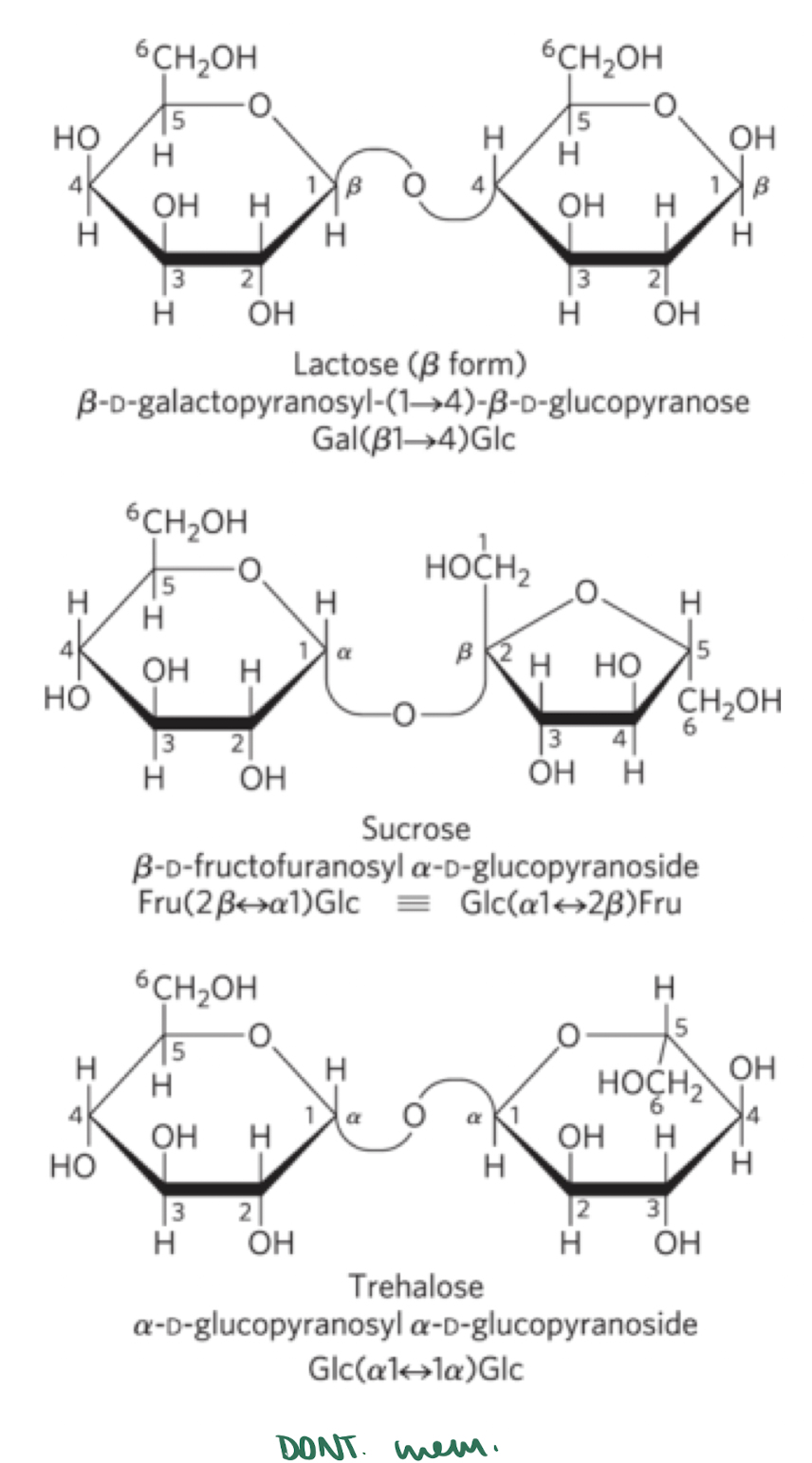
Naming Disaccharides: Be able to understand (wont be asked to name)
naming begins at non-reducing end
name α or beta
beta = C6 & O-glycosidic bond on same side
α = C6 & O0glycosidic bond on OPP side
name monosaccharide 1 : pyranose/fruanose + -osyl
direction of linkage: anomeric → hydroxyl
name monosaccharide 2: pyranose/furanose
name is reducing or non-reducing":
reducing sugars (free anomeric c): -ose
nonreducing sugars (locked anomeric c’s): -oside
→ indicate non-reducing sugars w a double-headed arrow in abbreviated form
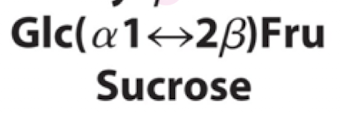
note: can use 3 letter codes for monosaccharides
ex. Glc (glucose)
ex. Gal (galactose)

Disaccharides: ex. Lactose (beta form)
lactose
disaccharide of galactose + glucose
galactose is on the non-reducing end
c1 of glucose unit is in a hemiacetal (reducing end) - THUS its can mutarotate (not fixed)
both sugars are pyranoses
a reducing sugar (2nd sugar indicated as reducing w -ose)
note: bc glucose unit can mutarotate in solution you dont have to includes its anomeric form (beta) in name

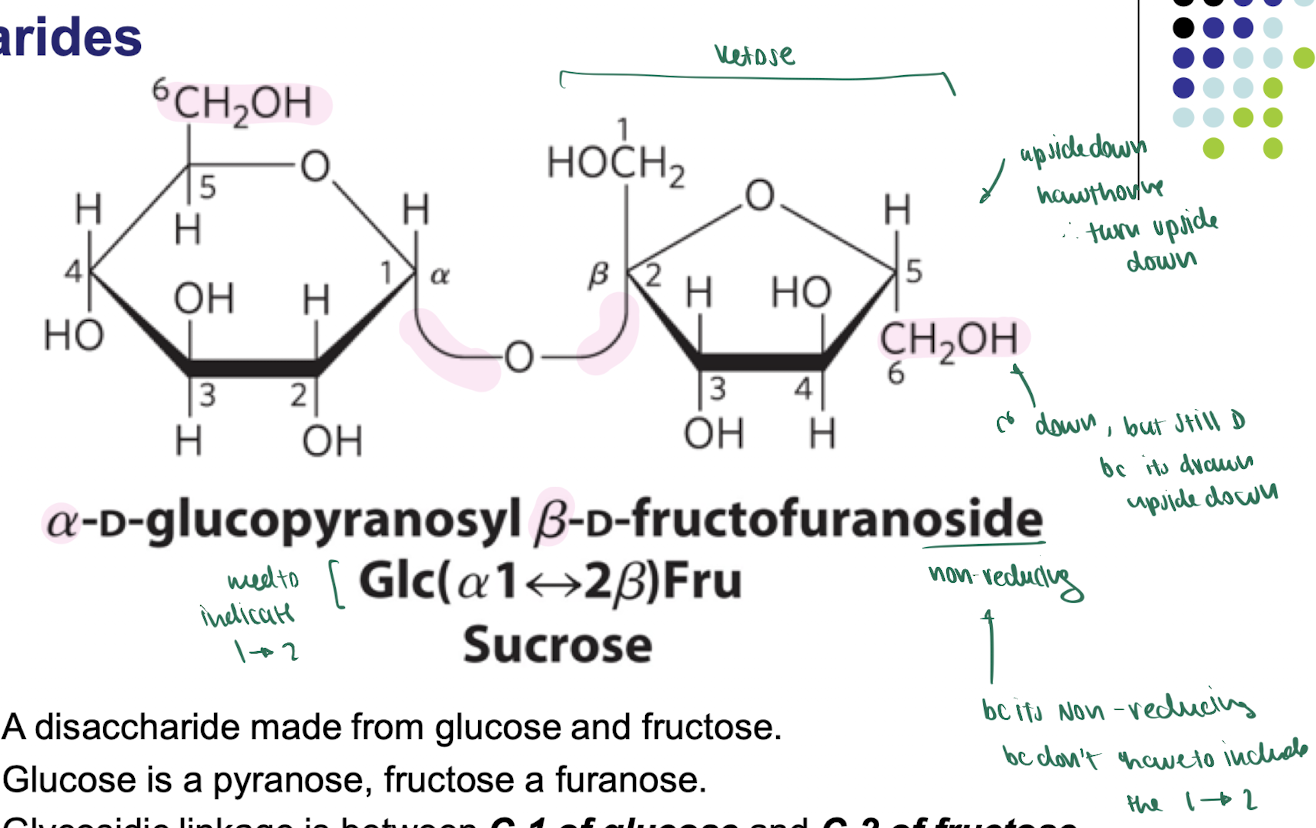
Disaccharides: ex. Sucrose
sucrose
disaccharide of glucose (pyranose) + fructose (furanose)
glycosidic linkage: c1 of glucose → c2 of fructose
both anomeric carbons are involved in glycoside bond, THUS non-reducing
indicate second sugar (fructose) as an -oside bc its non-reducing
indicate non-reducing sugar in abbreviated form w a double-headed arrow

Disaccharides: ex. Maltose

Q. Identify the monosaccharides and glycosidic bond in this disaccharide
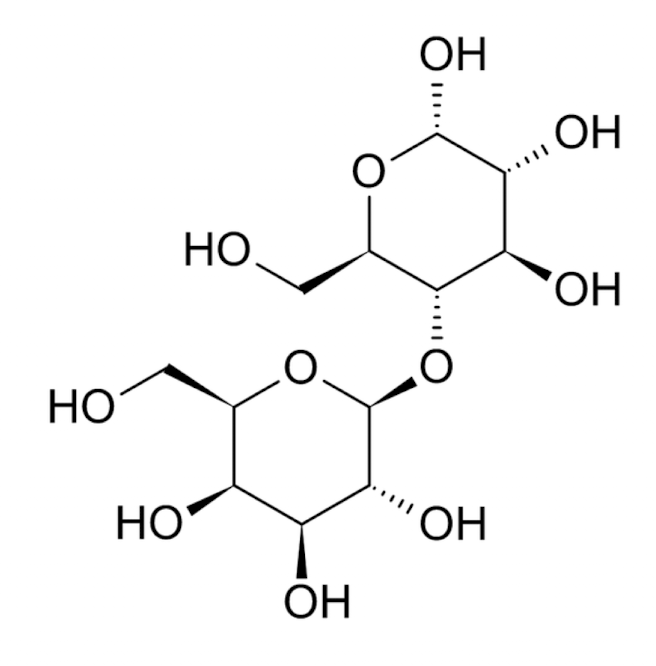
this is a mills projection, not a Haworth → thus we’re looking down on a Haworth projection
identify anomeric c as it is connected to 2 oxygens
# the sugars carbons from the anaemic c
determine up or down to identify units
wedged (twds) = up
dashed (away) = down
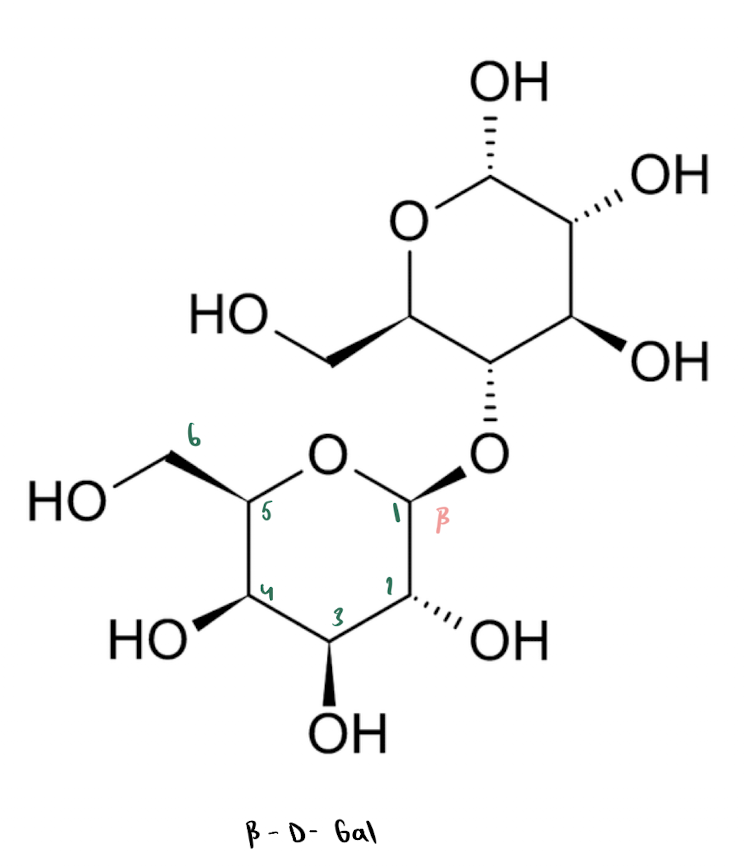
O-glycosidic bond: c1 → c4
reducing, thus 2nd sugar would end in -ose
1st unit: up, up, up, down, up
c6 and anomeric OH are both up → beta form
monosaccharide: galactose
c6 is up → D- enantiomer
answer: beta-D-galactose