Chapter 12: Upper GI
 Call Kai
 Learn
 Practice Test
 Spaced Repetition
 Match
 Flashcards
 Knowt Play
1/38

Earn XP
Description and Tags
Review Book A
39 Terms
What is the average weight of the adult human liver
3-4 pounds
Which abdominal quadrant contains the gallbladder
RUQ
What is the name of the soft tissue structure that separates the right from the left lobe of the liver
Falciform Ligament
Which lobe of the liver is larger, the right or left
Right
List the minor lobes of the liver
Quadrate and caudate
True or false: The liver performs more than 100 functions
True
The average healthy adult liver produces 1 gallon, or 3000-4000 mL of bile per day
False
List the three primary functions of the gallbladder
Store bile, concentrate bile, contract to release bile into duodenum
True/False: Concentrated levels of cholesterol in bile may lead to gallstones
True
What is a common site for impaction, or lodging of gallstones
Duodenal papilla
True/False: In about 40% of individuals, the end of the common bile duct and the end of the pancreatic duct totally separated into two ducts rather than combining into one single passageway into the duodenum
True
True/False: Older terminology for the main pancreatic duct is the duct of Vater
False
Is the gallbladder more posterior or anterior within the abdomen
Anteriorly
14.1: What is the primary location of the liver within the abdomen
To the right of the midsagittal plane
14.2: What is the primary location of an asthenic patient’s gallbladder within the abdomen
Near the midsagittal plane
14.3: What is the primary location of an hypersthenic patient’s gallbladder within the abdomen
To the right of the midsagittal plane
14.4: What is the primary location of an hyposthenic patient’s gallbladder within the abdomen
To the right of the midsagittal plane

Identify A
Left hapatic duct
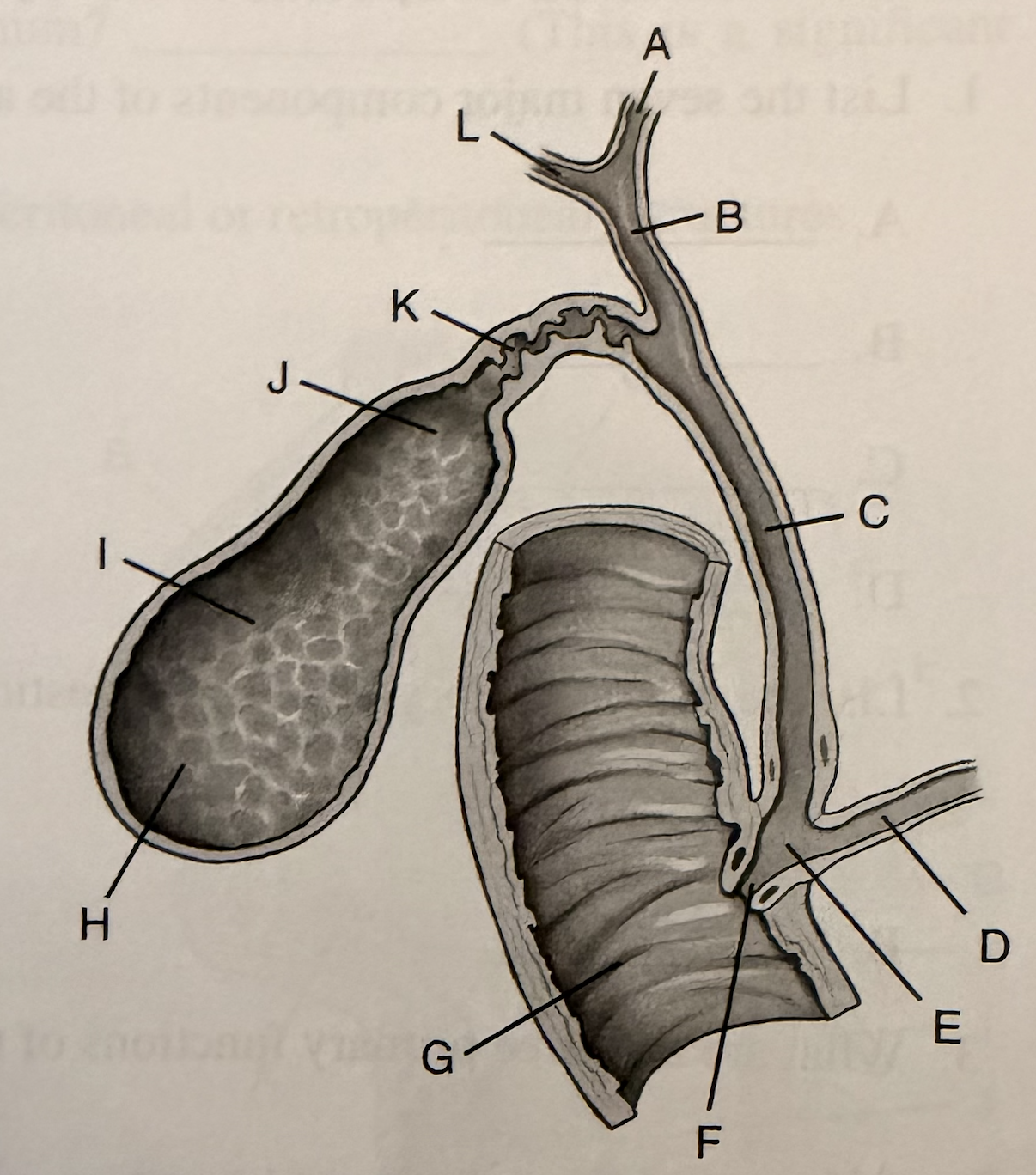
Identify B
Common hepatic duct

Identify C
Common bile duct
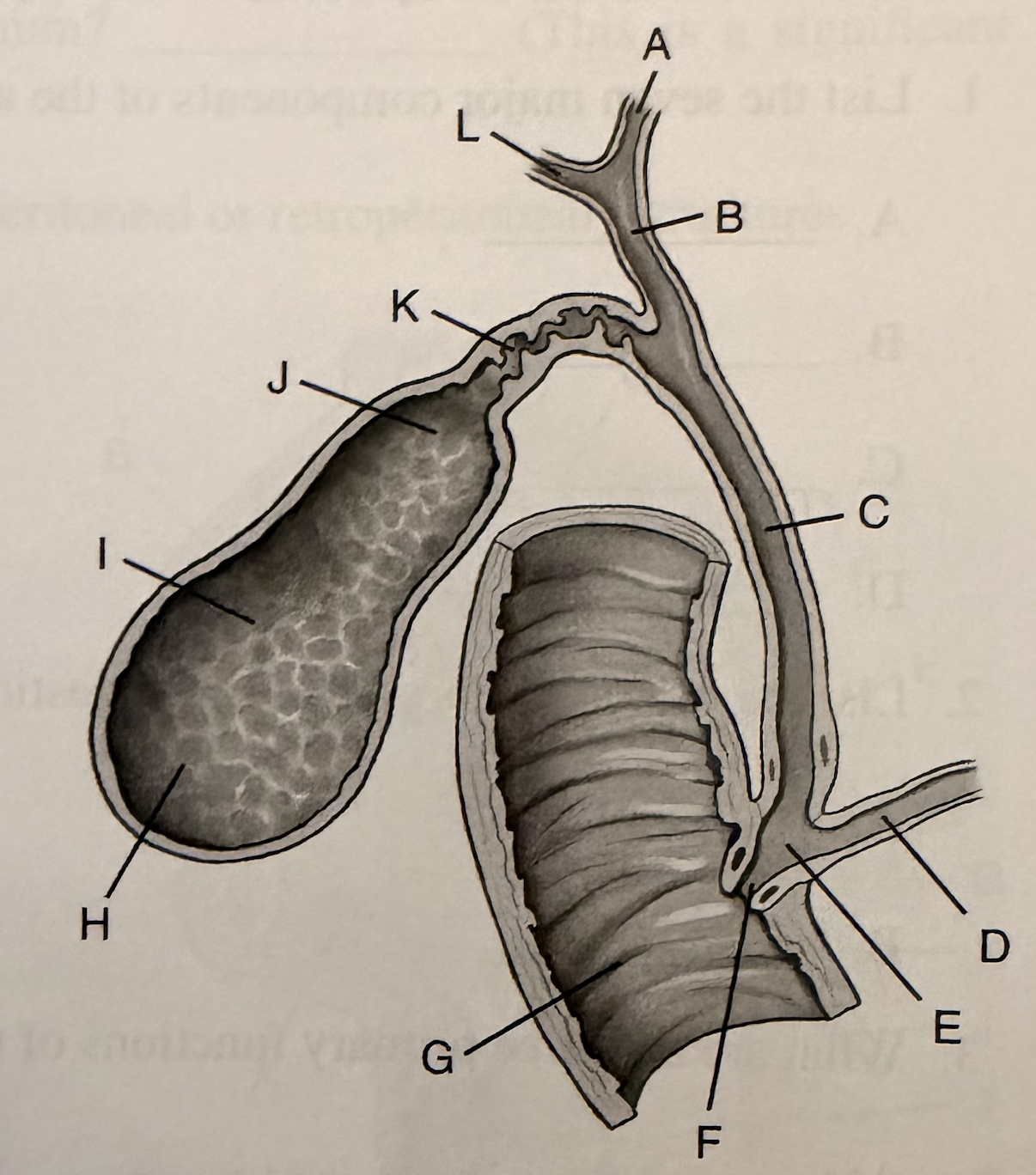
Identify D
Pancreatic duct

Identify E
Hepatopancreatic ampulla

Identify F
Duodenal papilla

Identify G
Duodenum

Identify H
Fundus of gallbladder

Identify I
Body of gallbladder

Identify J
Neck of gallbladder
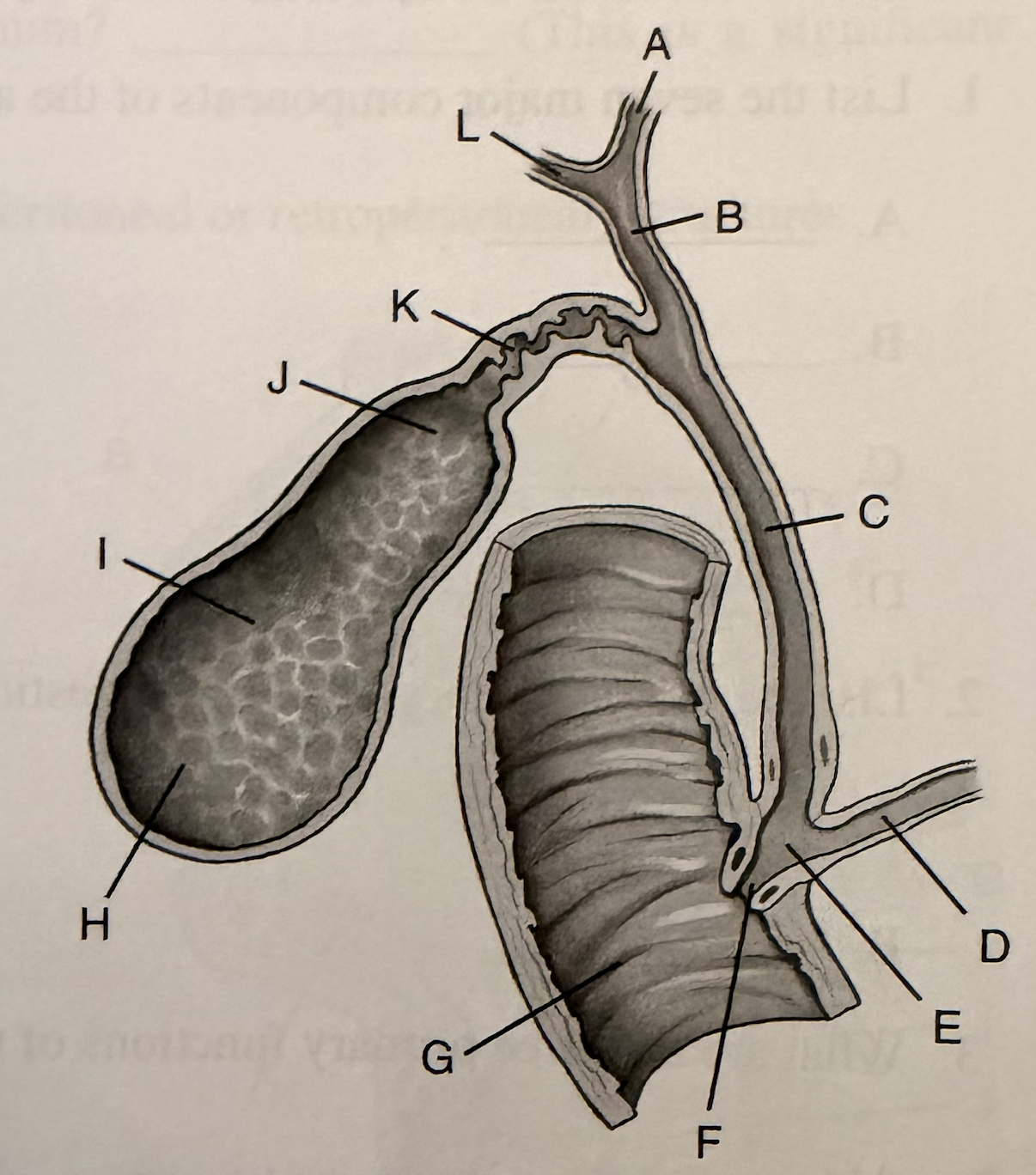
Identify K
Cystic duct
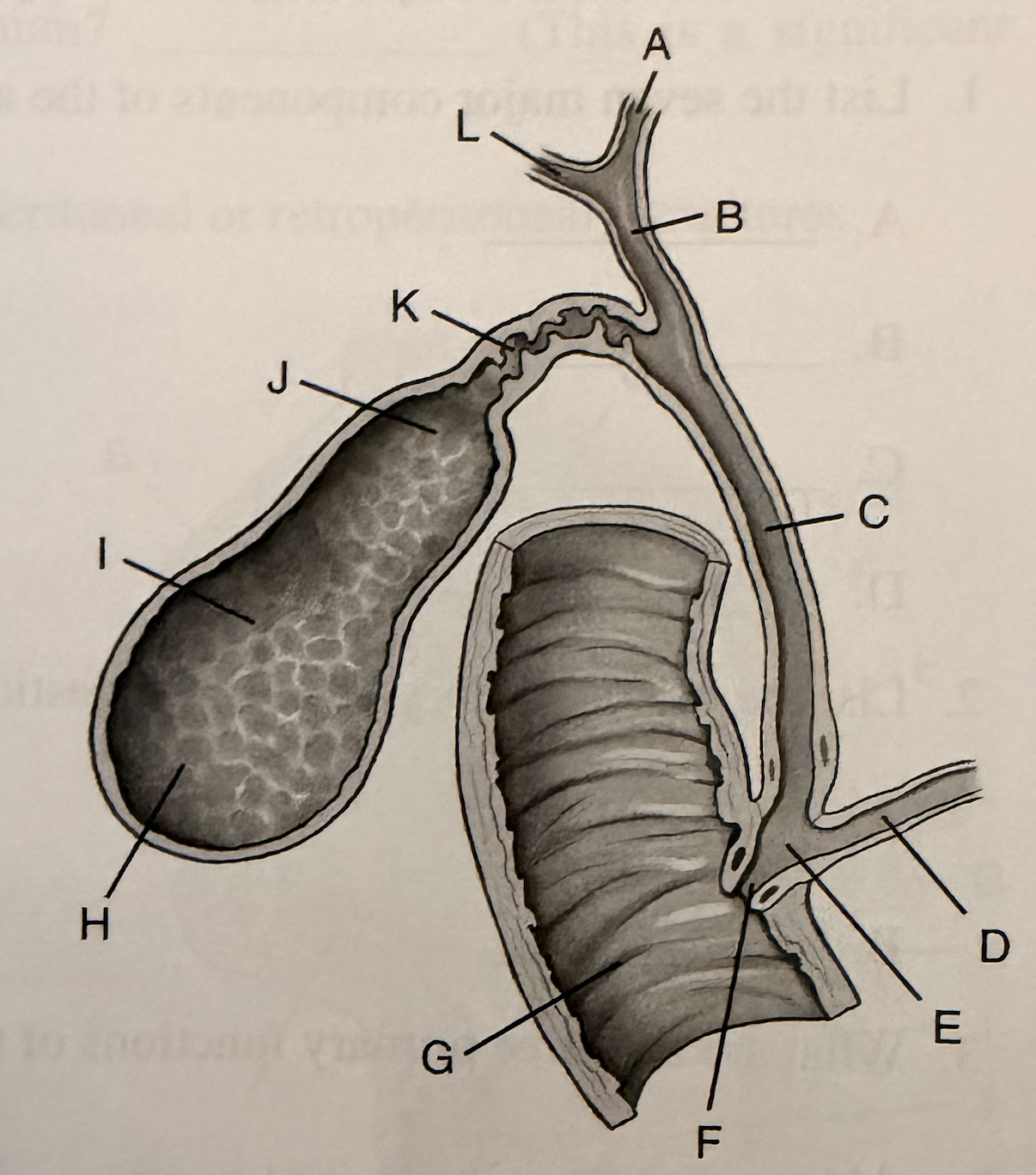
Identify L
Right hepatic duct
List four advantages of DMS as a noninvasive means to study the gallbladder and biliary ducts
No ionizing radiation, better detection of small calculi, no contrast media required, less patient preparation
A cholecystocholangiogram is a radiographic examination of _________
Study of both the gallbladder and the biliary ducts
Which imaging modality produces cholescintigraphy
A. CT
B. MRI
C. Radiography
D. Nuclear Medicine
Nuclear medicine
True/False: Acute cholecystitis may produce a thickened gallbladder wall
True
20.1: What is cholelithiasis
Condition of having gallstones
20.2: What is cholecystitis
Inflammation of the gallbladder
20.3: What is biliary stenosis
Narrowing of the biliary ducts
20.4: What is Cholecystectomy
Surgical removal of the gallbladder
20.5: What is Neoplasm
Benign or malignant tumors
20.6: What is Choledocholithiasis
Enlargement or narrowing of the biliary ducts because of the presence of stones