Anatomy 2300 Unit 3: Muscles of the Shoulder and Arm
 Call Kai
 Learn
Learn Practice Test
 Spaced Repetition
 Match
Match Flashcards
 Knowt Play
1/23

There's no tags or description
Looks like no tags are added yet.
Name | Mastery | Learn | Test | Matching | Spaced | Call with Kai | Chat |
|---|
No analytics yet
Send a link to your students to track their progress
24 Terms
Trapezius m. (action?)
Action: Elevates scapula, retracts scapula, depresses scapula
a broad, superficial muscle covering the posterior neck and upper back, spanning from the base of the skull and the cervical and thoracic spinous processes medially out to the clavicle, acromion, and scapular spine laterally

Levator Scapulae m. (action?)
Action: elevates scapula
lies deep to the trapezius along the posterolateral neck, running inferiorly from the transverse processes of the upper four cervical vertebrae down to the superior angle of the scapula

Rhomboid minor m. (action?)
Action: retracts scapula
lies deep to the trapezius in the upper back, running laterally and inferiorly from the C7 and T1 spinous processes to the medial border of the scapula, just superior to the rhomboid major

Rhomboid major m. (action?)
Action: retracts scapula
lies deep to the trapezius in the mid back, immediately inferior to the rhomboid minor, running laterally from the T2-T5 spinous processes to the medial border of the scapula

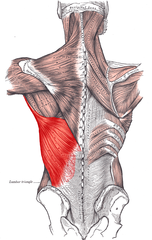
Latissimus dorsi m. (action? innervation?)
Action: Adducts arm (shoulder), extends arm (shoulder), medially rotates arm (shoulder)
Innervation: Thoracodorsal nerve
a broad, superficial muscle covering the lower back, running superiorly and laterally from the lower thoracic and lumbar spinous processes.
Rotator Cuff Muscles (name all)
muscles wrap around the glenohumeral joint on its anterior, superior, and posterior surfaces to stabilize the shoulder.
1. supraspinatus
2. infraspinatus
3. teres minor
4. subscapularis.

Subscapularis m. (action?)
Action: Medially rotates arm (shoulder)
lies on the anterior (costal) surface of the scapula, running laterally to the lesser tubercle of the humerus

Supraspinatus m. (action?)
Action: Abducts arm (shoulder)
sits superior to the scapular spine on the posterior scapula, running laterally to the greater tubercle of the humerus;

Infraspinatus m. (action?)
Action: Laterally rotates arm (shoulder)
sits inferior to the scapular spine on the posterior scapula, running laterally to the greater tubercle of the humerus; it laterally rotates the arm.

Teres minor m. (action? innervation?)
Action: Laterally rotates arm (shoulder)
Innervation: Axillary nerve
lies along the lateral border of the scapula, just inferior to the infraspinatus, and runs to the greater tubercle of the humerus; it laterally rotates the arm.

Teres Major m. (action?)
Action: Adducts arm (shoulder)
lies inferior to the teres minor along the inferior angle of the scapula, running superiorly and laterally to the anterior proximal humerus;

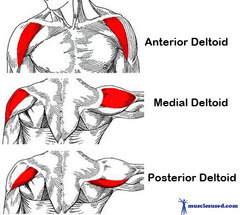
Deltoid m. (action? innervation?)
Action:
- Anterior part: Flexes arm (shoulder), medially rotates arm (shoulder)
- Middle part: Abducts arm (shoulder)
- Posterior part: Extends arm (shoulder), laterally rotates arm (shoulder)
Innervation: Axillary Nerve
caps the shoulder, wrapping anteriorly, laterally, and posteriorly around the glenohumeral joint from the clavicle, acromion, and scapular spine down to the lateral humerus
"SITS" acronym
the mnemonic for the four rotator cuff muscles, listed from superior to inferior around the scapula:
Supraspinatus
Infraspinatus
Teres minor
Subscapularis.
Pectoralis major m. (action?)
Action: Adducts arm (shoulder), medially rotates arm (shoulder)
a broad, superficial muscle covering the anterior chest wall, running laterally and inferiorly from the medial clavicle, sternum, and upper costal cartilages to the proximal humerus.

Pectoralis minor m. (action?)
Action: protracts the scapula; elevates the ribs when the scapula is fixed
lies deep to the pectoralis major on the anterior chest wall, running superiorly and laterally from the anterior surface of ribs 3-5 to the coracoid process of the scapula.

Serratus anterior m. (action? innervation?)
Action: Protracts scapula, holds scapula against thoracic wall, rotates scapula
Innervation: Long thoracic nerve
lies along the lateral thoracic wall, running posteriorly from the lateral surface of ribs 1-8 to wrap around and attach to the anterior (deep) surface of the medial border of the scapula

Winged Scapula
the outward, posterior protrusion of the medial border of the scapula away from the thoracic wall.
Its caused by weakness or paralysis of the serratus anterior, most often from long thoracic nerve injury.

Long head of Biceps Brachii mm. (action? innervation?)
Action: Flex forearm (elbow) when forearm is in supinated position, supinates forearm (radioulnar), slight arm flexion (shoulder)
Innervation: Musculocutaneous nerve
arises superiorly at the supraglenoid tubercle of the scapula, just above the glenoid cavity, and runs down the anterior arm.
Together with the short head, it flexes the forearm when supinated, supinates the forearm, and slightly flexes the arm at the shoulder.

Short head of biceps brachii mm. (action? innervation?)
Action: Flex forearm (elbow) when forearm is in supinated position, supinates forearm (radioulnar), slight arm flexion (shoulder)
Innervation: Musculocutaneous nerve
arises from the coracoid process of the scapula, medial to the long head, and runs down the anterior arm;
Together with the long head, it flexes the forearm when supinated, supinates the forearm, and slightly flexes the arm at the shoulder.

Coracobrachialis m. (action? innervation?)
Action: Flex arm (shoulder), adducts arm (shoulder)
Innervation: Musculocutaneous nerve
lies deep and medial to the biceps brachii in the proximal anterior arm, running from the coracoid process of the scapula down to the medial surface of the mid-humerus

Brachialis m. (action? innervation?)
Action: Flex forearm (elbow)
Innervation: Musculocutaneous nerve
lies deep to the biceps brachii in the distal anterior arm, running from the distal anterior humerus down to the proximal ulna

Long head of Triceps Brachii mm. (action? innervation?)
Action: Extend forearm (elbow)
Extends arm (shoulder)-long head only
Innervation: Radial nerve
arises superiorly at the infraglenoid tubercle of the scapula, just below the glenoid cavity, and runs down the posterior arm
It is the only head that also extends the arm at the shoulder, in addition to extending the forearm at the elbow along with the other two heads.

Lateral head of Triceps Brachii mm. (action? innervation?)
Action: Extend forearm (elbow)
Innervation: Radial nerve
lies on the posterior humerus superior to the radial groove; with the other two heads, it extends the forearm at the elbow.

Medial head of Triceps Brachii mm. (action? innervation?)
Action: Extend forearm (elbow)
Innervation: Radial nerve
lies deep on the posterior humerus inferior to the radial groove; with the other two heads, it extends the forearm at the elbow.
