Exam 3 Xray Physics
 Call Kai
 Learn
 Practice Test
 Spaced Repetition
 Match
 Flashcards
 Knowt Play
1/69

There's no tags or description
Looks like no tags are added yet.
70 Terms
When x-rays are produced, they are emitted:
in all directions
The x-rays emitted through the window are called the ______
useful beam
X-rays that escape through the protective housing are called ______ radiation
leakage
The cathode is the _________ side of the x-ray tube.
negative
The filament is embedded in a metal shroud called the:
focusing cup
What is a space charge?
a cloud of electrons
Which area of the anode is struck by electrons?
target
off-focus radiation
x-rays produced outside the focal spot
most common cause of tube failure:
Tungsten vaporization
What could cause rotational friction and an imbalance of the rotor anode assembly?
Excessive heating of the bearings
X-rays are produced:
isotropically
Considering the line focus principle, which focal spot do you want to be smaller?
Effective focal spot size
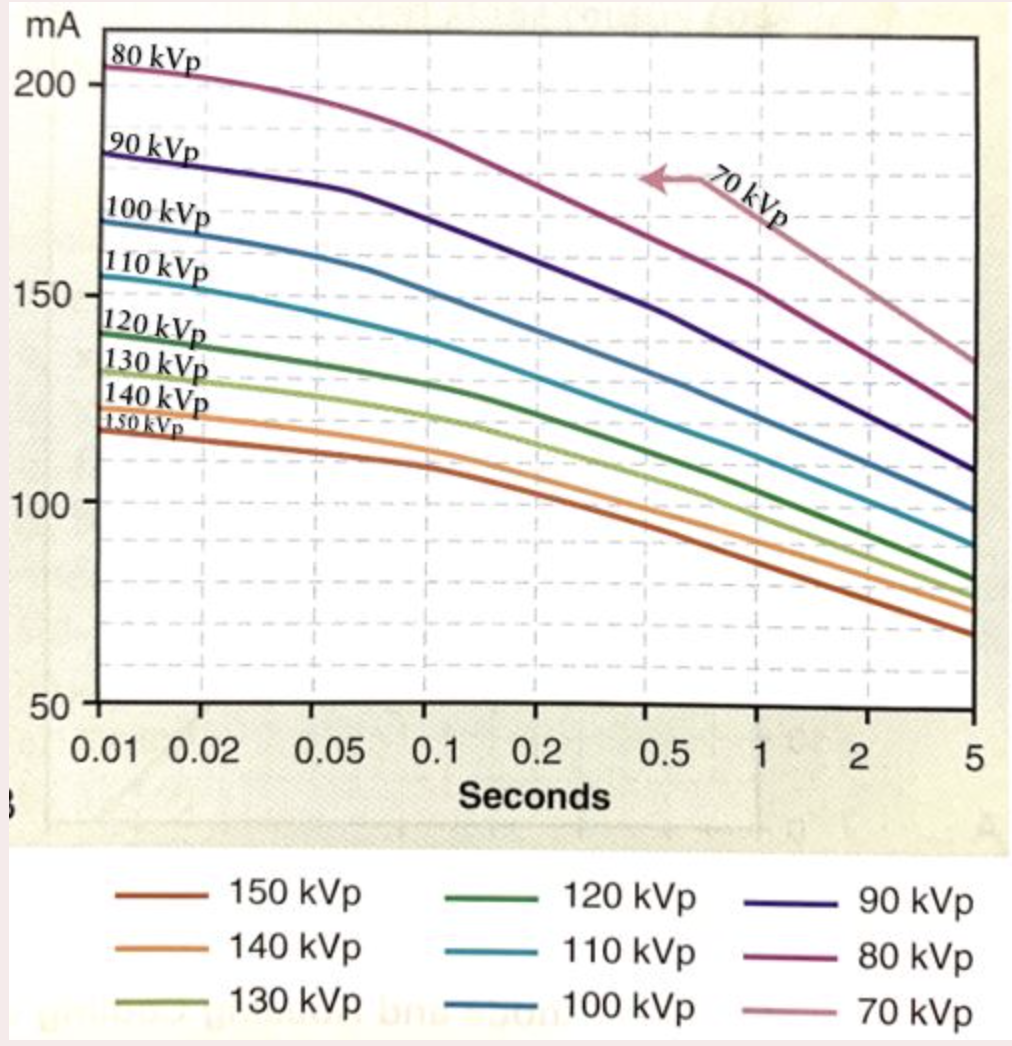
would it be safe or unsafe to use 80 kVp, 70 mA, and 1 second?
safe
Is X-ray production is an efficient process?
no
What produces a negative space cloud?
heated filament
What selects the filament size on the control panel?
Focal spot size

would it be safe or unsafe to use 120 kVp, 200 mA, and 0.2 sec?
unsafe
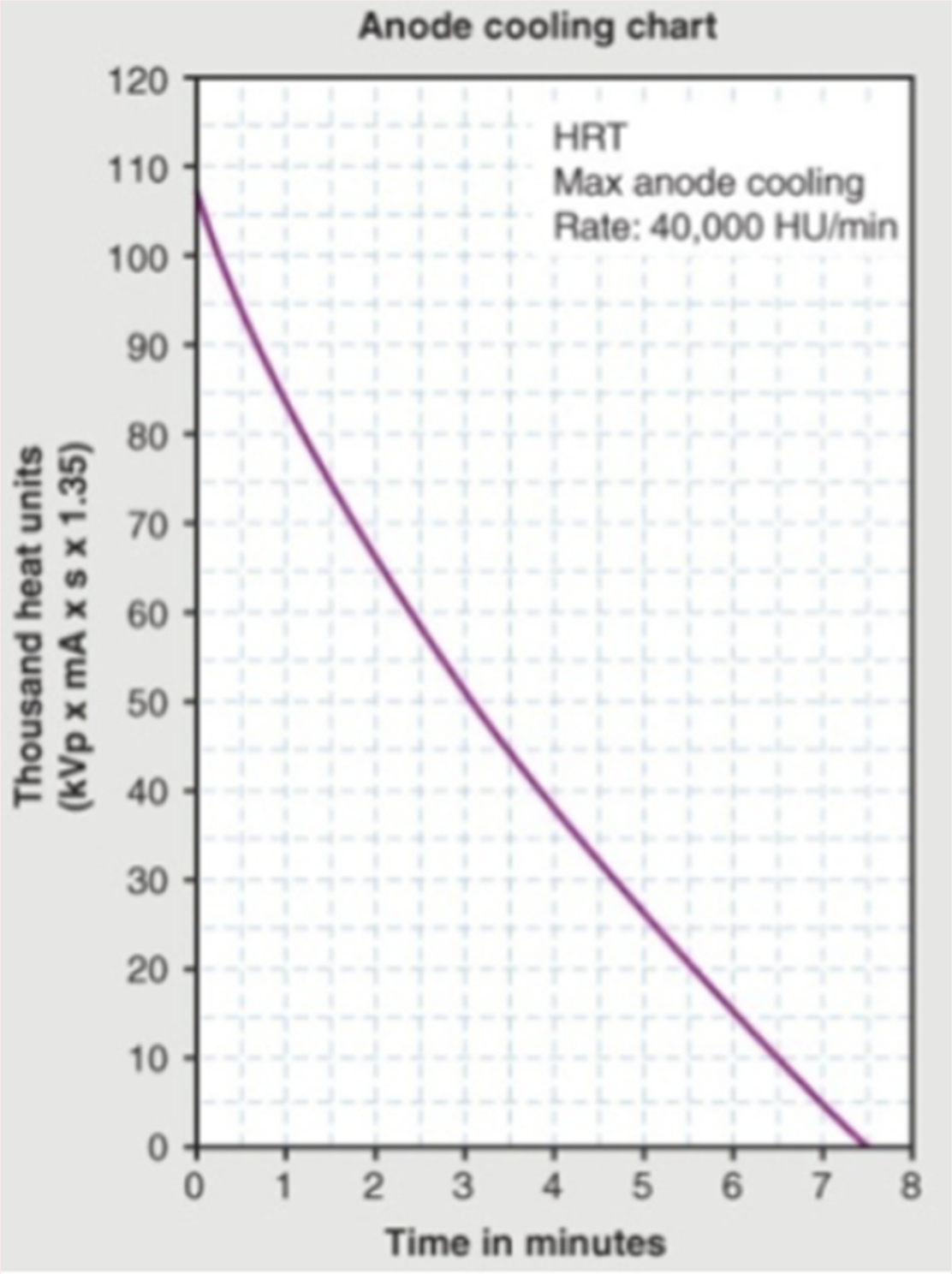
How long would it take the anode to cool from 65,000 HU to 15,000 HU?
4 minutes
A ______ effective focal spot size will increase image detail.
smaller
purpose of the tube housing
reduce leakage radiation and heat to the tube, protect from electrical shock
Explain how the anode rotates
Electromagnets are energized in sequence which turns the rotor in attempt to align with the energized electromagnet.
What is the type of motor used with x-ray tubes?
Induction motor
Electric current is supplied directly to the ____
stator
What is the most common type of anode material?
Tungsten
Why is Tungsten the most commonly used anode material?
high melting point, high heat capacity to withstand heat during production, and high atomic number to increase x-ray production (more interactions)
What is the melting point of the anode material in Celsius?
3400 degrees Celsius
What is the melting point of the anode material in Fahrenheit?
6700 degrees Fahrenheit
What is the anode rotation speed in a general x-ray tube?
3400 rpm

1
protective housing
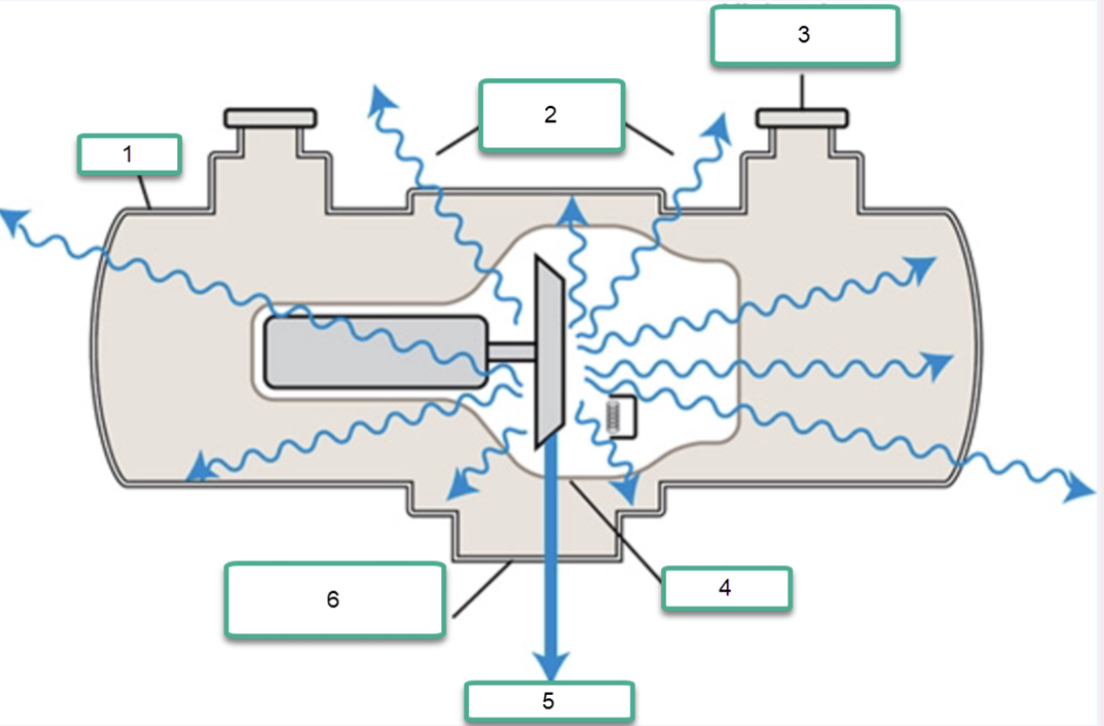
2
leakage radiation

3
high-voltage receptacles

4
tube enclosure/ envelope

5
primary beam
What material is the protective housing made out of?
lead
What material is the anode target made out of?
Tungsten
What material is the cathode filament made out of?
Tungsten
What material is the tube enclosure/envelope made out of?
glass or metal
What are the 3 purposes of the tube protective housing?
Electrical insulation
Heat protection
Reduction of leakage radiation
During x-ray production, what percentage of the interaction is heat and what percentage is photons?
99% Heat
1% X-ray Photons
What are 2 ways the tube housing assists in dissipating heat in the tube?
Oil bath
Cooling fans

1
Rotor

2
stator

4
cathode

5
anode target/ disc

6
Tube Enclosure/ envelope
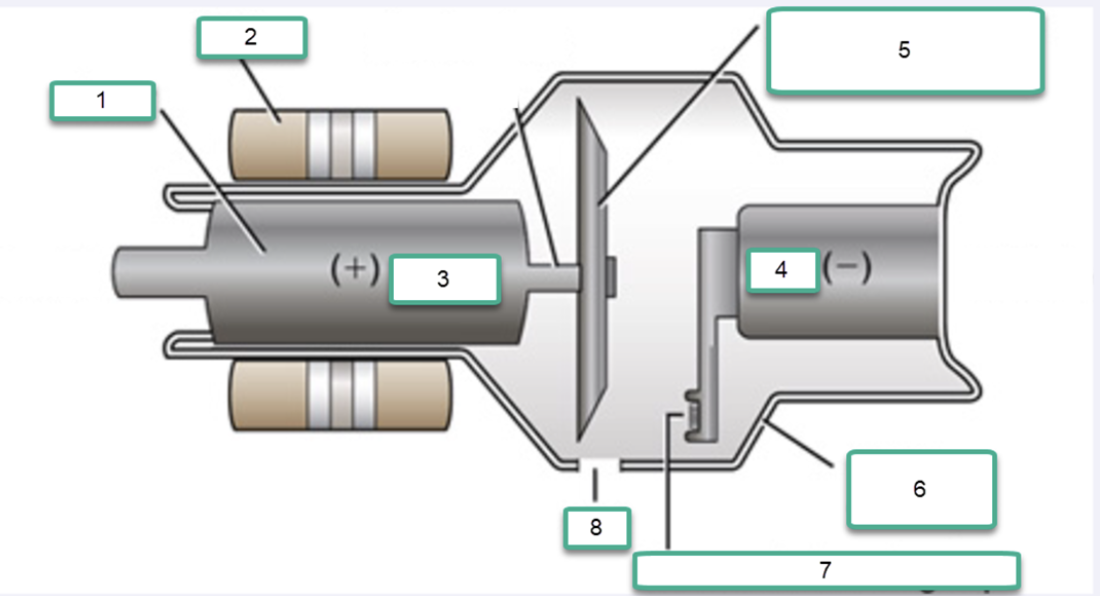
7
filament wire

8
Port Window
What is special about the port or window?
It is thinner than the rest of the x-ray tube/enclosure and the useful beam of X-rays is emitted through it
anode charge
positive
cathode charge
negative
focusing cup
negative

1
anode target/ disc

2
electron beam
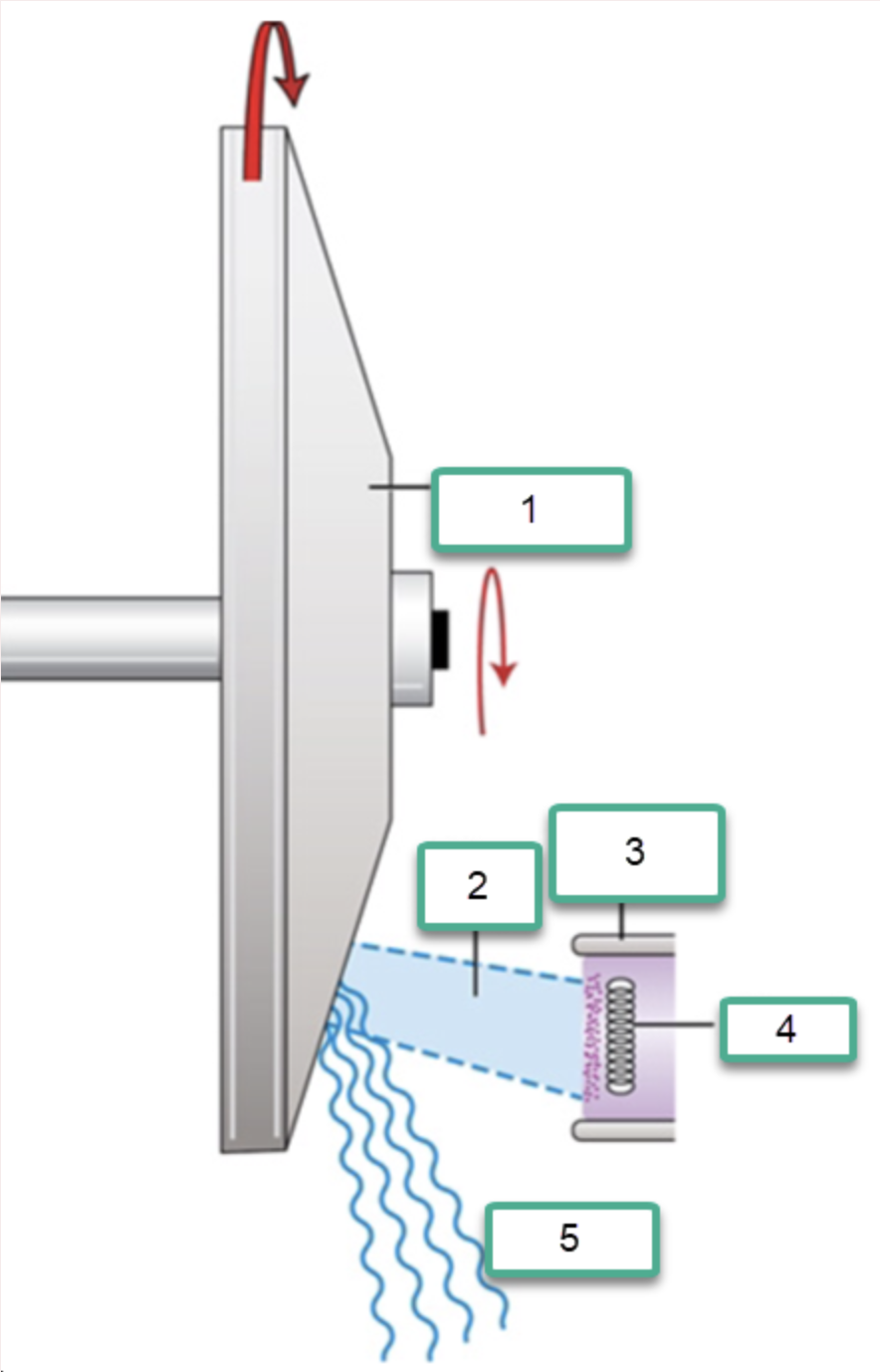
3
focusing cup

4
filament wire

5
primary beam
What is it called when an x-ray tube has 2 filament wires?
dual-focus
What part of the x-ray circuit protects the filament wire(s) from breakage/damage?
Step-down Transformer
What principle causes the anode to rotate?
Mutual Induction
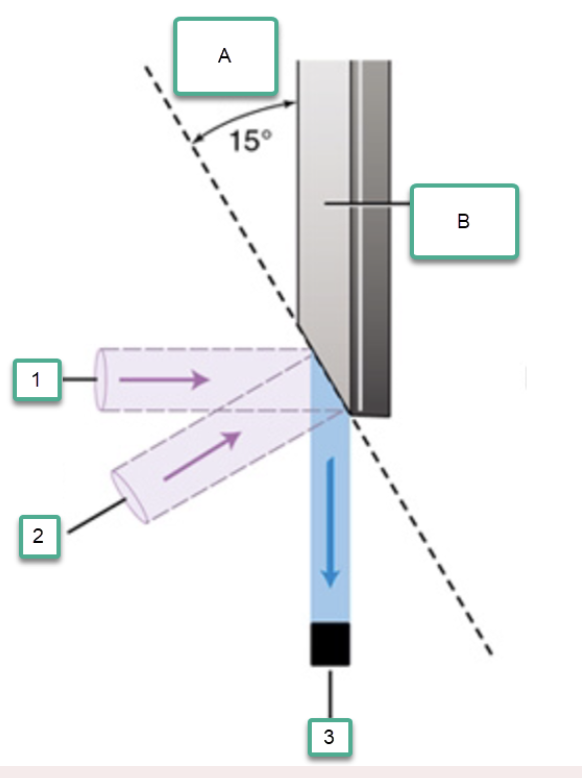
A
Anode angle

B
Anode target/disc

1
electron beam

2
actual focal spot

3
effective focal spot

What principle is this diagram showing?
line-focus
Electric current is supplied directly to the ______
stator
Most of the kinetic energy of electrons is converted into ____.
heat
Only approximately _____ % of electron kinetic energy is used for the production of x-radiation.
1
__________ x-rays are emitted when an outershell electron fills an inner shell void.
Characteristic