Microbio Lab 2
 Call Kai
 Learn
Learn Practice Test
 Spaced Repetition
 Match
Match Flashcards
 Knowt Play
1/94

There's no tags or description
Looks like no tags are added yet.
Name | Mastery | Learn | Test | Matching | Spaced | Call with Kai | Chat |
|---|
No analytics yet
Send a link to your students to track their progress
95 Terms
True or False? The transfer of genetic material from parents to their offspring is called horizontal gene transfer.
False
Two organelles that are theorized to have evolved from prokaryotic cells are ______________ and _________________.
mitochondria; chloroplasts
True or False? Organisms in domain archaea are more closely genetically related to organisms in domain bacteria than domain eukarya.
False
Which of the following support the endosymbiotic theory of mitochondria and chloroplast evolution? Select all that apply.
- mitochondria and chloroplasts have a single double-stranded circular chromosome
- mitochondria and chloroplasts have 70S ribosomes
What molecule is a component of both Gram-positive and Gram-negative bacterial cell walls?
peptidoglycan
Organisms in domain archaea have cell walls that contain _______________.
pseudopeptidoglycan
Many extremophiles such as halophiles, thermophiles, and acidophiles belong to domain _______________.
archaea
Prokaryotes reproduce asexually mainly by a process called ____________.
binary fission

Septum formation
3

daughter cells separate
5

cell partitions
4

DNA replication
1

Cell elongation
2

Nucleoid
G

Plasma membrane
B

Cell wall
C

Fimbriae
D

Capsule
I

Flagellum
E

Ribosome
A
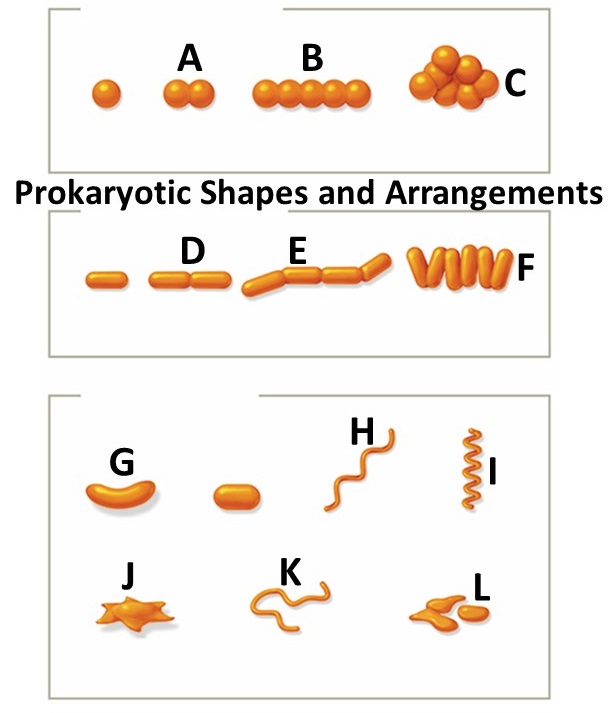
streptococci
B

vibrio
G

Pallisade
F

Diplococci
A

Filamentous
K

streptobacilli
E

Spiral
H

Spiral
H

Diplobacilli
D

Spirochete
I

Stella
J

Pleomorphic
L

Staphylococci
C

What is the shape and arrangement of the circled bacterial cells?
diplococci

What is the shape and arrangement of the circled bacterial cells?
staphylococci

What is the shape and arrangement of the circled bacterial cells?
cocci in tetrads

What is the shape and arrangement of these bacterial cells?
streptococci

What is the shape and arrangement of these bacterial cells?
streptobacilli
A patient presents with nausea and diarrhea, and informs you that he was recently in Africa and drank water from a stream. Tests for various parasitic infections were negative, so the illness is likely caused by a bacterial infection. After further testing the patient is diagnosed with chlorea caused by the bacterium, Vibrio cholerae. Using the information ascertained from the bacteria's name, what shape do you think this organism is?
comma shaped

Rough ER
C

Smoooth ER
E

Centroles
I

Golgi appartatus
K

Mitochondrion
F

Nucleus
D

Ribosome
G
When preparing a slide for bacterial staining, the _________________ step attaches the bacteria to the slide and kills the microorganisms.
heat fixing

Unstained bacteria are hard to see in a bright-field light microscope. Based on these images, what do you think the two stained specimens have in common? In both samples....
the contrast between the cells and background is increased
Using your knowledge about the charge of various bacterial cellular components, predict what charge an acidic dye has.
the ion is negatively charged
examples are crystal violet and methylene ble
Basic dye
stains microbial cells
Basic dye
colorful portion of the dye is negatively charged
Acidic dye
colorful portion of the dye is positively charged
Basic dye
examples include nigrosin and India ink
Acidic dye
repelled by microbial cells
Acidic dye
Heat-fix smear
Step 3
Rinse smear with deionized water
Step 5
Air-dry the smear
step 2
Spread the cells on a clean slide
Step 1
Blot the slide dry
Step 6
Flood smear with methylene blue
step 4
Which of the following actions should be taken when preparing a bacterial smear for staining with a basic dye? Select all that apply.
- cool the wire loop sufficiently after flame sterilization prior to taking your bacterial sample
- air-dry the smear completely prior to heat-fixing
Your medical laboratory receives a clinical specimen from a patient believed to have inhalation anthrax. Your lab assistant has stained the specimen with methylene blue and observes rods arranged in chains. Which of the following arrangements best describes the observed cellular shape and arrangement?
streptobacilli
You are preparing a bacterial smear from a broth culture for simple staining. You just spread a loopful of cells on a glass slide. What is the next step in the process?
air-dry the slide
Your clinical lab technician misplaced the stock of methylene blue. The technician want to stain the cells directly and asks if it would be acceptable to substitute acid fuchsin, an acidic dye, for methylene blue. Would this be an acceptable substitution?
No, methylene blue is a basic dye which stains cells and acid fuchsin is an acidic dye that stains the background.
Your eager lab partner decides to skip the step of resuspending the cells in a broth culture tube, saying, "I see a sediment at the bottom of the tube; I will just pick up cells from there." How should you respond?
Resuspending the culture ensures even sampling and appropriate smear thickness.
Replace tube
step 5
Uncap culture tube
step 1
Flame-sterilize tube lip
Step 2
Flame-sterilize tube lip and recap tube
step 4
Obtain one loopful of culture
Step 3
You just transferred one loopful of inoculum to a slide. What would be the likely result if you added serveral more loopfuls of culture. Select all that apply.
- Heat-fixation may be inadequate for some cells, resulting in staining inconsistencies
- Cell layering would make cellular morphology more difficult to determine.
How is a solid culture smear preparation different from a broth culture smear preparation?
water must first be added to the slide
You are preparing a bacterial smear from a solid culture for simple staining. You just transferred deionized water onto the glass slide. What should you do next?
flame sterilize and cool the loop
Your impatient lab partner doesn't want to wait for the slide to fully dry before heat-fixing the specimen. What do you advise?
Skipping the air-drying step may cause the cells to boil, distorting their morphology.
Where in the Bunsen burner flame should you heat-fix your specimen?
in the outer cone of the flame
What is the proper way to heat-fix a slide?
sweep it through the flame three times

Liliana has a suspected case of meningitis. The doctor performs a lumbar puncture to collect cerebrospinal fluid (CSF) for simple staining to determine if the meningitis is bacterial in nature. The image shows the results of the CSF simple stain. Does Liliana's specimen contain bacterial cells?
Yes; the bacterial cells have been directly stained by the methylene blue.

Based on the CSF micrograph shown and the informational table provided, which pathoge(s) are a possible cause of Liliana's illness? Select all that apply.
- Streptococcus pneumoniae
- Neisseria meningitidis

Bacterial cells were detected in a patient's CSF sample, so additional tests were ordered including culturing the CSF on blood agar. After examining the cultural characteristics of the colonies growing on the plate, you are concerned that more than one species may be present. Would a simple stain of each colony (A and B) be able to determine if there are two bacterial species growing on the blood agar plate?
Possibly; simple stains can provide information about certain bacterial characteristics and hence be able to distinguish species that differ in morphology.
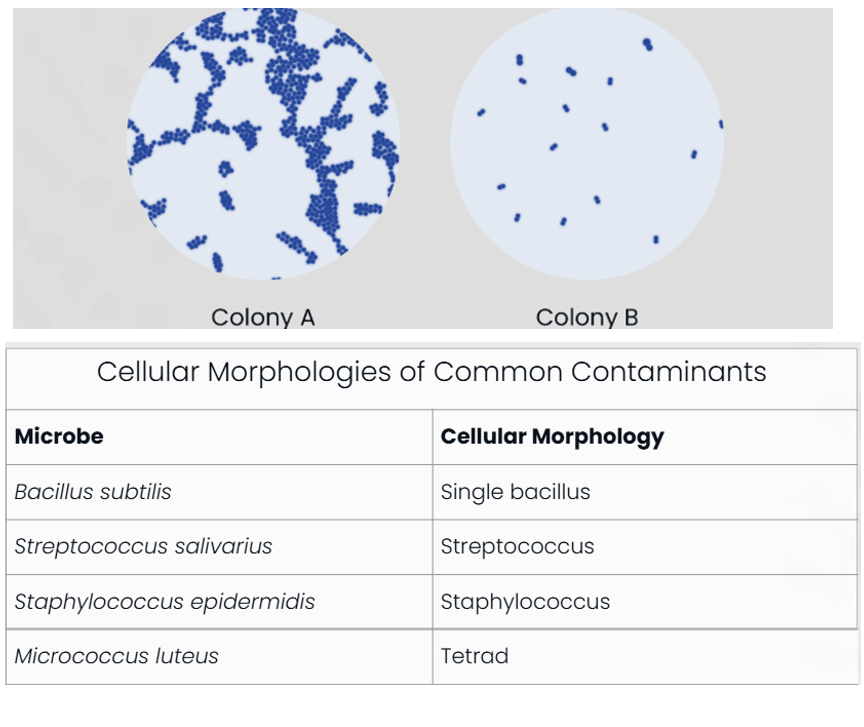
Smear preparations and simple stains are performed on both the Colony A and Colony B isolates from the blood agar plate. The cell morphology of Colony B is similar to the organism observed in the CSF sample. However, the cell morphology of Colony A differs, indicating that it is not the same species as Colony B. Based on the cell morphology listed in the table, Colony A is most likely which organism?
Staphylococcus epidermidis
Lilliana's CFS sample was stained with methylene blue. What type of information can this simple stain provide about the bacterial pathogen? Select all that apply.
- cellular arrangement
- cellular shape
- cellular size
A simple stain was performed on bacterial colony using methylene blue, a dye which stains cells blue. Which of the following statements are true? Select all that apply.
- methylene blue is a positively charged dye
- methylene blue is a basic dye
A simple stain is performed on a bacterial colony using India ink, a brown-colored acidic dye. How do you expect the specimen to appear after staining?
the cells will appear colorless and the background will be brown

Troubleshoot the following:
Your laboratory technician is having difficulty identifying the morphology of this stained specimen and asks for your advice. How should you respond?
the smear was made overly thick

Before air-drying and heat-fixing this specimen, your lab technician asks you which smear to use. Which smear (A or B) has an appropriate thickness for staining?
Smear A is better; it contains fewer cells, resulting in more accurate staining and more clearly visible cell morphology.
Troubleshoot the following:
Your lab partner is preparing a smear for simple staining from a solid culture. Oddly, the stained slide doesn't appear to have any cells on it. What went wrong?
the cells were inadequately heat-fixed
Slide shatters
overheating during heat-fixation
large groups of stained cells prevent accurate determination of cellular morphology and arrangement
smear made overly thick
No cells present
Inadequate heat-fixation
Only unstained cells are observed
smears made overly thiick
Stained cells are visible, but their cellular morphology is distorted
overheating during heat fixation
Which of the following procedural errors is most likely to result in distorted cellular morphology?
the smear is not sufficiently air-dried prior to heat-fixing
Which of the following problems may occur when a smear is made overly thick? Select all that apply.
-not all cells will properly adhere to the slide
-it’s difficult to determine cellular morphology
-the cellls are inconsistently stained
When heat-fixing a smear, you quickly pass the slide once through the Bunsen burner flame. Which of the following will most like occur because of this action?
the cells will not be visible under the microscope