Patient Care
 Call Kai
 Learn
Learn Practice Test
 Spaced Repetition
 Match
Match Flashcards
 Knowt Play
1/185

There's no tags or description
Looks like no tags are added yet.
Name | Mastery | Learn | Test | Matching | Spaced | Call with Kai | Chat |
|---|
No analytics yet
Send a link to your students to track their progress
186 Terms
Patient's Bill of Rights
Guarantees receivable of medical care regardless of personal conditions or Financial limitiation
Patient/Client Management Process (6)
Examination
Evaluation
Diagnosis
Prognosis
Intervention
Outcomes
Chart Review
Data collection
interview
Subjective report
prognosis
a forecast of the probable course and outcome of a disease or situation
Prognostic scale: functional expectation
Excellent, Good, Fair, Poor, Guarded
excellent goal qualities are
Sustainable
Measurable
Achievable
Revisable
Individulized
Steps to Communication with patients
1. Introduce self as PT student
2. Confirm correct patient
3. Ensure patient is ok with your presence
4. Give time estimation and session goal
5. Remain professional
6. Mindful of role as a student.
Gait/transfer belt position
Positioned toward lower waist
5 cardinal rules of body mechanics
1. keep load close
2. create appropriate base of support
3. use isometric muscle contraction of trunk
4. lift with legs, not back
5. don't twist, avoid crossing legs
Draping the patient
Done to provide for modesty, comfort, protection and warmth to the patient.
Introducing yourself as what
Student PT
Observe means to do what
Room scanning for equipment/patient scanning how is the patient and what do they need
Why are vital signs important?
To know when to push and when to stop
Normal heart rate
60-100 bpm
How to take manual heart rate of geriatric population
Take pulse for 60 seconds
When is heart rate measured and why
Prior to exertion to establish base line, During exertion looking for silent changes, after exertion and resting for 10 minutes
Pulse grade of heart rate
0 absent
1+ barely perceptible and easily obliterated with pressure
2+ weak, difficult to palpate, but slightly stronger than 1+
3+ normal, easy to palpate
4+ bounding, very strong, hyperactive
Sign of backup of fluid into the heart
Distention of jugular vein
pitted edema
fluid accumulation in the extremities; makes an indentation when pressed
bradycardia
slow heart rate (less than 60 bpm)
Tachycardia
Fast heart rate (HR greater than 100bpm)
Normal heart sounds
S1 and S2 (lub dub)
abnormal heart sounds
S3 and S4
Areas to listen to heart auscultations
Aortic area (second right intercostal space)
Pulmonic area (second left intercostal space
Tricuspid area (fourth left intercostal space)
Mitral area or apex( fifth left intercostal space
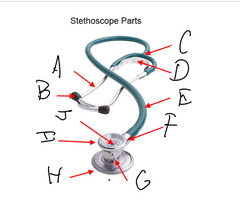
When do you use the bell on a stethoscope
When listening for low-pitched sounds and pediactrics
When do you use the diaphragm on a stethoscope
high pitched sounds
A
Binaural

What is the most accurate way to take blood pressure
Manual Blood pressure
B
Ear tips

Which artery did we listen to while we determined blood pressure?
brachial artery
C
Sound Conductor

Circumference of arm covered by blood pressure bladder for adult
80%
D
Binaural Spring

Circumference of arm covered by blood pressure bladder for child
40%
E
Tubing

where should the arm be when taking bp?
heart level and relaxed
F
Acoustic Valve stem

phases of blood pressure measurement
1. Tapping sound
2. Soft swishing sound
3. Crisp sound
4. Blowing sound
5. Silence
G
Drum
How high should you initially pump blood pressure
10 20 mmHg above normal
H
Diaphragm

How much mmHg can differ from a automated vs manual blood pressure measurement
10-15mmHg
I
Bell

What positions can increase diastolic pressure
Sitting and unsupported
J
Acoustic Sound Hole

What positions can increase systolic pressure
Supine and crossed legs
elevated blood pressure
120-129/less than 80
high blood pressure (hypertension) stage 1
130-139/80-89
high blood pressure (hypertension) stage 2
140/90 or above
hypertensive crisis
180/120
white coat hypertension
Elevated BP only at the physicians office
Masked HTN
Abnormnal BP only at home
Primary Hypertension
Elvated BP with unclear underlying etiology (cause)
secondary hypertension
Elevated BP with known cause
pseudo hypertension
Common in elderly population due to arterial noncompliance
orthostaic hypotension indicatior
drop of 20/10 or more
Symptoms of hypertension
Throbbing headache
Symptoms of hypotension
dizziness, fainting
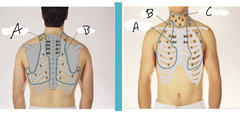
Normal lung auscultation sounds
Tracheal
Bronchial
Bronchovesicular
vesicular
A
Bronchovesicular

abnormal breath ausculatation sounds
High pitch wheezing acoustic quality
Low pitch snoring acoustic quality
B
Vesicular
Normal respiratory rate
12-20 breaths per minute
C
Bronchial/tracheal

bradypnea
less than 12 breaths per minute
Tachypnea
more than 20 breaths per minute
Normal body core temperature
95.9-99.5
oral temperature
98.6
axillary temperature
97.6
rectal temperature
.5-.7 greater than oral temperature (
SpO2
saturation of peripheral oxygen
How effective should hemoglobin binding be (SpO2)
95% or more
Blood pressure and heart is what in younger population
BP lower and HR is higher
What are we testing for during a neurological screening
Alertness and orientation
levels of alertness
alert, lethargic, obtunded, stuporous (semi coma), coma(deep coma)
Anthropometric
Human body measurements and can tell how effective the heart is pumping
alert
Awake,attentive to normal stimuli, appropriate interaction
lethargic
Drowsy, easily sidetracked, may fall asleep
Obtunded
difficult to arouse, confused when awake
Stupor
Responds only to noxious stimuli, unable to interact once aroused
Coma
Unarousable despite stimuli
4 factors of mental status/cognition
Person, place, time, situation
Documentation for some alert and oriented
A and O x 4 (A/O x 4)
Additional considerations for mental status/cognition
Environment/setting
People present
Sleep
Medication
S3-S5 strength/tone assessment
Innervates pelvic floor muscles
Normal "anal wink"
Dermatomes key land marks
No C1
Nipple is T4
Umbilicus is T10
What do you say during dermatome testing procedure
tell me when you feel me touch you
Dermatome scoring
0 unable to detect stimulus
1 inconsistent (could be hypo/hyper sensitive compared to a reference point)
2 normal consistent detection of stimulus
Reflex test procedure
1. Patient relaxed
2. Muscle midway between shortest and longest length
3. Stimulus must be strong and brief
4. Asses and compare bilaterally
Static position should be
No more than max 2 hours and shoulde be moving very 30 mins
prolonged pressure
Patient can't feel sensation of object poking them for a long time
friction
Skin is rubbing against forces of bed sheets
The Braden scale is used to assess
predicting pressure sore risk of integumentary system
Lower the score the higher the risk
Sensory, moisture, activity, mobility, nutrition, friction/shear
orthostatic hypotension
Decrease in blood pressure related to positional or postural changes from lying to sitting or standing positions
Before mobility assessment we need to
Have necessary equipment
Cognitive status
Vitals
strength assessment (MMT)
ROM
Level of assist
Independent (level of assistance)
100% on their own
Modified independent (level of assistance)
Can do task with equipment and without supervision
steps of mobility (5)
1. Simple instructions
2. Demonstrate to patient
3. Have paitent perform movement
4. Provide cues to improve
5. Continuous reassessment of comfort and safety
Supervision (level of assistance)
Uses verbal cues for safety and technique.
Someone must be there for safety