- Economics 21
 Call Kai
 Learn
Learn Practice Test
 Spaced Repetition
 Match
Match Flashcards
 Knowt Play
1/20

Earn XP
Description and Tags
20/1/26 Economies of Scale - 27/1/26 Whole Class Feedback Pt 2
Name | Mastery | Learn | Test | Matching | Spaced | Call with Kai | Chat |
|---|
No analytics yet
Send a link to your students to track their progress
21 Terms
Define External Economies of scale
Costs savings occurring from the growth of the industry or market which the firm is A PART OF, not the individual firm.
List and explain the 3 types of External Economies of Scale
Cluster Economies of scale (many firms in same industry are located close to each other - provides a market, sources of supply, trained labour)
Universities carrying out R&D (reduces a firm’s own training and research costs)
Tax breaks (government allows these for certain industries)
State and explain External EoS’ effect on the LRATC curve
External EoS cause cost per unit (ATC) to decrease, at each given quantity - LRATC curve moves lower.
Draw the External EoS curve
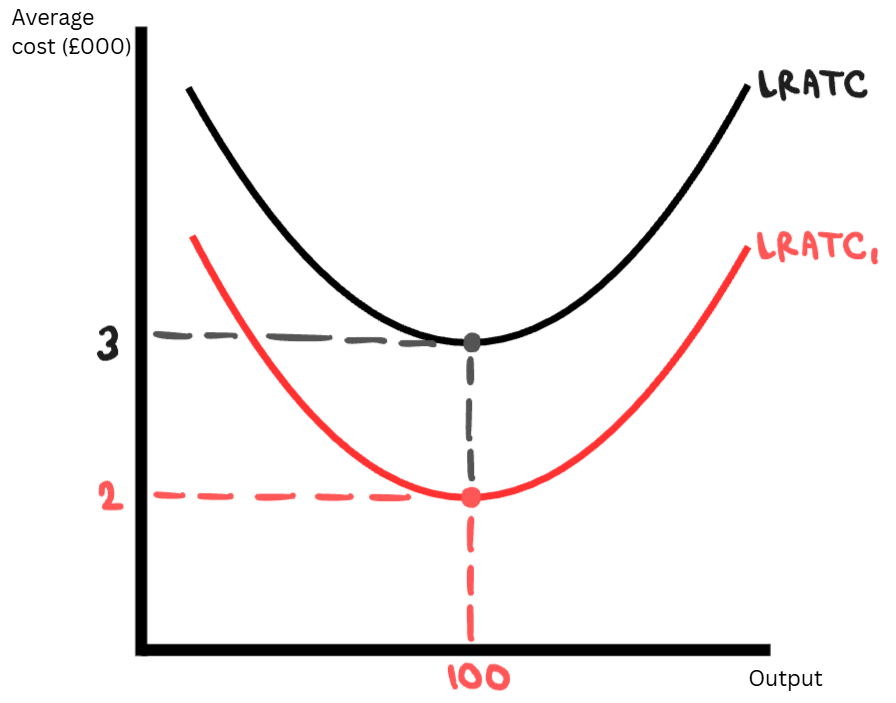
Define Diseconomies of Scale
When an increase in the scale of production, leads to an increase in LRATC for firms.
Name the 3 Internal Diseconomies of Scale
Motivational (alienation) DoS
Managerial (bureaucracy) DoS
Communication DoS
Define Motivational (alienation) DoS, and what it can lead to
Sense of alienation and loss of motivation in work. This overspecialisation leads to de-skilling and lack of incentive.
Define Managerial (bureaucracy) DoS
Large work forces make it difficult to monitor output/productivity (files, management, etc).
Define communication DoS
Large firms have layers of hierarchy, which make it difficult to coordinate complicated production processes across different locations.
Show where on an LRATC curve DEoS are present

Define External Diseconomies of Scale
Costs per unit increase due to changes within an industry, rather than a firm itself.
Name the 3 types of External DoS
Supply shortage
Increased raw material cost
Transport costs
Draw the graph for External Diseconomies of Scale
External DEoS cause cost per unit (ATC) to increase, at each given quantity - LRATC curve moves higher.

Define total revenue (again)
Total money collected from selling goods / services.
Give the formula for Total Revenue
TR = Price (P) X Quantity (Q)
Recall how to find Total Revenue from a supply and demand diagram
Work out the area under the demand curve (e.g. from equilibrium).
Give the formula for Average Revenue
Total Revenue (TR) / Quantity (Q)
If the price for all units sold is the same…
Average Revenue (AR) = Price (P)
Give the formula for profit
Profit = Total Revenue - Total costs
Define Marginal Revenue (MR)
Addition to total revenue, from production of 1 extra unit.
Give the formula for Marginal Revenue (MR)
TRx - TRx-1 = Change in TR (MR)