midterm 3 bio 311
 Call Kai
 Learn
 Practice Test
 Spaced Repetition
 Match
 Flashcards
 Knowt Play
1/86

There's no tags or description
Looks like no tags are added yet.
87 Terms
chargaff
discovered base pairings. A-T and C-G
griffith
mice experiments, heat killed virulent bacteria. discovered heat-killed virulent bacteria was able to alter living nonvirulent strands
horizontal gene transfer

watson/crick
used X-rays to understand DNA and its helix (stole their research from franklin, who discovered the width and structure of helixes using x-rays)
A-T and C-G go together exactly equally
hershey/chase
determined that DNA and not proteins were the programming for phages. when proteins were “tagged,” radioactivity remained outside the cells, whereas DNA “tagging” made radioactivity appear outside of the cells
phosphate groups/sulfur groups
avery
discovered DNA was what impacted the mice in griffith’s experiment
topoisomerase
helps release the tension from the unwinding in DNA
mismatch repair
helps fix incorrect bases in DNA
meselson/stahl
DNA replicates semiconversatively (1 new strand combines with 1 old strand)
evidence for DNA being the reason for pretty much…everything
viral DNA can program cells → bacteriophages, or viruses, infect a cell to overtake them
mice experiement
hershey/chase experiment
chargaff experiements
watson-crick double helix model

3 models for replication

how to prokaryotes replicate
-only one site of replication!

how do eukaryotes replicate
-multiple sites of replication!

how does DNA replication occur
-topoisomerase relieves tension
-helicase unwinds the “fork”
-primase makes RNA primers to then use the DNA as a template
the leading strand moves continuously, the lagging strand does not

how does DNA make new strands up close?
an incoming nucleotide is attached and DNA polymerase releases phosphate groups (2) as the bases pair up

how are lagging strands made?
lagging strands, or okazaki fragments, are synthesized in the opposite direction.
the rna primer comes in to slide along the lagging strand

what are histones
litthe proteins that pack DNA together (?)

what are nucleosomes?
beads of histones along a DNA string (histones = parts of nucleosomes)

what is chromatin
DNA + protein together

TH morgan (the beginning of all experiemnts)
responsible for “fly room” experiments, got a noble prize for discovering traits are found on chromosomes (DNA+protein). however, the next question was if DNA or protein was coding for the traits
what would a good molecule of heredity have to have?
variability to store info
can be stable
can replicate
ligase
glue!! joins DNA together
primase
makes RNA primer
what holds DNA strands together?
hydrogen bonding
why are nucleotides endergonic?
nucleotides power an endergonic reaction by releasing phosphate groups
what is nucleotide excision repair?
removes damaged DNA

GTP’s role of for DNA translation
responsible for making polypeptides for DNA translation
archibald garrod
decided genes dictate phenotypes by some sort of enzyme. his experiments were later developed by other scientists who said that enzymes are what determines metabolic pathways
what is the stop codon
UGA
what is a ribozyme
rna acting as an enzyme
what is gene expression
DNA making proteins, genes are expressed in different ways depending on transcription and translation
beadle-tatum
put neurospora cells on a medium to grow. found that what did not grow didn’t have the enzyme for that job
they also realized that different parts of a pathway could be individually blocked (one-gene one enzyme hypothesis—> genes decide what specific enzyme is activated)

trasncription
DNA reformatted into RNA
translation
mRNA or messenger RNA, codes for proteins/polypeptides in ribosomes
how does RNA creation work in bacteria/
DNA becomes mRNA, then goes to ribosomes
all in cytoplasm

how does RNA work in eukaryotes
dna becomes preRNA, then mRNA in the nucleus
moves into the cytoplasm to continue with the ribosome stage

how are codons and amino acids related?
a codon is a group of three nucleotides. the codon makes one amino acid.
triplet code is the idea that codons exist as groups of 3 nucleotides.

what are the steps of transcription?
the promoter starts to unwind DNA and RNA forms at the start point of the template strand (initiation)
the RNA is made. the DNA strand is read in the 3’ to 5’ direction and the RNA is made in the 5’ to 3’ direction (elongation). the DNA that is passed is rewound.
RNA is released (termination)

transcription unit
the segment of DNA that becomes an RNA strand
what’s happening in initiation?
-promotor is told where it is going to start on the DNA strand.
-transcription factors bind to the DNA before RNA polymerase II can join in, then RNA poly II unwinds the DNA
-the promoter region is often called the “TATA box” because it is made up of T and A nucleotides.

a picture of elongation

termination breakdown
RNA polymerase II makes a signal of letters which helps tell the RNA to end. when the signal is coded for, proteins attach to the strand and cut it.
what are 3 things that happen during RNA processing?
altering the ends of the strand
splicing the strand
ribozymes come in
how does the RNA strand change by altering it
-a 5’ cap made of guanine is added to the 5’ end
-a 3’ cap made of adenine (poly-A tai) is added to the 3’ end
-polydelynation signal tells the RNA to stop
UTRs are untranslated regions

what’s happening in rna splicing
-introns, noncoding parts of nucleic acidm are cut off
-exons, “expressed” parts, are kept
this process is done by spliceosomes

alternative splicing
A type of eukaryotic gene regulation at the RNA-processing level in which different mRNA molecules are produced from the same primary transcript, depending on which RNA segments are treated as exons and which as introns.
what is a general overview of translation?
-mRNA is sliding through a ribosome and tRNA is grabbing amino acids that are expressed by the codons on the mRNA strand, the tRNA slowly grows. tRNA has an anticodon end that matches the codons of the mRNA.
how do tRNA and amino acids pair up?
a specific enzyme attaches to a certain amino and tRNA
ATP becomes AMP + P x 2 as the amino and tRNA bond together and use energy to move out of the enzyme

what are the specific sites of a ribosome?
E site—exit site
P site—peptidyl tRNA site, for growing chain of amino acids
A site—aminoacyl-tRNA binding site for tRNA carrying the upcoming amino acids to add to the chain

initiation of translation
mRNA and small ribosomal subunit bind together. tRNA binds to the nucleotides of mRNA. then, the large subunit drops in to complete the structure.

elongation of translation
codon recognition occurs: anticodon and mRNA codon bind at the A site
pepetide bond formation: A site and P site amino acids bind together
translocation: tRNA moves from the A site to the P site

termination of translation
a site accepts a release factor which hydrolyzes the P site and its AA from each other. this uses GTP

what if the translation isn’t enough for a functional protein?
amino acids can be modified or removed, or pair up
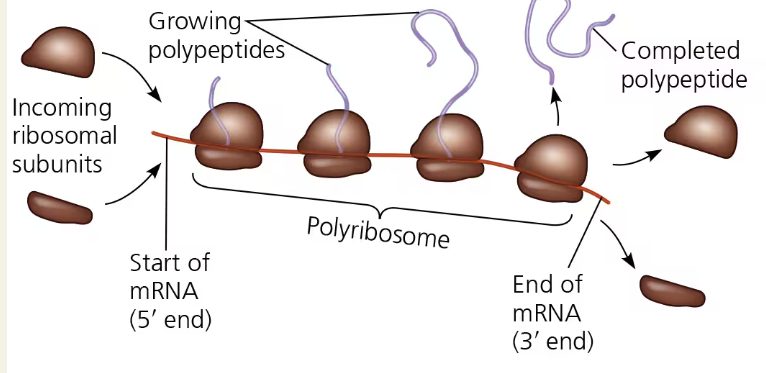
multiple polypeptides can be synthesized at once
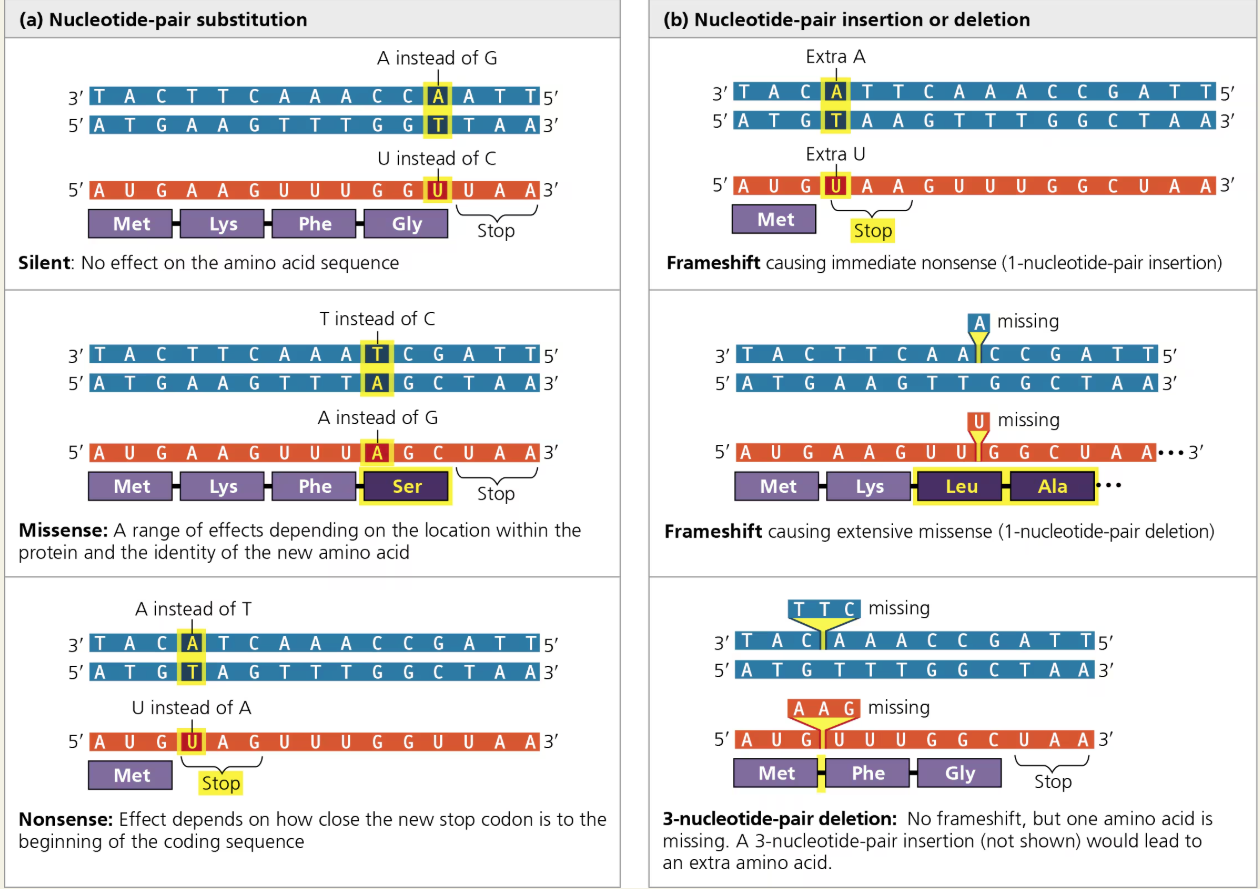
different types of mutations in DNA
what is the “trombone” model of DNA?

dna pol 1 vs pol 3
pol 3 helps put new nucleotides on the 3’ end of the strand of DNA
pol 1 replaces RNA primer with DNA on the lagging strand
what are telomeres
-telomeres will not divide forever, but they help give cells a longer life
what’s the start codon
AUG
what does redundent but not ambiguous mean?
multiple codons code for the same amino acid, but no codon codes for more than one amino acid
rna polymerase
unwinds DNA so that the RNA transcript can occur
what are chargaff’s rules
Base Pairing Rule:
In double-stranded DNA, the amount of adenine (A) is equal to the amount of thymine (T).
The amount of guanine (G) is equal to the amount of cytosine ©.
Mathematically:
A=T and G=C
Compositional Rule:
The total amount of purines (A + G) is equal to the total amount of pyrimidines (T + C).
This is a direct consequence of the base pairing rule.
Species-Specific Rule:
The relative amounts of A, T, G, and C vary between species, but the ratios are consistent within a species.
how many hydrogen bonds are between G-C and A-T
g-c is 3 H bands and a-t is 2 H bands
why do acetyl groups matter?
when acetyl groups attach to histone tails (the beads on a string!), they promote transcription because they unwind the chromatin
operators
part of bacteria gene coding only
enhancers
coordinate enzyme transcription involved in the same metabolic pathway IF they have the same control element (a noncoding sequence of DNA that helps DNA be transcribed)
can have steroid receptor proteins
often located far from their actual target genes (like, 1000s of nucleotides away kind of far)!
make an initiation complex when bound with activators
what are bacteria regulatory genes
-code for repressor proteins
-are not contained in the operon they control
-transcribe continuously
-have their own promoters
inducible enzymes
made when molecules inactivate a repressor protein
how do bacteria activate and deactivate their pathways?
essentially, if the enzyme is no longer needed, the cell will stop producing the genes that code for them

what do repressible operons look like?
repressible operons are usually on, but a small molecule represses it if needed
be able to DRAW THIS OUT

what are repressors
coded by regulatory genes, these guys come in to be reversible with the operon
what are corepressors
they help the shape of repressors snap into the right fit so that they can connect with the operator. tryptophan is a corepressor for its own operon!
what are inducible operons?
inducible operons are usually off, but can get “induced” to turn on.

what is negative gene regulation/negative controls?
operons turn off if the activated form of their repressor protein switches them off (Lac and tryp are both examples)
what is positive gene regulation
an inactive protein becomes activated, causing it to bind to an operon so that RNApoly wants to transcribe
commonly cAMP!! #shesbackforbusiness

differential gene expression
expression of many genes by cells with the same genome (library!!)
what are the different levels of eukaryotic gene expression? (basic description)

what can happen at the chromatin level of gene expression?
-compact DNA can be opened by acelytation, open DNA can become more condensed through methylation
-epigenetic inheritance: modified DNA doesn’t change the DNA sequence, but it could get passed down
what can happen at the transcription level of gene expression?
-control elements (segments of noncoding DNA that serve as places for TFs to bind)
-general and specific TFs (general is needed for all protein-coding genes, specific usually helps bend the DNA)
-combinato

combinational control

Coordinately Controlled Genes in Eukaryotes
what can happen at the post transcription level of gene expression?
rna processing, splicing, alternative splicing, mRNA degradation, protein processing or degradation
signal sequence

know how operons respond to their environment
what is the progression of chromatin organization?

what are nucleosomes

proteosomes
break down proteins if the cell no longer needs them
protein phosphorylating enzymes
transport proteins, modify them, or cleave them after transcription is over
nishis mutation chart