FINA Quiz Chapter 11-13
 Call Kai
 Learn
 Practice Test
 Spaced Repetition
 Match
 Flashcards
 Knowt Play
1/39

There's no tags or description
Looks like no tags are added yet.
40 Terms
Work Life Expectancy (WLE)
The total period a person is expected to be in the workforce
Remaining Work Life Expectancy (RWLE)
The working years left at a given point before retirement. This is the “n” for saving
Retirement Life Expectancy (RLE)
The period from retirement until death. This is the n for spending
Wage replacement ratio (WRR)
An estimate of the money needed in retirement, stated as a percentage of pre-retirement income.
= Retirement Need/ Pre-retirement income
Ex. Jordan needs $56,000 in retirement and earned $70,000
= 56k/70k= 80%
The Three Legged Stool
Retirement income typically comes from three sources:
Social Security
Employer- sponsored plans (401k), 403, pensions
Personal savings and Investments
Savings Benchmark by Age
Multiply gross pay by the ratio for the client’s age
Count investment assets for retirement only: not home equity or emergency funds
The ratio roughly doubles each decade after 35, which is compounding at work.
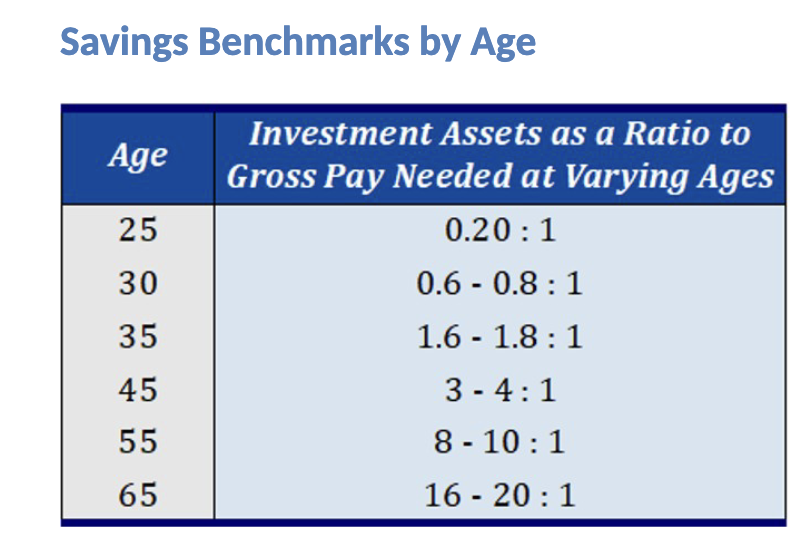
Ex. age 38, salary $110,000). Say she has $250,000 saved. That savings figure is made up for illustration.
Her multiple is $250,000 ÷ $110,000 = 2.27×.
She’s between the age 35 row (2×, which is $220,000) and the age 40 row (3×, which is $330,000).
Her age 40 target is 3 × $110,000 = $330,000.
At 38, she should be about 2.6× (roughly $286,000), so she is a bit behind.
Capital Needs Analysis- Four models
Annuity Method
Capital Preservation
Purchasing power Preservation
Capitalization of Earnings
Annuity Method
The portfolio is fully drawn down to zero by the end of the retirement period. Principal is spent down over time.
Capital Preservation
Only earnings (returns) are spent; the principal is never touched and is left intact at death.
Purchasing Power Preservation
Both principal and earnings are adjusted for inflation so that the real purchasing power of the portfolio is maintained throughout retirement.
Capitalization of Earnings
A perpetuity approach: principal is never spent, so the balance (in theory) lasts forever.
Capital= Annual Income need/Rate of return
Plan Testing Methods
Range of Estimates
Sensitivity Analysis
Monte Carlo Simulation
Range Estimates
Test best-care, expected, and worst-case scenarios to see the spread of possible outcomes
Sensitivity Analysis
Change one variable at a time (e.g. inflation rate, investment return) to see how much it affects the result
Monte Carlo Simulation
runs thousands of randomized scenarios using probability distributions for returns, inflation, and life expectancy to estimate the probability of success
Distribution Strategies in Retirement
4% rule
Bucket Approach
Sequence Of Returns Risk
4% rule
Withdraw about 4% of the starting balance in year one, then raise the dollar amount by inflation each year. Simple; uses one diversified portfolio
Ex. $1,000,000 portfolio- $40,000 withdrawal in year one.
Bucket Approach
Split money by when it when it will spent- near term cash, mid-term bonds, long-term stocks. Easier for clients to stay calm during a market downturn.
Sequence of Returns Risk
The risk that poor investment returns in early in retirement (when withdrawals begin) disproportionately damage the portfolios longevity.
Annual Retirement Need
(Current Salary X WRR)- Social Security Income
Step 2: Calculate the first retirement distribution at age 65
BEG
N= WLE (Years until retirement)
I= Inflation
PV= Annual Retirement Need
PMT= 0
FV= Solve For
Step 3: Capital Needed at retirement age 65.
BGN
N= RLE
I= Inflation adjusted (1 + Investment return)/(1 + Inflation rate)-1 X 100
PV= Solve For
PMT= Step 2; future annual income
FV= 0
Step 4: Required Annual Savings
END
N= WLE
I= Investment growth
PV= 0
PMT= solve for
FV= Step 3 capital needed at retirement.
Tax Formula
Gross Income
Minus Exclusions
= Income
-Above the line Adjustments
=AGI (Adjusted Gross Income)
-below the line deductions
=Taxable Income
xTax rate
=Tax liability
-credits
Tax Owed
Above the Line Adjustments
deductions claimed even if you don’t itemize (e.g. Traditional IRA contributions, student loan interest up to $2,500, HSA contributions, half of self-employment tax)
Reduces AGI
Below the Line Deductions
Standard or itemized, whichever is greater
Reduces taxable income, not AGI
FICA
for employees
6.2% social security + 1.45% Medicare= 7.65% (employer matches)
Self-Employment Tax
12.4% Social Security + 2.9% Medicare= 15.3%
92.35% of net profit is subject to SE tax (not 100%) — because employees don't have their wages reduced by the employer's half of FICA. To level the field, the self-employed exclude 7.65% of net profit first (100% - 7.65% = 92.35%).
Example: $100,000 net profit × 92.35% = $92,350 × 15.3% = $14,129.55 SE tax Half of SE tax ($7,064.78) is deductible as an above-the-line adjustment.
Half of SE is deductible as an above the line adjustment
Marginal Rate
The rate on your next dollar of income. Used for tax planning decisions.
Ex. Maya, Single $85,000 salary. After $15,750 standard deduction- $69,260 taxable income- 22% marginal bracket.
A $1,000 deduction saves her $220 (at 22%)
Effective (average) Rate
Total Tax/ Taxable Income
Always lower than the marginal rate in progressive system.
Tax Credit
reduces tax liability dollar-for-dollar. A $1,000 credit saves $1,000 in tax in every bracket.
A 1,000 credit always beats a 1,000 deduction in every bracket.
Child Tax Credit: $2,200 per child (OBBA), up to $1,700 refundable.
Tax Deduction
reduces taxable income. It value depends on marginal bracket.
A $1,000 deduction saves $120 at 12%, $220 at 22%, and $370 at 37%
Short-term Capital Gain
1 year or less
Taxed at ordinary rate (up to 37%).
Not Preferential treatment
Long-term Capital Gain
More than 1 year
0%, 15%, 20%
Preferential rates based on income
The Six Selection Factors
F: Formation: Ease and cost of formation (filling fees, attorney costs, state registration)
M: Management: Complexity of management and governance (boards, bylaws, minutes, voting rules)
T: Transferability: and dissolution (can you sell it, pass it on, or wind)
L: Liability: Protection of owners’ personal assets (can a creditor reach the house and savings?)
T: Taxation: Reporting requirements and taxation
P: Psychology: Psychological factors (control, prestige, “I want to be my own boss)
Sole Proprietorship
Self-Employment Tax:
Schedule C net profit x 92.35%= SE income base
SE x 15.3%= SE tax
Half of SE tax is deductible above the line
ex. $100,000 profit— $92,350 × 15.3%= $14,129.55 SE tax.
S Corporation: Salary vs Distribution
The owner must take a reasonable salary (subject to payroll tax: 12.4% Social Security +2.9% Medicare= 15.3%
Distributions above the salary are not subject to payroll tax
This the primary tax savings of S corp status: shifting profit from salary (taxed for payroll) to distribution (not taxed for payroll)
Must ensure the salary is “reasonable”— the IRS can reclassify excessive distributions as wages
S Corporation Eligibility Requirement
Maximum of 100 shareholders (family members can count as one)
One class of Stock (no preferred/common split)
Shareholders must be U.S. residents (individuals, estates, certain trusts)
Cannot be a C corporation or partnership
Fail one requirement, lose S status.
C Corporation- Double Taxation
The corporation pays entity-level tax on its earnings (21% flat federal rate)
When profits are distributed as dividends to shareholders, the shareholders pay tax again on their personal returns.
Pass through entites (LLCs,S Corps, partnerships) avoid the because profits flow through to the owners’ personal returns- taxed only once
Section 199A QBI deduction (2026-made Permanent)
Who: Owners of sole props, partnerships, LLCs, and S corps— not C corps
How much: up to 20% of qualified business income
Threshold: $201,750 single/ $403,500 joint before wage and service-business limits phase in
Fully phased in: at $276,750 single/$533,550 joint.