Geometric Design Test 1
 Call Kai
 Learn
Learn Practice Test
 Spaced Repetition
 Match
Match Flashcards
 Knowt Play
1/24

There's no tags or description
Looks like no tags are added yet.
Name | Mastery | Learn | Test | Matching | Spaced | Call with Kai | Chat |
|---|
No analytics yet
Send a link to your students to track their progress
25 Terms
From which point superelevation runoff starts?
where cross slope of the outside lane is leveled (zero)
Which of the following curve design criteria can apply to both sag and crest vertical curves?
Stopping sight distance
What is the value of maximum superelevation rate (emax) according to ALDOT?
8%
Which of the following is NOT an input into determining superelevation transition length?
Curve length
What is the relation between radius of the horizontal curve and super elevation?
Inversely proportional
According to typical ALDOT practice, what percentage of the superelevation transition length is placed on the tangent?
80%
Which type of horizontal curve is represented by the following curve?
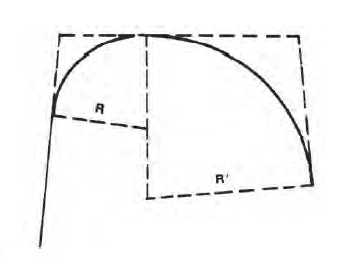
Compound
Which of the following factors will not affect sight distance for horizontal curves.
Cross section slope
What is the first step in the design of horizontal curve?
Determine the tangents
Which of the following is NOT considered part of the roadside clear zone?
Traveled way
Which of the following best defines Free-Flow Speed (FFS)?
The mean speed of passenger cars under low to moderate flow rates
Which of the following is NOT an ideal condition for a basic freeway segment?
20% heavy vehicles
Which type of median is generally used on freeways and rural multilane highways and is effective for surface-water drainage?
Depressed median
According to the AASHTO design guidance presented in class, what is the minimum width (in feet) typically used for a TWLTL?
10
Which of the following side slopes is generally considered non-recoverable for a run-off-road (ROR) vehicle?
1:3
What is the primary purpose of a highway shoulder?
To provide an area for vehicles to stop, particularly during emergencies
Which combination of grade characteristics has the greatest effect on heavy-vehicle performance?
Steepness and length
For a parabolic vertical curve, the vertical offset from the tangent is proportional to the ______ of the horizontal distance from the point of tangency.
Correct answer:
square of the distance
The “K” factor used in Vertical Curve design table according to AASHTO Green Book is defined as the:
required feet of curve length per 1% net change in grade
Which of the following is NOT a primary consideration in the design of vertical alignment?
Require horizontal and vertical curves to begin and end at the same stations
For roadway vertical-alignment calculations, roadway grades are designated as either __________ or ____________?
positive or negative