Bio 156 complex Histology: MUSCLE TISSUE
 Call Kai
 Learn
 Practice Test
 Spaced Repetition
 Match
 Flashcards
 Knowt Play
1/34

There's no tags or description
Looks like no tags are added yet.
35 Terms
what is muscular tissue?
tissue that allows the body to move
Excitable
muscle cells respond to stimulus
contractile
muscle cells shorten and create a pulling force
Muscle contraction
when a muscle pulls on bones, it can cause them to move

voluntary movement
movement under conscious control like opening a book
involuntary movement
movement that happens without conscious control, like your pupils getting smaller in bright light
what are the 3 subclasses of muscular tissue?
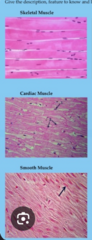
Skeletal Muscular Tissue
Cardiac Muscular Tissue
Smooth Muscular Tissue

what is the main function of skeletal muscle tissue
skeletal muscle allows voluntary body movements, like walking, facial expressions, and maintaining posture
where is skeletal muscle tissue found in the body?
it is primarily attached to bones throughout the body
what are the main characteristics of skeletal muscle tissue cells?
they are striated, multinucleated, long, and arranged in bundles

what does it mean that skeletal muscle is striated?
it has a striped appearance under a microscope because of the regular arrangement of actin and myosin proteins
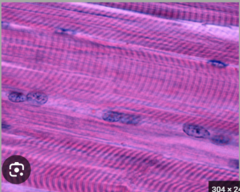
what does multinucleated mean, and why do skeletal muscle cells have multiple nuclei?
multinucleated means having more than one nuclei. skeletal muscle cells have many nuclei because multiple myoblasts fuse together to form one long muscle fiber.
what are the 2 main contractile proteins in skeletal muscle tissue
actin and myosin
what percentage of your body mass is made up of skeletal muscle?
about 40%
how does skeletal muscle help regulate body temperature?
it produces heat as a byproduct of muscle contractions, helping maintain a stable body temperature.
what is shivering, and why does it occur
shivering is the involuntary contraction of skeletal muscles in response to a lower-than-normal body temperature. it produces heat
what is a myocyte and where does it develop from
myocyte is a muscle cell that develops from myoblasts derived from the mesoderm
how is skeletal muscle tissue organized?
it is arranged in bundles surrounded by connective tissue
memory tips
S- striated M- multinucleated B- bundled B-primarily attached to Bones V- voluntary
what is the main function of cardiac muscle tissue?
It contracts to pump blood throughout the body

where is cardiac muscle tissue found in the body
it is only found in the walls of the heart

what are the characteristics of cardiac tissue under a microscope?
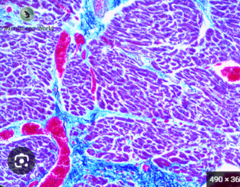
it appears striated, meaning it has a striped appearance and it only has one nuclei, usually in the center of the cell
Is cardiac muscle tissue voluntary or involuntary?
involuntary meaning it works without conscious control
what are cardiomyocytes?
cardiomyocytes are the individual cells that make up cardiac muscle tissue

what are intercalated discs?
specialized cell junctions that connect neighboring cardiac muscle cells

what are the 2 types of junctions found in intercalated discs
Anchoring junctions and Gap junctions
what are the functions of anchoring junctions?
they hold neighboring cells together
what are the functions of Gap Junctions?
they allow electrical signals to pass between cells so they can coordinate contractions
how are cardiac muscle arranged?
they connect to form long, branching muscle fibers that work together in a coordinated way
what does cardiac muscle have in common with skeletal and smooth muscle
cardiac muscle shares the striated appearance of skeletal muscle and the involuntary function of smooth muscle.
what is the function of smooth muscle?
it moves substances through the body, like pushing food through the digestive tract and controlling blood flow through blood vessels.

where is smooth muscle tissue found in the body?
in the walls of hollow organs, like the stomach, intestines, bladder and blood vessels
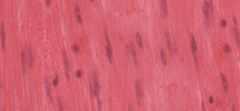
what are the main characteristics of smooth muscle cells?
they are nonstriated, spindle shaped, and have one centrally located nucleus.

is smooth muscle voluntary or involuntary
its involuntary, meaning it works without conscious control
how does smooth muscle differ from skeletal and cardiac muscle?
smooth muscle has no visible striations, has one nucleus per cell and contacts involuntarily. skeletal and cardiac are both striated.