Marketing 2205 Chapter 8: Developing New Products and Managing the PLC
 Call Kai
 Learn
 Practice Test
 Spaced Repetition
 Match
 Flashcards
 Knowt Play
1/19

There's no tags or description
Looks like no tags are added yet.
20 Terms
New Product Development Strategy
Developing new products through the firm’s own research & development efforts
Creating successful new products requires
Understanding consumers, markets, & competitors
Developing products that deliver superior value to customers
Major Stages in New Product Development
Figure 8.1

Idea Generation
Systematic search for new product ideas
Internal idea sources:
Internal social networks
Intrapreneurial programs
External idea sources:
Distributors & suppliers
Competitors
Customers
2. Idea Screening
Screening new product ideas to spot good ones & drop poor ones as soon as possible
Ways of screening new ideas:
New idea write-up reviewed by a committee
R-W-W framework - Real, win, worth doing
Real – real need & desire for it, clear product concept
Win – is there a sustainable competitive advantage
Worth – does it fit with the company’s growth strategy
3. Concept Development
Developing a new product into alternative product concepts
Find out how attractive each concept is to customers
Choose the best one
Product Concept
A product idea is an idea for a possible product that the company can see itself offering to the market.
A product concept is a detailed version of the new product idea stated in meaningful consumer terms.
Product image is the way consumers perceive an actual or potential product.
Concept Testing
Testing new product concepts with groups of target consumers
Methods:
Presenting the concepts to consumers symbolically or physically
Asking customers to respond by answering questions about their reactions to the concepts
4. Marketing Strategy Development
Initial marketing strategy for a new product
Three parts of the marketing strategy statement:
Describes the target market, planned value proposition, sales, market-share, & profit goals
Determines product’s planned price, distribution, & marketing budget
Develops long-run sales, profit goals, & overall marketing mix strategy
Business Analysis
A review of the sales, costs, & profit projections for a new product to find out whether theses factors satisfy the company’s objective.
Product Development
Developing the product concept into a physical product to ensure that the product idea can be turned into a workable market offering
7. Test Marketing
Introduces the product & its proposed marketing program into realistic market settings
Gives the marketer an experience with marketing a product before full introduction
Tests the product & its marketing program
Test marketing takes time, & costs can be high & gives competition insight into your actions.
Test Marketing Alternatives
Alternatives to standard test markets
Controlled (panel) test markets
Simulated test markets
Reasons for using alternative test markets
Reducing the costs
Speeding up the process
Not signaling moves to competitors
8. Commercialization
Introducing a new product into the market
Considerations for launching a new product
When to launch
Where to launch
Single location, region, national market, or international market
Managing New Product Development
Requires a holistic approach
Customer-centred
finding new ways to solve customer problems & create more customer-satisfying experiences.
Team-based
various company departments work together, overlapping the steps in the product development process.
Systematic
innovation management systems collect, review, evaluate, & manage new product ideas.
Sales & Profits over the Product’s Life from Inception to Decline
Figure 8.2

Styles, Fashions, & Fads
Figure 8.3

Summary of Product Life-Cycle Characteristics
Table 8.2
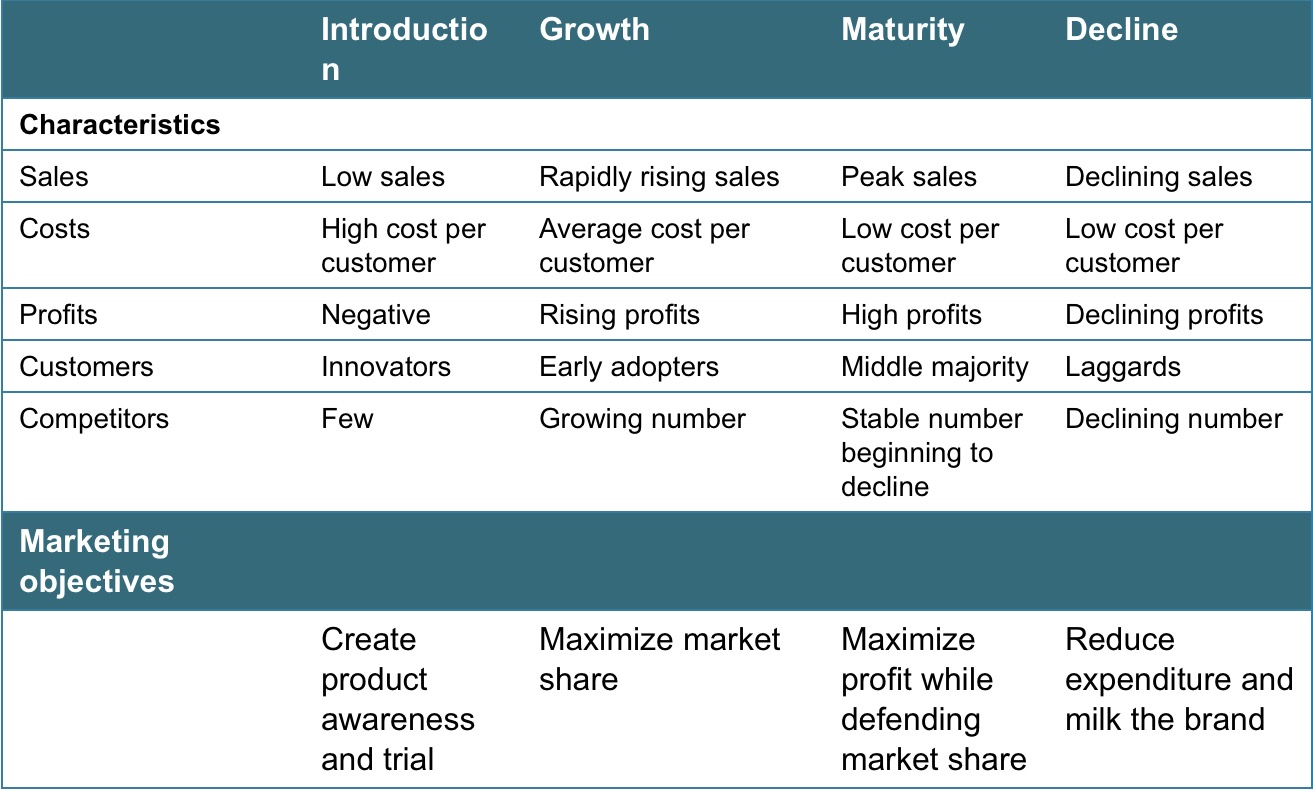
Summary of Product Life-Cycle Strategies
Table 8.2

Summary of Product Life-Cycle Strategies
Table 8.2

International Product & Services Marketing
Challenges facing international marketers:
Finding what products & services to introduce & in which countries
Deciding on how much to standardize or adapt the products & services for world markets
Service firms are taking the lead in international expansion.