A&P Lab Practical
 Call Kai
 Learn
 Practice Test
 Spaced Repetition
 Match
 Flashcards
 Knowt Play
1/110

There's no tags or description
Looks like no tags are added yet.
111 Terms
origin
attached to less moveable
insertion
attached to more moveable
what muscles are found in the femoral triangle?
adductor femoris
adductor longus
pectineus
adductor femoris + longus origin, insertion & action
pubic symphysis
femur
adducts thigh
pectineus action
adducts thigh
what muscles are in the quadriceps femoris?
rectus femoris
vastus lateralis
vastus medialis
vastus intermedius
quadriceps femoris insertion + action
patella & tibial tuberosity
extends knee
rectus femoris action
extends knee + flexes hip
what muscles are in the hamstrings?
biceps femoris
semitendinosus
semimembranosus
hamstrings origin + action
ischial tuberosity
flexes knee
what muscles are in the triceps surae?
gastrocnemius
soleus
plantaris
triceps surae insertion + action
calcaneus via calcaneal tendon
plantar flexion
gluteus maximus + medius action
abducts thigh
tibialis anterior action
dorsiflexion
flexor digitorum longus action
flexes digits
extensor digitorum longus action
extends digits
clavotrapezius insertion
clavicle
acromiotrapezius insertion
acromion of scapula
spinotrapezius insertion
scapular spine
clavodeltoid origin + insertion
clavicle
deltoid tuberosity
acromiodeltoid origin + insertion
acromion of scapula
deltoid tuberosity
spinodeltoid origin
scapular spine
what muscles are in the rotator cuff?
supraspinatus
infraspinatus
subscapularis
teres minor
supraspinatus origin, insertion, action
supraspinous fossa of scapula
humerus- greater tubercle
stabilizes humerus
infraspinatus origin, insertion, action
infraspinous fossa of scapula
humerus- greater tubercle
laterally rotates + stabilizes humerus
subscapularis origin, insetion, action
subscapular fossa
humerus- lesser tubercle
medially rotates + stabilizes humerus
levator scapulae ventralis insertion + action
scapula
elevates scapula
teres major origin + insertion
inferior angle of scapula
humerus
what muscles are found in the errector spinae?
iliocostalis
logissimus dorsi
spinalis dorsi
biceps brachii origin, insertion, action
scapula
radial tuberosity
flexes forearm
triceps brachii origin, insertion, action
scapula + humerus
ulna- olecranon process
extends forearm
pectoantebrachialis origin + action
manubrium of sternum
adducts the humerus
pectoralis major + minor origin, insertion, action
sternum
humerus
adducts the humerus
xiphihumeralis origin, insertion, action
xiphoid process of sternum
humerus
adducts the humerus
external intercostals origin, insertion, action
ribs
ribs
elevates ribs
internal intercostals origin, insertion & action
ribs
ribs
depresses ribs
scalenes action
elevates ribs
what is linea alba?
connective tissue
masseter origin, insertion & action
zygomatic arch
mandible
elevates mandible
digastric origin, insertion & action
mandible
hyoid bone
depresses mandible
sternohyoid origin + insertion
manubrium
hyoid bone
sternomastoid origin, insertion & action
manubrium
mastoid process of temporal bone
rotates head
what muscles are unique to cats? (not found in humans)
caudofemoralis
rhomboideus capitis
pectoantebrachialis
xiphihumeralis
epitrochelaris
adductor femoris in cats
single large muscle
adductor femoris in humans
split into 2 muscles (adductor magnus + brevis)
gluteal muscles in cats
smaller
medius larger than maximus
gluteal muscles in humans
large, maximus forms most of buttocks, extends thigh
trapezius in cats
split into 3 muscles
trapezius in humnas
single muscle
deltoid in cats
split into 3 muscles
deltoid in humans
single muscle
biceps brachii in cats
only 1 head
biceps brachii in humans
2 heads (long + short)
sternocleidomastoid in cats
split into 2 msucles (sternomastoid + cleidomastoid)
sternocleidomastoid in humans
single muscle with 2 heads
rectus abdominis in cats
absent
rectus abdominis in humans
support/reinforce abdominal wall
why are there differences?
humans are bipeds
cats are quadrupeds
bipeds
walk on 2 legs
quadrupeds
walk on all 4s (use their upper limbs to walk)

what is this?
sarcolemma
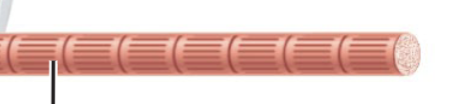
what is this?
myofibril

what is this?
sarcoplasmic reticulum
sarcoplasmic reticulum
stores and releases calcium ions

what is this?
t-tubules
t-tubules
carry action potentials into muscle fiber

label A-H
actin
z disc
h zone
myosin
I band
A band
sarcomere
m line

label A-E
z disc
sarcomere
m line
actin
myosin
myosin
thick filament
actin
thin filament
what happens to A band during contraction?
stays the same length
what happens to I band during contraction?
shortens
what happens to Z discs during contraction?
move closer together

label neuromuscular junction (slide view) A-C
axon
synaptic bulb of axon terminal
striated muscle

label neuromuscualr junction (A-C)
synaptic vesicles with Ach
synaptic cleft
motor end plate
motor neuron axon
carries nerve signal toward muscle
synaptic vesicles contain?
acetylcholine (ACh)
ACh function?
bind to receptors on motor end plate
muscle contraction producing enough tension to cause movement
isotonic contraction
muscle contraction that generates tension but does not produce skeletal movement
isometric contraction
which contraction generates greater force?
isometric
motor unit?
motor neuron and all muscle fibers it stimulates
motor neuron recruitment?
increasing number of active motor units
range of motion?
amount of possible movement at a joint
length-tension relationship?
force depends on muscle length
optimal sarcomere length?
80-120% of resting length
length-tension contraction type
isometric
length-tension instrument
hand dynamometer
what did length-tension lab measure?
grip strength
force-velocity relationship?
as load increases, shortening velocity decreases
higher shortening allows how much force?
less force
why is force lower at higher shortening velocity?
less time for cross-bridge format
force-velocity contraction type?
isotonic
How was force-velocity tested?
time a 90 degree contraction with different weights
why is warming a muscle prior to stretching/exercise important?
to prevent injury and improve muscle function
reasons why warming up improves muscle function
increase blood flow
faster chemical reactions
decreased synovial fluid viscosity
what instrument measures ROM?
goniometer
how did we test effect of temperature on flexibility?
measure hamstring ROM before and after exercise
effect of exercise on flexibility?
ROM generally increases after warming up
what occupies most of the space in a skeletal muscle fiber?
myofibrils