TEAS scientific notation/ chemistry/ SE
 Call Kai
 Learn
 Practice Test
 Spaced Repetition
 Match
 Flashcards
 Knowt Play
1/48

There's no tags or description
Looks like no tags are added yet.
49 Terms
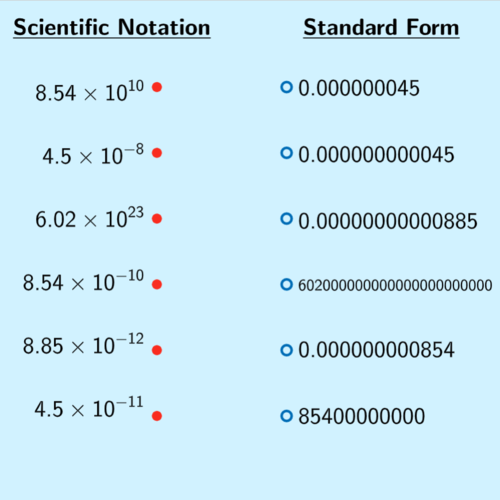
1. What is scientific notation?
a shortcut for writing REALLY big or REALLY small numbers.
Scientists work with numbers that have tons of zeros.
For example:
Really BIG number
Standard notation:
15,000,000,000,000
Scientific notation:
1.5 × 10¹³
Really SMALL number
Standard notation:
0.00000000529
Scientific notation:
5.29 × 10⁻⁹
Why do we do this?
Instead of writing 15 trillion with all those zeros, we make it shorter and easier to read.
Think of scientific notation as a NUMBER SHORTCUT.
2. The 3 parts of scientific notation
1.5 × 10¹³
1.5
Coefficient
10
Base
13
Exponent
Let's break down each word.
A. Coefficient = the number in front
Example: 1.5
It's the number before the multiplication sign.
It must be at least 1 but LESS than 10.
There should only be ONE nonzero digit before the decimal point.
Examples of good coefficients:
1.5
3.2
5.29
9.8
Examples that are NOT correct coefficients:
15
0.5
25.6
Memory trick: Coefficient = the number that comes first!
Base =
ALWAYS 10
Example: 10
The base is the number being raised to a power.
In scientific notation, the base is ALWAYS 10.
You don't need to change it.
Memory trick: Scientific notation = BASE 10. Every time!
1.5 × 10¹³
Exponent=
How many places the decimal moves
Example: 10¹³
The little raised number (13) is called the exponent.
It tells you how many places to move the decimal point.
There are TWO types:
Positive exponent (+) = BIG number.
Negative exponent (−) = SMALL number.
POSITIVE +
Big numbers
10³ Move decimal RIGHT.
NEGATIVE −
Small numbers
10⁻³Move decimal LEFT.
Catchy memory trick:
Positive = Push RIGHT ➡
Negative = Navigate LEFT ⬅
3. How to convert BIG numbers into scientific notation
15,000,000,000,000
Our goal is to turn it into a number between 1 and 10, multiplied by 10 to a power.
Step 1: Find the first nonzero number.
Here it is 1.
Step 2: Move the decimal until you have ONE number before the decimal.
15,000,000,000,000
Move the decimal 13 places to the LEFT.
1.5
Step 3: Count how many places you moved.
13 places
Step 4: Because the original number was BIG, use a positive exponent.
1.5 × 10¹³
Remember:
BIG number = positive exponent.

4. How to convert SMALL numbers into scientific notation
Now let's use your second example:
0.00000000529
Step 1: Find the first nonzero number.
Here it is 5.
Step 2: Move the decimal until you get a number between 1 and 10.
0.00000000529
Move the decimal 9 places to the RIGHT.
5.29
Step 3: Count the places.
9 places
Step 4: Because the original number was SMALL, use a negative exponent.
5.29 × 10⁻⁹
Remember:
SMALL number = negative exponent.

5. What if the TEAS asks you to go BACK to standard notation?
This is the opposite!
Instead of making the number shorter, you're making it longer.
Example 1: Positive exponent
3.2 x10³
Start with 3.2.
Exponent is positive 3.
Move decimal 3 places RIGHT.
3,200
Answer in standard notation
Example 2: Negative exponent
4.5 x 10 -³/ -3= negative
Start with 4.5.
Exponent is negative 3.
Move decimal 3 places LEFT.
0.0045
Answer in standard notation

The easiest rule to memorize
exponents
Exponent | Decimal moves | Result |
|---|---|---|
Positive (+) | RIGHT ➡ | Bigger number |
Negative (−) | LEFT ⬅ | Smaller number |
Important: When moving the decimal, if you run out of digits, add zeros to fill the empty spaces!
SCIENTIFIC NOTATION 🧠
Purpose: Make really big and really small numbers easier to write.
3 components:
Coefficient = number in front (1 to less than 10).
Base = always 10.
Exponent = tells how many places the decimal moves.
Converting standard → scientific
BIG number: decimal moves LEFT → positive exponent.
SMALL number: decimal moves RIGHT → negative exponent.
Converting scientific → standard
Positive exponent: move RIGHT.
Negative exponent: move LEFT.
THE MAGIC MEMORY TRICK
BIG = POSITIVE = RIGHT (when going back to standard)
SMALL = NEGATIVE = LEFT (when going back to standard)
Careful: When converting standard numbers INTO scientific notation, the decimal moves in the opposite direction!
1. What is the base in scientific notation?
10
2. What is the coefficient in 4.5 × 10³?
4.5

3. A positive exponent tells you to move the decimal which direction when converting to standard notation?
Positive = move RIGHT.
6. What is 6.3 × 10⁻² in standard notation?
0.063
4. Which scientific notation represents 0.00052?
5.2 × 10⁻⁴
Move the decimal 4 places right to get 5.2, so the exponent is −4.
5. What is 2.5 × 10³ in standard notation?
2,500

THE ATOM 🧬
Imagine an atom as a tiny little solar system.
The center is the nucleus.
Around the center are electrons.
Inside the center are protons and neutrons.
That's the foundation of this entire lesson!
1. What is an atom?
Atom = the tiny building block that makes up all matter.
Let's break down the hard words:
Matter: Anything that takes up space and has mass. Water, air, your desk, your body, EVERYTHING!
Subatomic particles: Tiny particles that make up an atom. (Sub = smaller than.)
Nucleus: The center of an atom.
Electron cloud: The area around the nucleus where electrons are found.
Think about building a house with LEGOs:
Just like LEGOs build something bigger, atoms are the tiny building blocks that make up the world around us.

2. The THREE particles of an atom
There are 3 particles:
+
1. PROTON
Positive charge (+)
Found INSIDE the nucleus.
0
2. NEUTRON
Neutral (0)
Found INSIDE the nucleus.
−
3. ELECTRON
Negative charge (−)
Found AROUND the nucleus.
Easy memory tricks!
Memorize these three:
PROTON = PLUS (+)
NEUTRON = NEUTRAL (0)
ELECTRON = EXTRA negative (−)
And remember:
P + N = Nucleus
Protons and neutrons live in the nucleus.
E = Everywhere around the nucleus
Electrons are in the electron cloud.
TEAS MUST KNOW
The nucleus contains protons and neutrons, NOT electrons.
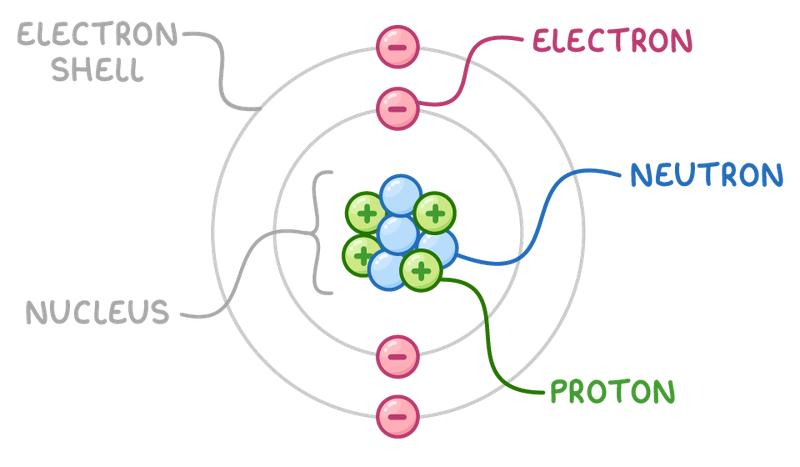
3. Where are these particles located?
Imagine the atom as a little solar system:
Atom | Think of it as |
|---|---|
Nucleus | The SUN in the center |
Electrons | The planets around it |
Protons | Positive particles in the center |
Neutrons | Neutral particles in the center |
Important: This solar system comparison is just a learning trick. Real electrons don't travel in neat planet-like circles. They occupy regions called electron clouds.
4. Understanding the CHARGES (this is important!)
Think of charges like a little math problem.
Positive (+) = adds positive charge.
Negative (−) = adds negative charge.
Neutral (0) = adds nothing.
The overall charge depends on the number of PROTONS and ELECTRONS.
Neutrons do NOT affect the electrical charge.
There are THREE possibilities:
Situation 1: Equal protons and electrons
Imagine:
5 protons (+)
5 electrons (−)
They cancel each other out!
NEUTRAL ATOM = 0
5 positive charges + 5 negative charges
Situation 2: More protons than electrons
Imagine:
6 protons (+)
4 electrons (−)
You have more positive charges!
POSITIVE CHARGE (+2)
More protons = positive
Situation 3: More electrons than protons
Imagine:
3 protons (+)
5 electrons (−)
You have more negative charges!
NEGATIVE CHARGE (−2)
More electrons = negative
THE MEMORY TRICK:
Protons win? POSITIVE.
Electrons win? NEGATIVE.
Tie? NEUTRAL.
5. What does it mean when an atom is NEUTRAL?
A neutral atom means:
Number of protons = Number of electrons
Example:
Particle | Amount |
|---|---|
Protons (+) | 8 |
Neutrons (0) | 8 |
Electrons (−) | 8 |
The 8 positives cancel the 8 negatives.
The atom has NO overall charge.
Remember
Neutrons can change in number without changing the atom's electrical charge.
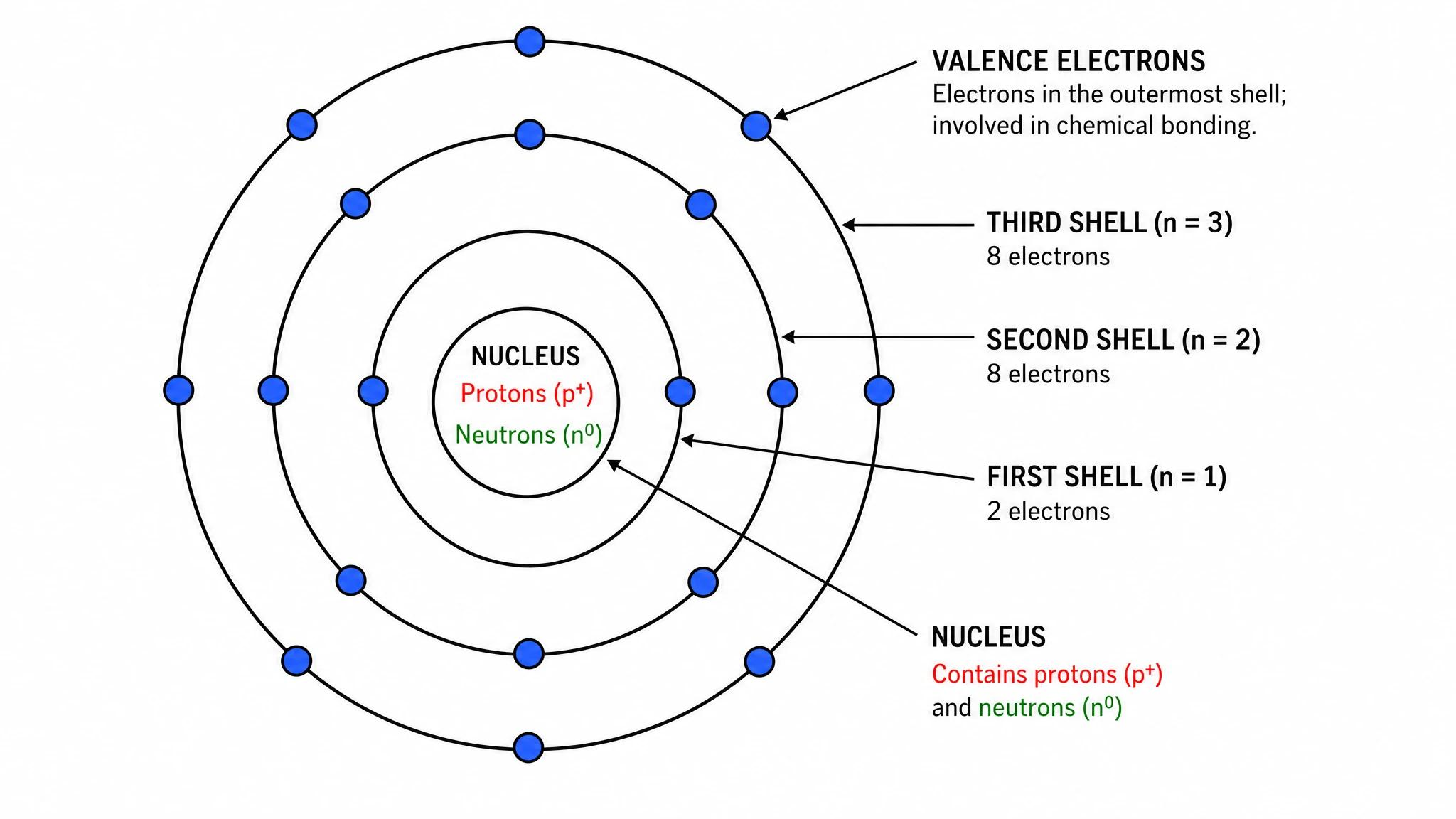
6. What are electron shells?
Now look at the RIGHT side of your uploaded picture.
You see circles surrounding the nucleus.
These are called electron shells.
Electron shell = an energy level where electrons are found.
Think of them like floors in a building:
1st floor = closest to the nucleus.
2nd floor = farther away.
3rd floor = even farther away.
Electrons occupy these energy levels.
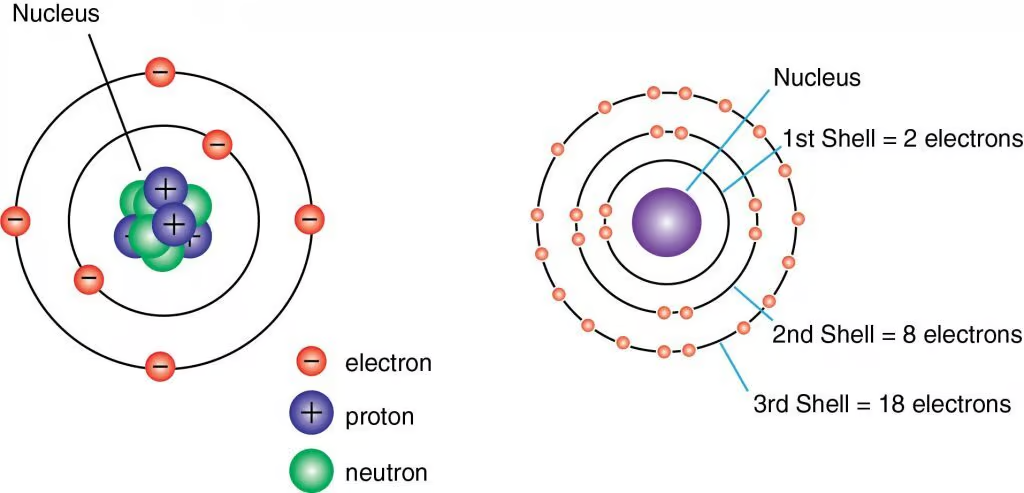
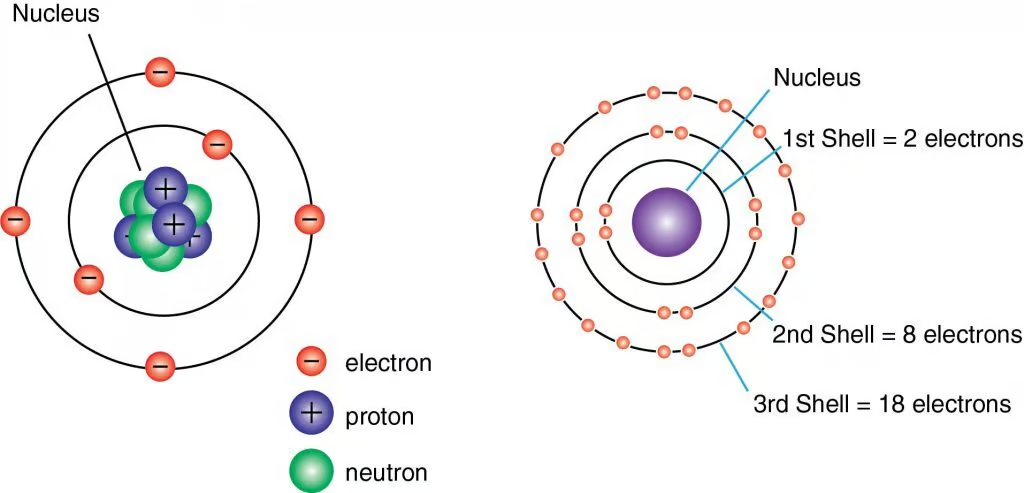
How many electrons fit in each shell?
Your lesson shows:
Shell | Maximum electrons |
|---|---|
1st shell | 2 |
2nd shell | 8 |
3rd shell | 18 |
Memory trick: 2 – 8 – 18
Think: First floor is small, second is bigger, third is bigger!
For basic introductory atom diagrams, you may also see the simplified filling pattern 2–8–8 for the first 20 elements. Follow the model or question being used.
Understand that electrons occupy different energy levels around the nucleus.
7. Is a real atom REALLY shaped like the picture?
This is another important part of your lesson!
Your picture uses something called the Bohr model.
Bohr model = a simplified drawing of an atom that helps us understand where electrons are located.
BUT there is something important:
The drawing is NOT the actual size or appearance of a real atom.
Your lesson mentions two things:
1. The nucleus is extremely tiny.
The nucleus is about 10,000 times smaller than the electron cloud in size.
2. Atoms are mostly empty space.
There is a LOT of space between the tiny nucleus and the regions where electrons are found.
Think of it like this:
Imagine a huge stadium.
The nucleus is like a tiny object in the middle.
The electron cloud occupies a much larger region around it.
Most of the atom's volume is empty space.
What to remember
The nucleus is tiny.
Electrons are found around it.
Atoms are mostly empty space.
Bohr models are simplified drawings, NOT exact pictures.
Your all-in-one TEAS cheat sheet
THE ATOM 🧬
What is an atom?
The tiny building block of all matter.
Where are the particles?
Nucleus = center of atom.
Electron cloud = area around nucleus.
3 particles to memorize
Particle | Charge | Location |
|---|---|---|
Proton | + | Nucleus |
Neutron | 0 | Nucleus |
Electron | − | Outside nucleus |
Electrical charge
Equal protons and electrons = NEUTRAL.
More protons = POSITIVE.
More electrons = NEGATIVE.
Neutrons do NOT affect charge.
Electron shells
1st = 2 electrons.
2nd = 8 electrons.
3rd = 18 electrons (maximum capacity).
Real atom
Nucleus is extremely tiny.
Atom is mostly empty space.
Bohr model is simplified.
. My secret tips to help you ace this section
Memorize the charges first. Proton +, Neutron 0, Electron −.
Never confuse location. Protons and neutrons = inside. Electrons = around.
Remember the tie rule. Equal protons and electrons = neutral.
Where are protons and neutrons located?
nucleus
1. Which particle has a positive charge?
proton
3. Which particle has a negative charge?
electron
4. An atom has 6 protons and 6 electrons. What is its overall charge?
neutral
5. An atom has 8 protons and 5 electrons. What is its overall charge?
positive
6. Do neutrons affect an atom's electrical charge?
No/ have no electrical charge.
8. What is true about a real atom?
It is mostly empty space
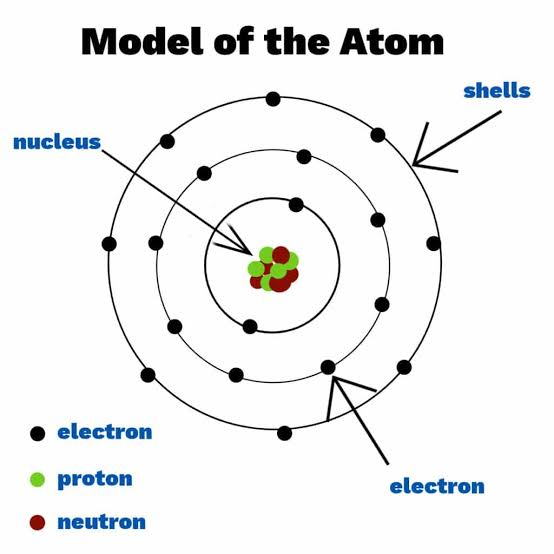
An atom has
a nucleus, and the nucleus contains TWO types of particles: protons and neutrons. Electrons are OUTSIDE the nucleus.
Imagine an atom like this:
Why does an atom have a nucleus?
Think of the nucleus as the CENTER and CORE of the atom.
It has two important jobs:
Holds protons and neutrons together in the center.
Contains almost all the atom's mass (weight).
Electrons are found in the space around the nucleus, in regions called electron clouds. Electron shells are simplified ways of showing their energy levels.
Memorize this! 🧠
Nucleus = the center
Protons = positive (+)
Neutrons = neutral (0)
Electrons = negative (−)
Electron shells = energy levels around the nucleus
The easiest way to remember:
The nucleus is the CENTER, and electrons are OUTSIDE.
That's the basic structure of an atom! ❤
Subatomic Particles, Mass & Electron Clouds 🧬
This lesson is basically teaching you 3 things:
How heavy the three particles of an atom are.
Why the nucleus is so dense.
How electrons move around the nucleus and why scientists use the electron cloud model.
1. First, let's remember the 3 particles
An atom has 3 main subatomic particles.
Particle | Charge | Location |
|---|---|---|
Proton | Positive (+1) | Nucleus |
Neutron | Neutral (0) | Nucleus |
Electron | Negative (−1) | Electron cloud |
Memory trick:
Proton = PLUS
Neutron = NEUTRAL
Electron = NEGATIVE
Remember: Protons and neutrons are in the center. Electrons are around the center.
2. What is AMU?
Your lesson introduces a new word:
AMU = Atomic Mass Unit.
Let's break that down:
Atomic = related to atoms.
Mass = how much matter something contains.
Unit = a way to measure something.
So, AMU is simply a measurement scientists use to describe how much mass an atom's particles have.
Think of AMU like inches measuring length or pounds measuring weight.
It's just a different measuring unit!
Look at how much each particle weighs:
Particle masses
Proton
1.0 amu Heavy
Neutron
1.0 amu Heavy
Electron
0.00054 amu VERY light
What does this mean?
Protons and neutrons are MUCH heavier than electrons.
In fact:
An electron is about 1,836 times lighter than a proton!
That's why your lesson says electrons are almost 2,000 times less massive.
Memory trick: The heavy twins and the tiny one!
Proton = heavy
Neutron = heavy
Electron = SUPER light
Think of the proton and neutron as two big bowling balls and the electron as a tiny grain of sand.
TEAS TIP
Protons and neutrons each have approximately 1 amu. Electrons have almost no mass compared with them.
3. Why is the nucleus so DENSE?
This sounds complicated, but it's actually easy!
First, what does dense mean?
Dense = lots of stuff packed into a very small space.
Imagine putting 100 people inside a tiny room.
That's a crowded space!
Now think about the nucleus:
It is extremely tiny.
It contains protons and neutrons.
Protons and neutrons carry almost ALL the atom's mass.
So, even though the nucleus is tiny, it contains almost all the mass!
Remember this!
Nucleus = tiny but heavy and dense.
Electron cloud = takes up most of the atom's volume, but contributes very little mass.
Memory trick:
The CENTER holds the WEIGHT!
Why?
Because the protons and neutrons are heavy and live in the nucleus.

4. What are electron shells and energy levels?
Remember those circles around the nucleus in your Bohr model?
Those are called electron shells or energy levels.
They represent where electrons can exist around the nucleus.
Think of an apartment building:
1st floor = closest to the nucleus.
2nd floor = farther away.
3rd floor = even farther away.
Each floor represents a different energy level.
Here's the important part:
The closer an electron is to the nucleus, the LESS energy it has.
The farther an electron is from the nucleus, the MORE energy it has.
Why?
Electrons farther away occupy higher energy levels.
How many electrons fit in each shell?
For the shell capacities taught in your lesson:
Energy level | Maximum electrons |
|---|---|
1st | 2 |
2nd | 8 |
3rd | 18 |
2 – 8 – 18
Your electron shell memory trick!
First floor = 2
Second floor = 8
Third floor = 18

5. What is the Bohr model vs. the Quantum Mechanical Model?
Scientists have different ways of drawing and understanding atoms.
There are TWO models you need to know:
A. Bohr model
The Bohr model shows electrons on circular rings around the nucleus.
Think of it like planets going around the sun.
BUT there's a problem!
Real electrons don't travel around the nucleus in perfect circles like the drawing shows.
The Bohr model is a simplified picture to help us learn.
B. Quantum mechanical model (electron cloud model)
This model is closer to how scientists understand real atoms.
Instead of showing electrons traveling on perfect circular paths, it shows regions where electrons are LIKELY to be found.
Let's break down the difficult words:
Quantum mechanical model: A scientific model that describes how electrons behave in atoms.
Probability: The likelihood or chance that something will happen.
Electron cloud: The region around the nucleus where an electron is likely to be found.
Orbit: A specific path around something.
Why do scientists use an electron cloud?
Because electrons don't behave like tiny planets traveling on predictable circular paths.
Scientists cannot know an electron's exact position and exact momentum (which includes its motion) at the same time.
This is related to something called the Heisenberg uncertainty principle.
Don't let that name scare you!
For your TEAS, remember:
We cannot know an electron's exact position and momentum simultaneously.
That's why scientists use probability to describe where electrons are likely to be.
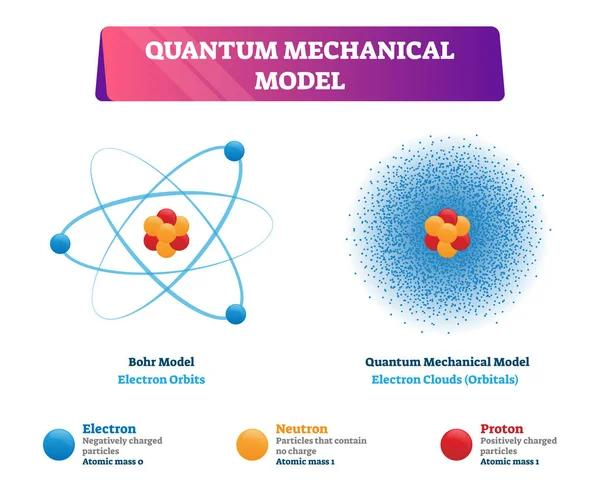
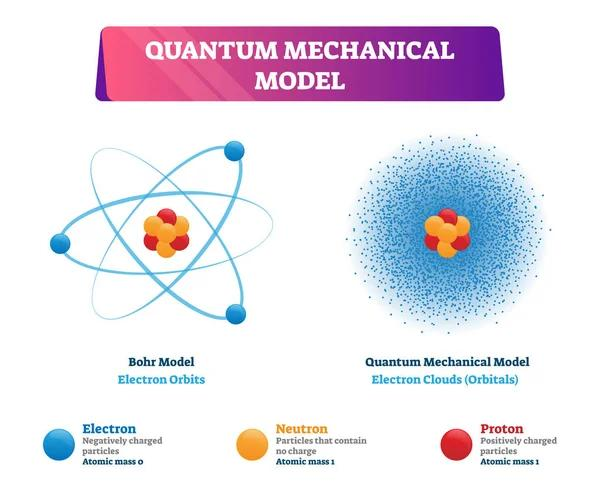
6. Bohr Model vs. Quantum Mechanical Model: Side-by-side
Bohr model | Quantum model |
|---|---|
Shows circular rings | Shows electron clouds |
Simplified picture | More accurate scientific model |
Shows energy levels | Shows energy levels and probability regions |
Easy to visualize | Describes real electron behavior better |
Catchy memory trick:
BOHR = Bubbles/rings around the nucleus.
QUANTUM = Cloud of possibilities.
TEAS MUST KNOW
The quantum mechanical model is the modern model of the atom. The Bohr model is a simplified representation.


7. Your ultimate cheat sheet 🧠
atoms
ATOM REVIEW
1. Subatomic particles
Proton: +1 charge, 1 amu, nucleus.
Neutron: 0 charge, 1 amu, nucleus.
Electron: −1 charge, 0.00054 amu, electron cloud.
2. Mass
Protons and neutrons = almost all the atom's mass.
Electrons = extremely tiny mass.
AMU = atomic mass unit.
3. Nucleus
Very tiny.
Very dense.
Contains protons and neutrons.
Holds almost all the atom's mass.
4. Electron shells
1st shell = 2.
2nd shell = 8.
3rd shell = 18.
Closer = lower energy.
Farther = higher energy.
Ground state = lowest available energy levels.
5. Atomic models
Bohr model = circular rings.
Quantum mechanical model = electron clouds/probability.
Exact position and momentum cannot both be known simultaneously.
Protons and neutrons are heavy; electrons are light.
The nucleus is tiny but contains almost all the mass.
Electrons farther away have higher energy.
Bohr = rings; Quantum = probability clouds.
1. Which particle has the smallest mass?
Electrons
about 1,836 times lighter than protons.
2. What does AMU stand for?
Atomic Mass Unit
3. Which particles contribute almost all of an atom's mass?
Protons and neutrons
4. Why is the nucleus extremely dense?
It contains heavy particles packed into a tiny space
The nucleus is tiny but contains almost all the atom's mass.
5. Which electrons have lower energy?
Electrons closest to the nucleus
6. What is the maximum number of electrons in the first shell?
2
7. Which model shows electrons as probability clouds?
Quantum mechanical model
8. What does ground state mean?
means the electrons are in their lowest available energy levels.
Which subatomic particles affect the overall charge of the atom?
Protons and electrons
Because protons are positively charged and electrons are negatively charged, they affect the overall charge of the atom. Neutrons do not affect the charge because they are uncharged.
What does normal state mean?
"An atom in its normal state will have electrons lying in the lowest possible energy levels."
Let's translate that!
Normal state = Ground state.
Ground state means the electrons are in their lowest available energy levels.
Think of it like this:
You have an apartment building, and you want to live on the lowest floor available.
That's the ground state!
What is ground state?
Remember that electrons live around the nucleus in different energy levels (shells).
Think of it like this:
Electrons can be in a LOW energy level (close to the nucleus).
Or a HIGH energy level (farther from the nucleus).
Ground state = electrons are at their LOWEST available energy levels.
Imagine this:
Think of an apartment building:
1st floor = low energy.
2nd floor = higher energy.
3rd floor = even higher energy.
Normally, electrons stay in the lowest available floors instead of higher ones.
If an electron absorbs energy (for example, from light), it can move to a higher energy level. That's called an excited state.
🧠 Memory trick
Ground state = LOW energy = normal.
Excited state = HIGH energy = gained energy.

The Periodic Table of Elements 🧪
1. What is the periodic table?
The periodic table is a BIG chart that organizes all the known chemical elements.
First, what's an element?
An element is a pure substance made of only ONE type of atom.
Examples:
Oxygen = an element.
Gold = an element.
Hydrogen = an element.
Carbon = an element.
Think of the periodic table like a giant organized family chart.
Every element gets its own little box!
Why do we need it?
Because scientists use it to organize elements and understand their properties (how they behave).

2. How to read ONE little box
It shows Argon.
Let's break down EVERYTHING inside that box.
Example: ARGON
18
Ar
Argon
39.95
1. Atomic number = 18
2. Chemical symbol = Ar
3. Element name = Argon
4. Atomic mass = 39.95
A. Atomic number = how many PROTONS
This is VERY important!
Atomic number tells you how many protons an atom has.
For example:
Argon has an atomic number of 18.
That means:
18 protons.
If the atom is neutral, it also has 18 electrons.
TEAS MUST KNOW
Atomic number = NUMBER OF PROTONS.
Memory trick: Atomic NUMBER = count the protons!
And remember, the number of protons determines WHICH element it is.


B. Chemical symbol =
abbreviation
An abbreviation is a shorter way of writing a word.
Examples:
Element | Symbol |
|---|---|
Hydrogen | H |
Oxygen | O |
Carbon | C |
Gold | Au |
Silver | Ag |
Argon | Ar |
Sodium | Na |
Notice something?
First letter is ALWAYS capitalized.
If there's a second or third letter, it is lowercase.
For example:
Ar = correct.
AR = incorrect.
ar = incorrect.
Memory trick: One BIG letter, the rest little!
C. Element name
This is simply the name of the element.
For example:
Ar = Argon.
O = Oxygen.
Na = Sodium.
Nothing complicated here!


D. Atomic mass =
how much mass the atom has
Remember AMU from our previous lesson?
AMU = atomic mass unit.
Atomic mass tells us the average mass of an element's atoms, accounting for its naturally occurring isotopes.
For Argon, the atomic mass is 39.95 amu.
For now, remember:
Atomic mass ≈ protons + neutrons.
This is a useful shortcut for estimating the mass number of an individual atom, but atomic mass on the periodic table is usually a decimal because it is an average.
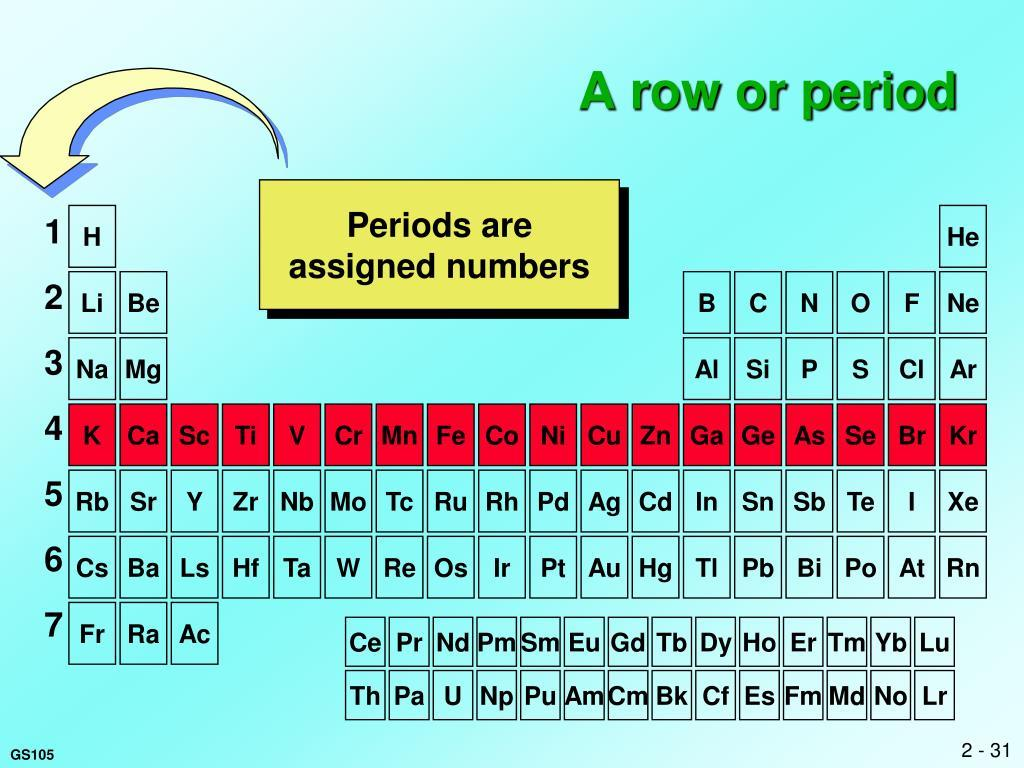
3. Rows vs. columns: PERIODS vs. GROUPS
There are two directions:
PERIODS
ROWS = Horizontal ➡
These go from LEFT to RIGHT.
There are 7 periods.
GROUPS
COLUMNS = Vertical ⬇
These go from TOP to BOTTOM.
There are 18 groups.
Easy memory tricks
PERIOD = ROW → Think of a period as a horizontal line.
GROUP = COLUMN → Think of people standing together in a vertical group.
Another trick:
Periods = across.
Groups = down.
Let's use Argon again!
Argon is in:
Period 3 = third row.
Group 18 = eighteenth column.
So if the TEAS asks:
"Which period and group is Argon in?"
Answer: Period 3, Group 18.


4. What are element families?
a-b
groups of elements that have similar properties (similar ways of behaving).
Think of a family in real life.
People in a family can have things in common.
Elements in the same family also share similar chemical behavior.
Your periodic table highlights different families using colors.
A. Group 1: Alkali metals
Where? First column on the LEFT.
Examples: Lithium (Li), Sodium (Na), Potassium (K).
What are they like? Very reactive metals.
Reactive means they react easily with other substances.
Memory trick: Alkali = Active! These metals react easily.
Important: Hydrogen is at the top of group 1, but it is NOT an alkali metal. It is a nonmetal.
B. Group 2: Alkaline earth metals
Where? Second column.
Examples: Beryllium (Be), Magnesium (Mg), Calcium (Ca).
What are they like? Reactive metals.
Memory trick: Alkaline = column TWO.


4. What are element families?
c-d
C. Groups 3–12: Transition metals
Where? Middle of the periodic table.
Examples: Iron (Fe), Copper (Cu), Gold (Au), Silver (Ag).
What are they like? Metals that often conduct heat and electricity well.
Conduct means allow something to pass through.
Memory trick: Transition metals = the MIDDLE metals.
D. Group 17: Halogens
Where? Second column from the RIGHT.
Examples: Fluorine (F), Chlorine (Cl), Bromine (Br), Iodine (I).
What are they like? Very reactive nonmetals.
Memory trick: Halogens = 17 = highly reactive nonmetals.


4. What are element families?
e-f
E. Group 18: Noble gases
Where? LAST column on the RIGHT.
Examples: Helium (He), Neon (Ne), Argon (Ar).
What are they like? Very unreactive gases under normal conditions.
Unreactive means they don't easily react with other elements.
Why? Their outer electron shells are generally full, making them very stable.
Memory trick: Noble gases = happy alone!
They usually don't need to react with other elements.
F. Lanthanides and Actinides
Where? Two separate rows at the BOTTOM.
Lanthanides = first bottom row.
Actinides = second bottom row.
They are special groups of metals.
Memory trick:
LANthanides = row ONE.
ACtinides = row TWO.

5. How to memorize the periodic table's important locations
Your periodic table map
Group 1
Alkali metals
Group 2
Alkaline earth metals
Groups 3–12
Transition metals
Group 17
Halogens
Group 18
Noble gases
Bottom two rows
Lanthanides
Actinides
My favorite memory trick:
1 = Alkali
2 = Alkaline
Middle = Transition
17 = Halogens
18 = Noble

6. Let's put everything together with an example!
"An atom has an atomic number of 11.
What element is it?"
Look at your periodic table.
Find number 11.
11
Na
Sodium
22.99
SODIUM
What does this tell us?
Element name = Sodium.
Chemical symbol = Na.
Atomic number = 11.
Protons = 11.
Electrons = 11 if neutral.
Period = 3.
Group = 1.
Atomic mass = 22.99 amu.
7. Your ultimate TEAS cheat sheet ❤
PERIODIC TABLE REVIEW
What is it?
A chart that organizes all chemical elements.
Inside each element box:
Atomic number = number of protons.
Symbol = abbreviation.
Name = element name.
Atomic mass = average mass of its atoms.
Rows and columns:
Periods = horizontal rows (7).
Groups = vertical columns (18).
Same group = similar chemical properties.
Important families:
Group 1 = Alkali metals.
Group 2 = Alkaline earth metals.
Groups 3–12 = Transition metals.
Group 17 = Halogens.
Group 18 = Noble gases.
Bottom two rows = Lanthanides and Actinides.
VERY IMPORTANT:
Atomic number = protons.
Neutral atom = protons equal electrons.
Atomic mass = average mass, approximately related to protons + neutrons.

1. What does the atomic number tell you?
Number of protons
number always tells you the number of protons.
2. What is the chemical symbol for Sodium?
Na
3. What are horizontal rows called?
Periods
4. What are vertical columns called?
groups
5. Which group contains noble gases?
Group 18
6. Where are transition metals located?
middle

7. Which family contains Chlorine?
belongs to Group 17, the halogens.
8. A neutral atom has 12 protons. How many electrons does it have?
12
A neutral atom has equal numbers of protons and electrons.
1. Why do some elements have weird symbols?
Every element has a chemical symbol (a short abbreviation for its name).
Some symbols look like their English names:
Element | Symbol |
|---|---|
Hydrogen | H |
Oxygen | O |
Carbon | C |
Argon | Ar |
BUT some look different!
For example:
Element | Symbol | Why? |
|---|---|---|
Sodium | Na | From its Latin name, Natrium |
Potassium | K | From its Latin name, Kalium |
Iron | Fe | From its Latin name, Ferrum |
Gold | Au | From its Latin name, Aurum |
Silver | Ag | From its Latin name, Argentum |
Why does this happen?
Because some chemical symbols come from OLD Latin or Greek names instead of English names.
🧠 Memory trick: Don't assume the symbol always matches the English name!
For the TEAS, recognize these especially:
Sodium = Na
Potassium = K
Iron = Fe
Gold = Au
Silver = Ag
2. What is atomic number?
the number of PROTONS in an atom.
That's it!
For example, look at Argon:
18
Ar
Argon
39.95
18 PROTONS
Because its atomic number is 18!
Every Argon atom ALWAYS has 18 protons.
It doesn't matter if it has:
More neutrons.
Fewer neutrons.
More or fewer electrons.
The number of protons NEVER changes if it is going to remain that element.
For example:
18 protons = Argon.
11 protons = Sodium.
8 protons = Oxygen.
Change the proton number, and you change the element!
Atomic NUMBER = Proton NUMBER.
Protons = Element identity.
Change protons = Change element.
Change neutrons = Same element, possibly a different isotope.
Change electrons = Same element, possibly a charged atom (ion).
3. An atom has 8 protons. Which element is it?
oxygen
4. If an atom gains a neutron, does it become a different element?
Changing neutrons can create a different isotope, but it remains the same element.
#An iron atom has 26 protons.