Intro to Cognitive Neuroscience Exam #1
 Call Kai
 Learn
Learn Practice Test
 Spaced Repetition
 Match
Match Flashcards
 Knowt Play
1/64

There's no tags or description
Looks like no tags are added yet.
Name | Mastery | Learn | Test | Matching | Spaced | Call with Kai | Chat |
|---|
No analytics yet
Send a link to your students to track their progress
65 Terms
Cognition
variety of higher mental processes (thinking, perceiving, imagining, speaking, acting, planning, etc.)
Neuroscience
biological investigations of the brain and the nervous system
Cognitive Neuroscience
the intersection of cognitive science, cognitive psychology, biology, and neuroscience
Dualism
the philosophical or theological view that reality, a domain, or a specific problem can be divided into two fundamental, irreducible principles or substances
Rene Descartes said that “spirits” flow through ventricles of the brain
Pineal Gland (in relation to dualism)
Believed to be the connection between the immortal mind and the physical/mortal body
Phrenology
Discredited 19th century pseudoscience that claimed an individual’s personality traits and metal faculties could be determined by measuring the bumps and depressions on their skull
Phrenologists
Franz Joseph Gall and Johann Spurzheim (early 19th century)
35 areas (different functions)
brain grows to accommodate functions
anatomical personology
Results of Jean-Pierre Flourens
removed localized portions of cortex and noted their effects on bird behaviors
all sensations, all perceptions, and all volitions occupy the same seat in these cerebral organs. The aculty of sensation, perception and volition is then essentially one faculty
aggregate field (mass action)
Jacksonian seizures
originate in the motor cortex and cause abnormal movements or sensations on just one side of the body
Neuron doctrine
the fundamental scientific principle hat the nervous system is composed of discrete, individual cells rather than a continuous, fused network
neurons are the basic functional units of the brain
these basic building blocks can be studied to understand how the mind works
by the 1900s, the neuron doctrine began to gain acceptance, and some form of localizationalism was broadly accepted
Brodmann and cytoarchitecture
consistent with localizationalists, different cytoarchitecture corresponds to different functions
Marr’s 3 levels: level 1
computational level, the goal
what’s the purpose of the behavior
in computers: what does the program do?
not WHAT the computation is, but WHY
Marr’s 3 levels: level 2
algorithmic level, the method
what are the processes, steps, etc.
Marr’s 3 levels: level 3
implementation level, the substrate
what runs the algorithm?
neural structures, silicon, etc.
Phineas Gage
got an iron rod straight through his skull
before the accident, he was known as a hardworking, efficient and smart businessman
after the accident, he became impulsive, profane, and struggled to maintain employment
Impact: provided early evidence for brain localization and the frontal lobe
Henry Molaison
faced with uncontrollable seizures, he had a neurosurgeon remove parts of his temporal lobes including the hippocampus, amygdala, and surrounding cortex on both sides of his brain
it cured his epilepsy, but it caused him to develop severe anterograde amnesia and be unable to develop any new long-term memories
Impact: proved that the hippocampus is required to transfer short-term experiences into lasting experiences and showed that there are multiple, distinct memory systems

rostral
a

dorsal
b

caudal
c

ventral
d
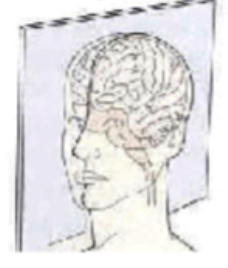
slice orientation
sagittal
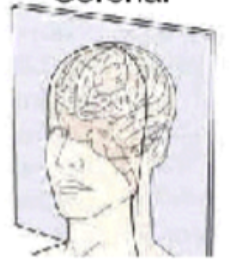
slice orientation
coronal

slice orientation
transverse
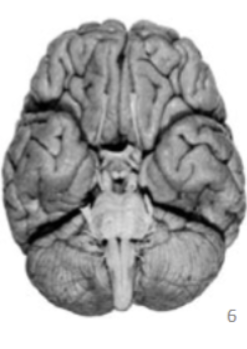
brain viewpoint
ventral

brain viewpoint
medial

brain viewpoint
lateral

brain viewpoint
dorsal
layers of the brain
skull, dura, gray matter
gyrus
bump
sulcus
groove
compsition of gray matter
cell bodies of neurons and glia (nerve glue)
composition of white matter
myelinated axons
purpose of the folded cortex
increase surface area (gyri and sulci) and reduce axonal distance
frontal lobe
front of the brain, largest lobe
decision-making, problem-solving, reasoning, volunatry movement, language production (Broca’s area), and personality
temporal lobe
sides of the brain
processing auditory information (hearing), language comprehension (Wernicke’s area), memory encoding, and emotion
parietal lobe
top and back of the head
processing sensory information like touch, temperature, pressure, and pain; spatial awareness and navigation
occipital lobe
back of the brain rests on the base of the skull
Processes visual information, including color, shape, recognition, and spatial perception
what are the brain ventricles for
to produce, store, and circulate cerebrospinal fluid

motor and somatosensory homunculi
a distorted visual map of the human body laid across the cerebral cortex, showing how much brain space is dedicated to different body parts
association cortices
multiple sensory modlities
integrate sensory and motor
allocating attention
what is cognitive psychology
the construction and reconstruction of biologically relevant aspects of the external world
not always isomorphic relationship world/perception
emphasis on costruction (assumptions about the structure of the world)
to reconstruct, sometimes decisions are arbitrary
study of mental activity as information processing problem
internal (metal representations)
chronometrics
measure reaction time
finer analysis of internal representations
handle on mental events which are rapid and efficient
serial processing
tasks sequentially, one after another
parallel processing
executes multiple tasks simultaneously using different resources
stroop effect
a delay in reaction time that happens when the meaning of a word clashes with the color of its ink
reduction is response in manual, not verbal
reduce interference with dual task or with practice
eye tracking
use eye movements/gaze patterns to tap into mental processes
basic uses of eye tracking
where are they looking?
how frequently do they make saccades?
do they reurn to previously fixated locations?
fixation monitoring (if you don’t want them to wander)
gaze-dependent stimulus presentation
purpose of computer modeling
computers represent and transform information
good model for studying human cognition
ai: simulate human behavior
examine representation
examine info transformation
representations:
symbolic entities or subsymbolic
neural netowkrs
best mapping between input and output
limitations of comupter modeling
simplification
not quite neuron-like; non-linear activation but not really biological
small in scale, narrow problems
intracellular recording
very difficult, graded membrane potentials (ask: how close re we to spiking?)
extracellular recording
more common, action potentials (“spikes”)
relevance of a neuron’s baseline activity
neurons are constantly active
measure changes to experiemntal manipulation
what increases or decreases firing rate?
receptive field
the specific region of sensory space (like an area of skin or a patch of the visual field) or the set of input data that can change the electrical activity or response of a particular neuron

raster plots
present visual depictions of how frequently an electrode records a spike
pros of single-cell recording
excellent spatial and temporal resolution (“gold standard”)
cons of single-cell recording
limited spatial coverage
are single neuron(s) representive of the whole region?
not human
not causal
complex cell preferences
complex cells in the visual cortex prefer oriented edges or light patterns moving in a specific direction, responding regardless of the exact position or polarity (light vs dark bar) within their receptive field
animal lesions
neural structure contributes to the task
lesions → impairs performance on task
is brain region necessary for task?
some caveats
area may be bypassed to other regions and not be involved itself
animal may learn to compensate for deficit, so the system is reorganized
animal lesions: what techniques can be used?
aspirate tissue: destroy brain structure via suction
electrolyte lesion: similar, using electrical charge
neurochemical lesion: designed to damage specific cell types only)
reversible lesion
cooling (i.e. via cooled methanol pump)
pharmacological
i.e. scopolamine
genetic manipulations
genome mapped
not completely understood yet
goal: to find genetic basis for brain disorders
approach: produce genetic alterations in animals
“knockout” mice
what is CT
computed tomography (CT)
like x-ray but from all possible directions
many more images = more radiation exposure
intervening tissue absorbs radiation (bone a lot; blood a little)
reconstructs differential absorption
MRI
properties of hydorgen spin are measured
EEG
recorded from scalp electrodes
DTI: why diffusion is relevant
tracking the microscopic, random motion of water molecules acts as a natural probe to map the structural wiring and organization of brain tissue
DTI: what it is used to estimate and measure
uses MRI to measure diffusion of water through axons