Micro Quiz 4
 Call Kai
 Learn
 Practice Test
 Spaced Repetition
 Match
 Flashcards
 Knowt Play
1/28

Earn XP
Description and Tags
Objectives covered on Microbiology Quiz 4
29 Terms
Virus Definition (CEO)
A virus is a genetic element that contains either RNA or DNA surrounded by a protein capsid and that replicates only inside host cells
Virus Definition (Textbook)
Viruses require a host and viral-host interactions are specific
Capsid
protein shell that surrounds/protects the genome of a virus (symmetric)
Capsomere
one of the individual protein molecules that assemble together to form the capsid shell around the viral nucleic acid.
can help determine the size and shape of the virion.
Envelope of a virus
outer layer of the virion made from a phospholipid bilayer taken from the host cell membrane. (lipoprotein envelope)
surrounds the nucleocapsid and contains viral-surface proteins that mediate attachment to host cell for entry
Helical symmetry
rod shaped, with capsomere proteins and nucleic acid arranged in a helix around an axis.
Icosahedral symmetry
capsid forms a roughly spherical shell shaped like an icosahedron, a solid with 20 triangular faces and 12 vertices (most efficient way to build a closed protein shell, smallest # of capsomeres)
What viruses are enveloped?
Animal viruses
Virus Characteristics
acellular
capsid: symmetric and protects genome
metabolically inactive
require hosts
very small: 5-50 nm
diverse genomes
complex viruses
more than one symmetrical part
example: T4 bacteriophage or structurally complex
example: mimivirus (fibres, star-fished shaped structure)
virus structure
capsid, nucleic acid, envelope
Phage
virus that infects bacteria
simple viruses
virions consist of only of a nucleic acid and a protein capsid, with no additional structures (most plant and bacterial viruses are described as naked)
Why might a virus capsid include viral enzymes?
certain essential steps of infection and replication cannot be carried out by host-cell enzymes and must be supplied by the virus itself.
through viral entry
examples: T4 virus and lysozyme
maturation - HIV
Five steps of a virus life cycle
Attachment (adsorption) of the virion to the host cell
Penetration (entry, injection) of the virion nucleic acid into the host cell
Synthesis of virus nucleic acid (genome) and protein by host cell machinery as redirected by the virus
Assembly of capsids and packaging of viral genomes into new virions
Release of new virions from cells (lyse host cell)
only infectious if virus has a capsid
Two classification methods of viruses
Classification I - host(s) including reservoirs, morphological features, genome
Classification II - type of genome (DNA vs. RNA), ss vs ds, plus vs minus strand, presence of reverse transcription (seven classes)
what viruses dominate Archaea?
dsDNA
what viruses dominate bacteria?
dsDNA
what viruses dominate eukarya?
ssRNA +
what viruses dominate animals?
dsDNA
what viruses dominate plants?
ssRNA +

Fill in the table
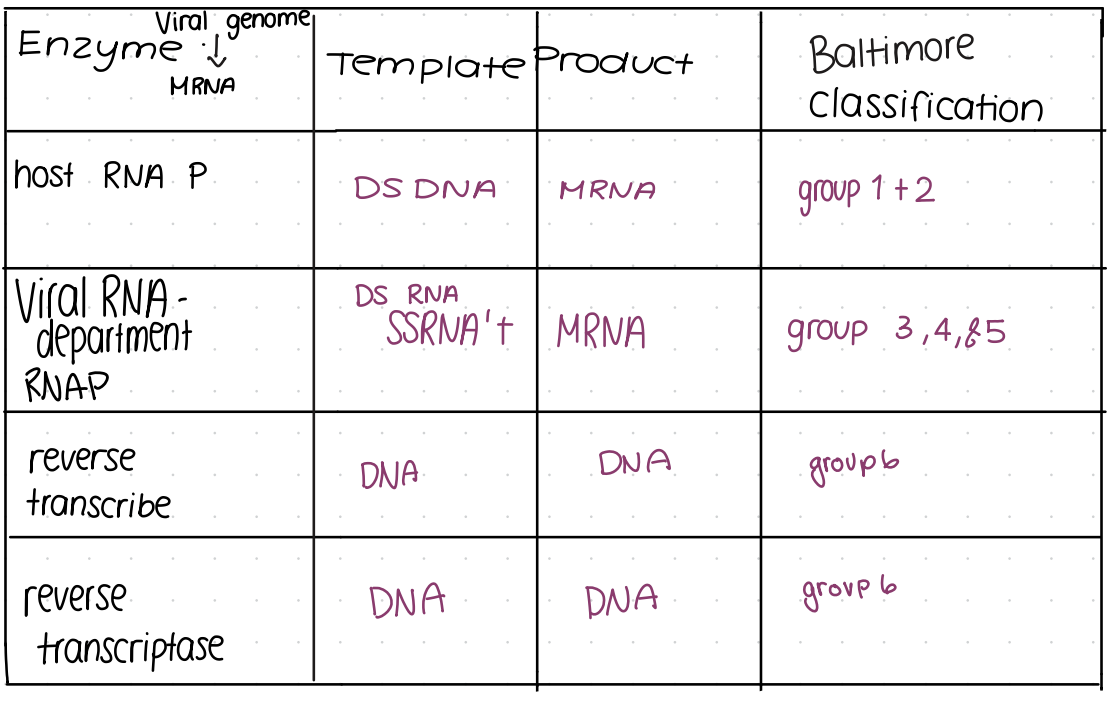
4 possible host effects for animal viruses
transform into cancer cells (HPV)
Lysis (CPV)
persistent infection (zika, influenza)
latent infection (HIV)
Two methods of viral entry for animal viruses?
fusion of viral envelope and host cell cytoplasmic membrane
endocytosis
Difference in bacterial and animal viral entry
In bacteria viruses, the virus usually injects its genome into the host WITHOUT the capsid entering the host (work via attachment)
In animal viruses, usually enter host and go through un-coating, this is through either fusion of envelope and host cytoplasmic membrane or endocytosis or penetration.
Influenza - Case Study
Host receptor: sialic acid receptor
viral protein: HA (hemagglutin)
synthesis: Replicate genome—-RNA —- Nucleus (protein coats in cytoplasm)
entry method: endocytosis
CPV - Case Study
Host receptor: TfR (transferrin)
Viral Protein: VP2 (capsid protein)
Synthesis: Replicate nucleic acid —- DNA viruses —- nucleus
entry method: Clathrin-dependent endocytosis
Zika - Case study
Host receptor: fibroblast, brain cells - multiple receptors
Viral protein: E dimer (envelope protein)
Synthesis: RNA viruses —— cytoplasm
entry method: Clathrin-dependent endocytosis
HIV - Case study
Host receptor: CD4 and then CCR5 receptors on T helper cells
Viral protein: envelope protein
Synthesis: nucleic acid — retrovirus = cytoplasm and nucleus (provirus) protein coat rough ER
Entry method: fusion of viral envelope and host cytoplasmic membrane or endocytosis