C (7) Headache
 Call Kai
 Learn
 Practice Test
 Spaced Repetition
 Match
 Flashcards
 Knowt Play
1/77

There's no tags or description
Looks like no tags are added yet.
78 Terms
Headache Types
Primary vs. secondary
Medication-overuse headache
Tension
Migraine
Sinus
Headache Types
Primary headache:
not associated with an underlying illness.
Headache Types
Secondary headache:
headache is a symptom/manifestation of another condition.
Headache Types
Most headaches appropriate for self-treatment:
Tension-type
Previously diagnosed migraine
Sinus headache
Headache Types
Tension Headache - topics we discuss?
Triggers:
Episodic vs. Chronic
Headache Types
Tension Headache - Triggers:
Emotional conflicts - Stress/Anxiety/Depression
Headache Types
Tension Headache: Episodic vs. Chronic
Episodic
<15 days/month
Pain associated with the peripheral nervous system
Chronic
15+ days/month for ≥3 months
Stimulus associated with the central nervous system
Headache Types
In community practice, the major way to distinguish episodic vs. chronic tension headache is…
how often the headaches occur.
Headache Types
Migraine - what topics we cover?
Pathophysiology
triggers
tracking?
Headache Types
Migraine - Pathophysiology
trigeminal nerve activated in CNS → neuronal inflammation → pain.
Headache Types
Migraine - triggers
“Students Hate Cramming At Midnight, Bro.” 😭
S = Stress / fatigue
H = Hypoglycemia / skipping meals → think Hungry
C = Caffeine
A = Alcohol
M = Menstrual cycle
B = Barometric pressure changes
Food can also trigger (come back if time):
Red wine
Aged cheese
Aspartame
MSG
Headache Types
Migraine - tracking?
keep headache diary → find triggers → avoid triggers
Headache Types
Sinus Headache - topics we discuss?
Pathophysiology
Headache Types
Sinus Headache - Pathophysiology
MUCUS (in sinus cavity) → PRESSURE → PAIN
And treatment idea:
Drain mucus → ↓ pressure → ↓ headache.
Headache Types
Medication-Overuse Headache - topics we discuss
what it is
treatment
Headache Types
Medication-Overuse Headache - what it is?
Medication-overuse headache = too much analgesic use → rebound headache
>2 days/week for ≥3 months = suspect medication-overuse headache.
Stop the analgesic → headache can come back/worsen
Take the analgesic again → headache may improve → clue that overuse is causing it
Headache Types
Medication-Overuse Headache - treatment?
Medication-overuse headache → STOP → REBOUND → REFER → LIMIT
STOP analgesic for ≥1 month
REBOUND: headaches may get worse during withdrawal
REFER: may need provider/prescription treatment
LIMIT: OTC analgesics to ≤3 days/week to help prevent recurrence
Distinguishing Headache Types
CHART
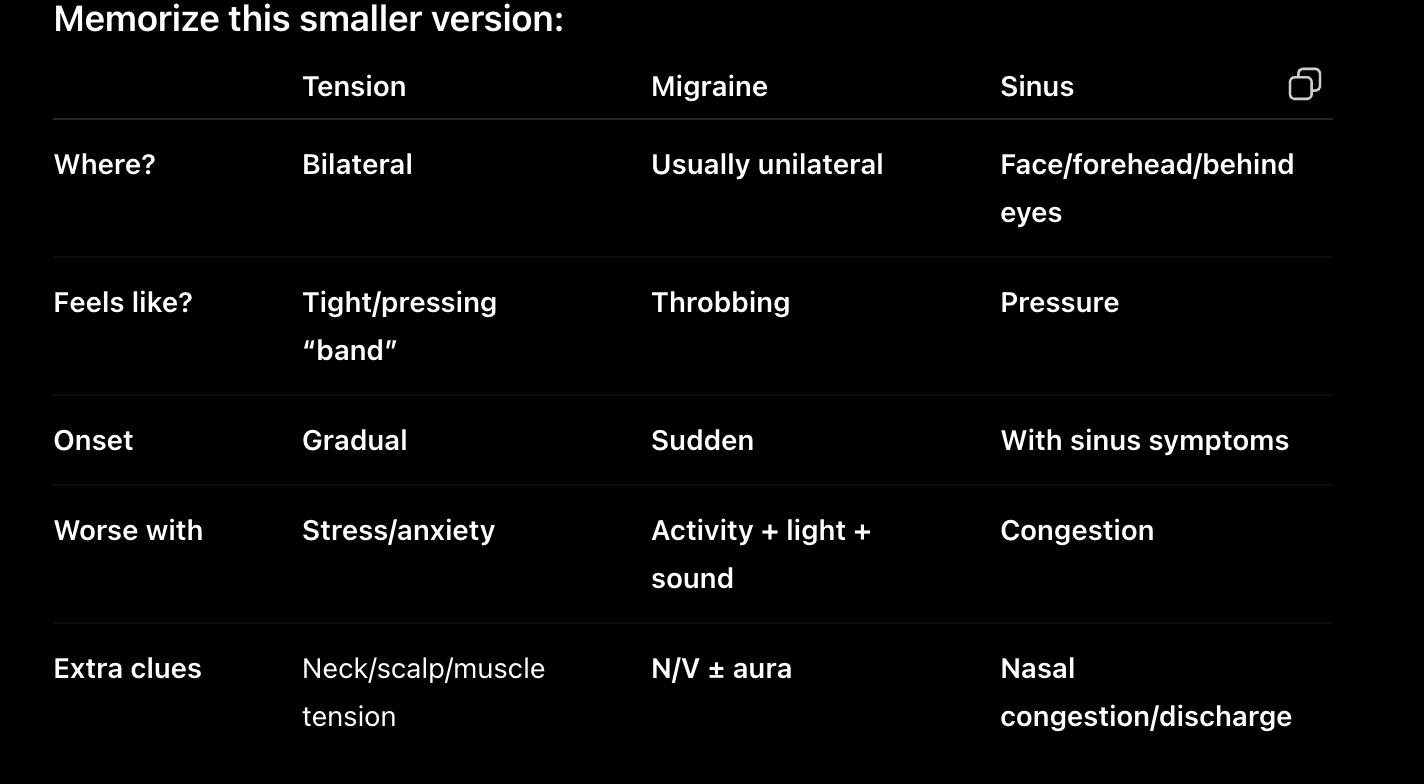
Distinguishing Headache Types
Aura:
visual warning (lights/halos) that comes BEFORE the migraine
Self-care
topics we discuss
Exclusions for self-care
Nonpharmacologic treatment
Pharmacologic Treatment
Refer?
1. NUMBERS — say this like a chant
“7 pain, 10 days, 8 kid, 3 drinks, 104 fever.”
7–10/10 pain
>10 days
<8 years
≥3 drinks/day
>104°F
2. NON-NUMBERS — only 5 buckets
PATTERN
First/worst
Getting worse
PATIENT
Liver disease
Cancer/HIV
PREGNANCY
New headache
Last trimester
SCARY
Serious infection
Stiff neck
Neuro changes → vision, seizure, mental status
TYPE
Secondary headache → refer
Exception = sinus
Migraine not previously diagnosed → refer
Self-care
Nonpharmacologic Therapy - overview
Nonpharmacologic Therapy…
for Tension headache
for Migraine
Other options:
Professor's food-trigger examples:
Self-care
Nonpharmacologic Therapy - Tension headache
Relaxation
Massage/Physical therapy
Self-care
Nonpharmacologic Therapy - Migraine
Maintain regular:
Sleep
Eating
Exercise
Self-care
Nonpharmacologic Therapy - Other options:
AVOID triggers + DARK/ICE + STRESS control + MAGNESIUM prevention
Headache-Specific Pharmacologic Treatment
Tension
Any of the OTC analgesic classes discussed can be effective.
take at onset of pain for best effect.
Headache-Specific Pharmacologic Treatment
Migraine
REFER = Undiagnosed migrain
OTC analgesic = take EARLY → aura/first pain
Triptans = abortive treatment → stop an active migraine
Migraine prevention drugs = recognize the list, not heavy memorization (COME-BACK)
Beta blocker
TCA
CCB
Divalproex
Topiramate
Gabapentin
Headache-Specific Pharmacologic Treatment
Sinus
Sinus headache → decongestant for cause + analgesic for pain
Know the 2 decongestants:
Oxymetazoline
Pseudoephedrine
OTC ANALGESIC - ADULTS

OTC ANALGESIC
Naproxen
may take 2 tablets for the first dose, then remaining tablet 8–12 hours later
max 3 × 220 mg = 660 mg/day.
EXAM ALERT- In self-care cases, use the…
self-care limits, not prescription-strength limits.
OTC ANALGESIC - PEDS
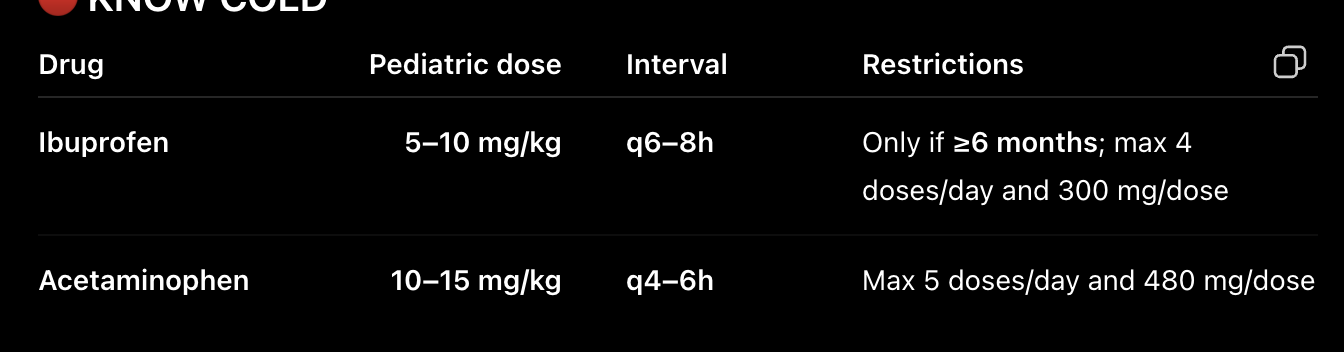
OTC ANALGESIC
Pediatric Dosing - what is dosing based on?
Prefer weight-based dosing over age-based dosing.
OTC ANALGESIC
main differences between pediatric vs. adult dosing?
Pediatric ibuprofen interval differs from adult:
Pediatric: q6–8h
Adult/self-care: q4–6h
APAP interval stays q4–6h.
PRACTICE / READING ASSESSMENT
Question: What is an appropriate weight-based dose of acetaminophen for a 6-month-old child weighing 15 lb, expressed as a measurable mL dose?
15 lb ÷ 2.2 = 6.82 kg
APAP = 10–15 mg/kg
Dose range ≈ 68–102 mg
APAP concentration = 160 mg/5 mL = 32 mg/mL
Approximate volume range = 2.1–3.2 mL
Syringe-measurable dose selected by professor = 2.5 mL
✅ Correct answer: 2.5 mL
🚨 EXAM ALERT: For the first exam, professor expects you to recall the Tylenol concentration 160 mg/5 mL. She said it would be supplied on later comprehensive exams.
📝 PRACTICE / READING ASSESSMENT — 20-lb Child
Question: What would be the most appropriate acetaminophen suppository product for a patient weighing 20 lb?
Calculation:
20 lb ÷ 2.2 ≈ 9 kg
10–15 mg/kg
Dose range ≈ 90–136 mg
✅ Professor selected Children's FeverAll 120 mg suppository because 120 mg falls within the weight-based range.
She specifically explained:
80 mg is below the range → underdosing.
Avoid doses above the range because of toxicity risk.
📝 PRACTICE / READING ASSESSMENT — Teething
Question: What would you recommend for teething pain in a 5-month-old infant weighing 15 lb?
The complete original answer choices are not fully recoverable from the supplied sources.
Professor discussed:
Two ibuprofen/Advil choices → eliminate because patient is <6 months.
Children's Tylenol 10 mg/kg q4–6h
Children's Tylenol 10 mg/kg q6–8h
✅ Correct: Children's Tylenol 10 mg/kg q4–6h
Why:
Ibuprofen cannot be used before 6 months.
APAP interval remains q4–6h in children.
Acetaminophen
topics overview
Mechanism/Kinetics
Adult/Pediatric Formulations to Recognize
Maximum Dose
Hepatotoxicity
Interactions
Acetaminophen
Mechanism:
CENTRAL (CNS) → ↓ prostaglandin synthesis
PERIPHERAL (body tissues) → ↓ pain impulses/signals
Extensive hepatic(liver) metabolism
Acetaminophen
Kinetics:
Oral onset ≈ 30 minutes
IR duration listed on PowerPoint: 4 hours
ER: 6–8 hours
Acetaminophen
Adult Formulations to Recognize

Regular strength = 325 mg → q4–6h
Extra strength = 500 mg → q4–6h
Arthritis / ER = 650 mg → q8h
Acetaminophen
Pediatric Formulations to Recognize

Peds APAP liquid: Infant = Children = 160 mg/5 mL → use weight-based dosing.
Suppositories come in different strengths
Acetaminophen
Pediatric Formulations: → Choose the dose based on the
child's weight, not simply whether the package says infant/children.
Acetaminophen
Pediatric Formulations: Professor Counseling for Suppositories
Remove the suppository from the plastic/foil protective wrapper before rectal insertion.
Suppositories can be useful when a young child cannot reliably swallow liquid or spits medication out.
Acetaminophen
Maximum Dose
Before 2011: 4000 mg/day
Tylenol manufacturer reduced self-care max:
Regular Strength → 3250 mg/day = 10 × 325 mg
Extra Strength → 3000 mg/day = 6 × 500 mg
Prescription combination products are no longer to contain >325 mg APAP per dose/unit.
Acetaminophen
PROFESSOR EMPHASIS: Know ________ mg/day for self-care.
3000–3250
Acetaminophen
Toxicity
Hepatotoxicity:
Acetaminophen
Hepatotoxicity: More conservative dosing/avoidance may be needed with: - skip
Liver disease
≥3 alcoholic drinks/day
Other hepatotoxic drugs
Poor nutritional intake
Acetaminophen
Toxicity: Adverse Effects
Leading cause of acute liver failure in the U.S. according to the slide.
Common:
stomach upset
Stop/seek care:
yellow skin/eyes
bloody stool/vomit
abnormal bruising/bleeding
allergic reaction
Acetaminophen
Interactions
Alcohol = BAD for liver
Warfarin = APAP still BEST choice
What OTC meds are NSAIDs?
ibuprofen
naproxen
NSAIDs
topics we cover?
Mechanism/Kinetics
Brands/Concentrations
Drug-Interactions/Cautions
Toxicity
GI Toxicity
risk factors
warning signs
Cardiovascular Risk
Kidney Function
NSAIDs
Mechanism
Central + peripheral inhibition of COX
→ ↓ prostaglandin synthesisEliminated primarily through kidneys
NSAIDs
Kinetics
NSAID onset = 30 min
Naproxen = last 12 h
Ibuprofen: adult 4–6, kid 6–8
NSAIDs
Adult Formulations- skip
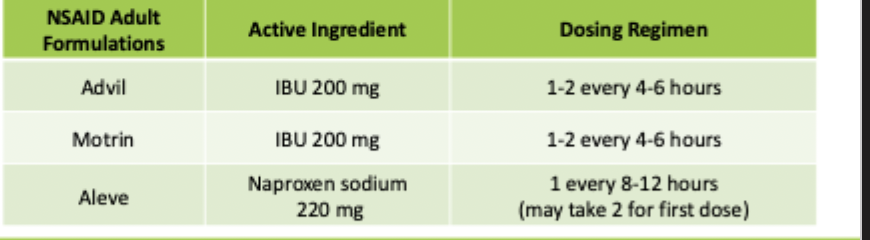
IBU = Advil/Motrin = 200–400 q4–6
NAP = Aleve = 220 q8–12; may take 2 first
NSAIDs
Pediatric Formulations

Ibuprofen liquids = DIFFERENT concentrations → Infant 50/1.25; Children 100/5
NSAIDs
Toxicity
GI/GUT → bleed
HEART → MI/stroke/BP/HF
KIDNEY → ↓ blood flow → damage
NSAIDs
Toxicity: Adverse Effects
Common:
stomach upset → take with food
Stop:
severe stomach pain
bloody stool/vomit
abnormal bruising/bleeding
allergic reaction
NSAID
Drug Interactions/Cautions
NSAID + anticoagulant → ↑ bleeding → avoid; use APAP instead
Aspirin 81 mg = antiplatelet/CV protection, NOT pain relief
Aspirin analgesia starts around 325 mg
If ASA 81 mg + NSAID must both be used:
ASA ≥30 min BEFORE OR ≥8 hr AFTER the NSAID
What combination drug we talk about?
APAP + Ibuprofen Combination
APAP + Ibuprofen Combination
APAP 250 mg
Ibuprofen 125 mg
2 caplets q6h
Max 6 caplets/day
APAP + Ibuprofen Combination
Main counseling issue
less dosing flexibility + higher risk of dosing mistakes.
Salicylates
What drugs under this?
aspirin
magnesium salicylate
Salicylates
topics we cover?
Mechanism/Kinetics
Formulations/Brands
Toxicity
Intoxication
GI Effects
Reye Syndrome
Salicylates
Mechanism/Kinetics
Inhibit COX-1 and COX-2
→ inhibit prostaglandinsRenally excreted.
Salicylates
Formulations:
Enteric coated - protects stomach, delays absorption, delays pain relief.
Buffered - intended to absorb faster, but pain relief isn’t meaningfully faster
Sustained release
Salicylates
Brands
Bayer → aspirin
Ecotrin → aspirin
St. Joseph → low-dose aspirin
Doan's → magnesium salicylate
⭐ Aspirin dosing for analgesia received greater emphasis than magnesium salicylate because magnesium salicylate is less commonly used.
Salicylates
Toxicity
same as NSAIDS PLUS:
Intoxication: TINNITUS = hallmark, hyperventilation
Reye syndrome: avoid aspirin/salicylates in patients <18, especially around viral illness.
Salicylates
Toxicity: Adverse Effects
Common:
stomach upset
Stop:
severe stomach pain
bloody stool/vomit
abnormal bruising/bleeding
allergic reaction
Aspirin
What topics we cover?
Intolerance
Drug/Disease Interactions
Aspirin
Intolerance
Aspirin allergy → skin + breathing reaction
NO ibuprofen/naproxen as well
use APAP or magnesium salicylate instead
Aspirin
Drug/Disease Interactions
SAME AS NORMAL NSAIDS: Aspirin + NSAIDs/anticoagulants/alcohol/corticosteroids → ↑ bleeding risk
Gout → avoid aspirin for pain because aspirin can ↑ uric acid and worsen gout
Combination Products
Migraine/tension headache → caffeine combo
Pain keeping patient awake → Tylenol PM = APAP + diphenhydramine (Sleep)
Sinus headache/congestion → analgesic + pseudoephedrine (sinus)
Agent Comparison
APAP = not anti-inflammatory
NSAIDs = strongest inflammation control
- Aspirin/NSAIDs = similar pain relief
- Naproxen = longer acting than ibuprofen
SPECIAL POPULATIONS
Children
Ibuprofen ≥6 months
Naproxen ≥12 years
Aspirin ≥18 years
APAP = no comparable age cutoff on this slide
Elderly → APAP
Pregnancy/Lactation
APAP = preferred/appropriate option if needed
NSAIDs = avoid in 3rd trimester
Naproxen = avoid during lactation
Aspirin = avoid pregnancy + lactation
Renal impairment
Use caution with NSAIDs + salicylates
Pediatric Counseling
use Weight-based dosing→ syringe → concentration concentration
APAP infant + children concentrations = SAME
Ibuprofen infant + children concentrations = DIFFERENT
Avoid alternating APAP + ibuprofen routinely because it can cause dosing errors
SKIP - OPTIONAL
Adult Counseling / When to Stop
All analgesics
Know the maximum daily dose
Do NOT self-treat headache >10 total days
Limit analgesics to ≤3 days/week to reduce medication-overuse headache
Adult Counseling / When to Stop
specific analgesics
APAP
Common:
Stomach upset
Stop therapy for:
Yellow skin/eyes
Bloody stool/vomit
Abnormal bruising/bleeding
Allergic reaction
NSAIDs
Common:
Stomach upset → take with food/milk
Stop for:
Severe stomach pain
Bloody stool/vomit
Abnormal bruising/bleeding
Allergic reaction
Salicylates
Common:
Stomach upset
Stop for:
Severe stomach pain
Bloody stool/vomit
Abnormal bruising/bleeding
Allergic reaction