Enzymes
 Call Kai
 Learn
Learn Practice Test
 Spaced Repetition
 Match
Match Flashcards
 Knowt Play
1/45

There's no tags or description
Looks like no tags are added yet.
Name | Mastery | Learn | Test | Matching | Spaced | Call with Kai | Chat |
|---|
No analytics yet
Send a link to your students to track their progress
46 Terms
Enzymes
Proteins that function as biological catalysts
Catalysts
It accelerates process
Reduces
Catalysts offers alternative pathway which (increases/reduces) activation energy (Ea)
Yeast
What does “zyme” mean in enzyme (greek etymology)
“ferments”
What is the former name of enzymes
Globular proteins
Most enzymes are ______ proteins
Simple
A ______ enzyme is composed of only amino acid chain
Conjugated
A _______ enzyme has a non protein part in addition to a protein part (protein part + non protein part)
Apoenzyme
The protein part of an enzyme and is inactive in itself
Cofactor
It is the nonprotein organic or inorganic (cofactor/co-enzyme) moiety
Holoenzyme
= apoenzyme + cofactor
Active site
It is the site where catalysis happens
Substrate
These are compounds being catalyzed
H-bonds
Salt links
Van der Waals Interaction
Hydrophobic Effect
What are the interactions between the active site and substrate?
Contact Binding Residues
(Amino Acid Residue Bonding)
It binds reversibly
Directly affects binding partner
Weak interaction ( H and ionic bonds)
Auxiliary Residues
(Amino Acid Residue Bonding)
Only stabilizes the substrate
Metal coordination/structural/indirect stabilization
Class of enzyme
Type of bond, functional group, or chemical donor
Specific mechanism, acceptor molecule, or co-substrate
Unique Identifier
What does each of the 4 digit classification number of enzymes mean?
Oxidoreductases
Class of enzyme that does:
Redox Reactions
Transfer or Electrons

Transferases
Class of enzyme that does:
Transfer of chemical groups
Commonly transfers bio-energetic molecules

Hydrolases
Class of enzyme that does:
Hydrolysis (bond cleavage with the transfer of functional group to water)

Lyases
Class of enzyme that does:
Non-hydrolytic bond cleavage

Isomerases
Class of enzyme that does:
Intramolecular group transfer (orientation in space/ isomerism)

Ligases (synthases)
Class of enzyme that does:
Synthesis of new covalent bond between substrates, using ATP hydrolysis

Alcohol Dehydrogenase
Example of Oxidoreductases

OA: NAD+
RA: CH3CH2OH
OP: CH3CHO
RP: NADH + H+
Oxidizing and reducing agent?
Oxidized and reduced product?

Hexokinase
Example of Transferases

Hydrolysis - removal of water from a larger molecule to make a smaller molecule
Condensation/ dehydration synthesis - removal of water from smaller molecules to form a larger macromolecule
Hydrolases involves two types. What are those?
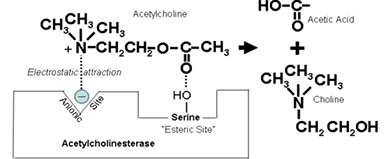
Acetylcholinesterase (by hydrolysis)
Example of Hydrolases
Pyruvate decarboxylase
Example of Lyases

Triose Phosphate Isomerase
Example of Isomerases

Coenzyme
Organic type of cofactor
Metal-ion
Inorganic type of cofactor
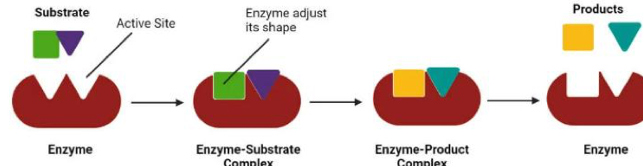
Lock and Key Model
(Enzyme Model)
Fixed geometrical conformation
“only substrate of specific shape can bind with the active site, just like a lock and a key”

Induced Fit
(Enzyme Model)
Usually has the tendency to attach to the conformational changes based on the substrate
Both the substrate enzyme’s active site undergoes conformational changes up until the substrate is fully attached to the enzyme.
True
T/F
All given functional groups can act as acids or bases
Covalent catalysis
General acid-base catalysis is usually combined with ______ catalysis
donates
A bronsted acid (donates/accepts) protons
accepts
A bronsted base (donates/accepts) protons
General acid catalysis
This enzyme mechanism involves an amino acid donating a hydrogen ion, as in the reaction


General base catalysis
This enzyme mechanism involves an amino acid taking a hydrogen ion from one of the substrates, such as the reaction:
True
T/F
Acid catalysis can accelerate hydrolysis and other bond-cleavage reactions.
True
T/F
Base Catalysis can activate water, alcohols, and thiols for nucleophilic attack
Metal Ions (Metal-ion catalysis)
(Mechanism of Action)
_______ enhances the rate of chemical reactions by acting as Lewis acids, forming complexes with reactants, and stabilizing transition states.
Adducts (from formation of coordinate covalent bonds)
_______ are products of a direct addition reaction between two or more distinct molecules, where all atoms from the original components are retained in the resulting single molecule.
Scissile bonds
These are bonds susceptible to cleavage.
metal coordination can withdraw electron density from a substrate, altering bond polarity and making cleavage easier.
Covalent Catalysis
(Mechanism of Action)
Involves the formation of a covalent bond between the enzyme and at least one of the substrates involved in the reaction.
often, this involves nucleophilic catalysis