BIOL 359 - Midterm 1
 Call Kai
 Learn
 Practice Test
 Spaced Repetition
 Match
 Flashcards
 Knowt Play
1/106

There's no tags or description
Looks like no tags are added yet.
107 Terms
Evolution before Darwin
Plato - Idealism: the idea that all natural phenomena are imperfect representations of a true essence in an ideal unseen world
Aristotle - Furthered Plato’s concept by envisioning a static world in which a Deity had created fixed essences, which are templates for all species.
Graduation form inanimate matter to barely animate to “higher” forms (through plants and invertebrates) in a Scale of Nature, moving from least to most perfect
Christianity expanded the Scale of Nature by creating the Great Chain of Being
Permanent and unchanging since change would imply imperfection in the og creation
Linnaues
The father of taxonomy, he established the framework for modern classification in his System Naturae
His purpose in classification was to discover the pattern among God’s creations
Lamarack
Combined spontaneous gen w/ a mechanism of biological change. Species change over time into new species.
Explanation: inheritance of acquired characteristics e.g. “use and disuse”
Cuvier
Father of comparative anatomy, paleontology, and a proponent of Catastrophism: the widely held belief that the Earth’s features had been primarily modeled by great catastrophes that resulted from forces that no longer operate today
Hutton & Lyell
Hutton — Father of modern geology and is responsible for the Principle of Uniformitarianism: geological process that operate today are the same as those that operated in the past.
Lyell — Published Principles of Geology which presented evidence for uniformitarianism and ended the era of catastrophism.
Uniformitarianism is the opposite of Catastrophism
Darwin & Wallace & Mendel & Modern Synthesis or Neo-Darwinian Synthesis
His examination of finches collected from the Galapagos islands led him to develop the idea that species can change. Both Darin & Wallace has similar idea of NS.
Mendel: provided the basis of modern genetics which was consistent w/ NS
Neo-Darwinian Synthesis: established that NS acts on heritable variation (genes) and is consistent w/ the evolution of taxa at all levels.
Darwin’s Evolutionary Theory
The origin of Species was published w/ 2 major tenets
All species, living and extinct, have descended w/o interruption from one or a few original forms of life
Theory of natural selection
Biologist accepted this as evidence for evolution, but the mechanism of inheritance was still unknown.
Intelligent Design Theory
An alternative “scientific theory” to explain biological origins and complexity. ID theory holds that the bio complexity apparent in nature cannot be explained by Darwinian evolution and is consistent w/ ID.
Presupposes that any complex structure must be the result of an intelligent designer but offers no test of this presupposition. Nor does it offer a method by which this presupposition can be tested so it is not falsifiable and internally inconsistent and NOT a scientific theory.
A Fact
In science, an observation that has been repeatedly confirmed and for all practical purposes is accepted as true. it is observable.
But nothing in science is every final.
Hypothesis
A tentative statement about the natural world leading to deductions or predictions that can be tested. If the deductions are verified, it becomes more probable that the hypothesis is correct.
If the deductions are incorrect, the og hypothesis is abandoned or modified.
A Law
In science, a descriptive generalization about how some aspect of the natural world behaves under specific conditions.
Explains WHAT happens under specific conditions
A Theory
In science, a well substantiated explanation of some aspect of the natural world that incorporates facts, laws, and tested hypotheses.
Key elements of scientific theories are that they must be falsifiable and internally consistent.
Explains WHY it happens.
Note: cannot turn law into theory or fact and vice versa
Paley
His logic on explaining why ID theory is true
Because of the Earth’s complexity with evolution, there had to be a creator/designer as complex things (like watches and clock) had makers.
The Flagellum: Behe
Behe states that a flagellum is irreducibly complex b/c it cannot function if any one of its proteins are absent. B/c of its irreducible complexity, (1) it could not have functional precursors and (2) could not arise by selection and must have arisen by design.
See DOC
Misconceptions about Science and Evolution
Does science tell us that God cannot exist
Science (and hence Evolution) has nothing to say about the existence of God, or about spirituality
Some people state that they have faith in science and evolution
Science (and hence evolution) IS NOT a faith, which by definition is acceptance in the absence of evidence
Some people claim that the theory of evolution justifices immorality and unethical behavior
Science DOES NOT directly inform us about question concerning morality and ethics
The Naturalistic Fallacy: the way that things are is the way that they should be
Science informs us about the way the natural world is, NOT about how it should be
Evolution vs Homology vs Analogy
Evolution: descent w/ modification or as a change in pop allele frequencies
Theory of Evolution provides a logical explanation for a wide range of observations and makes predictions that can be tested scientifically.
Homology: similarity resulting from common ancestry (the same origin), often despite differences in function
Analogy: similarity in function but diff same evolutionary origin
i.e. shark vs orca
How do species change over time?
Microevolution: small evolutionary changes within species or populations (group of the same species)
Speciation: linages split and diverge: an ancestral species can give rise to 2+ descendants or daughter species
Macroevolution: refers to larger phenotypic changes sufficient to place an organism in a diff higher-level taxon (e.g., phylum)
Over time, microevolution results in both speciation and macroevolutionary differences.
Selective Breeding: Mice
Researchers selectively bred mice for the ability to run on an exercise wheel over 24 gens. The results show that the selected group ran 2.78 times as far each day than the control group
Field Mustard Plant
Evidence for Descent w/ Modification, Direct Observation of Change
Researchers tested and confirmed that a wild pop of field mustard evolved an earlier average flowering time following a drought, using a carefully controlled experimental common garden approach.
During long growing season (rainy) later flowering time better b/c more time to grow = more seeds
In drought, earlier flowering time better b/c more likely to survive
Fruit Flies
Evidence for Descent w/ Modification, Direct Observation of Change
Some fruit fly larvae travel farther (rovers) than others (sitters).
Larval foraging exhibits density-dependent selection: the proportion of rovers increases when reared at high densities.
Rovers are advantageous when food is scarce because it is more worth it to use up the energy. But if food is abundant than sitters are advantageous as to not waste energy.
Apple Maggot Fly
Evidence for Descent w/ Modification, Direct Observation of Change
Fly’s native host plant is the Hawthorn tree and produces a fruit in fall similar to crab apples. Lies their eggs on the fruit and larvae develop in it.
Apple trees were introduced and fly began parasitizing it. The fly pop parasitizing apple trees have evolved heritable diff related to the fact that apples ripen earlier than hawthorn fruit, and apple and hawthorn maggot flies are now considered incipient (beginning) species.
Evolution of Vestigial Structures
Evidence for Descent w/ Modification
For humans, they no longer have use for a tail bone and goosebumps
The ancestral marine form (fully armored) had invaded freshwater lakes adjacent to the Pacific coast. It rapidly evolved to lose its armor and pelvic structure.
The ɸ6 Bacteriophage
Evidence from Lab Experiements
Wildtype of ɸ6 can infect 4 varieties of P. syringae. Mutant type can infect P. syringae and P. pseudoalcaligenes. Can exchange gene when in the same host.
The mutant type was grown in P. pseudoalcaligenes culture for 150 gens. After 12 days, new strain evolved, narrow type which can infect P. pseudoalcaligenes but not P. syringae.
Wildtype and narrow type are now isolated since they can’t infect the same host and exchange genes. Considered diff species b/c reproductively isolated.
What is a species?
Species are groups of interbreeding natural pop that are reproductively isolated from other such groups.
Evidence from Natural Populations
Speciation is not a sudden event, but a gradual process. Observations on living orgs provide direct evidence of speciation by showing that pop can diverge to the point that their individuals can no longer interbreed.
Shown through threespine sticklebacks:
Single variable pop → distinguishable but interbreeding subpop → distinct pop w/ limited interbreeding → reproductively isolated pop = species
The Fossil Record
Paleontology = the study of fossil and prehistoric life
Null Hypothesis: evolution has not occurred
Prediction: Should see the same organisms that exist today throughout the entire Fossil Record
Alternate hypothesis: evolution has occurred
Prediction: Should see changes in the org that have inhabited the Earth throughout the fossil record, and there should be strong geo patterns w/ respect to the similarity of organism within the fossil record, and those that exist today
The Law of Succession
Fossils in a given geographic region are more closely related to the extant (currently living) fauna of that region than they are to organisms in a diff geographic region.
Phylogenetic Trees
Phylogenetics: the study of ancestor/descendent relationships
Phylogeny: a hypothesis of ancestor/descendent relationships
When wanting to know how close species are in terms of relation, find the most recent common ancestor
Evidence for Common Ancestry
Transitional Forms: Blennies
The aquatic, amphibious, and terrestrial (later 2 evolved from the same species) formed from same common ancestor
Did not evolve from each other
Transitional Forms: Archaeopteryx
Birds descended from dinos and transitional fossils can be seen from archaeopteryx as they have flight features and wings but w/ dino characteristics
Transitional Form: Turtles
Amniote have shoulder blades on top of the ribs
Odontochelys is on plane with the ribs
Modern turtles have shoulder blades below the ribs
Examples of Homologies
Studies have revealed striking similarities among org that provide evidence for descent w/ modification.
Structural Homologies:
Mammals/ tetrapods have 2 bones + little bones w/ the underlying design of this is similar, even though their function and appearance are diff
Plants have the same reproductive organs, anther = male, stigma = females, similar functions and structures
Developmental Homologies
Embryos of different animals in the early stage are very similar w/ the tail + pharyngeal pouch
Male hernias (problem resulting from developmental homology) is when an organ or fatty tissue squeezes through a weak spot in the fascia
Genetic Homology
With a few exceptions, all organisms share a universal genetic code which supports the theory that we all descend from the same common ancestor. We also have the basic genetic machinery that reads the codes: ribosomes.
Pseudogenes have no promotor or introns, which means it cannot replicate. This causes mutations to accumulate faster and can estimate age based on how many mutations there are compared to og gene.
Consequence: orgs more closely related will share more pseudogenes but # shared is not random. More recent pseudogenes will be shared by less orgs
Evolutionary Events
When reconstructing phylogeny, it results in nested sets of shared traits which occur through big evolution events and will likely be passed down through all descendents.
Age of Earth
Assume that all of the components of our solar system were formed at the same time, however, two classes of can didate rocks become available to date the origin of Earth: moon rocks and meteorites. Both uranium–lead and potassium–argon dating systems place the age of the moon rocks at 4.53 billion years. Also, virtually every meteorite found on Earth that has been dated yields an age of 4.6 billion years. Scientists thus infer that our planet is about 4.6 billion years old
Geologists recognized that considerable amounts of time were required to build mountains (orogeny), as well as create the geological strata observed in nature. Based on this evidence, a 6000-year-old Earth (idea of special creation) and catastrophism are not possible.
Fundamental Geological Principles
Principle of Superposition: younger geo layers sit on top of older ones
Principle of Og Horizontality: lava and sedimentary rocks were originally laid down in a horizontal position
Principle of Cross Cutting Relationships rocks that intrude into other rocks are younger than their host rocks
Principle of Inclusions: boulders or other fragments found in a body of rock are older than their host rocks
Principle of Faunal Succession: more recent fossils are more similar to existing life forms than older fossils
Radiometric Dating
Radiometric dating lets geologists assign absolute ages to rocks by determining the isotopes half-life. Many radioactive isotopes decay through a series of intermediates until a stable daughter isotope is produced.
An important assumption is that the ratio of parent-to-daughter isotopes present when the rock was formed is known. But this assumption can be tested.
Go to DOC
Correspondence among Scientific Data Sets
Plate tectonics central geo principle since 1960s
Geologists have determined how contients have moved over time
Continental drift and the fossil record provide strong evidence that the Earth and its life forms have changed through time
Natural Selection
Darwin’s contribution to science was the formal development of a mechanism that explains how evolution occurred = NS
Natural Selection: diff in the survival and reproduction of phenotypes, leading to diff in their contribution to the next gen, resulting in a change in the frequency of heritable phenotypic variations in pop over time
In NS, survival on its own is meaningless if there is no contribution to the next gen.
Components of Natural Selection
Living things produce more offspring than can be supported
Excess fecundity is universal in nature.
There is a constant struggle for existence
Individuals in a pop vary in phenotypes
Some of this variation is heritable (genotypes)
Individuals best adapted to current conditions are most likely to survive and reproduce
If these adaptations are heritable, they will be passed on to their offspring
Evolutionary/ Darwinian Fitness
Fitness refers to an individual’s contribution to the next gen in terms of #s of offspring given the current environment. The more offspring an individual contribute to the next gen, the greater the individual’s evolutionary fitness.
Measures of Fitness
Fitness is a measure of reproductive success, which is affected by 3 elements of natural selection:
Viability or Mortality Selection: an individual’s ability to survive and reach reproductive age
Sexual Selection: an individual’s ability to procure a mate (mating success)
Fecundity Selection: family size, which is usually measured as the # of female gametes (eggs) produced as they are the limiting factor due to require more energy to create
Adaptation
An adaptation is a trait or characteristic that increases an individual’s fitness, in comparison to individuals that do not possess the trait.
Natural selection results in adaptive evolution. It is the principle mechanism of adaptive evolution.
Darwin’s Four Postulates **
Each of these postulates is testable
Individuals within species are variable
Some of these variations are heritable
In every gen, more offspring are produced than survive, some are more successful (more fit) at survival and reproduction than other
The survival and reproduction of individuals is not random. Those who reproduce, or reproduce the most are those w/ the most fav variations and are naturally selected
Those who survive and contribute the most to the next gen are the most fit
Testing Darwin's 4 Postulates w/ Finches
Postulate 1: are pop variable?
Researchers marked every finch and noted wing and tail length, beak width and depth, and beak length. All traits were observed to be variable, and conform to postulate 1
Postulate 2: is some variation heritable?
Variation could exist b/c of env factors, genetic factors, or both. Heritability was measured by measuring beak size similarity b/w parents and offspring
strong positive relationship so beak variation has genetic basis
Postulate 3: is there an excess to offspring?
There was a large drought so only a fraction of pop survived & reproduced
strong relation b/w pop size and seed availability & variation in survival presented an opportunity for selection
Postulate 4: are survival and reproduction nonrandom?
avg beak size and other traits in the pop change from drought survivors as avg beak size grew larger
small birds died and survivors passed on their traits to offspring
Therefore, evolution did occur
Heritabiltiy
The proportion of trait variation in a pop which is attributable to genetic factors (genotypes) as opposed to env induced differences.
Natural Selection is Dynamic
The phenotypes favored in one gen can be vary diff than those fav in a subsequent gen if the env keeps changing.
Not all changes due to natural selection are permanent as the traits are always one gen behind from the present.
Natural Section on Acts on Existing Phenotypic Variation
NS does not produce any new variation; it acts on heritable phenotypic variation already present in the pop and altered the frequency of diff phenotypic variants.
The only mechanism that can produce new variations on its own is mutations.
How Natural Selection Operates
NS acts on individuals but consequences (traits of individual do not change) occur in pop
NS acts on phenotypes, but evolution consist of change in allele frequencies
NS does not look forward (cannot predict the future)
NS can produce new traits in conjunction w mutation
NS does not lead to perfection
NS is nonrandom (not surviving and reproducing by luck/chance) but not progressive → no end goal
NS acts on individuals, not for the good of the species
Antagonistic Selection
Unnatural selection or opposing forces of NS on diff components of fitness.
Human induced selection regimes in natural populations.
Human harvesting practices can often impose selection regimes on natural op w/ unintended (and often undesirable) evolutionary consequences. ex. hunting and fishing regulations
Types of Variation
Genetic Variation: individuals can possess diff phenotypes as a result of genetic diff (diff genotypes), transmitted from parents to offspring
Env variation: individuals can possess diff phenotypes as a result of exposure to diff env, despite identical genotypes
Genotype by Env Interactions: individuals can possess diff phenotypes as a result of the interaction of their genotypes w/ the env
Phenotypic Plasticity vs Rxn norm
Phenotypic plasticity: genetically identical individuals can have diff phenotypes in diff env conditions. It is an env variation
Rxn norm: the pattern or range of phenotypes that the same genotype can possess as a result of diff env.
Diff genotypes can have diff rxn norms. Genetic variation in rxn norm (e.g. among diff genotypes) is genotype by env interaction (G x E)
Inducible Defense in Water Fleas
When genetically identical clones of Daphnia are placed in habitats w/ and w/o phantom midge predation, the individuals exposed to midge predation develop defenses in the form of neck teeth and a thicker carapace. This is phenotypic plasticity and env variation
Sex Ratio in Leopard Geckos
In many species of reptiles, an individual’s sex is determined by the temp at which it develops in the egg. Individual reared at warm or cool temps tend to be female, those at intermediate temp tend to be male. Researchers compared to the sex ratio among offspring who always shared a father, and sometimes but not always a mother as well. Each father’s offspring was reared at either 30 or 32.5 degree, and the sex ratios among the offspring were examined.
This is an example of genotype by env interaction.
Mutation
Mutation: any heritable change in the genetic material (DNA). Can be single gene mutations (affect a single gene only) or chromosomal mutations (affect many genes)
ultimate source of all genetic variation, and provides the raw material for other evolutionary forces, such as NS and genetic drift to act on.
Evolutionary force is anything that can change pop allele freq on its own
no mutation = no evolution
Initially, any new mutation at a diploid nuclear locus (a fixed position on a chromosome where a gene and its alleles are located) will have a low freq in pop (1/2N, where N is pop size). As result mutation by itself barely impacts pop allele freq but w. other forces like selection, it can be big.
Point Mutations
Point mutations are single base pair changes w/ 2 types: transitions and transversions.
Transition is from purine to purine or etc. Transversion is from purine to pyrimidine or the opposite. Transitions is more common b/c of the structure of the DNA will change going from 2 ring to 1 ring or opposite.
It can be synonymous (i.e. do not change AA) or non-synonymous (i.e. AA replacement). Many mutations are silent (synonymous) b/c of genetic code redundancy.
Synonymous mutations are not always neutral while non-synonymous can be neutral
Nonsense mutation: mutation that results in a premature stop codon
Indels
Indels: refer to the insertion or deletion of one or more nucleotides in DNA sequence. Indels frequently result in reading frameshifts, which are most often highly deleterious.
Insertions and deletions result in new alleles.
Pleiotropy + Example
Pleiotropy is when a single mutation affects multiple phenotypic traits. Most mutations that have phenotypic effects show evidence of pleiotropy.
PKU in humans is caused by a single mutation in the gene coding the enzyme phenylalanine hydroxylase, which is involved in the conversion of phenylalanine to tyrosine. It results in a build-up for phenylalanine in the body. Phenotypic effects of PKU include eczema, light skin, hair and eye color, etc.
Mutation effects on fitness
Natural Mutations: have no effect on fitness
Deleterious Mutations: reduce the fitness of an individual
Beneficial Mutations (or adv): increase the fitness of an individual
Lethal Mutation: a deleterious mutation that results in an organism’s death before it can reproduce
Mutations that result in phenotypic change will be exposed to NS (e.g. loss of function mutations)
Codon Bias
Codon bias: non-random use of synonymous codons for a given AA. Most orgs only use one or two of the codons for a given AA.
In a cell, there might be a stronger preference for tRNAs for specific anticodons. So, if you have a synonymous codon that creates the same AA (even tho in theory u can create the same protein), it would stop or slow the translation of the protein because of no tRNA. So not all synonomous codons are neutral.
Sickle Cell Anemia
Individuals that are homo for the mutant allele have sickle cell anemia. But individuals that are hetero for the normal allele + sickle allele are resistant to malaria. While homo for the normal allele are susceptible to malaria.
Hetero superiority maintains the allele in areas where malaria is endemic - regularly occurring. So heteros have higher fitness in areas w/ malaria.
Variability of Mutation Rates
Variation among individuals:
Diff DNA poly may make errors at diff rate — during replication
Rates of point mutation can also vary w/ correction efficiency — after replication
Variation among species:
Gen time can influence variation in real time mutation rates (e.g. long-lived vs short-lived orgs)
Variation among genomic regions:
Some people have argued that mutation rates are lower in regions of the genome where they are more likely to be deleterious, but this is hotly contested
Gene Duplication
Gene duplication can result in: Loci that retain their function, gain a new function or become a pseudogene, and importantly, has also resulted in the evolution gene families (group of genes from a common ancestor). Can be caused by
Unequal crossing over: an error in the genetic recombo that happens during meiosis.
occurs when the same nucleotide sequence occurs in more than one place on the chromosome
Retroposition: when mRNA gets reverse transcripted to form double stranded DNA but w/o introns so usually create pseudogenes
Paralogous vs Orthologous
Paralogous: genes that are duplicated within a genome and diverge in function such as the hemoglobin genes (paralogues)
Orthologous: genes that share a common ancestral sequence, and are separated by a speciation event (orthologues)
Both are types of homology.
Paralogous & Orthologous Genes
This figure shows the relationships among genes when a duplication event is followed by a speciation event.
Genes shown in diff colors: a1 and B1, as well as a2 and B2 are paralogous.
Genes shown in the same color: a1 and a2, as well as B1 and B2 are orthologous

Inversions
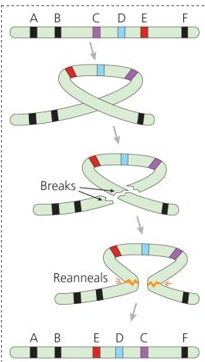
A type of chromosomal mutation and is often the resulted from radiation breaking the 2 double-strand in a chromosome and a chromosome segment can detach, flip, and reanneal in its original location. Affects linkage (tendency for alleles of diff genes to assort together at meiosis) & gene order.
suppresses recombo and maintains combo of alleles across nearby loci and thus affects NS
Genetic Cline
An increase or decrease in the frequency of an allele or genetical variant over geographic distance.
Example: fruit flies had an increase of frequency of a standard chromosome (EST) inversion the closer they got to the North and South pole likely due to similar env changes
Polyploidy
Large scale mutation w/ duplication of entire sets of chromosomes (entire genome)
Human gametes are haploid while zygotes are diploid
But many organisms can be polyploid (i.e. tetraploid 4n)
Often occurs in orgs that can self-fertilize (autopolyploid), and more rarely results when diff species hybridize (allopolyploid)
Usually caused by errors in meiosis resulting in diploid gametes
Why is polyploidy important?
It can result in new species being formed as there is reproduction isolation b/w 2n and 4n individuals
Doubled chromosomes can gain new functions, increasing potential for adaptation
Important source of genetic variation in natural pop - especially plants
Mutations w/ Evolutionary Impact

2 Early Views of How Genetic Variation Exists in Natural Population
The Classical Hypothesis: pop contain very little variation, selection maintains a single best allele at any locus (fixed position of gene and allele on chromosome), and heterozygotes are rare. Heterozygotes occur as a result of rare deleterious mutations that are quickly eliminated by selection.
The Balance Hypothesis: individuals are heterozygous at many loci, and balancing selection maintains lots of genetic variability
Balancing selection — any form of selection that results in the maintenance of genetic variability
Measuring Genetic Variation
The most frequently used measure of genetic variation is the pop heterozygosity, which is the # of heterozygotes / total # of individuals.
To measure the diversity of pop at a locus you need to determine individual’s genotypes. Protein electrophoresis was the first method to do this as homozygotes would only show one band while heterozygotes would have multiple bands.
P.E. studies revealed substantial genetic variation which provided strong support for the balance hypothesis.
The High Genetic Variability Resulted in a New Debate
The Selectionist Hypothesis: Balancing Selection results in the maintenance of high genetic variability (hetero usually have higher fitness)
The Neutral Hypothesis: most alleles in natural pop are neutral, and do not affect fitness
The Hardy-Weinberg Principle
The HW principles show us how allele and genotype freq behave in natural pop if no external forces are acting on them (none of HW principles assumptions are violated) and the pop is mating randomly.
Allows us predict genotype freq from allele freq under these conditions — it is a model of random mating that serves as a start point or null hypothesis in pop genetic studies.
Panmictic Population
A sexually reproducing pop where each male has an equal prob of mating w/ each female, and each female has an equal probability of mating w/ each male.
Panmictic = randomly mating
Ex. Suppose that a pop has the following Genotype freq at a particular locus: AA = 0.26, AB = 0.47, BB = 0.27
Then the probability that any given individual mates w/ an AA is 0.26 and so on.
Assumption: genotype freq are the same among males and females and the pop is infinitely large
Random Mating = Random Union of Gametes
Meiosis: reduction divisions that produce haploid gametes from diploid parent cells to form zygotes. Hence, a randomly mating pop can be thought of as a pool of gametes or a pool of alleles.
Genotype AA individuals produce only A gametes/ alleles. Genotype AB individuals produce equal proportions of A and B gametes/ alleles, etc.
Gametes carrying a specific allele are produced in the same proportion as the frequency of the allele in the pop
Look at doc under Modeling Random Mating: The Probability that 2 Gametes (Alleles) Unite
Assumptions of the HW Principle
No selection
No mutation
No migration
Infinitely large pop (no chance events)
Random mate selection (panmictic)
Pop is diploid
Pop reproduces sexually
The HW principle provides a null model to predict genotype freq from allele freq in the absence of evolutionary forces & non-random mating
If nothing is violated, the allele and genotype freq will not change b/w gen, our expected genotype freq will be equal to observed and the pop is in Hardy-Weinberg Equilibrium.
The HW Principle: Important Points
If a pop is out of HW equilibrium, it will take a SINGLE gen of random mating to restore HW equilibrium.
If there are no violations of its assumptions, the HW principle shows that genotype and allele freq will not change from one gen to the next
The HW Principle as a Null Hypothesis
The HW principle provides a null hypothesis about expected genotype frequencies in natural pop, which we can use to test alternate hypothesis.
Alternate hypothesis can represent a violation of some (but not all) of the HW principles assumptions.
DOC: testing hypothesis about natural pop: the X2 goodness of fit test
The Degree of Freedom
In general, the degrees of freedom is equal to the # of classes of data (# of diff genotypes, denoted K) minus 1, minus the # of parameters estimated from the data. in this case one parameter, the freq of allele A was estimated from the data.
Hence: DF = K - 1 - 1 —> 3 - 1 - 1 = 1
Why don’t we also subtract a parameter for the freq of allele B? Usually, but not always, the DF works out to be the # of genotypic classes minus the # of alleles
Hardy-Weinberg Disequilibrium
When observed genotype freq are not equal to those expected using p2, 2pq, q2, we have HW disequilibrium, also referred to as Hardy-Weinberg deviation.
HW equilibrium will always be a result of a heterozygote deficit or a heterozygote excess. Both evolutionary and non-evolutionary factors can result in HW deviations.
Fewer 2pq than expected = deficit
More 2pq than expected = excess
The violations result in a change in allele freq OR HW diseq OR change in allele freq + HW diseq
Assumptions of the HW principle & HW disequilibrium
Random mate selection (panmictic) *
No mutation
No migration *
Infinitely large population (no chance events)
No selection *
Population is diploid
Population reproduces sexually *
an * indicates an assumption whose violation can result in HW diseq. Not all violations of the HW principle result in HW diseq.
Selection on HW Principle
NS can cause HW diseq at nuclear loci in the form of both heterozygote deficits, as well as heterozygote excesses.
Selection can change allele freq, and result in HW diseq
Selection on Hetero & Homo + example
Fitness of hetero
If 1 allele is recessive and other is dominant, then the fitness of the hetero = fitness of homo
fitness can be b/w that of the 2 homo (codominant)
fitness can also be superior or inferior to that of either homo
Hetero inferiority (underdominance) or superiority (overdominance) can produce interesting outcomes
Example: Drosophila has a single locus w/ 2 alleles
Homo for one allele were viable, the other homo was not
Allowed pop to evolve for 15 gens
Viable allele approached an eq freq of 0.79 rather than 1. This is a result of heterozygote superiority (overdominance) - maintains genetic diversity in the population
Modes of Selection on Quantitative Traits
A quantitative trait is a phenotypic characteristic that varies continuously, as opposed to discretely, and involves multiple loci
Directional Selection: fitness consistently increases (or decreases) w/ the value of a trait
Stabilizing Selection: individuals w/ intermediate values of a trait have highest fitness
Disruptive Selection: individuals w/ extreme values of a trait have the highest fitness

Selection on Quantitative Traits
Directional and stabilizing selection are common, and disruptive selection is thought to be rarer.
Directional and stabilizing selection reduce phenotypic variation in a pop. So, why do natural pop exhibit significant levels of phenotype variation?
Pop are not in evolutionary eq w/ respect to directional or stabilizing selection
In most pop, there is a balance b/w mutation and selection
Disruptive selection may be more common than thought
Mutation & HW Disequilibrium
Mutation will not result in HW diseq in a randomly mating pop, even though it changes allele freq (slightly).
So, not all violations of the assumptions of the HW principle result in HW diseq. However, mutation does change allele freq, and when all of the assumptions of the HW principle are met, allele and genotype freq are stable from gen to gen.
Mutation changes allele frequencies but does not cause HW diseq
Mutation-Selection Balance + Example
Most mutations are deleterious. Selection will remove these mutations from the pop, but mutations will re-introduce them.
At some point the rate at which new copies of a deleterious allele appear through mutation will equal the rate at which selection removes them mutation-selection balance.
This can account for the persistence of deleterious alleles within pop (aka genetic variations)
Example found in DOC
Selective sweep: the rapid fixation of a beneficial allele by selection
Migration
Movement of alleles b/w population. Gene flow. Can be random or non-random.
Caused by anything that moves alleles from one pop to another
Island pop are excellent “laboratories” for examining migration
Migration generally acts to homogenize pop (male allele freq equal) and causes HW diseq
Migration can change allele freq and cause HW diseq
Lake Erie Water Snakes
Ex of migration from mainland to island
Snakes vary in color pattern which is determine by a single locus w/ 2 alleles. Unbanded island snakes have a higher rate of survival than banded immigrants on islands. Selection favors unbanded snakes on the islands.
The island does not possess only unbanded snakes b/c of migration. It prevents the island pop from becoming fixed for the unbanded alleles. It maintains the banded snakes on the Island even though they have lower fitness.
Migration can prevent the divergence of pop & works against selection in this ex
FST
A measure of genetic differentiation among diff populations
FST (the fixation index) is a measure of how much pop differ in allele freq at a locus or quantifies genetic variability among pop. It can be computed for 2+ pop and take on values from 0 to 1.
FST = 0, all pop have identical alle freq
FST = 1, no alleles are shared among pop
Migration reduces the value of FST among pop
Random vs Unrandom evolutionary mechanisms
An evolutionary force or mechanism is anything that can change pop allele freq.
NS is non-random
Mutation is random
Migration can be either random or non-random
Genetic Drift — a purely random and stochastic mechanism of evolution
Genetic Drift
Refers to change fluctuations in allele freq b/c of randomly sampling gametes each gen. Unite to form zygotes.
To conceptualize drift, think of each gen as a random sample of gametes produced by the previous gen. Think of drift as the sampling error spread across gens as it changes allele freq across generation, even if mating is random.
Violates the assumption that there is an infinitely large population w/ no chance events.
Genetic Drift changes allele freq but does not cause HW diseq
Genetic Drift on Alleles
It is most powerful when pop size is small. The larger the pop, the weaker that drift will be as an evolutionary mechanism. It can produce substantial changes in allele freq by causing them to wander over gen, w/ 2 effects
Alleles drift to fixation or loss
The freq of hetero decrease over time
Note: heterozygosity is highest when alleles are equal freq
The Probability of Fixation
The probability that one allele or another will go to fixation depends on where it starts. Ex. A = 0.6 and B = 0.4. The prob that drift will fix A is 0.6 and will fix B is 0.4. 0 = lost and 1 = fixed
Result is that allelic diversity in a pop decreases and pop hetero decrease over time
pop small = stronger genetic drift = faster hetero decline = alleles are fixed
Drosophila Drift Example
8 males + 8 females in a pop, 107 separate pop, pop was established w/ 16 heteros (A/B). Maintained po of 16 flies by picking 8 males + 8 females randomly each gen.
By gen 19, most pop are fixed for one allele or the other. Each allele freq was 0.5 (all individuals were heterozygotes) and at gen 19, the same # of pop are fixed for either allele
Genetic drift causes pop to diverge and increases FST over time.
Other Types of Sampling Error
The Founder Effect: When a new pop (small pop) is founded or established by some colonists, the allele freq in this pop can diff from those in the source or parental pop due to sampling error and chance.
When a pop is founded, its size can remain small for a while, during which drift will be strong - further altering allele freq
Bottleneck: a sharp decline in pop size that can dramatically change allele freq by sampling error
Founder Effects, Bottlenecks, and HW diseq
HW diseq can arise b/c of both bottlenecks and founder effects, w/ either hetero excess or deficits.
However, after the initial founder/bottleneck event, one round of random mating will restore HW eq
So, both can change allele freq and cause HW diseq
Genetic Drift + NS
When a pop is small, genetic drif can be more powerful than NS, and result in the random fixation of deleterious alleles.
Drift is more powerful when pop is small, but selection will be more powerful when pop is large.
Genetic Drit + Migration
Migration (homogenize the pop) is a force that will oppose genetic drift. Drift results in pop divergence (increases FST), but migration acts to homogenize pop (decrease FST).
Takes little migration to counter the effects of drift. Migration can restore lost genetic diversity and counter the negative effects of drift.
NS + Migration
Migration can oppose NS and increase the freq of a deleterious allele in pop. In such cases, an eq can emerge b/w selection and migration, but difficult to derive.
Migration could also work w/ selection and increase the freq of a beneficial allele or be neutral w/ respect to selection.
Non-Random Mating
Non-random mating can indirectly affect evolution but does not change allele freq on its own.
Includes inbreeding, outbreeding, positive assortative mating, and negative assortative mating.
Non-random mating causes HW diseq but does not change allele freq