Quiz 2 - Senior Design/Transitions
 Call Kai
 Learn
 Practice Test
 Spaced Repetition
 Match
 Flashcards
 Knowt Play
1/99

There's no tags or description
Looks like no tags are added yet.
100 Terms
FDA Least Burdenome Approach (LBA)
the minimum amount of info necessary to adequately address a relevant regulatory question or other issue through the most efficient manner
considers type of info, diff. approaches to generating/providing info, and when during total product life cycle info should be generated/provided to the FDA
applies to all products that meet the staturary definition of a device and throughout the total product lifecycle (premarket and postmarket)
eliminates unnecessary burdens that may delay the marketing of beneficial new products
What does the FDA LBA apply to?
applies to all products that meet the staturary definition of a device and throughout the total product lifecycle (premarket and postmarket)
LBA Guiding Principles
industry (anyone submitting) should submit material. including premarket submissions, to FDA that are the least burdensome for the FDA to review
well-organized, clear, and concise info
should not submit unfo unrelated to the regulatory decision to FDA
should reference applicable FDA guidance docs and Standards where FDA recs were considered
right info provided at the right time to address right questions
regulatory approaches should be designed to fit tech, considering its unique innovation cycles, evidence generation needs, and timely patient access
FDA intends to leverage data from other countries and decisions by other national medi device regulatory authorities to the extent appropriate and feasible
FDA intends to apply the least burdensome principles in the international med device harmonization efforts
What does the FDA intend to do regarding the LBA?
FDA intends to leverage data from other countries and decisions by other national medi device regulatory authorities to the extent appropriate and feasible
FDA intends to apply the least burdensome principles in the international med device harmonization efforts
Business Model Canvas

Transitions Project Canvas
a “living document” that should be revisitied and updated regularly; should challenge assumptions based on new data (ethnographic, testing, etc.); use it as a “weekly scoreboard” reflecting your evolving understanding of you rproject topic
focuses you on what the specific project is and what you are doing

Value Proposition
refers to the value an entity promises to deliver to customers should they choose to buy their product
why is you “thing” better than “thing(s)” currently commercially available?
for us - focuses on what value your design project might be able to deliver if it were ultimately sucessful and available for sale
Minimum Viable Prototype (MVP)
prototype with just just enough resolution or features to allow “customers” to provide feedback or as the basis for you to conduct “killer experiments”
can be used to conduct other “quick and dirty” testing of final concept chosen for development
typically not a highly refined or even necessarily functional prototype
ex. sketch, non-functional/fabicated from basic materials (cardboard or foam core board)
Killer Experiments
a means to decide whether you should “kill” the concept or go a different direction
An MVP is typicall not what?
a highly refined or eve necessarily functional prototype
key is to apply concept of what is “minimum but viable” for a given “killer experiment”
might have to be a little bit more refined depending on particular development effort like 3d printed, working circulitry, machined, or includes actual “production” materials
Killer Experiment
some type of “experiment” (quick and dirty, basic eval., informal V&V) you should conduct to quickly determine a particular conceptual solution would not work and should be dropped from further consideration
what evals. could you perform to most quickly kill a potential concept by showing waht you had int mine would not work or is not what the “customer” is asking for
NOT: something that requires a lot of prep. or a formal lab-based experiment
ex. thought experiments, enthographic experiments
Minimum Viable Feature Set (MVFS)
what min prototype performance characteristics would allow you to credibly conclude that you have acheived the most critical clinical need(s) you have identified
what min viable feature set would you need to formulate to support these min performance characteristics
What must all DDF docs be written in?
a professional style → avoid colloquialisms, don’t format response like a HW assignment (i.e say Step 1: determine whether…), assume reader is FDA, avoid hyoerlinks (write links out), and consider an appendix when appropriate
More Comments about DDF Documents
do not add extraneous info
follow his instructions not what scapre from online or previous DDF from class
do not ruminate, be “wishy washy”, ask rhetorical questions, or educate teh reader
choose a format think is appropriate and most professionally communicates info
Any Product Development Process
identifiy unmet need, figure out customer(s), and ger thier input (user needs)
based on user needs understanding/enthographic data, formulate a set of performance specifications that your product must meet
develop a prototype and conduct preliminary testing to determine whether prototype meets performance specifications *freeze design)
transfer frozen design to manufactoring
create production equivalent product to conduct final formal testing
Product Development Process but for Transitions
identify unmet need (enthography)
figure out customer(s) and get their input (enthography, use cases, user needs)
formulate a set of risk-based design input specifications that your product must meet and hazards/risks you must minimize (hazard and risk analysis, product design specification (PDS))
develop a prototype using some design process then freeze design (dimensioned and tolerances drawings, CAD models)
evalulate whether the frozen engineering protoype meets the performance specifications (verification)
evaluate whether the frozen engineering prototype meets the customers expectations (validation)
Design Input and Design Output Alignment
when design output objectively satisfies deisgn input (i.e. prototype meets the quantitative performance specifications) then:
design can be frozen
detailed design docs can be creeated (finalized CAD models, dimensioned/toleranced drawings)
frozen design can be “transferred to manufcatoring”
after “manufactoring engineering effort” formal verification and validation conducted on “production equivalents
What underpins the FDA medical product “design process”?
common sense
US law implemented in FDA’s Quality Management System Regulation (21 CFR 820)
international standards (ISO 13485)
requirements for a “quality system” (hopefully satisfies FDA regulation and international standards)
Regulatory Requirements for Medical Product Development
US: 21 CFR 820 - FDA Quality Management System Regulation and CFR
Europe, Canada, etc.: EU Medical device regulation (EU MDR) and country-specific regulations
Code of Federal Regulations (CFR)
an FDA regulation contained in the Code of Federal Regulations, Title 21 (21 CFR)
Title 21 (21 CFR)
part of this FDA regulation that focus on the medical device manufacturers are Parts 800-1299
ex. 21 CFR Part 820 - the Quality System Regulation (QSR/QMSR) regulates Design Controls and Production and Process Controls (were the FDA controls)
FDA’s Design Controls
provided a “framework” for medical device engineers to follow and, crucially, deocument that process as it happens
goals was to ensure med. device you’re developing is safe and effective
inent was to make your device “safe” based on design choice you make
helped you to prove that your med device meets the requirements you define, meets the user needs, and product’s intended use you formulate, and in the future can be manufactored to meet all specifications you have defined
simple what good engineers already do intuitively
What was the goal of the FDA’s design controls?
was to ensure med. device you’re developing is safe and effective
What was the intent of the FDA’s design controls?
was to make your device “safe” based on design choice you make
What do the FDA’s design controls help you prove?
hat your med device meets the requirements you define, meets the user needs, and product’s intended use you formulate, and in the future can be manufactored to meet all specifications you have defined
Engineers Intuitive - FDA Design Controls
start w/ problem → conduct enthography to determine users’ needs, and working forward from there
Where the FDA design controls “fit”?

What did the design controls focus on?
the design and testing pahses of new medical peoduct design and hance is the section of the QSR/QMSR most applicable to transitions
What is considered the Bible?
http://www.ecfr.gov
Medical device regulations are complex but design controls are what?
the most complex process in any quality system
FDA’s Quality Management System Regulation (QMSR)
the legal tool used by the FDA to force manufacturers to design devices that are safe and effective
prospectively figure out what will/could go wrong so design it to be safe and effective
What do the design controls force medical produce designers to do?
to identify and systematically mitigate/reduce risks through thoughtful design decisions

any medical product “design process” (that you define) is implemented via a “quality system” (that you define) to satisfy FDA regulation (according to your “best interpretation” at the time)
Quality System
a collection of documented procedures and processes focused on consistent design and fabrication of safe and effective medical products
policies/procedures work together to demonstrate compliance w/ tboth customer requirements as well as the applicable regulatory requirements
unless it is “written down”, it did not happen
How did you create a “quality system” - approproate for you specific product - that hopefully complies with FDA regulation?

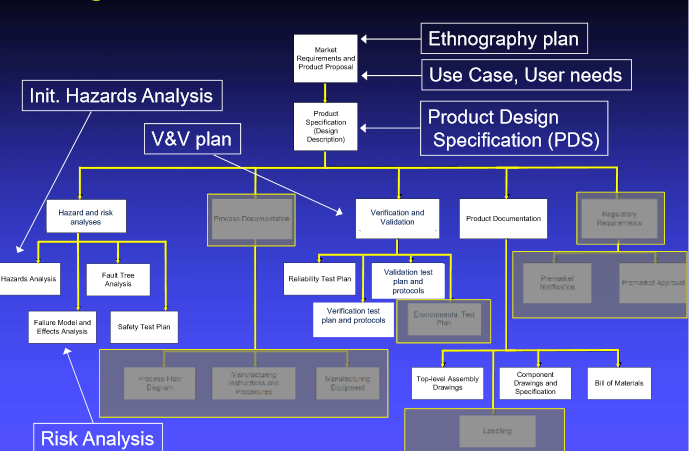
Design Controls “subset”
FDA Guidance Document
represents the FDA’s “current thinking” on a spectrum of topics
first thing you should do when faced w/ a new challenge in life sciences
these are free unlike standards or standard guidance docs
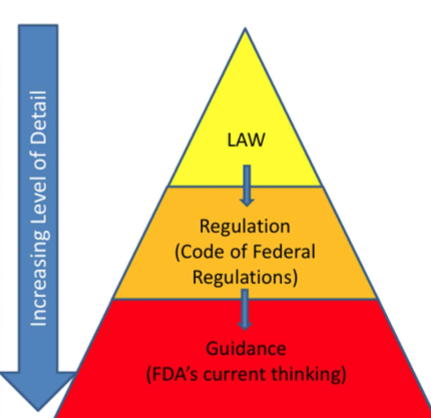
Guidance Documents Again
provide additional interpretation of regulation related to the design, production, labeling, promotion, manufactoring, and testing or regulated products
may also relate processing, content, and evaluation or approval of submissions as weel as to inspection and enforcement policies
are not regulations and alternative approaches may be chosen to comply with laws/regulations
What may guidance docs relate?
processing, content, and evaluation or approval of submissions as weel as to inspection and enforcement policies
Guidance docs are not what?
are not regulations and alternative approaches may be chosen to comply with laws/regulations
User Needs
formulated/refined based on ethnographic data and use cases
Use Case
a description of how a person/people that use your product to accomplish (or will accomplish) a goal (at least 3 elements: user/actor, goal, and description)
likely diff. per archetype
composed of a series of steps that describe how an archetype achieves a goal using the product
may also help you identify performance requirements and where hazards or errors could occur
What may use cases help you identify?
the performance requirements and where hazards or errors could occur
Use Case - User/Actor
can be a single person or a group (same archetype typically)
person “acting” or performing the action
Use Case - Goal
the desired user outcome → what the user/actor wants to accomplish
Use Case - Description
description of how the device/system is used to complete a specific goal (how it is currently used or will be used to achieve a specific outcome)
How are use cases broken down?
into single instances of use (“scene”) representing each meaningful step in the overall use of your product
combine several scenes = scenario
Scenario - Use Cases
ssometimes presented illustratively using a storyboard
Use Case - Important Perspective
retrospective - designed based on current practice is designing/redesigning a product that will be used in the same/similar way
prospective - if desiging a new product that will change current use or perhaps create a new usage
User Needs
typically, after created use cases, move onto defining qualitative these
a product’s performance specifications should be based on these and not on technological capabilities (or unsubstantiated beliefs held by the engineering design team)
essentially what the customer wants not what you can provide
User Needs DDF Document
based on results from ethnography efforts and use cases
must be continously revised as new info is obtained through project effort
attempts to establish key user needs at a high level (i.e. qualitatively)
user needs should be considered in formulation of MVFS
User Needs DDF Doc for a Med Product - What to Include
an intro to unmet clinical need, product, and profile of the user(s)
intended use statement
indication(s) for use statement(s)
a (bulleted) list of qualitative user needs
(statements should be harmonized w/ other DDF docs and non-DDF docs)
FDA Design Controls Summary
was part of US law implemented within FDA’s Quality System Regulation (21 CFR 820.30)
provided a “framework” for med device engineers to follow and document that process as it happens
framework now comes from section 7.3 of ISO 13485::2016
EU Medicaal Devices Directive (EU MDD) - Timeline
until 2021 - med devices in European market regulated by MDD
first introduced in 1992, purpose was to align laws relating to the production of med devices in the (new) EU
under this, each country within the EU was responsible for devising its own laws to implement the guidance contained to the directive
What did the EU MDD include?
Essential Requirements
Essential Requirements
manufacturers and importers must meet to legally market or sell their devices in the EU
What did the specific requirements of depend on bc of the many types of devices covered by the MDD?
depended on the classification and intended use of the evice as weel as the regulation of the countries it was being marketed
EU Notified Body
in most case the use of this was required to access compliance with the EU MDD before a CE mark could be applied by the manufacturer to the product
approves the company not the product
EU MDD - Issues
inconsistencies/loopholes resulting from country-to-country implementation approach contributed to unsafe products entering the the market and causing patient harm
in reaction to aboved, EU MDR was created
EU Medical Device Regulation (EU MDR)
the latest regulation (2017)
supersedes MDD
a binding legislative act unlike the prior EU MDD which was up to interpretation and individual implementation of EU member states
manufacturers legally muct comply with this to market their products in the EU
EU MDD → EU MDR Transition Time
existing, approved med devices had a transition time of 4 years (COVID elongated this) to meet new MDR requirements (“reapproved”) to show compliance with new, more stringent, regulation
EU MDR - Elements
parts that represent “EU analogue” to FDA’s QMSR
ex. Annex I (appendix 1) - a series of General Safety and Performance Requirements (GSPR’s) that the product designers must address
EU MDR - Annex I (General Requirements)
elininate or reduce risks as much as possible (via design-based designs)
elminate or redice risks related to user error
ensure users are informed about any residual risks
all known/foreseeable risks shall be acceptable when weighed against the evaluated benefits to the patient and/or user (benefit-risk analysis)
MDD vs MDR Picture

EU MDR Medical Device Categories
non-invasive
invasive
“active” - something that puts energy into the patient (pacemaker)
special rule-based devices (ex. combined products)
Classifications of Devices (EU)
Class I - devi ces w/ lowest perceived risk
Class IIa - medium-risk devices
Class IIb - medium- to high-risk devices
Class III - high-risk devices
greater th risk = higher the classification = more intense evaluation by regulatory authorities
Where do the classifiications of devices for the EU come from?
understanding the intended use, indications for us, technological characteristics, and risks to the patient, clinician, etc.
not very diff. from US - key diff. between US and EU is how med products are approved or cleared for sales and marketing
Market “Clearance/Approval” - US vs EU
US - FDA (only FDA) clears/approves individual product
EU - a third party, for-profit company (Notified Body) evaluates and approves a manufacturer’s Quality System Management System and deisgn documentation (manufacturer gets approved) → once approved, can put “CE Mark” on any similar product they predice (mark required for sale in the EU)
Notified Body - Definition
a non-gov for-profit organization that has been empowered by an EU member country to assess the conformity of a manufactorer’s processes to th applicable current regulatory requirements
uses same Standards docs to assess conformity to regulatory requirements
standards = basis of QMS then
Demonstrating Conformity to Regulation
manufacturers must demonstrate their med device meets requirements of current EU regulatory requirements by carrying out confirmity assessment
route depends on classification
Confirmity Assessment
carry out this to show that manufacturers must demonstrate their med device meets requirements of current EU regulatory requirements
Steos Required to Market a Medical Product in the EU
classification based on intended use, risk, etc. (including ensuring product is a med device)
choose confirmity assessment route (our version of regulatory pathways)
compile risk-based technical documentation file (i.e. DDF) created by leveraging appropriate Standards
obtain manufacturer certification from a Notified Bod of your choice
declare “confirmity” of the product with the EU MDR requirements, place CE mark on the product, and start marketing/selling
CE Mark
required for distribution and sale in the EU
demonstartes that the product complies with set consensus Standards (e.g., ISO 13485)
Design Dossier
a synonym for a design and development file (DDF)
Confirmity Assessment Definition
can include inspection and examination of a product, its design, and the manufacturing environment and processes associated with it
Declaration of Confirmity
allows the manufacturer to label the product with the CE Mark
Notified Body Slide Definition
may desgnate that a med device conforms to regulation including ther general safety and performance requirements, for med devices
Where to access “free” ISO Standards?
ANSI Incorporated by Reference (IBR)
ISO 13485:2016
Medical devices - Quality management systems - Requirements for regulatpry purposes
Standard that sets out the requirements for a quality managment system specific to the medical product industry
similar to FDA’s QMSR
adherence is technically voluntary
Old vs New FDA QSR Design Controls PIcture

ICH Q9
provides a globally recognized framework for managing risks that could compromise the quality of pharmaceutical products
guideline to guide systematic risk assessment and mitigation to ensure that every step of the manufactoring process is safe and robust
What must youdo first before formulating a quantitative design specification?
conduct risk analyses which begins with hazard idenitificatuib
“Previous” FDA Design Controls - Hazards and Risk Analysis
“previous” 21 CFR 820.30 - Design Controls → 21 CFR 820.30(g) - Design validation
Design Validation
shall include software validation and hazard [and risk] analysis where appropriate
Shall vs Should
shall/must - info considered directive in nature and described in these terms indicate mandatory actions
should/may - guidance info described in these terms indicate desirable but not mandatory actions
ISO 14971
a Standard for the application of risk management to the development of med devices
includes a process for risk management throughout the product life cycle
a “recognized consensus Standard” in the FDA QMSR
Hazard - ISO 14971
potential source of harm
Hazardous Situation - ISO 14971
cirumstances that cause people to be exposed to one or more hazards
Foreseeable Sequence of Events - ISO 14971
these lead to hazardous situations
Harm - ISO 14971
injury or damage to the health of people
Hazard Analysis
must occur before risk analysis
recognize each product type has a unique sets of haxards associated with its use
hazards must be thoughtfully analyzed since they form the basis for all future risk analyses and product design specifications
poor initial this can haunt you
Hazards must be what?
thoughtfully analyzed since they form the basis for all future risk analyses and product design specifications
Initial Hazard Analysis (IHA)
key design and development file (DDF) focusing on hazard identification and evaluation
What should the IHA document list one-by-one?
the hazard
the hazardous situation
the forseeable sequence of events
the harm(s)
severity
process is performed and documented step-by-step for each hazard
the word “risk” should not appear in this
Severity - IHA Document
should just be a basic, qualitative assignment of the severity of the harm is if the hazard occurs (and should reference some “scale” you have defined (e.g., high, medium, or low))
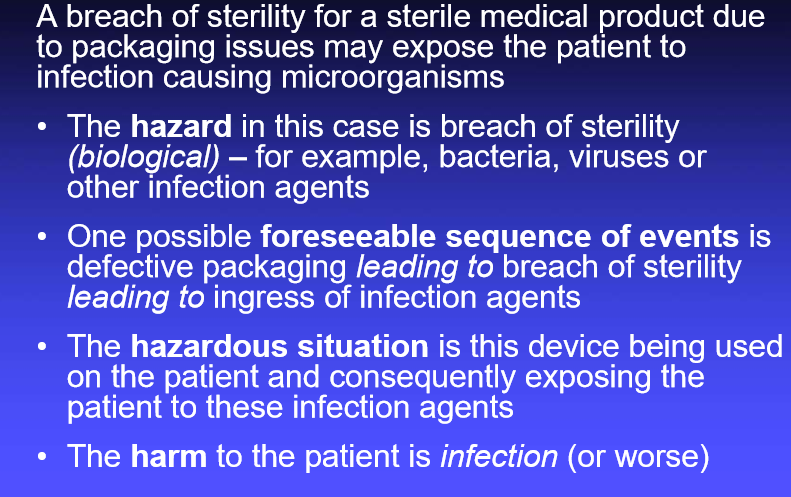
IHA Document Example
Sources of Hazards
clincial experience (patients included)
company experience (legacy knowledge)
archival literature search
recall history (public domain at FDA website → big clude to what the hazards are)
total product life cycle (TPLC) link in the product classification database
our enthograpy efforts (i.e., the date we have generated by conducting the activities on the plans)

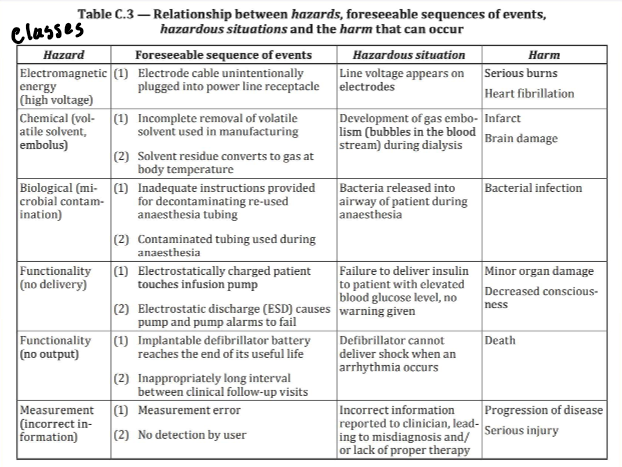
Some Hazard Examples Picture


Mapping Hazards to ISO 14971:2019
this updated version provids a series of high-level hazards in “Annex C” (i.e., Appendix C)

3 Main Types of Hazards
performance-related, energy-related, and biological/chemical-related hazards