elements compounds mixtures
 Call Kai
 Learn
Learn Practice Test
 Spaced Repetition
 Match
Match Flashcards
 Knowt Play
1/12

There's no tags or description
Looks like no tags are added yet.
Name | Mastery | Learn | Test | Matching | Spaced | Call with Kai | Chat |
|---|
No analytics yet
Send a link to your students to track their progress
13 Terms
what is an element
a substance made of only one type of atom, made of the same number of protons, and cannot be split into anything simpler e.g. magnesium
what is a compound
a pure substance made of 2 or more elements chemically bonded
cannot be separated by physical means
e.g. co2
what is a mixture
a combination of 2 or more substances (elements and/or compounds) that are not chemically bonded together
can be separated by physical methods e.g. filtration
e.g. sand and water
a mixture is an impure substance
e.g. water is pure, boils at 100 C sharp
however, mixtures boil / melt gradually over a range of temperatures

filtration
used to separate an insoluble solid from a mixture of a liquid and solid
can filter out solid impurities from mixture
• put filter paper in funnel above beaker
• pour in mixture
• filter paper will allow small liquid particles through as FILTRATE
• solid particles are too large to pass through the filter paper, remain in paper as RESIDUE
csrystallisation
used to separate dissolved, soluble solid from liquid e.g. salt and water
• pour solution into evaporating dish, gently heat using bunsen burner
• some water will evaporate and solution will become more concentrated and saturated
• once some water has evaporated or crystals start to form, remove dish from heat and leave to cool
• the salt will form crystals as it becomes insoluble in the cold, highly concentrated solution
• filter crystals out of solution, leave in a warm place to dry e.g. warm oven or dessicator
separate rock salt
use filtration and evaporation
rock salt = sand + salt
1. grind rock salt using pestle and mortar
2. dissolve in a beaker and stir
3. filter mixture through filter paper in a funnel
4. crystallise the solution
5. the sand is insoluble, so it will remain in the filter paper as residue
6. the salt is dissolved in the solution so it will form crystals in the evaporating dish when the solution is crystallised
chromatography
used to separate mixture with substances with different solubilities e.g. dyes in a black ink
1. draw baseline at bottom of filter paper sheet., with pencil as insoluble, won't dissolve in solvent
2. add spots of different inks to baseline in regular intervals
3. loosely roll up sheet, put in beaker of solvent e.g. water
4. make sure solvent level is below baseline so inks do not dissolve into solvent
5. place lid on top of beaker so solvent doesn't evaporate
6. solvent seeps up paper, carrying inks with it
7. diff inks have diff solubilities, more soluble = travel further up paper
8. when solvent nearly at top of paper, take out beaker, leave to dry
9. end result = chromatogram
how chromatography separates mixtures
• works because different dyes move up the paper at different rates
• some will stick to paper and some will dissolve more readily in the solvent, moving up the paper more quickly
interpret chromatograms
• Pure substances will produce only one spot on the chromatogram
Impure substances will produce more than one spot on the chromatogram
• If two or more substances are the same, they will produce identical chromatograms
• If the substance is a mixture, it will separate on the paper to show all the different components as separate spots
rf value
chromatography carried out to see if substance is present in mixture
run pure sample of substance along mixture itself. if it has same rf value as one of the spots, likely to be same.
• measure from baseline to centre of spot
• distance travelled by solute / distance travelled by solvent
simple distillation
• used to separate liquid from solution
• gently heat solution in flask, part of solution with lowest boiling point is evaporated first
• the vapour is then cooled, condensed and collected
• the rest of the solution remains in the flask
• problem: can only be used to separate liquids with very different boiling points

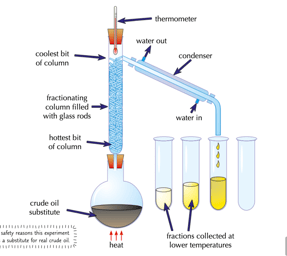
fractional distillation
used to separate 2 or more liquids with different boiling points
• heat solution in flask with fractionating column on top, to boiling point of substance with lowest boiling point
• liquid with lowest boiling point evaporates first. it will evaporate and rise to the top of the column and the vapour will pass through a condenser, where it is cooled, condensed and then collected in a beaker
• liquids with higher boiling points may start to evaporate but the glass column is cooler towards the top so they will only get part of the way up before condensing and running back down to the flask
• when first liquid been collected, raise the temp until next one reaches the top