L60 - Outbreak Investigations and Mechanisms of Disease Transmission
 Call Kai
 Learn
 Practice Test
 Spaced Repetition
 Match
 Flashcards
 Knowt Play
1/48

There's no tags or description
Looks like no tags are added yet.
49 Terms
Why are Communities Important in Outbreak Investigations?
Disease develops through connections among people, animals, plants, and their environment
What are the Seven Basic Questions of an Outbreak Investigation?
Who
What
When
Where
Why
How
What do we do now?
What is an Outbreak?
Disease cases or health events clearly exceeding normal expectations for a population, time, and place
Synonymously with “epidemic”
How does the Outbreak Threshold vary by Disease?
One Ebola case may trigger an investigation → common diseases may require a larger increase above baseline
What caused the Mass Die-Offs of Saiga Antelope?
Hemorrhagic septicemia associated with Pasteurella multocida type B
Which Environmental Factors were associated with Saiga Die-Offs?
High temperature and high humidity
Why was identifying the Bacterium Insufficient to explain Saiga Outbreaks?
Investigators also needed to explain why mass mortality occurred under particular environmental conditions
What is the Main Goal of Early Outbreak Detection?
Shorten the time between detection and intervention to reduce cases and deaths

What is the Difference Between Patient Zero and the Index Case?
Patient zero is the first infected individual
Index case is the first recognized case
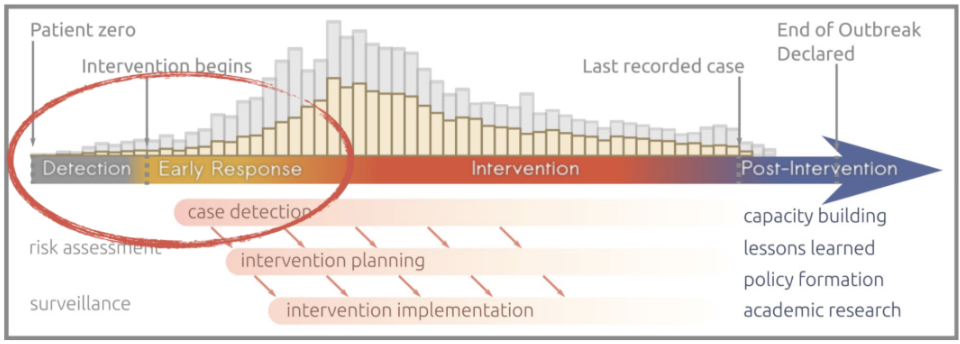
Why is the Left Side of the Epidemic Curve Important?
It represents early detection and response, when interventions may prevent extensive transmission
What are Three Examples of Outbreak Interventions?
Treatment
Vaccination
Restrictions on animal movement
What is the Primary Outbreak Focus of USDA APHIS?
Rapid animal disease control and mitigation of local, national, and international economic impacts
Why are Economic Impacts Important in Veterinary Outbreak Responses?
Outbreaks can disrupt livestock movement, agricultural production, business continuity, and trade
What are the Major CDFA Outbreak Response Activities?
Detection, quarantine, surveillance, epidemiological investigation, control, eradication, and recovery
What is the Primary Focus of WHO Outbreak Responses?
Human public health through coordinated surveillance, investigation, case management, and prevention
Which Additional Components are Important in WHO Outbreak Responses?
Health education, social mobilization, media, logistics, security, coordination, and vector control
How do Veterinary and Public Health Outbreak Priorities differ?
Veterinary responses emphasize animal health and agricultural impacts
Public health emphasizes human health
What is the Epidemiological Triad?
The interaction of agent, host, and environment in disease occurrence

What is the One Health Approach to Outbreak Investigations?
An integrated approach considering human, animal, and environmental health

Why is Multidisciplinary Collaboration Important in Outbreak Responses?
Different specialists contribute complementary expertise needed for investigation, control, and communication
Direct contact with infectious bodily fluids from infected individuals
What is Zoonotic Spillover?
Transmission of a pathogen from an animal source into humans
How did Human Movement contribute to the West African Ebola Outbreak?
Movement across communities and national borders allowed the virus to spread widely
It caused 28,652 cases and 11,325 deaths, severely disrupting health systems and economies
What did Genomic Epidemiology reveal about the West African Ebola Outbreak?
How can Pathogen Sequencing support Outbreak Investigations?
It helps identify:
Related cases
Possible transmission chains
Geographic spread
Which Leadership Roles did Veterinarians hold during the Ebola Response?
Epidemiology and laboratory task force leads
Scientific officers
Field laboratory leads
Response leaders
Why are Veterinarians Valuable in International Outbreak Responses?
Their training in infectious diseases, diagnostics, epidemiology, and population health supports investigations
What were Major Challenges during the Sierra Leone Ebola Response?
Limited resources
Poor communication
Uncertain case locations
Shortages of supplies and personnel
What are Three Key Tools for Organizing Outbreak Data?
Line lists
Geographic maps
Contact or exposure tracing diagrams
What is Contact Tracing?
Identifying and investigating contacts or exposure connections among cases

What is the Purpose of a Contact Tracing Diagram?
To visualize possible links and transmission relationships between individuals or herds
Which Patterns should Investigators seek in Contact Tracing?
Shared contacts
Exposures
Locations
Species
Timing of disease
What is a Line List?
A table organizing information about individual cases or herds, usually one case per row

Which Information belongs in an Outbreak Line List?
Case ID
Species
Age
Onset date
Clinical signs
Location
Test results
Possible exposures
Why are Line Lists Useful in Outbreak Investigations?
They organize large amounts of case data and help reveal patterns before formal analysis
How are Geographic Maps Useful in Outbreak Investigations?
They reveal spatial clustering, possible exposure locations, and geographic spread

How do Line Lists, Maps, and Contact Tracing differ?
Line lists organize case details
Maps show locations
Contact tracing shows connections
School and business closures, food shortages, quarantine, healthcare disruption, and economic instability
Limited PPE, unfamiliar disease presentations, and inadequate resources increased occupational exposure
Fear of dogs as possible sources of infection contributed to abandonment and increased stray populations
What is the Veterinary Role in Outbreak Risk Communication?
Provide accurate scientific information to prevent misinformation and unnecessary harm to animals
How can Veterinarians help prevent Outbreaks Before They Occur?
Vaccination research
Surveillance
Management changes
Preventive education
What are the Major Roles of Veterinarians in Population Health?
Lead investigations
Study zoonotic threats
Develop interventions
Communicate with stakeholders
Outbreak Investigation Basics SUMMARY
Question | What Investigators Need to Determine |
Who? | Which individuals, species, or populations are affected? |
What? | What disease or health event is occurring? |
When? | When did cases begin and occur? |
Where? | Where are the cases geographically located? |
Why? | What risk factors or conditions contributed to the outbreak? |
How? | How is the disease transmitted or spreading? |
Now what? | What interventions are needed to control the outbreak? |
Key concept: Outbreak investigations identify disease patterns, sources, transmission pathways, and appropriate interventions.
Outbreak Response Organizations SUMMARY
Organization | Primary Focus | Main Priorities |
USDA APHIS | National animal health | Rapid disease control, limiting economic losses, protecting agricultural trade |
CDFA | California animal health | Disease detection, quarantine, surveillance, eradication, recovery |
WHO | Human and international public health | Epidemiological investigation, case management, health education, logistics, coordination |
One Health Teams | Human, animal, and environmental health | Multidisciplinary investigation, zoonotic disease control, prevention |
Remember:
USDA and CDFA emphasize animal disease management
WHO emphasizes human health
One Health integrates all three health sectors
Veterinary vs. Public Health vs. One Health Responses SUMMARY
Category | Veterinary | Public Health | One Health |
Primary Focus | Animal populations | Human populations | Humans, animals, environment |
Major Concern | Animal disease, welfare, economic losses | Human illness, transmission, community safety | Interconnected disease risks |
Investigation | Herd surveillance, animal diagnostics, movement tracing | Human case surveillance, contact tracing | Integrated animal-human-environmental surveillance |
Interventions | Vaccination, quarantine, animal management | Vaccination, education, infection control | Coordinated interventions across sectors |
Example | Saiga antelope die-offs | West African Ebola response | Rift Valley fever control |
Key distinction: Veterinary and public health responses have different primary populations, while One Health combines their perspectives to address shared disease risks.
Epidemiological Data Organization Tools SUMMARY
Tool | Purpose | Information Collected | Example |
Line List | Organizes individual case data | Species, age, clinical signs, onset, location, exposures | Comparing cattle with similar symptoms |
Geographic Map | Identifies spatial disease patterns | Case locations, geographic clusters | Mapping affected farms |
Contact Tracing Diagram | Identifies connections between cases | Contacts, exposure relationships, possible transmission links | Tracing animal movement between farms |
How to Differentiate the Three Tools
Line list = WHO and WHAT: Who is sick, and what characteristics do cases share?
Map = WHERE: Where are cases occurring?
Contact tracing = HOW: How might cases be connected?
All three tools can also help analyze when cases occurred and identify possible disease sources.
Veterinary Contributions to Outbreak Investigations SUMMARY
Veterinary Role | Contribution | Example From Lecture |
Disease Surveillance | Detect unusual disease patterns early | Rift Valley fever monitoring |
Epidemiological Investigation | Identify sources, risk factors, and transmission pathways | Saiga antelope outbreaks |
Laboratory Diagnostics | Identify causative pathogens | Ebola laboratory task force |
Outbreak Leadership | Coordinate epidemiological and field response teams | Veterinarians leading Ebola response teams |
Disease Prevention | Develop vaccines and other interventions | Rift Valley fever vaccination research |
Risk Communication | Educate communities and reduce misinformation | Addressing fears about dogs during Ebola |
One Health Collaboration | Integrate animal, human, and environmental perspectives | Rift Valley fever prevention |
Key concept: Veterinarians are not limited to treating individual animals. They can lead outbreak investigations, coordinate responses, conduct research, and develop population-level interventions.