4.7 Aldehydes and Ketones
 Call Kai
 Learn
 Practice Test
 Spaced Repetition
 Match
 Flashcards
 Knowt Play
1/36

There's no tags or description
Looks like no tags are added yet.
37 Terms
C=O
Carbonyl group
General formula for ald + ket
CnH2nO
Func group
Aldehyde- CHO, ketone CO


Double C bond
Enals- ald , enones- ket
Double O
ane 2,4-dione
E.g pentane-2,4-Dione
Double OH
diol e.g propane-1,2-diol
OH in ald
hydroxyl
Melting point
High, van der waals forces, permeant dipole dipole forces between polar C=o groups on neighbouring molecules lots of energy to break.
Short chain aldehydes/ketones liquids, melting points increase as carbon chain increases in length. due to increased strength of van der Waals forces between neighbouring chains.
Solubility
Short chain ald/ket miscible with water soluble. hydrogen bonds formed between polar C=O group and water molecules compensates for energy needed to break the hydrogen bonds between water molecules
Larger ald/ket less soluble in water, dissolve more readily in non-polar solvents eg. hexane. due to increasing length of non-polar carbon chain which cannot formhydrogen bonds to water molecules.
Aldehyde + water

Aldehydes formation
Oxidation of primary alcohol.
CH3CH2OH + [O] → CH3CHO + H2O ethanal (distillation)
CH3CHO + [O] → CH3COOH ethanoic acid (reflux)
Ketones formation
Oxidation of secondary Alchohols
CH3CH(OH)CH3 + [O] → CH3COCH3 +H2O
propan-2-ol → propanone
How test between ald/ket
gently warm mixture in water bath
Acidified potassium dichromate(VI) solution
Orange to green
Cr2O7 2- + 14H+ + 6e- → 2Cr3- + 7H20

Tollens' reagent
silver nitrate dissolved in ammonia solution. colourless to a silver mirror
Ag+ + e- → Ag
Fehling's solution
mixture of copper sulfate, sodium tartrate, sodium hydroxide in solution. blue solution changes to a red precipitate
2Cu2+ + 2OH- +2e- → Cu2O + H2O
(Cu2+ + e- → Cu+)
Aldehyde + ammoniacal silver nitrate
CH3CHO → Ethanoic acid

Oxidation of aldehyde
→ COOH

nucleophile Def
an ion or molecule with a lone pair of electrons that attacks regions of low electron density
Hydrogen cyanide formation
Hydrogen cyanide toxic gas, made situ from sodium/potassium cyanide and sulfuric acid KCN + H2SO4 → HCN + KHSO4
Hcn undergo Heterolytic fission to form, cyanide ion ( nucleophile)
HCN → CN- + H+
HCN + ald+/ket → cyanohydrin
CH3CHO + HCN → CH3CH(OH)CN
Ethanal + HCN → 2-hydroxypropanenitrile (ethanal cyanohydrin)
Propanone + HCN → 2-hydroxy-2-methylpropanetrile (propanone cyanohydrin)
Nucleophilic addition reaction

Addition reaction:
One in which a pi bind of a double covalent bind is broken and species are added across the bind
Ketone Nucleophilic addition HCN mechanism

Ethanal HCN mechanism

Nitrile Optically inactive
Racemic mixture formed of two optical isomers, carbonyl group flat so cyanide nucleophile attacks carbon atom at top or bottom, no preference for side so 50:50
Ketone- no chiral centre

Reduction of ald/ket agent
Reducing agent - lithium tetrahydridoaluminate(III) , LiAlH4. lithal dissolve led in dry ether (explosive on contact with water_
Aldehyde + [H] → 1o alchohol
CH3CHO + 2[H] → CH3CH2OH
ethanal → ethanol
Ketone + [H] → 2o Alchohol
CH3COCH2CH3 + 2[H] → CH3CH(OH)CH2CH3
butanone → butan-2-ol
Nucleophilic addition
Identify substance
Melting point test, IR, mass spec
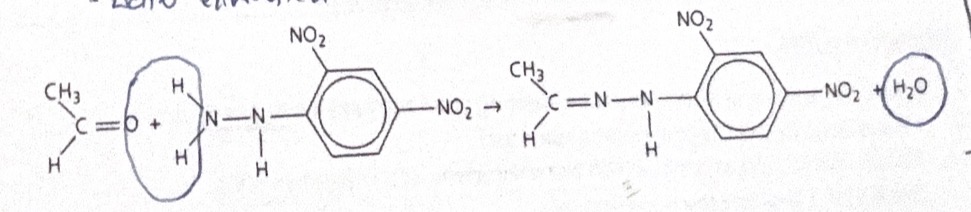
2,4-dinitrophenylhydrazine (2,4-DNP(H) / Brady's reagent) derivative
2,4-dinitrophenylydrazone all orange solids e.g propanone-2,4-dinitrophenylhydrazone High melting point due to large no, of electrons (strong van der waals forces) and NO2 groups (perm dipole-dipole_
2,4 DNP condensation reaction
Nucleophilic attack of carbonyl carbon by nitrogen lone pair, water eliminated

Preparation of 2,4-DNP
Place 5 cm3 of 2,4-dinitrophenylhydrazine solution in a suitable container. (Conical flask)
• Add some drops of test liquid e.& propanal or test solid dissolved in ethanol. put in
If crystals do not form add some dilute sulfuric acid and warm the mixture.
• Cool the mixture in iced water.
• Filter off the orange crystals using suction filtration

Impure solid melting point
lower temperature, and over a range of temperatures.
Recrystallisation
Dissolve impure crystals in minimum volume of hot solvent. Filter when hot by gravity filtration, using a hot funnel, or fluted filter paper, to remove insoluble impurities.
Allow filtrate to cool and crystallise.
Filter off crystals using suction filtration
Dry by sucking air over crystals in Buchner funnel and then in a low temperature oven/desiccator.
Recrystallisation purpose
Remove both soluble and insoluble Impurities dissolved in minimum amount of hot solvent and then filtered. Removes as remain in filter solvent chosen for recrystallisation which 2,4-DNP derivative soluble at high temperatures but insoluble at low temperatures.
Melting Point Test:
Place some solid in a capillary tube/melting point tube sealed at one end
• Heat slowly (using melting point apparatus)
Record temperature at which solid starts and finishes melting
Repeat and average the temperatures.
• Compare temperature(s) with known values in a data book