Stroke Recovery
 Call Kai
 Learn
Learn Practice Test
 Spaced Repetition
 Match
Match Flashcards
 Knowt Play
1/27

There's no tags or description
Looks like no tags are added yet.
Name | Mastery | Learn | Test | Matching | Spaced | Call with Kai | Chat |
|---|
No analytics yet
Send a link to your students to track their progress
28 Terms
What is the difference between stroke recovery and compensation?
Recovery: the restoration of lost functional and progressing towards a normal movement strategy. Will demonstrate improved selective motor control.
Compensation: An alternative strategy is used to accomplish a task which is sometimes necessary and appropriate but doesn’t represent neurologic recovery.
What are the 10 principles of neuroplasticity?
1.Use it or Lose it
2.Use it and improve it
3.Specificity
4.Repetition Matters
5.Intensity Matters
6.Time matters
7.Salience matters
8.Age matters
9. Interference
10.Transference

What does the stroke recovery timeline look like?
Acute Stage: 0-3 months - rapid, spontaneous recovery with intense rehab
Subacute Stage:3-6 months - continued improvement and therapy adjustment
Chronic Stage: 6 months - neuroplasticity driven recovery + secondary prevention, multidisciplinary approach

What is the focus at each stage of the timeline for stroke patients?
Acute Care: Medical stability + prevention + early mobility + initiation of recovery
Sub-acute Care: Building capacity, recovery + task specific practice + intensity + functional independence
Chronic Care: Recovery + fitness + participation
What are the acute care considerations for a stroke patient?
Short LOS - placement recommendations, education, setting the table, know resources (average of 5 days)
Focus on early mobilization after the first 24 hours following a stroke in accordance with hemodynamic stability and safety criteria. Duration should be 1-45 mins divided into 1-3 times a day. Focusing on sitting, standing, and walking activities.
What are some acute care considerations and goals for a stroke patient?

What are interventions to focus on during the acute care phase of stroke rehab?
-Bed mobility
-Sitting balance
-Transfers
-Standing
-Early gait
-Supported stepping
-Active movement
-Positioning
-Patient/family education
What are the sub-acute care considerations for a stroke?
Pt will be transitioned into inpatient rehab if they can tolerate 6 days a week for a minimum of 3 hours of active rehab per day.
Pt will be transitioned into transitional care unit (long term rehab) if they cannot participate for a less intense sessions of 60-90 mins for 5 days a week.
A shorter onset-to admission interval within the first 20 days has shown to significantly improve functional outcomes.
What mobility and gait related interventions should be performed in sub-acute rehab?
-Task specific gait training
-High-intensity gait training
-Treadmill training
-Overground training
-Body-weight training
-Aerobic conditioning
-Walking variability
-Community mobility
-Stair training
What balance related interventions should be performed in sub-acute rehab?
Static —> Dynamic —> Reactive —> Context-specific
-Anticipatory postural adjustments
-Reactive Balance
-Dynamic Balance
-Perturbation training
-Dual-task training
-Community-level balance challenges
What are specific interventions for improving LE motor recovery in sub-acute rehab?
-Repetitive stepping
-Sit-to-stand
-Squatting
-Step-ups
-Selective motor control
-Strengthening (progressive resistance, functional strength, power, sit to stand, step ups, squats)
-Task-specific strengthening
What are specific interventions for improving UE motor recovery in sub-acute rehab?
-Reaching
-Grasp/release
-Repetitive task practice
-Constraint-induced movement therapy
-Bilateral training
-Mirror therapy - good for lower level
-Functional e-stim
What are considerations for cardiovascular training in stroke patients in sub-acute rehab?
-Aerobic conditioning
-Walking
-Intensity monitoring
-RPE/HR
-Secondary stroke prevention
What is the chronic stage of stroke recovery
Generally, considered more than 6 months following a stroke and interventions are aimed at being restorative (improve impairments, activity limitations and participation restrictions), preventative (minimizing potential complications), and compensatory (modifying the task, activity, or environment).
What are common impairments that still remain in the chronic stage of stroke recovery?
-Postural control
-Gait
-Sensory loss
-Neglect
-Flexibility
-Muscle weakness
-Hypertonicity
How should interventions be created based on patient presentation?
Impairment —> Activity Limitation —> Intervention
Ex. Poor dorsiflexion —> foot clearance during gait —> task-specific stepping —> strengthening —> FES/AFO
How should feedback be utilized for stroke patients?
Knowledge of results can be used to emphasize task goals. Manual feedback can be used for facilitation and is useful for cognitive deficits and to guide movement when pt lacks active control.
However, use feedback effectively to avoid dependence on the therapist by providing decreasing amounts to physical guidance and augmented feedback systemically.
What are treatment options for ipsilateral pushing or Pusher’s Syndrome?
Can use a visual mirror feedback and a computer-generated interactive visual to reduce pusher’s syndrome.
Therapist can sit on the patient’s less involved side and instruct the patient to lean over or have the patient positioned with stronger side next to a wall and instruct to lean towards the wall.
What are gait training considerations for stroke patients in chronic stage of recovery?
Focus was on variability and alternating every 10 mins between speed dependent treadmill training (70-80% of HRR) and skill-dependent treadmill training, overground training or variable tasks, stair climbing
What are variable stepping considerations for stroke patients in chronic stage of recovery?
-Walking in all directions
-Walking on different surfaces
-Stair climbing
-Walking in a community environment
-Activities that involve coincident timing
-Dual task activities
What is BWSTT (Body weight supported treadmill training)?
Can use a closed-loop environment to improve recovery of walking ability after stroke using intensive task-oriented training. Kinematics of the phase relationships of the full gait cycle are promoted. Can be used with manual assistance.
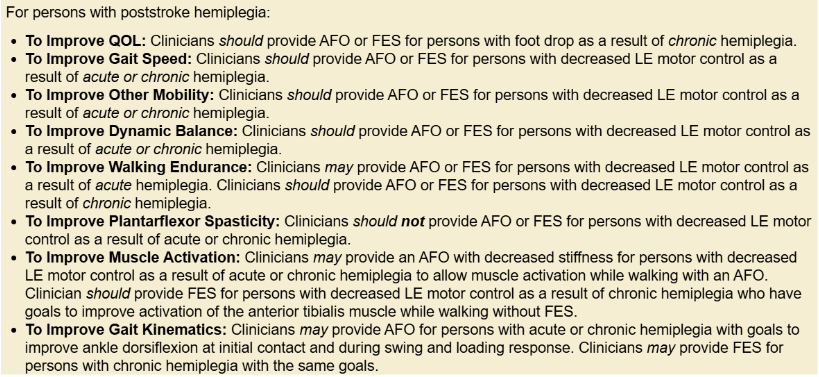
What are the possible uses/reasons to consider AFO/FES for a stroke patient?
What is constraint-induced movement therapy (CIMT)?
Pt is engaged in intense task-oriented practice of the more affected UE for up to 6 hours a day performed consecutive weekdays for 10-15 days. The unaffected UE is restrained from use by having the patient wear a safety mitt for up to 90% of waking hours.
Modified CIMT (mCIMT) has been used for patients with stroke (30 mins of functional task practice and shaping 3 days per week and restraint of the unaffected UE for up to 5 hours a day. Over 10-week period.

How can E-stim be utilized for stroke patients?
NMES or EMG-triggered NMES can both be used for patients recovering from stroke to reduce spasticity, improve sensory awareness, prevent or reduce shoulder subluxation and stimulate volitional movements.
Once patient has selective capacity of the UE, e-stim is not used.
How can mirror therapy be used in stroke recovery?
Use of mirrors is contraindicated in patients with marked visuospatial perceptual impairments.
Setup: Put affected limb hidden behind the mirror and your healthy limb in front.
Clear distractions: remove watches, rings, and jewelry, from the healthy arm
Practice: perform slow and simple movements while staring intently at the reflection, not the real arm.
Duration: 10 to 30 minutes a day, several times a week
What are technology/tools commonly used in stroke recovery?
-Treadmill
-Body-weight support
-FES
-Robotics
-Exoskeleton
-VR
-Wearables
What should be the focus during stroke recovery according to current standards?
-Functional movement
-Patient generates
-Task=focused
-High repetition
-Active practice
-Appropriate challenge
-Variable environments
What does OPTIMIZE stand for in stroke recovery?
O = Outcome
P = Potential
T = Task-specific
-I = Intensity
-M = Meaningful
-I = Individualize
-Z = Zero in on dose
-E = Evaluate