4. Reverse Osmosis and Nanofiltration
 Call Kai
 Learn
 Practice Test
 Spaced Repetition
 Match
 Flashcards
 Knowt Play
1/13

There's no tags or description
Looks like no tags are added yet.
14 Terms
What is reverse osmosis?
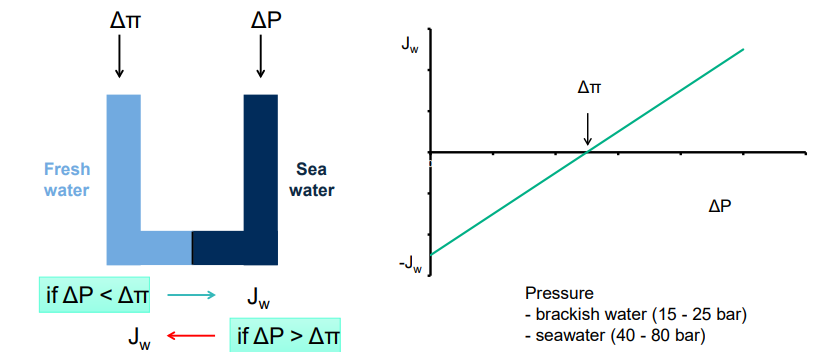
Reverse osmosis (RO) is another pressure-driven membrane-based process.
It is the inverse process to osmosis, that is, pressure in excess of the osmotic pressure forces the water to move through a semipermeable membrane.
RO characterized by pore diameters less than 1 nm (<1nm)
RO has molecular weight cutoff of <200 Da
What is osmotic pressure?
Osmotic pressure is the minimum pressure which needs to be applied to a solution to prevent the inward flow of its pure solvent across a semipermeable membrane.
Describe van’t Hoff’s equation to calculate osmotic pressure
For most non-electrolytes dissolved in water, the van't Hoff factor is essentially 1.
For most ionic compounds dissolved in water, the van't Hoff factor is equal to the number of discrete ions in a formula unit of the substance.
This is true for ideal solutions only, as occasionally ion pairing occurs in solution. The deviation for the van’t Hoff factor tends to be greatest where the ions have multiple charges.

Describe the structure of reverse osmosis membrane
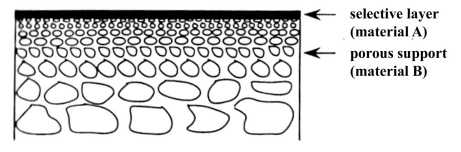
Most RO membranes have an asymmetric/composite structure
A thin, dense, top layer (< 1µm)
A porous sub layer (50 – 150 µm) providing mechanical strength
What are the applications of reverse osmosis?
The main application of reverse osmosis is to separate out salt from water.

What is nanofiltration?
Nanofiltration (NF) membranes are defined as a type of pressure-driven membrane process to remove most organic molecules, nearly all viruses, most of the natural organic matter and a range of salts.
Nanofiltration has a molecular weight cutoff of 150-2000 Da
Describe the structure of a nanofiltration membrane
Most NF membranes have an asymmetric/composite structure
A thin, dense, top layer (< 1µm)
A porous sub layer (50 – 150 µm) providing mechanical strength
What are the applications of nanofiltration?
Nanofiltration can retain larger divalent ions such as Ca²⁺ and CO₃²⁻
It also retains pollutants such as herbicides, pesticides & insecticides, dyes and sugars
Nanofiltration also removes PFAs & synthetic dyes
It is also used to concentrate sugar
What are composite membranes?
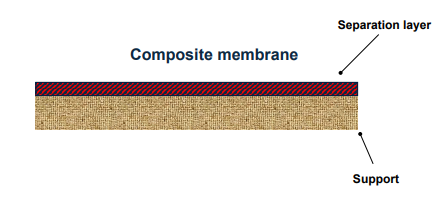
Some RO and most NF membranes are composite
The top layer and the sub layers are composed of different polymeric materials
Both layers can be optimised separately
What are the different methods that could be used to prepare compostie membranes?
DIp coating
In site polymerisation
Interfacial polymerisation
Describe dip coating
It is the simplest technique
1. Support is immersed in a bath of the coating (polymer, pre-polymer or monomer in solvent).
2. The membrane is removed
3. The solvent evaporates, leaving a thin layer coated onto the support

Desrcibe in site polymerisation
The top layer is polymerised on the top of the support
Describe interfacial polymerisation
Two extremely reactive monomers are bought together at the interface between two immiscible solvents

Summary of reverse osmosis & nanofiltration table
