Lighting 2 Quiz 3
 Call Kai
 Learn
 Practice Test
 Spaced Repetition
 Match
 Flashcards
 Knowt Play
1/198

There's no tags or description
Looks like no tags are added yet.
199 Terms
Who is often referred to as the “Father of Lighting Design”
Richard Kelly
The first lighting design consultancy was opened by Richard Kelly in what year?
1935
Who was the lighting designer for some of the 20th century’s most iconic buildings, including Seagram’s building, Glass House, and Kimbell Art Museum?
Richard Kelly
Which building was constructed in 1958 inn NYC, designed by Mies van der Rohe?
Seagram Building
What was the key lighting feature in the Seagram building?
Custom build wall wash lights to highlight the travertine making the building appear to float.
What building was built in 1949 and designed by Philip Johnson? (This was Richard Kelly’s private residence)
Glass House
What was the biggest challenge when designing the Glass House?
The glass became a mirror at night.
True or False: Glass can’t be lit.
True
You can’t light glass because it is transparent.
What were some of the key lighting features of the Glass House?
Minimal soft lighting inside along with highlighting the landscape outside. This allowed clear views.
Richard Kelly summarized his theory of lighting with what three concepts?
1. Focal Glow (Highlight)
2. Ambient Luminescence (Graded Wash)
3. Play of Brilliants (Sharp Detail)
A way to highlight elements of interest is …
Focal Glow
The background lighting that serves to perceive the environment in general is …
Ambient Luminescence
Light as information, which can be dynamic or colorful is …
Play of Brilliants
What are the 6 similar aspects of lighting design?
1. Ambient
2. Task
3. Accent
4. Decorative
5. Kinetic
6. Daylight
The uniform blanket of light all around us is …
Ambient Lighting
Overcast sky is an example of:
Ambient Lighting
Light that allows you to perform a specific task is …
Task lighting
Stair Lights are an example of:
Light on display/artwork is an example of:
Accent Lighting
Lighting specifically designed to be attractive are
Chandeliers are an example of:
Decorative lighting
Lighting that moves or is interactive is …
Kinetic Lighting
Billboards are an example of:
Kinetic lighting
Who was an early leader in studying the psychological impacts of lighting?
John E. Flynn
True or False: Flynn felt contemporary lighting design was too narrow, focusing primarily on the visual task, and, in particular on its illuminance. He proposed that lighting design should be much broader and include the viewer’s perception of the entire room.
True
Flynn felt that good lighting design must:
1. Create focal centers
2. Outline the space
3. Be uncluttering
4. Create patterns of light and shade
5. Provide orientation
6. Present the space without distortion
7. Be stimulating without being overpowered
8. Be glare-free
9. Provide balanced luminance ratios
Much of Flynn’s research focused on which two issues?
1. The effect of light on subjective impression and attitude
2. The effect of light on performance and overt behavior
What are the three consistent expressions that Flynn’s research identified?
1. Evaluative
2. Perceptual Clarity
3. Spaciousness
Spaciousness is also known as …
large-small ; open-cramped
Perceptual clarity is also known as …
Clear-hazy ; focused-unfocused
Evaluative is also known as …
pleasant-unpleasant ; relaxed-tense
What are the three Flynn modes?
1. Overhead/Peripheral
2. Uniform/Non-uniform
3. Bright/Dim
Which Flynn Mode denotes the distribution of light in the space, including whether the lighting provides modeling (accenting) of objects?
Uniform/Non-uniform
Which Flynn mode denotes the perceptual distinction between vertical lighting on wall surfaces and horizontal (overhead) lighting on central horizontal surfaces?
Overhead/Peripheral
Which Flynn mode denotes the illuminance on the horizontal work plane in the space?
Bright/Dim
What is the fourth/additional mode that Flynn ultimately decided was SECONDARY to the main modes?
Visually Warm/Cool (The perceived color tone of the room in Kelvin)
What are the five subjective impressions of the Flynn modes?
1. Visual Clarity
2. Spaciousness
3. Relaxation
4. Privacy, Intimacy
5. Pleasantness
What are the Reinforcing light modes for the subjective impression visual clarity?
Bright, uniform lighting mode; some peripheral emphasis, such as high reflectance walls or wall lighting.
What are the Reinforcing light modes for the subjective impression spaciousness?
Uniform, peripheral (wall) lighting; brightness is a reinforcing factor, but not a decisive one.
What are the Reinforcing light modes for the subjective impression relaxation?
Nonuniform lighting mode; peripheral (wall) emphasis, rather than uniform lighting.
What are the Reinforcing light modes for the subjective impression visual privacy/intimacy?
Nonuniform lighting mode. Tendency towards low light intensities in the immediate locale of the user, with higher brightness remote from the user.
What are the Reinforcing light modes for the subjective impression pleasantness?
Nonuniform lighting mode. Peripheral (wall) emphasis.
What is the “Moth effect” (Moire effect)
“it is an optical phenomenon that can occur when two sets of similar, closely spaced patterns (such as light fixtures, grilles, or surface textures) are overlaid at slightly different angles or spacings. The result is an interference pattern of alternating light and dark fringes, often perceived as a rippling or wavy visual effect”
What are the seven stages of the lighting design process?
1. Programming
2. Schematic Design
3. Design Development
4. Contract Documents
5. Bidding/Negotiation
6. Construction
7. Post-Occ. Evaluation
What is the research and decision-making process used to define the scope of a project for which design is to be undertaken?
Programming
True or False: During the programming phase, it is typically the Architect (“Programmer”) and Owner who work together to define the activities, occupancies, capacities, module sizes, and special requirements.”
True
What is a fact-finding and ideation phase?
Schematic Design
True or False: In early schematic design, information resulting from the programming phase is collected and disseminated, so that all members of the design team are working from the same starting point.
True
The goal of what phase is to expand on the generalities recorded in the schematic design phase and to move toward a set of construction documents. (involves verification, validation, and refinement)
Design Development
What is the process of designing the visual environment? (Between Schematic Design and Design Development)
1. How do you want the space to look/feel?
2. Direction and Distribution
3. Color
4. Light Sources and Location
5. Fixture Selection
6. Create Lighting Layout
7. Iterate
What does a programming statement do?
Guides your Design
True or False: Programming WHAT lighting should accomplish.
False
It also needs to establish WHY.
True or False: Schematic Design explores the patterns of light needed to create the desired experience.
True
What should you consider for the schematic design?
1. Direction
2. Distribution
3. Brightness and Contrast
4. Visual Experience

What luminaire is this?
Troffer
Troffer Luminaire Traits:
1. Ambient lighting
2. Direct distribution
3. Recessed or ceiling surface mounted
4. Diffuser or louvres for glare control

What luminaire is this?
Downlight
Downlight Luminaire Traits:
1. Direct distribution
2. Task, ambient, or accent lighting
3. Recessed or ceiling surface mounted
4. Reflector and baffles for glare and distribution control
True or False: There is an increased luminance/chance for glare with a smaller aperture.
True (L= flux/Area)

What luminaire is this?
linear
Linear luminaire traits:
1. All distribution types
2. Ambient lighting
3. Pendant, surface, or recess mounted
4. Lens, diffuser, and/or louvres for beam shaping and glare control
True or False: When describing a fixture, say the fixture is hung/hanging.
False
Say it is suspended

What luminaire is this?
Wall washer
Wall washer luminaire traits:
1. Task and accent lighting
2. Recessed, track, or surface (including cantilevered) mounting
3. Lensing and/or reflectors provide beam shaping

What luminaire is this?
Wall grazer
Wall grazer luminaire traits:
1. Accent and task lighting
2. Recessed or surface mounted, often placed in a cove
3. Linear with minimal separation from wall
4. Lensing and/or reflectors provide beam shaping
True or False: Wall grazers are only for textured walls.
True
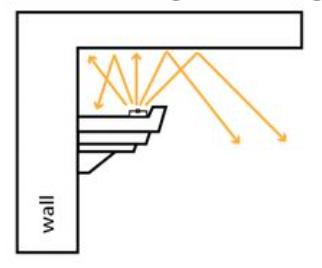
Is this a cove or a slot?
Cove
Strip/Tape/Cove luminaire traits:
1. Ambient and accent lighting
2. Surface mounted, shielded by an architectural cove
3. Linear with minimal separation from wall or ceiling
4. Lensing and/or reflectors provide beam shaping

What luminaire is this?
Sconce
Sconce luminaire traits:
1. Accent or decorative light
2. Wall surface mounted
3. Shielded for glare control

What luminaire is this?
Track
Track luminaire traits:
1. Task or accent lighting
2. Designed for end-user adjustability
3. Shielding and/or baffles for glare control

What luminaire is this?
Decorative
Decorative luminaire traits:
“custom luminaires can be designed and built for specific projects”

What luminaire is this?
Portable

What luminaire is this?
Custom Detail
Luminaire components
1. Housing
2. Mounting
3. Finish
Lamp Components:
1. Source
2. Driver
3. Optics
*Look at page 428 in notes for more info
The IP rating system stands for:
Ingress Protection
Ingress Protection protects against:
1. Dust (0-6)
2. Liquid (0-8)
A ground recessed luminaire should be rated an:
IP 68
Luminaire Mounting:
1. Recessed
2. Pendant
3. Surface (Wall and ceiling)
4. Track
Luminaire dimensions
Some examples include:
2×4
2×2
2.5 inch downlight
*More info on page 431 of notes
True or False: Finishes will not alter the distribution of light, and therefore the IES file.
False
it WILL alter …

This optic is a:
baffle

This optic is a:
Reflector

This optic is a:
Diffuser

This optic is a:
louvres

This optic is a:
Shielding

This optic is a:
Lens
What two optics are opaque or translucent materials shaped or configured to reduce or eliminate the direct view of the lamp from outside the luminaire?
Baffles and Louvres
What optic is a light control element that scatters and redirects incident light in many directions?
Diffuser
What optic is a device, usually of coated metal or plastic that exhibits a high reflectance, shaped to redirect by reflection the light emitted by a lamp?
Reflector
What optic is a light control device that takes advantage of the change in direction light undergoes as it passes through the boundary of materials of differing optical density?
Refractor
Which optic can alter the spectral power distribution of the optical radiation produced by the lamp before it leaves the luminaire (without necessarily altering the spatial distribution of radiation)?
Filters

This luminaire has what CIE classification?
Indirect
More common in sconces and decorative fixtures.

This luminaire has what CIE classification?
Semi-Indirect
Less common among suspended linears.