Lab Quiz #2 - Spectrophotometry
 Call Kai
 Learn
 Practice Test
 Spaced Repetition
 Match
 Flashcards
 Knowt Play
1/45

There's no tags or description
Looks like no tags are added yet.
46 Terms
a form of energy; electromagnetic radiation or photons of energy emitted as waves
light
What unit is light measured in?
nanometers (nm) (10^-9 of a meter)
What are the wavelengths associated with visible light, UV light, and infrared light?
UV light: 200 - 400nm
Visible light: 400 - 760nm
Infrared light: 760 - 3000nm
Which area of the visible light spectrum will provide the greatest absorbance for a substance?
A colored solution has the greatest absorbance in its *complimentary (opposite)* color range

blue goes with
orange
yellow goes with
violet
Red goes with
green
What is the most useful measure of light?
Absorbance (also called optical density (OD)
What is the first main principles of spectrophotometric methods?
1) Substances absorb light at specific wavelengths, therefore the wavelength absorption pattern can be the basis for the identification of an analyte (*each analyte has a specific wavelength*)
What is the second main principle of spectrophotometric methods?
2) The amount of light absorbed is proportional to the amount of substance that is present (*absorption is directly proportional to substance present*)
What is trasmittance?
the light that is not retained but passed through a substance (inversely proportional)
what is absorption
the amount of light taken up by a substance (directly proportional)
What is Beer's Law
Concentration of an analyte in a solution is directly proportional to amount of light absorbed or inversely proportional to amount of transmitted light
Note about beers law
since a and b are constant, absorbance (A) is equal to c (concentration) which makes sense because they are directly proportional.
variable for beers law: A*
*A = abc*
variable for beers law: A
A = absorbance
Variable for beers law: a
a = absorptivity constant for the substance (constant for at defined wavelength, pH, temp, and environmental conditions).
variable for beers law: b
b = the length of light path through a substance (constant set by spect. 1cm)
variable for beers law: c
c = the concentration of the substance
What is the formula based on Beer's Law that can be used to solve for an unknown concentration or absorbance?
A1/C1 = A2/C2
Concentration of a known substance (C1)
Absorption of the substance of known concentration (A1)
Absorption of the unknown substance (A2)
Which axis are absorbance and concentration ALWAYS on?
Concentration: x-axis
Absorbance: y-axis
The extent to which a range over a measurement, such as *absorbance, is directly proportional to the concentration*. Relationship of two variables that produces a straight line when plotted on a graph.
linearity
Absorbance vs. concentration is a (linear/non-linear) function.
% Transmittance vs. concentration is a (linear/non-linear) function.
A vs C = linear
%T vs. C = non-linear
provides wavelengths of light in the visible spectrum or UV range
light source/lamp
If you are measuring a colored product then you set it in the (visible/UV) light spectrum?
If you are measuring something colorless then you set it in the (visible/UV) light spectrum?
Colored = visible
Colorless = UV
What types of lamps are used for visible light and UV light?
Tungsten lamp for visible light
hydrogen deuterium or mercury-arc for UV
Newer specs have a laser bean
used to eliminate unwanted wavelengths of light and allow the desired light to reach the sample; use diffraction grating
monochromator
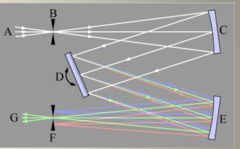
Smaller bandwidth:
greater resolution, increased sensitivity, decreased intensity of light
Larger bandwidth:
decreased resolution, decreased sensitivity, increased intensity of light
What is a bandpass/bandwidth?
the range of wavelengths exiting the slit
holds the cuvette containing the test solution; may be round or square and either glass, plastic or quartz
sample holder
Which is better --> square or round sample holder?
square because curved bends the light
Sample holders may be either glass, plastic or quartz. What is each material used for?
glass and plastic used for visible light
quartz used for UV light
converts light energy to electrons to produce an electrical signal
photodetector
What is the most common photodetector used in the lab? Why?
*photomultiplier tube* because of the rapid response and its ability to amplify the signal
read-out device that presents changes in electrical energy numerically; gives A units or %T; may be linked to LIS (lab info system) or HIS/EMR for fast delivery of information to the provider
readout device/meter
gives power to the device; supply must be continuous and stable and required to have a back-up power supply such as batteries
power source
What is the purpose of blanking an instrument?
Zeroing and blanking the instrument sets the limits of the instrument from no light transmitted to all light transmitted (we can use water blank or reagent blank)
a check of an instrument to ensure continued accuracy throughout the reportable range of the test results for the test system
calibration
a material of known value used to calibrate, or adjust a measurement procedure, or to compare the response obtained with the response of a test specimen and/or sample; are commercially prepared from manufacturer
calibrators
reference material whose concentration is determined by assay with a reference method
standard (used interchangeably with calibrator)
the ability of a photometric system to yield a linear relationship between the amount of radiant power absorbed by a substance and the concentration of that substance
linearity
What is the manufacturing process for controls
Controls have the same base matrix as the substance being tested
What is the manufacturing process for calibrators?
manufactured to contain a specified amount of a pure analyte and adding it to an appropriate solvent for analysis (such as Grade A water), so they contain a known amount of analyte
What 4 situations would require a calibration?
1) Reagent lot number changed
2) Extensive maintenance performed on the instrument
3) Based on manufacturer's guidelines
4) If calibration fails
When does CLIA require calibration verification?
CLIA requires calibration verification every 6 months, after a major preventative maintenance repair, or whenever recommended by the manufacturer