5.1 How Enzymes Work: Active Sites & Energy Diagrams
 Call Kai
 Learn
 Practice Test
 Spaced Repetition
 Match
 Flashcards
 Knowt Play
1/6

There's no tags or description
Looks like no tags are added yet.
7 Terms
Enzymes
purpose: reduce times for reactions to biological time scales
increase kinetic rate
features:
usually proteins
don’t have to be (ex. ribosomes), but the same principles apply
highly SPECIFIC - only want specific rxns to increase
operate under mild conditions
ex. soil bacteria need soil cond. (temp, atm)
may require cofactors
may be regulated
Enzymes: Active site
→ enzyme’s active site provides a favourable sequestered environ for biologically important rxns to occur
analogous to ligand-binding site, EXCEPT it also catalyses a rxn
formation of a specific complex (ES) b/w enzyme & substrate is essential to the action of enzymes
Enzymes: May require Cofactors
Cofactors = additional chemical components that assist in enzyme fxn
→ types:
metal ions - used to complement/stabilize (-) charges
coenzymes (NAD+, FAD) = organic molecules necessary for some molecules to fxn
prosthetic groups = metal ions or coenzymes that are tightly or covalently associated with a polypeptide/protein
→ permanent attached to enzyme
Holoenzyme (holoprotein) = enzyme (protein) + prosthetic group
active & functional
Apoenzyme (apoprotein) = enzyme (protein) w/o prosthetic group
How do enzymes increase kinetic rate (speed up) of Reactions?
→ Enzymes REDUCE the activation energy (ΔG‡) of a rxn
uncatalayzed rxn (ΔG‡ uncat) : requires more energy to reach the transition state (higher energy than substrate)
should be a larger value than ΔG‡ cat
higher activation energy → decreased rate constant
path: S → TS → P
catalyzed rxn (ΔG‡ cat): lower activation energy → increased rate constant
uses enzyme
path: S → ES → ETS (lower than TS) → EP → P
Binding energy ΔGB (ΔΔG‡ cat) = difference in rate b/w the catalyzed & uncatalyzed rxns

Free Energy Diagram:


note: free energy (ΔG) provides the direction the rxn proceeds based on substrate energy
ΔG ISNT affected by enzymes
Multistep Reactions
→ reaction mechanism may involve multiple transition states & intermediates
rate limiting steps determine the overall rate
ex. in a rxn mechanism where the first transition state has higher activation energy than the 2nd transition state: 1st TS, with the larger value, sets the rate for substrate → product for the whole rxn
thus it determine the overall rate for the rxn
ex. in a rxn mechanism where the 2nd transition state has higher activation energy than the 1st transition state: 2nd TS, with the larger value, sets the rate for substrate → product for the whole rxn
thus it determine the overall rate for the rxn

Rate of a Reaction: Relationship B/w Activation energy & Rate Constant
→ rate of a rxn is related to [substrate(s)] & a rate constant (k)
first order rxn = increased [S] results in increased rate
V = k[S]
→ lowering activation energy (ΔG‡) using enzymes exponentially INCREASES the rate constant (k)
high activation energy (ΔG‡) = decreased rate constant
low activation energy (ΔG‡) = increased rate constant
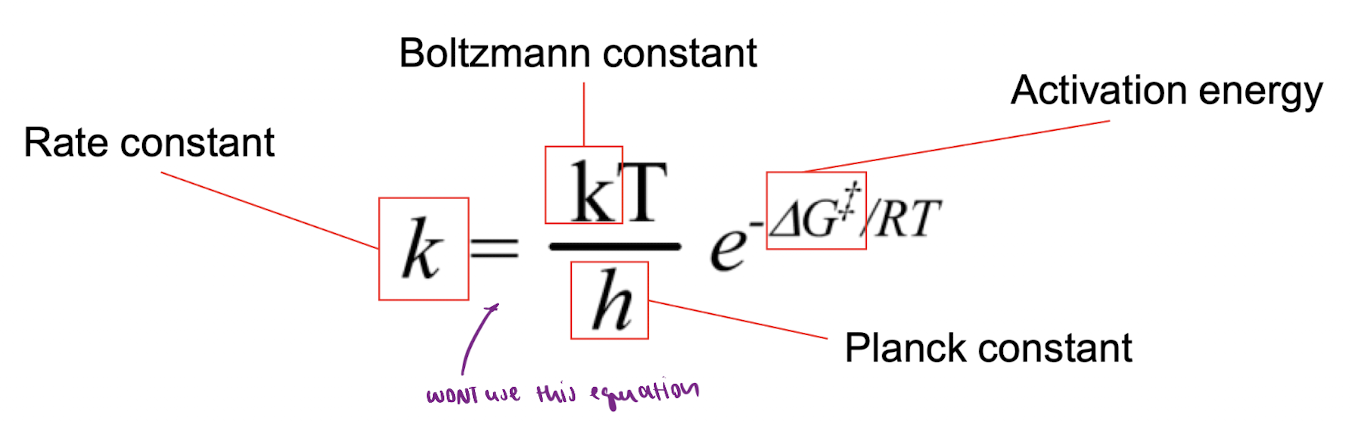
→ rate enhancement is connected to strength of binding
Rate of a Reaction: ex. Carbonic Anhydrase
carbonic anhydrase is in RBC’s and converts CO2 to soluble H2CO3

Uncatalyzed rxn (no enzyme used)
activation energy: ΔG‡uncat = 81KJ/mol (small barrier)
THUS, k uncat = 0.10 s^-1 (not fast enough)
catalyzed rxn (using enzyme)
activation energy: ΔG‡cat = 40KJ/mol (lower barrier, 41KJ/mol less than uncat)
THUS, k cat = 1.0 × 10^6 s^-1 (faster)
→ catalyzed rxn has a 10^7 fold rate enhancement, by decreasing activation energy by 41KJ/mol