Test 3 Chem
 Call Kai
 Learn
 Practice Test
 Spaced Repetition
 Match
 Flashcards
 Knowt Play
1/143

There's no tags or description
Looks like no tags are added yet.
144 Terms
Molecular polarity
Whether a molecule has a net dipole moment. Requires polar bonds AND an asymmetric molecular geometry so bond dipoles do not cancel. Symmetric shapes with identical terminal atoms (linear; trigonal planar; tetrahedral with identical groups) are nonpolar.
Electron domain (electron group) geometry
The 3D arrangement of ALL electron groups (bonds; lone pairs; single electrons) around a central atom. Determined by steric number: 2 = linear; 3 = trigonal planar; 4 = tetrahedral; 5 = trigonal bipyramidal; 6 = octahedral.
linear electron domain geometry
steric number: 2
Bond angle: 180
trigonal planar electron domain geometry
steric number: 3
Bond angle: 120
Special MOLECULAR geometries
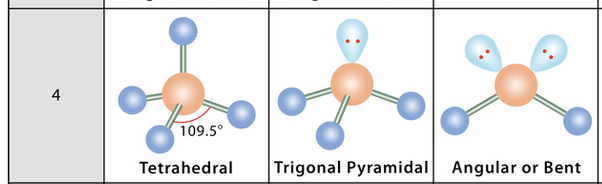
2 bonds, 1 lone pair: bent

tetrahedral electron domain geometry
steric number: 4
Bond angle: 109.5
Special MOLECULAR geometries
3 bonds, 1 lone pair: trigonal pyramidal
2 bonds, 2 lone pairs: bent
trigonal bipyramidal electron domain geometry
steric number: 5
Bond angle: 90/120
Special MOLECULAR geometries
4 bonds, 1 lone pair: Seasaw
3 bonds, 2 lone pairs: T-shaped
2 bonds, 3 lone pairs: linear

octahedral electron domain geometry
steric number: 6
Bond angle: 90
5 bonds, 1 lone pair: Square Pyramidal
4 bonds, 2 lone pairs: Square Planar

Valence bond theory
Bonds form when atomic orbitals (each with one electron) overlap and the electrons are shared in the overlap region. Bonding is localized between two atoms; hybridization explains observed molecular geometries.
Hybridization
Mixing of atomic orbitals (s; p; d) on one atom to form new; equivalent hybrid orbitals that explain observed geometry. Number of hybrid orbitals = number of atomic orbitals mixed = steric number.
Hybrid orbitals
Equivalent orbitals formed by mixing atomic orbitals on one atom. sp (2; linear; 180 deg); sp2 (3; trigonal planar; 120 deg); sp3 (4; tetrahedral; 109.5 deg); sp3d (5; trigonal bipyramidal); sp3d2 (6; octahedral).
Unhybridized (atomic) orbitals
Atomic orbitals left over on an atom that did not mix into hybrids. They are typically p orbitals that form pi bonds (e.g.; one unhybridized p on each sp2 carbon in C=C; two on each sp carbon in a triple bond).
Bonding scheme
A description of each bond in a molecule by naming the orbitals that overlap (e.g.; C(sp3)-H(1s) sigma bond; C(sp2)-C(sp2) sigma bond plus C(2p)-C(2p) pi bond). Also assigns lone pairs to their orbitals.
Sigma (σ) bond
Bond formed by head-on (end-to-end) orbital overlap along the internuclear axis. All single bonds are sigma; every double or triple bond contains exactly one sigma bond. Allows free rotation.

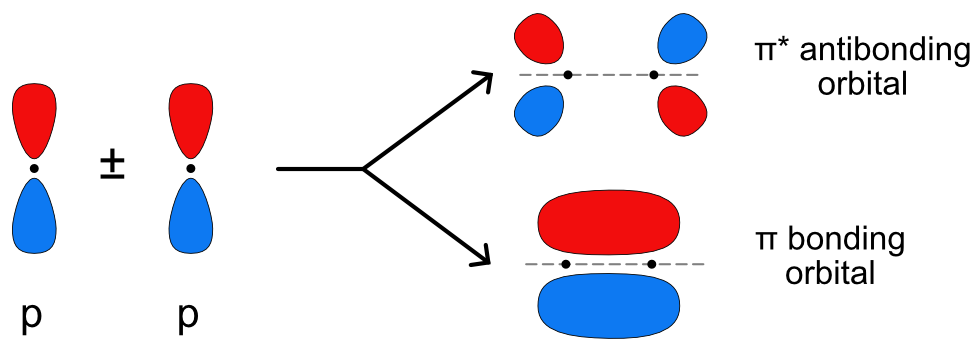
Pi (π) bond
Bond formed by side-by-side overlap of parallel unhybridized p orbitals; with electron density above and below the internuclear axis. A double bond = 1 sigma + 1 pi; a triple bond = 1 sigma + 2 pi. Restricts rotation.
Orbital overlap
The region where orbitals of two atoms occupy the same space; greater overlap generally means a stronger bond. Sigma = head-on overlap; pi = side-by-side overlap.
Molecular orbital (MO) theory
Atomic orbitals combine to form delocalized molecular orbitals over the whole molecule. N atomic orbitals combine to make N molecular orbitals. Electrons fill MOs from lowest energy up (Aufbau; Pauli; Hund).
MO diagram for when average atomic number < 8
pi bonds go UNDER sigma 2p orbital

MO diagram for when average atomic number >= 8
pi bonds go OVER sigma 2p orbital

MO diagram for heteronuclear bonds
MORE ELECTRONEGATIVE ATOM LOWER ORBITAL DIAGRAM

Bonding orbitals
MOs formed by constructive (in-phase) overlap; lower in energy than the parent atomic orbitals; electron density is concentrated between nuclei. Electrons here stabilize the bond.
Anti-bonding orbitals
MOs formed by destructive (out-of-phase) overlap; higher in energy than the parent atomic orbitals; have a node between the nuclei and are marked with *. Electrons here destabilize the bond.
Non-bonding electrons (lone pairs)
Valence electrons that are not involved in bonding; they sit on one atom. They occupy more space than bonding pairs and compress bond angles.
Bond order
In MO theory: (bonding electrons - antibonding electrons)/2. Higher bond order = stronger; shorter bond. Bond order of 0 means the molecule is not expected to be stable.
Paramagnetic
Contains one or more unpaired electrons; attracted into a magnetic field. Identified from an MO diagram that has unpaired electrons (e.g.; O2).
Diamagnetic
All electrons are paired; weakly repelled by a magnetic field. Identified from an MO diagram with no unpaired electrons (e.g.; N2; F2).
HOMO (highest occupied molecular orbital)
The highest-energy MO that contains electrons.
LUMO (lowest unoccupied molecular orbital)
The lowest-energy MO that contains no electrons. The HOMO-LUMO gap is analogous to a band gap in solids.
Metallic bonding
Bonding in metals described as a lattice of cations in a 'sea' of delocalized valence electrons; in band theory; the overlap of a huge number of atomic orbitals creates closely spaced MOs forming bands.
Band gap
The energy gap between the top of the valence band and the bottom of the conduction band. Conductors: none/overlapping bands. Semiconductors: small gap. Insulators: large gap.
Valence band
The band of closely spaced MOs formed from the valence orbitals that is filled (or highest filled) with electrons at 0 K.
Conduction band
The band of empty (or partially filled) MOs above the valence band; electrons promoted here can move freely and conduct electricity.
Dipole moment
A measure of charge separation in a molecule (vector quantity; µ = charge × distance). Points toward the more electronegative end. Net dipole moment of zero = nonpolar molecule.
Cis isomer
Isomer in which two identical/similar groups are on the SAME side of a double bond (or ring). Arises from restricted rotation about a pi bond. Often polar.
Trans isomer
Isomer in which two identical/similar groups are on OPPOSITE sides of a double bond (or ring). Arises from restricted rotation about a pi bond. Dipoles often cancel; so may be nonpolar.
Steric number (SN)
Number of atoms bonded to the central atom + number of lone pairs on the central atom. Determines electron domain geometry and hybridization.
Ideal gas
A hypothetical gas whose particles have negligible volume and no intermolecular attractions/repulsions; obeys PV = nRT exactly.
Kinetic Molecular Theory
Model of gases: (1) particles are tiny with negligible volume relative to container; (2) particles are in constant random motion; (3) no attractive or repulsive forces between particles; (4) collisions are perfectly elastic; (5) average kinetic energy is proportional to absolute temperature.
Maxwell-Boltzmann distribution for gases
Graph of the distribution of molecular speeds in a gas sample. Higher T: curve shifts right; flattens and broadens. Lighter gas (same T): curve shifts right and broadens. Same T means same average KE for all gases.
Root mean square velocity (urms)
Square root of the average of the squared speeds: urms = sqrt(3RT/MM); with R = 8.314 J/(mol·K) and MM in kg/mol.
Diffusion
Gradual mixing of gases due to random molecular motion; gas spreads from high to low concentration.
Effusion
Escape of gas molecules through a tiny hole into a vacuum.
Graham's Law of Effusion
Rate of effusion (or diffusion) is inversely proportional to the square root of molar mass: rate1/rate2 = sqrt(MM2/MM1). Lighter gases effuse/diffuse faster.
Mean free path
The average distance a gas molecule travels between collisions. Increases as pressure decreases (fewer molecules) and as particle size decreases.
Gas pressure
Force per unit area caused by gas particles colliding with container walls. P = F/A. Units: atm; mmHg; torr; kPa; bar; psi (1 atm = 760 mmHg = 760 torr = 101.325 kPa = 1.01325 bar = 14.7 psi).
Avogadro's Law
At constant T and P; volume is directly proportional to moles of gas: V1/n1 = V2/n2.
Boyle's Law
At constant T and n; pressure and volume are inversely proportional: P1V1 = P2V2.
Charles's Law
At constant P and n; volume is directly proportional to absolute temperature (K): V1/T1 = V2/T2.
Combined Gas Law
P1V1/(n1T1) = P2V2/(n2T2). Use when P; V; T (and possibly n) all change. T must be in kelvin.
Ideal Gas Law
PV = nRT. R = 0.08206 L·atm/(mol·K) (or 8.314 J/(mol·K)). T in K; P in atm; V in L when using 0.08206.
Gas density
d = m/V = P×MM/(RT). Increases with higher molar mass and pressure; decreases with higher temperature.
STP (Standard Temperature and Pressure)
0 °C (273.15 K) and 1 atm (as used in this course; check notes for 1 bar convention).
Molar volume at STP (standard molar volume)
Volume of 1 mole of ideal gas at STP = 22.4 L/mol.
Partial pressure
The pressure a gas in a mixture would exert if it alone occupied the container: PA = XA × Ptotal = nART/V.
Total pressure
Sum of the partial pressures of all gases in a mixture: Ptotal = PA + PB + PC + …
Dalton's Law of Total Pressure
The total pressure of a gas mixture equals the sum of the partial pressures of the individual gases.
Mole fraction
XA = nA/ntotal = PA/Ptotal. Mole fractions in a mixture add to 1 (XA + XB + XC + … = 1).
Real gas behavior
Gases deviate from ideal behavior at high pressure and low temperature; where particle volume and intermolecular attractions become significant.
van der Waals parameter a
Corrects pressure for intermolecular attractions. Larger a = stronger attractions (larger; more polarizable molecules). Attractions lower the measured pressure; so P + a(n/V)^2.
van der Waals parameter b
Corrects volume for the finite volume of gas particles (excluded volume). Larger b = larger molecules. Available volume = V - nb.
Supercritical fluid
Substance above both its critical temperature and critical pressure; has properties of both liquid and gas and no distinct liquid/gas phase boundary.
Phases
Distinct; physically uniform states of matter (solid; liquid; gas) determined by balance between kinetic energy and intermolecular forces.
Intermolecular forces (IMFs)
Attractive forces BETWEEN molecules (weaker than covalent bonds). Strength order (roughly): ion-dipole > hydrogen bonding > dipole-dipole > London dispersion (for similar molar mass).
London dispersion forces
Weak attractions from temporary (instantaneous) dipoles; present in ALL molecules. Increase with larger molar mass/more electrons and greater polarizability and surface area.
Dipole forces (dipole-dipole; permanent dipoles)
Attractions between the positive end of one polar molecule and the negative end of another.
Hydrogen bonding
Strong dipole-dipole attraction between H bonded to N; O; or F on one molecule and a lone pair on N; O; or F of another molecule.
Ion-dipole forces
Attraction between an ion and a polar molecule (e.g.; Na+ with water); strongest IMF; important in dissolving ionic compounds in polar solvents.
Polarizability
How easily the electron cloud of an atom/molecule is distorted. Larger; heavier molecules with more electrons are more polarizable and have stronger dispersion forces.
Viscosity
A liquid's resistance to flow. Increases with stronger IMFs and larger; more complex molecules; decreases with higher temperature.
Surface tension
Energy required to increase the surface area of a liquid; caused by net inward pull of IMFs on surface molecules. Stronger IMFs = higher surface tension.
Vapor pressure
Pressure exerted by the vapor in dynamic equilibrium with its liquid (or solid) in a closed container. Increases with temperature; weaker IMFs = higher vapor pressure.
Evaporation
Phase change from liquid to gas at the surface of a liquid; endothermic.
Normal boiling point
Temperature at which the vapor pressure of a liquid equals 1 atm (760 torr). Stronger IMFs = higher normal boiling point.
Condensation
Phase change from gas to liquid; exothermic.
Phase changes
Transitions between solid; liquid; and gas: melting; freezing (fusion); vaporization; condensation; sublimation; deposition.
Fusion (freezing)
Liquid to solid. Exothermic. (Melting/fusion in the opposite direction is solid to liquid; endothermic.)
Melting
Solid to liquid; endothermic. Melting point increases with stronger IMFs.
Sublimation
Solid directly to gas; endothermic.
Deposition
Gas directly to solid; exothermic.
Heating curve
Plot of temperature vs. heat added. Sloped sections = heating one phase (q = mcΔT); flat plateaus = phase changes (q = nΔH) where temperature stays constant.
Coulomb's Law
Force/energy of attraction between charges is proportional to the product of the charges and inversely proportional to the distance between them (E ∝ q1q2/d). Greater charge and smaller distance = stronger attraction.
Enthalpy of vaporization (ΔHvap)
Heat required to convert one mole of liquid to gas at constant pressure. Larger ΔHvap = stronger IMFs.
Critical point
Endpoint of the liquid-gas coexistence curve on a phase diagram; at the critical temperature and critical pressure; beyond it a supercritical fluid exists.
Critical temperature
Highest temperature at which a gas can be liquefied by pressure alone.
Critical pressure
Pressure required to liquefy a gas at its critical temperature.
Triple point
Unique temperature and pressure at which solid; liquid; and gas phases coexist in equilibrium.
Phase diagram
Plot of pressure vs. temperature showing regions of stability of each phase and the lines (fusion; vaporization; sublimation curves) where phases coexist; plus the triple point and critical point.
Equation: Bond order (MO theory)
Bond Order = (bonding electrons - antibonding electrons)/2
Equation: Root mean square velocity
urms = sqrt(3RT/MM) (R = 8.314 J/mol·K; MM in kg/mol)
Equation: Average kinetic energy (per mole)
KEave = (3/2)RT (R = 8.314 J/mol·K)
Equation: Average kinetic energy (per particle)
KEave = (1/2)mv^2
Equation: Boyle's Law
P1V1 = P2V2
Equation: Charles's Law
V1/T1 = V2/T2 (T in K)
Equation: Combined Gas Law
P1V1/(n1T1) = P2V2/(n2T2)
Equation: Ideal Gas Law
PV = nRT
Equation: Gas density / molar mass
P × MM = dRT (d = density; MM = molar mass)
Equation: Dalton's Law
Ptotal = PA + PB + PC + …
Equation: Total moles
ntotal = nA + nB + …
Equation: Mole fraction
XA = PA/Ptotal = nA/ntotal
Equation: Sum of mole fractions
1 = XA + XB + XC + …
Equation: van der Waals equation
[P + a(n/V)^2](V - nb) = nRT (a corrects for attractions; b corrects for particle volume)